Spanish prayers for the Rosary: a step-by-step guide
Spanish prayers for the Rosary: a step-by-step guide
To pray the Rosary in Spanish, begin with the Sign of the Cross, state the first mystery, and use the standard prayers on each bead: the Our Father, ten Hail Marys, and the Glory Be. The Rosary has five decades, and each decade focuses on one event from the life of Jesus and Mary.
The Spanish names and prayers below follow the commonly used Catholic form. You can pray the complete Rosary in Spanish, use Spanish only for the repeated prayers, or follow along with a bilingual guide until the sequence becomes familiar.
The Rosary combines vocal prayer with quiet meditation. The repeated words give your attention a steady rhythm, while the mystery for each decade directs your thoughts toward the Gospel, the life of Christ, and Mary’s role in salvation history.
A complete Rosary usually includes the Joyful Mysteries, Luminous Mysteries, Sorrowful Mysteries, or Glorious Mysteries. Each group contains five events, one for every decade. Many Catholics follow a customary schedule, but personal or parish practice may vary.
Helpful approach: You do not need perfect Spanish pronunciation to begin. Read slowly, understand the meaning of each prayer, and let the mystery guide your attention instead of rushing through the words.
Spanish prayers used in the Rosary
La señal de la Santa Cruz
The Rosary begins and ends with the Sign of the Cross. Make the gesture of the cross while saying:
Por la señal de la Santa Cruz, de nuestros enemigos líbranos, Señor, Dios nuestro. En el nombre del Padre, y del Hijo, y del Espíritu Santo. Amén.
This opening prayer asks God for protection and places the prayer under the sign of the Trinity. At the end of the Rosary, repeat the shorter Trinitarian formula: En el nombre del Padre, y del Hijo, y del Espíritu Santo. Amén.
El Credo de los Apóstoles
Say the Apostles’ Creed on the crucifix or opening cross:
Creo en Dios, Padre todopoderoso, Creador del cielo y de la tierra. Creo en Jesucristo, su único Hijo, nuestro Señor, que fue concebido por obra y gracia del Espíritu Santo; nació de Santa María Virgen; padeció bajo el poder de Poncio Pilato; fue crucificado, muerto y sepultado; descendió a los infiernos; al tercer día resucitó de entre los muertos; subió a los cielos y está sentado a la derecha de Dios, Padre todopoderoso. Desde allí ha de venir a juzgar a vivos y muertos.
Creo en el Espíritu Santo, la santa Iglesia católica, la comunión de los santos, el perdón de los pecados, la resurrección de la carne y la vida eterna. Amén.
The creed expresses the central beliefs of the Christian faith, including the Trinity, Jesus’ incarnation, death, resurrection, the Church, forgiveness, and eternal life. It is a statement of faith before the meditative prayers begin.
El Padre Nuestro
Say the Our Father on the large bead before each decade:
Padre nuestro, que estás en el cielo, santificado sea tu nombre; venga a nosotros tu reino; hágase tu voluntad en la tierra como en el cielo. Danos hoy nuestro pan de cada día; perdona nuestras ofensas, como también nosotros perdonamos a los que nos ofenden; no nos dejes caer en la tentación, y líbranos del mal. Amén.
This prayer asks for God’s kingdom, daily provision, forgiveness, strength in temptation, and deliverance from evil. The large beads help you distinguish the five Our Fathers from the ten Hail Marys in each decade.
Dios te salve, María, llena eres de gracia; el Señor es contigo. Bendita tú eres entre todas las mujeres y bendito es el fruto de tu vientre, Jesús.
Santa María, Madre de Dios, ruega por nosotros, pecadores, ahora y en la hora de nuestra muerte. Amén.
The first part greets Mary and honors Jesus, the fruit of her womb. The second part asks Mary to pray for those who are praying, both now and at the hour of death. The prayer is repeated ten times, but each repetition can be offered with a different intention or with renewed attention to the mystery.
El Gloria
After the ten Hail Marys, say the Glory Be:
Gloria al Padre, y al Hijo, y al Espíritu Santo. Como era en el principio, ahora y siempre, por los siglos de los siglos. Amén.
This brief doxology gives praise to the Father, the Son, and the Holy Spirit. Because it concludes every decade, it brings the mind back from the specific mystery to the glory of the Holy Trinity.
La oración de Fátima
Many people add the Fatima Prayer after each Glory Be. It is customary but not required for every form of the Rosary:
Oh, Jesús mío, perdona nuestros pecados, líbranos del fuego del infierno, lleva al cielo a todas las almas, especialmente a las más necesitadas de tu misericordia. Amén.
This prayer asks for mercy and salvation, with particular concern for people who are most in need of God’s mercy. If your parish or family uses a different version, follow that local custom.
La Salve
Many Spanish-speaking Catholics conclude the Rosary with La Salve, also called the Hail Holy Queen:
Dios te salve, Reina y Madre de misericordia, vida, dulzura y esperanza nuestra; Dios te salve. A ti llamamos los desterrados hijos de Eva; a ti suspiramos, gimiendo y llorando en este valle de lágrimas. Ea, pues, Señora, abogada nuestra, vuelve a nosotros esos tus ojos misericordiosos; y después de este destierro, muéstranos a Jesús, fruto bendito de tu vientre. ¡Oh clementísima, oh piadosa, oh dulce siempre Virgen María! Ruega por nosotros, Santa Madre de Dios, para que seamos dignos de alcanzar las promesas de Nuestro Señor Jesucristo. Amén.
The wording may differ slightly between prayer books and countries. Terms such as Reina y Madre, abogada nuestra, and Santa Madre de Dios express honor for Mary while directing the prayer toward Christ.
How to pray the Rosary in Spanish step by step
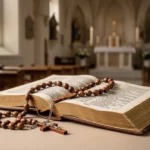
Hold the Rosary and move from the crucifix through the beads in order. The physical sequence is simple, but pausing briefly at each mystery makes the prayer more reflective and less mechanical.
Make the Sign of the Cross. Begin with the Spanish opening formula and the Trinitarian gesture.
Pray the Apostles’ Creed. Say the creed on the crucifix.
Pray one Our Father. Use the large bead immediately above the crucifix.
Pray three Hail Marys. These three small beads are traditionally offered for an increase in faith, hope, and charity, although you may use another intention.
Pray the Glory Be. Say it after the three opening Hail Marys.
Name the first mystery. Announce the mystery in Spanish, such as “El primer misterio gozoso: La Anunciación.”
Pray one Our Father. Say it on the large bead at the start of the decade.
Pray ten Hail Marys. Move one small bead at a time while meditating on the announced mystery.
Pray the Glory Be. Add the Fatima Prayer if that is your custom.
Repeat the decade pattern four more times. Announce the next mystery before each new Our Father.
Pray the concluding prayers. Say La Salve and finish with the Sign of the Cross, following your customary form.
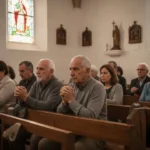
For a group Rosary, one person often announces each mystery and leads the first part of the prayer. The group responds together. If you are praying alone, say the full prayers at your own pace and pause whenever you need to regain focus.
The mysteries provide the subject for meditation. Their Spanish names are useful when praying with a Spanish-speaking parish, listening to an audio Rosary, or reading a Spanish prayer booklet.
Los misterios gozosos
The Joyful Mysteries traditionally focus on Jesus’ early life and Mary’s faithful response. They are often prayed on Monday and Saturday.
La Anunciación: The angel announces that Mary will become the mother of Jesus.
La Visitación: Mary visits Elizabeth, and both women recognize God’s work in their lives.
El Nacimiento de Jesús: Jesus is born in Bethlehem.
La Presentación de Jesús en el templo: Mary and Joseph present Jesus in the Temple.
El Niño Jesús perdido y hallado en el templo: Jesus is found in the Temple after Mary and Joseph search for him.
These mysteries can lead you to consider humility, obedience, family life, joy, and patient trust. They are not limited to happy emotions; they also include uncertainty, searching, and the cost of faithful obedience.
Los misterios luminosos
The Luminous Mysteries reflect on important moments in Jesus’ public ministry. They are commonly prayed on Thursday.
El Bautismo de Jesús en el Jordán: Jesus begins his public mission at the Jordan River.
Las bodas de Caná: Jesus performs his first sign at a wedding feast.
El anuncio del Reino de Dios: Jesus proclaims God’s kingdom and calls people to conversion.
La Transfiguración: Jesus is revealed in glory before three disciples.
La institución de la Eucaristía: Jesus gives the Eucharist to his disciples at the Last Supper.
When praying these mysteries, you might focus on conversion, discipleship, compassion, prayer, and the presence of Christ. The second mystery, Las bodas de Caná, also invites reflection on Mary’s intercession and her direction to follow Jesus.
Los misterios dolorosos
The Sorrowful Mysteries center on Jesus’ Passion and death. They are commonly prayed on Tuesday and Friday.
La oración de Jesús en el huerto: Jesus prays in Gethsemane before his arrest.
La flagelación de Jesús: Jesus is scourged.
La coronación de espinas: Jesus is mocked and crowned with thorns.
Jesús con la cruz a cuestas: Jesus carries the cross toward Calvary.
La crucifixión y muerte de Jesús: Jesus is crucified and dies.
These mysteries can be prayed for people who suffer, for those facing illness or grief, and for the grace to remain faithful during hardship. Meditation does not mean seeking pain; it means bringing human suffering into prayer while remembering Jesus’ love and self-giving.
Los misterios gloriosos
The Glorious Mysteries turn toward the Resurrection and the hope of eternal life. They are commonly prayed on Wednesday and Sunday.
La Resurrección de Jesús: Jesus rises from the dead.
La Ascensión de Jesús al cielo: Jesus returns to the Father.
La venida del Espíritu Santo: The Holy Spirit comes upon the apostles and Mary.
La Asunción de María: Mary is taken into heavenly glory.
La coronación de María: Mary is honored as Queen of Heaven and Earth.
The Glorious Mysteries emphasize hope, resurrection, the Holy Spirit, Mary’s heavenly destiny, and Christ’s victory. They can be especially meaningful during Sunday prayer, Easter seasons, or times when you need to place grief and uncertainty within the larger promise of Christian hope.
Traditional days for praying each set
A customary weekly schedule helps you choose the mysteries without having to decide each time. The schedule is a guide, not a rule that prevents you from praying another set when your circumstances suggest it.
Monday: Joyful Mysteries
Tuesday: Sorrowful Mysteries
Wednesday: Glorious Mysteries
Thursday: Luminous Mysteries
Friday: Sorrowful Mysteries
Saturday: Joyful Mysteries
Sunday: Glorious Mysteries, with some communities adapting the choice to the liturgical season
Spanish-speaking families may follow a parish schedule, a devotional calendar, or a local custom that differs from this pattern. The essential practice is to pray five decades while meditating on a set of mysteries, not to treat the weekday schedule as a requirement.
How to meditate while repeating Spanish prayers
Because the Hail Mary is repeated many times, some people worry that they are merely reciting words. A useful method is to announce the mystery clearly, imagine the Gospel scene respectfully, and connect the prayer to a person or need related to that mystery.
For example, during La Visitación, you might pray for a pregnant relative, a caregiver, or someone who needs companionship. During La oración de Jesús en el huerto, you might pray for people facing fear, serious illness, or a difficult decision. The intention gives the repeated words a personal direction.
Try these practices when your attention wanders:
Pause for one quiet breath after naming the mystery.
Focus on one phrase, such as “ruega por nosotros”, for the entire decade.
Use the ten Hail Marys to pray for ten people or concerns.
Picture the setting of the mystery without trying to create a detailed mental image.
Return gently to the prayer when you notice distraction instead of criticizing yourself.
Spanish pronunciation does not need to sound like a native speaker’s pronunciation. Aim for clear, unhurried speech. The word María has the stress on the second syllable, and Jesús has the stress on the final syllable; the accent marks show where the emphasis belongs.
Knowing a few terms makes Spanish prayer cards and group instructions easier to follow. These words also help you identify where you are in the Rosary.
El rosario: the Rosary
La cuenta: the bead
La cruz: the cross
El misterio: the mystery
La decena: the decade of ten Hail Marys
La intención: the prayer intention
Ruega por nosotros: pray for us
Amén: amen
Los misterios gozosos: Joyful Mysteries
Los misterios luminosos: Luminous Mysteries
Los misterios dolorosos: Sorrowful Mysteries
Los misterios gloriosos: Glorious Mysteries
The word decena can be confusing because it refers to one group of ten Hail Marys, not to the entire Rosary. A full five-decade Rosary contains five decenas, each beginning with an Our Father and ending with a Glory Be.
Ways to pray the Spanish Rosary with other people
When praying with a group, agree beforehand on the version of the prayers. Different countries and prayer books may use small wording variations, particularly in the opening of the Our Father, the final prayer, or the Fatima Prayer.
A leader can announce the mystery in Spanish and allow a short pause before beginning. If some participants are more comfortable in English, the group can alternate languages by decade or use Spanish for the Hail Mary while keeping the announcements bilingual.
For a mixed-language group: Choose one person to announce each mystery, print the Spanish prayers in advance, and explain the response pattern before beginning. Consistent pacing is more helpful than correcting every accent.
Families can also give each decade a specific intention, such as a family member, a community concern, people who are sick, or those who have died. Children may follow the beads, lead a Hail Mary, or announce a mystery before they can read every prayer fluently.
Common questions about praying the Rosary in Spanish
Do you have to pray the entire Rosary in Spanish?
No. You may pray in Spanish, English, or both. Some people say the repeated prayers in Spanish while announcing the mysteries in English; others pray one decade in Spanish and the next in English. Understanding the prayer and participating attentively matter more than using only one language.
What should you do if you lose your place?
Look at the bead in your hand and identify whether it is a large bead or a small bead. Large beads normally mark the Our Father, while small beads mark the Hail Mary. If you are still unsure, finish the current prayer and continue with the next clearly identifiable bead rather than starting the entire decade again.
Are the weekday mystery assignments mandatory?
No. The customary schedule is a convenient devotional practice, not a condition for praying the Rosary. You can choose mysteries connected to a feast, a personal intention, or the needs of your family. If you are attending a group Rosary, follow the set chosen by the leader so everyone can pray together.
Can a non-native speaker lead a Spanish Rosary?
Yes. Prepare by reading the prayers aloud, marking unfamiliar words, and listening to a careful recording if one is available. Speak at a moderate pace and provide the written prayers for participants. A respectful, steady leader can guide a group even when the pronunciation is not flawless.
Frequently asked questions
What is the first prayer of the Rosary in Spanish?
The Rosary begins with “La señal de la Santa Cruz,” the Sign of the Cross. After that, you pray the Apostles’ Creed on the crucifix, followed by one Our Father and three Hail Marys. Some communities use a slightly different opening formula, so a parish prayer booklet may have small wording variations.
How many Hail Marys are in a Spanish Rosary?
A standard five-decade Rosary contains fifty Hail Marys, with ten in each decade. The opening sequence also includes three additional Hail Marys, making fifty-three in the complete prayer. The language does not change the number of prayers; Spanish simply gives you the traditional wording used by many Spanish-speaking Catholics.
What does “misterios gozosos” mean?
“Misterios gozosos” means “Joyful Mysteries.” This set includes the Annunciation, Visitation, Birth of Jesus, Presentation in the Temple, and Finding of Jesus in the Temple. They focus mainly on events from Jesus’ childhood and Mary’s response to God’s call.
Is the Fatima Prayer required in the Spanish Rosary?
No. The Fatima Prayer is a widely used addition after the Glory Be in each decade, but it is not essential to the basic structure of the Rosary. If your family or parish includes it, use the Spanish wording they provide; if not, continue from the Glory Be to the next mystery.











Leave a Reply