To pray the rosary in Spanish, begin with the Sign of the Cross, the Apostles’ Creed, one Our Father, three Hail Marys, and a Glory Be. Announce the day’s mystery, pray one Our Father, ten Hail Marys, and one Glory Be for each decade, then finish with the Hail Holy Queen and the Sign of the Cross.
The Spanish names for the main prayers are Credo or Símbolo de los Apóstoles, Padre Nuestro, Avemaría, Gloria, and Salve. The rosary is a repeating prayer that combines these words with meditation on significant events in the lives of Jesus and Mary.
The rosary is a Catholic devotion traditionally prayed with a string of beads. Its repeated prayers create a steady rhythm, while the mysteries direct your attention to the Gospel, Christian faith, and the life of Christ. You may pray alone, with family, in a parish group, or in any language that helps you pray attentively.
Spanish-speaking Catholics may use slightly different wording depending on their country, parish, prayer book, or Bible tradition. The versions below are widely recognized in the United States and across much of the Spanish-speaking Catholic world. Small differences, such as vosotros versus ustedes or punctuation in the Creed, do not change the basic order of the rosary.
Helpful approach: You do not need to know every prayer perfectly before beginning. Keep the Spanish text nearby, pray slowly, and let the meaning of each mystery guide your attention.
Prayers of the rosary in Spanish
These are the principal prayers used during a traditional rosary. Reading them aloud can help you become familiar with their rhythm and pronunciation. In many Spanish-speaking communities, the prayers are recited together, so you may hear regional variations.
Señal de la Cruz
En el nombre del Padre, y del Hijo, y del Espíritu Santo. Amén.
This prayer begins and ends the rosary. It expresses belief in the Trinity: the Father, the Son, and the Holy Spirit. As you say it, make the Sign of the Cross according to your local Catholic custom.
Credo de los Apóstoles
Creo en Dios, Padre todopoderoso, Creador del cielo y de la tierra. Creo en Jesucristo, su único Hijo, nuestro Señor, que fue concebido por obra y gracia del Espíritu Santo, nació de Santa María Virgen, padeció bajo el poder de Poncio Pilato, fue crucificado, muerto y sepultado, descendió a los infiernos, al tercer día resucitó de entre los muertos, subió a los cielos y está sentado a la derecha de Dios, Padre todopoderoso. Desde allí ha de venir a juzgar a vivos y muertos.
Creo en el Espíritu Santo, la santa Iglesia católica, la comunión de los santos, el perdón de los pecados, la resurrección de la carne y la vida eterna. Amén.
The Creed is usually prayed while holding the crucifix. It states the central beliefs of Christianity, including faith in God, Jesus Christ, the Holy Spirit, the Church, forgiveness, resurrection, and eternal life.
Padre Nuestro
Padre nuestro, que estás en el cielo, santificado sea tu nombre; venga a nosotros tu reino; hágase tu voluntad en la tierra como en el cielo.
Danos hoy nuestro pan de cada día; perdona nuestras ofensas, como también nosotros perdonamos a los que nos ofenden; no nos dejes caer en la tentación, y líbranos del mal. Amén.
The Our Father is prayed once before each decade. Its petitions include daily provision, forgiveness, moral strength, and protection from evil. Some communities say deudas instead of ofensas; both forms are familiar in Spanish-speaking Catholic practice.
Avemaría
Dios te salve, María, llena eres de gracia; el Señor es contigo. Bendita tú eres entre todas las mujeres, y bendito es el fruto de tu vientre, Jesús.
Santa María, Madre de Dios, ruega por nosotros, pecadores, ahora y en la hora de nuestra muerte. Amén.
The Hail Mary is prayed ten times in each decade. The first part reflects the angel’s greeting and Elizabeth’s blessing in the Gospel; the second part asks Mary to pray for those saying the prayer. The rosary contains five decades, so the Hail Mary is normally repeated fifty times.
Gloria
Gloria al Padre, y al Hijo, y al Espíritu Santo. Como era en el principio, ahora y siempre, por los siglos de los siglos. Amén.
The Glory Be is prayed after the ten Hail Marys in each decade. It turns attention from the repeated petitions toward praise of the Trinity.
Oración de Fátima
Many Catholics add this prayer after each Glory Be, although it is not required for every form of the rosary:
Oh Jesús mío, perdona nuestros pecados, líbranos del fuego del infierno, lleva al cielo a todas las almas, especialmente a las más necesitadas de tu misericordia. Amén.
This optional prayer asks for mercy and spiritual care for all souls. If you are praying with a group, follow the group’s custom because some communities use a slightly different Spanish wording.
Salve
The Hail Holy Queen is commonly prayed after all five decades:
Dios te salve, Reina y Madre de misericordia, vida, dulzura y esperanza nuestra; Dios te salve.
A ti llamamos los desterrados hijos de Eva; a ti suspiramos, gimiendo y llorando en este valle de lágrimas.
Ea, pues, Señora, abogada nuestra, vuelve a nosotros esos tus ojos misericordiosos; y después de este destierro, muéstranos a Jesús, fruto bendito de tu vientre.
¡Oh clemente, oh piadosa, oh dulce Virgen María! Ruega por nosotros, Santa Madre de Dios, para que seamos dignos de alcanzar las promesas de nuestro Señor Jesucristo. Amén.
The Salve addresses Mary as a mother who prays for the faithful. Its language is older and more poetic than everyday Spanish, so it may take several repetitions to feel natural.
How to pray the rosary in Spanish step by step
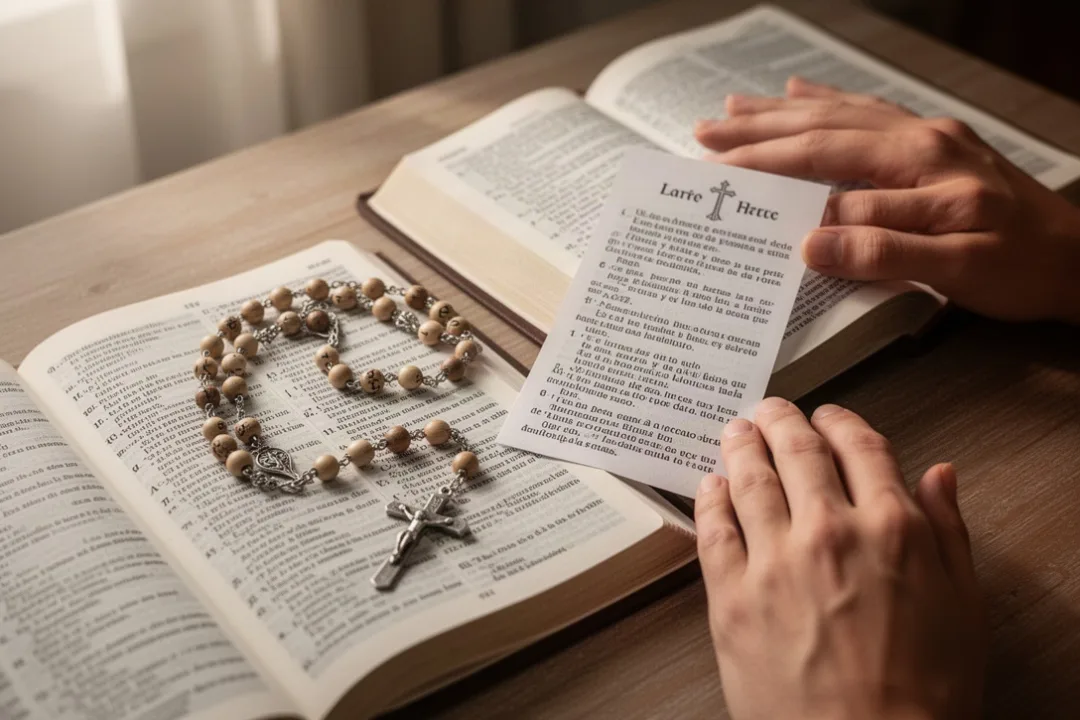
A standard rosary has a crucifix, a short chain, five larger beads, and groups of ten smaller beads called decades. You can use physical beads, count on your fingers, or pray without beads if necessary. The beads help you keep your place, but they are not what makes the prayer meaningful.
Begin with the crucifix. Make the Sign of the Cross and pray the Apostles’ Creed in Spanish.
Move to the first large bead. Pray the Padre Nuestro.
Pray the three small beads. Say the Avemaría once on each bead, traditionally for growth in faith, hope, and charity.
Pray the Glory Be. This is said on the chain or bead before the first decade.
Announce the first mystery. Name the mystery clearly, such as “El primer misterio gozoso: La Anunciación.”
Pray the first decade. Say one Padre Nuestro, ten Avemarías, and one Gloria.
Add the optional Fátima prayer. Include it if that is your custom or if you are praying with a group that uses it.
Repeat the pattern. Announce the next mystery and pray the remaining four decades in the same order.
Finish with the Salve. Pray the Hail Holy Queen, followed by any customary closing prayer.
End with the Sign of the Cross. This marks the completion of the rosary.
Before each decade, pause briefly after announcing the mystery. Rather than rushing through the words, consider what the event reveals about Jesus’ life, Mary’s faith, or your own need for prayer. You can also offer the decade for a particular person, family, concern, or intention.
The rosary has four sets of mysteries: Joyful, Sorrowful, Glorious, and Luminous. Each set contains five events for meditation. The following weekly schedule is widely used, though personal or parish customs may differ.
Monday and Saturday: the Joyful Mysteries
Tuesday and Friday: the Sorrowful Mysteries
Wednesday and Sunday: the Glorious Mysteries
Thursday: the Luminous Mysteries
Some people pray the mysteries assigned to a particular liturgical season, while others choose a set based on their intentions. There is no need to abandon prayer because you missed the customary day. Select the set you can pray with attention and consistency.
Los misterios gozosos
The Joyful Mysteries focus on events surrounding Jesus’ birth and early life. They are often prayed on Monday and Saturday.
El primer misterio gozoso: La Anunciación. Mary receives the angel’s message and accepts her role in God’s plan.
El segundo misterio gozoso: La Visitación. Mary visits Elizabeth, and the two women recognize God’s work in their lives.
El tercer misterio gozoso: El Nacimiento de Jesús. Jesus is born in Bethlehem amid poverty and simplicity.
El cuarto misterio gozoso: La Presentación de Jesús en el templo. Mary and Joseph present the child according to Jewish religious custom.
El quinto misterio gozoso: El Niño Jesús perdido y hallado en el templo. Jesus is found in the temple after his parents search for him.
These mysteries can be connected to family life, new beginnings, patience, obedience, and the responsibilities of caring for others. When praying them in Spanish, the repeated phrase misterio gozoso means “Joyful Mystery.”
Los misterios dolorosos
The Sorrowful Mysteries invite meditation on Jesus’ suffering and death. They are customarily prayed on Tuesday and Friday.
El primer misterio doloroso: La agonía de Jesús en el huerto. Jesus faces suffering in prayer before his arrest.
El segundo misterio doloroso: La flagelación de Jesús. Jesus is physically abused before his crucifixion.
El tercer misterio doloroso: La coronación de espinas. Soldiers mock Jesus as a king and place a crown of thorns on him.
El cuarto misterio doloroso: Jesús con la cruz a cuestas. Jesus carries the cross toward the place of execution.
El quinto misterio doloroso: La crucifixión y muerte de Jesús. Jesus dies on the cross.
These mysteries are not meant to glorify suffering for its own sake. They can lead you to pray for people experiencing grief, violence, illness, injustice, or fear, while remembering the Christian belief that suffering and death do not have the final word.
Los misterios gloriosos
The Glorious Mysteries turn toward the Resurrection and the life of the Church. They are customarily prayed on Wednesday and Sunday.
El primer misterio glorioso: La resurrección de Jesús. Jesus rises from the dead.
El segundo misterio glorioso: La ascensión de Jesús al cielo. Jesus returns to the Father.
El tercer misterio glorioso: La venida del Espíritu Santo. The Holy Spirit comes upon the apostles and Mary.
El cuarto misterio glorioso: La asunción de María al cielo. Mary is taken into heavenly glory.
El quinto misterio glorioso: La coronación de María. Mary is honored as Queen of Heaven.
The Spanish adjective glorioso means “Glorious.” These mysteries can shape prayers of gratitude, hope, renewal, and trust in life beyond death.
Los misterios luminosos
The Luminous Mysteries reflect on important moments in Jesus’ public ministry. They are commonly prayed on Thursday.
El primer misterio luminoso: El bautismo de Jesús en el Jordán. Jesus begins his public mission through baptism.
El segundo misterio luminoso: La autorrevelación de Jesús en las bodas de Caná. Jesus reveals his divine power at a wedding feast.
El tercer misterio luminoso: El anuncio del Reino de Dios. Jesus calls people to conversion and announces God’s reign.
El cuarto misterio luminoso: La transfiguración. Jesus’ glory is revealed to Peter, James, and John.
El quinto misterio luminoso: La institución de la Eucaristía. Jesus gives himself to the Church in the Eucharist.
The word luminoso means “Luminous” or “Light-filled.” These mysteries help connect the rosary with Jesus’ teaching, acts of mercy, revelation, and sacramental life.
How to pronounce common rosary words in Spanish
You do not need perfect Spanish pronunciation to pray sincerely. Still, learning a few recurring sounds can make the prayers easier to follow. Spanish vowels are generally consistent: a sounds like the “a” in “father,” e is similar to the vowel in “they” but shorter, i resembles “ee,” o is a clear “o,” and u resembles “oo.”
María: mah-REE-ah
Jesús: heh-SOOS
Señor: seh-NYOR
Espíritu Santo: es-PEE-ree-too SAHN-toh
pecadores: peh-kah-DOH-res
misericordia: mee-seh-ree-KOR-dee-ah
misterio: mees-TEH-ree-oh
ruega: RWEH-gah
The Spanish j in Jesús has a breathy sound, somewhat like the English sound in “house.” The letter ñ in Señor sounds like the “ny” in “canyon.” In many regions, z and soft c are pronounced like “s”; in parts of Spain, they may have a “th” sound.
For group prayer: Listen for the group’s pace instead of translating every word as you go. You can practice the prayers privately, then join the spoken responses when you feel ready.
How to meditate while repeating the prayers
The rosary is more than a Spanish vocabulary exercise or a test of memory. The repeated prayers provide a framework, but the central activity is meditation on the mystery. You might picture the setting, consider the people involved, or connect the event with someone who needs compassion and strength.
For example, during the Visitation, you might pray for a pregnant relative, a caregiver, or someone bringing help to another person. During the Crucifixion, you might remember people who are suffering and ask for courage to respond to injustice. During the Resurrection, you might bring a situation of loss or discouragement before God.
A simple pattern can keep your mind focused during each decade:
Name the scene. Say the Spanish name of the mystery and recall what happens.
Notice a virtue. Consider faith, humility, compassion, courage, patience, or hope.
Offer an intention. Pray for a person, community, or need connected to that virtue.
Return gently when distracted. Do not treat distraction as failure; simply return to the mystery and the prayer.
Some people use an image, a short phrase, or a few seconds of silence before each Hail Mary. Others focus on the words themselves. Both approaches can be fruitful, and your method may change from day to day.
Common ways to pray the rosary in Spanish
You can pray the rosary in several settings. A personal rosary may be quiet and flexible, while a parish rosary usually follows a leader-and-response pattern. In a family setting, different people may lead the decades so that children and older relatives can participate.
Personal prayer: Read from a Spanish prayer card, app, or printed guide at your own pace.
Family prayer: Assign one person to announce each mystery and another to lead each decade.
Parish prayer: Follow the local order, including any additional petitions or closing prayers.
Bilingual prayer: Say the fixed prayers in Spanish while offering your personal intentions in English or another language.
Prayer with children: Pray one decade at a time and explain one mystery in simple language.
When praying with people from different countries, expect variations in pronunciation and wording. A Mexican parish, a Puerto Rican family, and a Spanish congregation may use different accents or versions of certain lines. The shared structure remains recognizable: five decades, ten Hail Marys per decade, and meditation on one mystery at a time.
What to do if you miss a prayer or lose your place
If you lose count, do not restart automatically. Estimate where you were and continue. The beads are aids for prayer, not a scorecard. If you realize that you skipped a Hail Mary or said the wrong prayer, you can calmly correct it or leave the mistake behind.
If you cannot pray all five decades, pray one decade with attention. A single decade includes an Our Father, ten Hail Marys, and a Glory Be, so it can be a complete short prayer when time, health, or circumstances limit you. You may return to the remaining decades later.
If you are learning Spanish, consider keeping a pronunciation guide beside the full prayers. Read each line aloud several times, then listen to a trusted Spanish-speaking Catholic group or parish recording. Avoid trying to memorize everything at once; learning the Padre Nuestro and Avemaría first gives you the foundation for most of the rosary.
How to finish the rosary with personal intentions
After the Salve, many people add a brief personal prayer. You can thank God, ask for help, pray for another person, or remain silent for a moment. A personal intention does not need formal wording, and it can be expressed in Spanish, English, or both.
For example, you might say, “Señor, acompaña a mi familia y danos paz”, meaning “Lord, be with my family and give us peace.” You could also name a person directly and ask Mary to pray for that person. Keep the ending simple so that it reflects the prayer you have just completed.
The rosary can become familiar without becoming automatic. Use the Spanish prayers as a doorway into attentive reflection, not as a requirement to sound native. With regular practice, the words, bead order, and mystery cycle become easier to remember, leaving more attention for faith, gratitude, and care for others.
Frequently asked questions
How long does it take to pray the rosary in Spanish?
A complete five-decade rosary usually takes about 15 to 30 minutes, depending on the pace, pauses, singing, and added prayers. A group may take longer because it may include intentions, reflections, or responses. If you have limited time, praying one decade in Spanish is a meaningful shorter practice.
Can I pray the rosary in Spanish if I am still learning the language?
Yes. Use a printed prayer guide, read slowly, and learn the recurring prayers first. You can pray the mysteries in English while saying the fixed prayers in Spanish, or switch languages as needed. Understanding the meaning matters more than having perfect pronunciation.
Is the Fatima Prayer required in the Spanish rosary?
No. The Fatima Prayer is a widespread optional addition after each Glory Be. The essential structure consists of the opening prayers, five decades with their mysteries, and the customary closing prayers. If you are praying with a parish group, follow its established practice.
What is the difference between a rosary and a decade?
A rosary normally includes five decades, while one decade is a single group of ten Hail Marys. Each decade also includes one Our Father, one Glory Be, and meditation on a mystery. Praying one decade can be useful when you have less time or are teaching someone the basic pattern.












Leave a Reply