Mystery for Wednesday: Pray the Glorious Mysteries
Mystery for Wednesday: Pray the Glorious Mysteries
If you are asking, “Which mystery do I pray on Wednesday?” the traditional answer is the Glorious Mysteries of the Rosary. These five decades center on Jesus’ Resurrection and the hope of eternal life, then turn to his Ascension, the coming of the Holy Spirit, Mary’s Assumption, and her Coronation in heaven.
The Wednesday Rosary is not a separate prayer with different opening words. You pray the usual Rosary, but you meditate on the five Glorious Mysteries during the five decades. Each mystery gives you a particular scene or truth to consider while repeating the Our Father, Hail Mary, and Glory Be.
Quick answer: The standard mystery for Wednesday is the Glorious Mysteries. They are also traditionally prayed on Sunday, except during Advent and Christmas when some people choose the Joyful Mysteries instead.
Why Wednesday is assigned to the Glorious Mysteries
The Rosary is often prayed according to a weekly pattern that gives each day a different set of mysteries. Wednesday is associated with the Glorious Mysteries because the middle of the week provides a natural opportunity to refocus on Christ’s victory over death and the Christian hope of resurrection.
The Resurrection is the heart of Christian faith, so the Glorious Mysteries are not simply a reminder of events that happened after Jesus’ Passion. They present a complete movement from death to life, from earthly ministry to heavenly glory, and from the disciples’ uncertainty to the Church’s mission through the Holy Spirit.
The usual weekly schedule is:
Monday and Saturday: the Joyful Mysteries
Tuesday and Friday: the Sorrowful Mysteries
Wednesday and Sunday: the Glorious Mysteries
Thursday: the Luminous Mysteries
This schedule is a helpful tradition, not a rule that limits when you may pray a particular set. You can pray the Glorious Mysteries on any day, especially when a particular mystery speaks to a need, feast, season, or intention in your life.
How to pray the Rosary on Wednesday
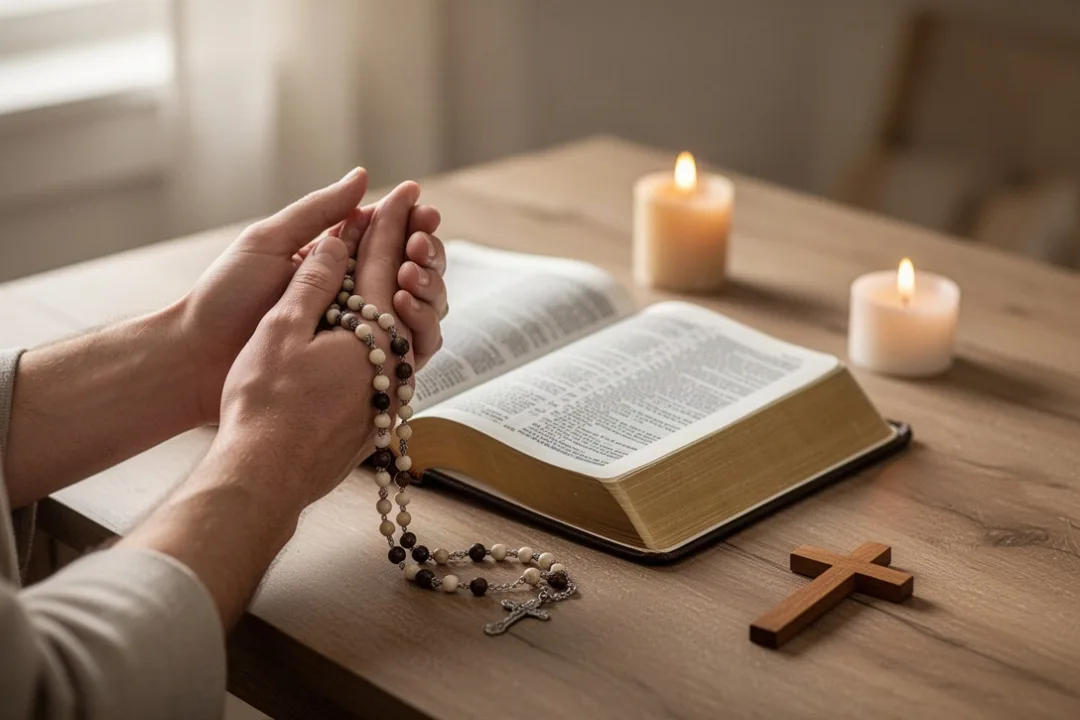
A standard Rosary includes five decades. On Wednesday, announce one Glorious Mystery before each decade and spend a few moments bringing its meaning to mind. You do not need to create a detailed mental picture or force yourself to feel a certain emotion. Quiet attention, faith, and a sincere intention are enough.
Begin with the Sign of the Cross. This formally starts the prayer.
Pray the Apostles’ Creed. This expresses the essential beliefs of the Christian faith.
Pray the Our Father on the first large bead.
Pray three Hail Marys on the next three beads, traditionally for growth in faith, hope, and charity.
Pray the Glory Be.
Announce the First Glorious Mystery and pray one Our Father, ten Hail Marys, and one Glory Be.
Repeat the pattern for the remaining four Glorious Mysteries.
End with a customary closing prayer, such as the Hail Holy Queen, and make the Sign of the Cross.
Some people add the Fatima Prayer after each Glory Be, while others include personal prayers before or after the Rosary. These practices can support your devotion, but the essential structure remains the same: five mysteries, five Our Fathers, fifty Hail Marys, and meditation on the life of Christ and Mary.
The First Glorious Mystery: The Resurrection
The First Glorious Mystery is the Resurrection of Jesus. After Jesus dies and is placed in the tomb, his followers discover that the tomb is empty and encounter the risen Lord. The Gospel accounts are found in Matthew 28, Mark 16, Luke 24, and John 20.
The Resurrection reveals that death does not have the final word. It is not merely a happy ending after a painful chapter; it is the decisive victory of God over sin and death. When you pray this decade, you can place your fears, losses, and uncertainty before the risen Christ.
This mystery may be especially meaningful when you feel discouraged or spiritually tired. The disciples did not immediately understand everything that had happened. Their faith grew as they listened, remembered Jesus’ words, and recognized him in their midst. You can bring the same gradual process of faith to prayer.
What to contemplate during the first decade
The stone rolled away and the empty tomb as signs of new life.
The women who went to the tomb and became early witnesses to the Resurrection.
The transformation of frightened disciples into people willing to announce the Gospel.
The promise that suffering and death are not the end of the Christian story.
A personal situation that needs Christ’s healing, renewal, or courage.
A useful intention for this decade is hope. You might pray for someone grieving, a family facing hardship, people recovering from addiction, or your own ability to begin again after failure. The Resurrection does not deny pain; it places pain within God’s promise of redemption.
The Second Glorious Mystery is the Ascension of Jesus into heaven. After appearing to his disciples and teaching them, Jesus is taken up into heaven, as described in Luke 24 and Acts 1. The Ascension marks the completion of his earthly mission and the beginning of the disciples’ public witness.
It can seem at first that the Ascension means Jesus is leaving his followers behind. Its deeper meaning is different. Jesus enters the glory of the Father while remaining present to the Church in a new way. The disciples are entrusted with a mission rather than being asked to remain passive observers.
Praying this mystery can help you consider the direction of your own life. Christian faith is not only about receiving comfort in prayer. It also sends you back into ordinary responsibilities with a clearer sense of love, service, forgiveness, and truth.
How the Ascension shapes daily faith
The Ascension points toward heavenly hope, but it does not encourage escape from the world. The disciples return to their community and wait in prayer for the Holy Spirit. Their hope becomes active and practical.
During this decade, consider the people and duties that have been placed in front of you. A parent caring for children, a worker serving customers, a student facing difficult work, or a person assisting a sick relative can all make ordinary actions part of a larger vocation. The Ascension invites you to see earthly responsibilities in the light of eternal purpose.
You may also pray for those who feel abandoned. The mystery reminds you that God’s presence is not measured only by visible evidence. Jesus’ physical departure opens the way for the Spirit’s presence and for the Church’s worldwide mission.
The Third Glorious Mystery: The Descent of the Holy Spirit
The Third Glorious Mystery is the Descent of the Holy Spirit at Pentecost. In Acts 2, the disciples are gathered together when the Holy Spirit comes upon them. They receive courage and begin proclaiming the Gospel to people from many nations.
Before Pentecost, the disciples are still waiting and uncertain. After receiving the Spirit, they speak with confidence and begin the work of building the Church. This mystery shows that Christian mission does not depend only on natural talent, education, or personality. God gives grace for the work he asks people to do.
The Holy Spirit is associated with gifts such as wisdom, understanding, counsel, fortitude, knowledge, piety, and reverence for God. You can pray for these gifts in a concrete way rather than treating them as abstract religious ideas.
Prayers to bring to the Pentecost decade
Ask for wisdom before making an important decision.
Ask for fortitude when you must endure hardship or defend what is right.
Ask for understanding when another person’s needs or actions are difficult to grasp.
Ask for charity in conversations where patience and restraint are needed.
Ask for guidance in serving your parish, family, workplace, or community.
This mystery is also a prayer for unity. At Pentecost, people from different places hear the disciples in a way they can understand. You might offer the decade for divided families, churches, communities, or nations, asking for honest speech, patient listening, and reconciliation.
Prayer tip: If your mind wanders, return gently to one phrase such as “Come, Holy Spirit” or “Give me courage to serve.” The goal is not perfect concentration but faithful return.
The Fourth Glorious Mystery: The Assumption of Mary
The Fourth Glorious Mystery is the Assumption of the Blessed Virgin Mary. This doctrine teaches that, at the end of her earthly life, Mary was taken body and soul into heavenly glory. The dogma was formally defined by the Catholic Church in 1950, while the belief itself has a much older history in Christian tradition.
The Bible does not give a narrative account of Mary’s Assumption. The mystery is understood in relation to Mary’s unique role as the mother of Jesus, her faithful cooperation with God’s grace, and the Christian hope of bodily resurrection. It points beyond Mary to the destiny God promises to all who belong to Christ.
When you pray this decade, you can meditate on the dignity of the human body and the value of ordinary faithfulness. Mary’s holiness is not presented as self-created greatness. Her life reflects receptivity, courage, service, and trust through circumstances she could not fully control.
The Assumption reminds you that salvation is not the abandonment of the body or the erasure of your personal identity. Christian hope includes the redemption of the whole person. This can bring comfort when illness, aging, disability, or grief makes human vulnerability especially visible.
You might pray for people who are sick, for caregivers, for those approaching death, or for families mourning someone they love. You can also ask for grace to treat your own body and the bodies of others with respect, patience, and compassion.
Mary’s Assumption also encourages perseverance. Her life included joy, uncertainty, sorrow, and waiting. The mystery presents her faithfulness as leading toward glory, even though that glory was not always visible during her earthly life.
The Fifth Glorious Mystery: The Coronation of Mary
The Fifth Glorious Mystery is the Coronation of Mary as Queen of Heaven and Earth. This mystery reflects biblical images of Mary as the mother of the Messiah and draws on the Church’s understanding of her place in the communion of saints. Revelation 12 is often associated with this meditation, although the passage uses symbolic imagery and does not provide a direct narrative of a coronation.
Mary’s queenship is understood through her relationship with Christ. It is not a claim that she replaces God or stands apart from the work of Jesus. Instead, it points to her honored place among the redeemed and to her continuing role as a motherly intercessor in Catholic devotion.
This mystery can teach you that true greatness is connected with humble service. Mary’s honor follows a life of trust and cooperation with God. The Rosary does not present glory as worldly power, personal status, or control over others.
Intentions for the Coronation decade
You may pray this decade for the Church, for families, for mothers, or for people who carry responsibility without recognition. It is also fitting to pray for those who misuse authority, asking that leadership become protective, just, and oriented toward the common good.
The Coronation can also turn your attention toward the saints. The Church teaches that all who are united with God share in heavenly glory, each in a way suited to God’s grace. You can ask the saints to pray for you while remembering that every grace ultimately comes from God.
How to meditate instead of merely repeating the prayers
The repeated prayers give the Rosary its rhythm, but the mysteries give it its focus. If you rush through the words without considering the mystery, the Rosary can feel mechanical. If you stop trying to pray because your attention wanders, you may place an unnecessary burden on yourself.
Try holding one simple image, truth, or intention in mind during each decade. You might imagine the disciples discovering the empty tomb, reflect on the mission Jesus gives his followers, or ask the Holy Spirit to guide one difficult conversation.
These practical habits can help:
Read a short Gospel passage beforehand, especially for the Resurrection, Ascension, or Pentecost.
Choose one intention per decade instead of trying to remember every concern at once.
Pray slowly enough to hear the words, but do not worry about maintaining a perfect pace.
Use a quiet physical cue, such as holding the crucifix or moving one bead at a time, to return your attention.
Accept distractions without frustration. Notice them, offer them to God, and return to the mystery.
The Rosary is vocal prayer and meditation together. Your mind may move between the Gospel scene, the meaning of the mystery, and the people you are praying for. That movement is normal. Faithful prayer does not require every decade to feel peaceful or emotionally powerful.
Choosing Wednesday intentions for different needs
The Glorious Mysteries are especially suited to prayers for hope, courage, renewal, mission, healing, and eternal life. You can pray the entire Rosary for one person or assign a different intention to each decade.
For example, the first decade may be offered for someone grieving, the second for a person seeking direction, the third for families needing reconciliation, the fourth for the sick and elderly, and the fifth for the Church and its leaders. There is no required formula for these intentions.
Wednesday can also be a useful midpoint in your week. If Monday began with a list of responsibilities and Tuesday brought setbacks, the Glorious Mysteries invite you to place the rest of the week in a larger perspective. The prayer does not make every problem disappear, but it can change the way you carry it.
Can you pray a different mystery on Wednesday?
Yes. The traditional schedule is a guide, not a command. You may choose the Joyful Mysteries when preparing for Christmas, the Sorrowful Mysteries during Lent, or the Luminous Mysteries when you want to reflect on Jesus’ public ministry. Some people also follow a parish, family, or personal schedule that differs from the customary one.
The most important consideration is consistent, attentive prayer. If you begin the Rosary late, have limited time, or are praying with a group that has chosen another set, you do not need to abandon the prayer because it is Wednesday. Any approved form of Rosary meditation can lead your attention toward Christ.
Still, if you are looking for the standard answer to “mystery for Wednesday,” use the Glorious Mysteries: Resurrection, Ascension, Descent of the Holy Spirit, Assumption, and Coronation.
A simple Wednesday Rosary plan
If you are new to the Wednesday Rosary, keep the plan uncomplicated. Set aside a quiet period, decide what intention you want to carry, and begin with the ordinary opening prayers. Before each decade, announce the mystery clearly and allow a few seconds for your attention to settle.
Prepare: choose a place, time, and intention.
Announce: name the Glorious Mystery before each decade.
Reflect: hold one scene, truth, or prayer request in mind.
Repeat: pray the decade without demanding perfect concentration.
Respond: after the Rosary, identify one practical act of faith, hope, or charity for the day.
That final response can be small: calling someone who is lonely, apologizing, making a difficult decision honestly, helping with a practical need, or setting aside time for further prayer. The Glorious Mysteries lead from contemplation toward hope-filled action.
The Wednesday mystery in one sentence
The traditional mystery for Wednesday is the Glorious Mysteries of the Rosary, prayed to meditate on Jesus’ Resurrection and Ascension, the Holy Spirit’s coming at Pentecost, Mary’s Assumption, and her Coronation. Pray them with the usual Rosary prayers, bring your own intentions, and remember that the daily schedule is a helpful tradition rather than a restriction.
Frequently asked questions
What are the five Glorious Mysteries prayed on Wednesday?
The five Glorious Mysteries are the Resurrection of Jesus, the Ascension of Jesus into heaven, the Descent of the Holy Spirit at Pentecost, the Assumption of Mary, and the Coronation of Mary as Queen of Heaven and Earth. Each mystery is prayed during one decade of the Rosary.
Are the Glorious Mysteries always prayed on Wednesday?
They are the traditional choice for Wednesday, but the schedule is not binding. You may pray another set because of the liturgical season, a personal intention, or a group’s custom. The Glorious Mysteries are also commonly prayed on Sunday.
How long does a Wednesday Rosary usually take?
A five-decade Rosary commonly takes about 15 to 30 minutes, depending on your pace, pauses, and additional prayers. Reading Scripture or spending more time meditating on each mystery can make the prayer longer. A slower pace is not required for the Rosary to be meaningful.
What should I think about during each Hail Mary?
Keep your attention on the Glorious Mystery announced before the decade. You might reflect on a Gospel scene, repeat a short prayer connected with the mystery, or offer a specific intention. When distractions arise, return calmly to the mystery instead of trying to force perfect concentration.








Leave a Reply