You may have seen someone moving beads through their fingers while quietly repeating prayers and wondered, what is a rosary for? A rosary is used primarily for prayer and meditation. In Catholic practice, it helps you reflect on important events in the lives of Jesus Christ and Mary while giving your hands and voice a steady pattern to follow.
The beads are not considered magical, and the rosary is not meant to be a charm or a substitute for faith. They serve as a practical guide for keeping track of prayers. The repeated words create a calm rhythm, while the mysteries of the Rosary direct your attention to themes such as Jesus’ birth, ministry, suffering, death, and resurrection.
You can pray a rosary alone or with other people, aloud or silently, at home, in church, while traveling, or during a difficult period. Some Catholics pray the full set of mysteries each day; others pray one group of mysteries when they have a few quiet minutes. The purpose is not to finish as quickly as possible, but to remain present to God through thoughtful, repeated prayer.
A rosary gives prayer a clear structure. Instead of deciding what to say next, you follow a familiar sequence of prayers and meditations. That structure can be especially helpful when you feel distracted, anxious, tired, or unsure how to begin praying.
The repetition is meant to support reflection rather than replace it. As you pray each group of ten Hail Marys, known as a decade, you consider one mystery. The words continue in the background while your mind returns to the event or spiritual theme connected with that decade.
For example, while reflecting on the Nativity, you might think about Christ’s birth, God entering human life, or the humility of the people involved. While reflecting on the Crucifixion, you might consider suffering, forgiveness, compassion, or the cost of love. The mystery gives the repeated prayers a particular focus.
To remember: the beads help you keep count of each prayer.
To meditate: the mysteries give your thoughts a subject.
To ask: you can bring personal needs, other people, and the world before God.
To praise: the prayers express gratitude for God’s work in Christ.
To persevere: the repeated pattern makes it easier to continue when concentration is difficult.
The rosary can also create a small pause in a crowded day. Ten or fifteen minutes of steady prayer may help you step away from constant activity and examine what you are carrying emotionally and spiritually. That pause does not make problems disappear, but it can help you respond with greater patience and perspective.
The central purpose: Catholics pray the rosary to contemplate Christ with Mary, not merely to recite a fixed number of prayers or complete a religious task.
Many people also use the rosary as a form of intercessory prayer. You might pray for a sick relative, a grieving friend, peace in a troubled community, guidance about a decision, or strength during a temptation. The intention can be named before you begin or quietly held in mind as you move through the decades.
How the rosary beads organize the prayers
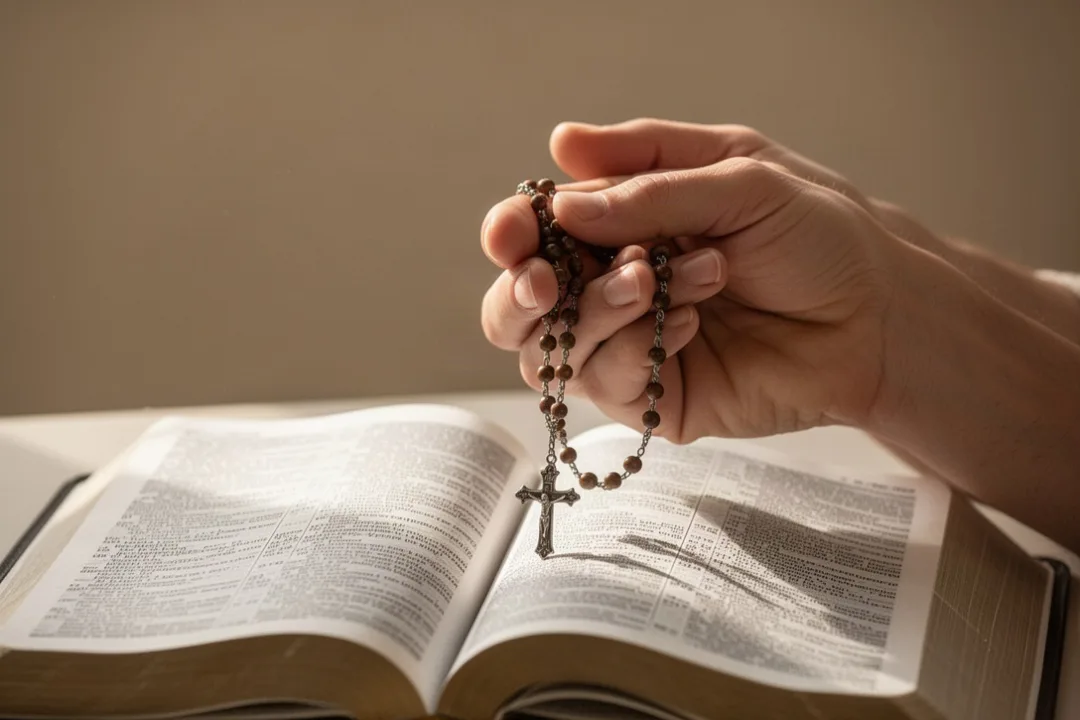
A standard rosary has a crucifix, a short chain or cord, several single beads, and five groups of ten smaller beads. The physical arrangement corresponds to the sequence of prayers. Holding the beads can make an abstract routine easier to follow, especially when you are learning.
The exact design can vary. Some rosaries include a center medal or image, and some are made with different materials. A small one-decade rosary has only one group of ten beads and can be carried easily. A finger rosary may have a compact ring-shaped design. These forms are used for the same basic purpose: guiding prayer.
A traditional five-decade rosary is normally prayed in this order:
Begin at the crucifix with the Sign of the Cross and the Apostles’ Creed.
Use the first single bead for the Our Father.
Pray three Hail Marys on the next three beads, traditionally asking for growth in faith, hope, and charity.
Pray the Glory Be on the next single bead.
Announce the first mystery, then pray an Our Father, ten Hail Marys, and a Glory Be.
Repeat that pattern for the remaining four mysteries.
Finish with the customary closing prayers and the Sign of the Cross.
Prayer customs can differ by family, parish, religious community, or country. Some people add the Fatima Prayer after each Glory Be. Others include a concluding prayer asking for Mary’s intercession. These additions are common, but they are not necessary for the rosary to be prayed meaningfully.
The beads do not have to be expensive, and you do not need a particular style to begin. If you do not own a rosary, you can use your fingers, a printed guide, or a prayer app. What matters is the prayerful attention, not the object itself.
It is also fine to pause, lose your place, or make a mistake. Simply return to the last bead or prayer you remember. The rosary is a tool for prayer, not a test of memory or speed.
What the five groups of Rosary mysteries mean
The Rosary is traditionally organized around four sets of mysteries: the Joyful Mysteries, Luminous Mysteries, Sorrowful Mysteries, and Glorious Mysteries. Each set contains five scenes or events. Together, they move through major parts of the Gospel story and Christian belief.
The Joyful Mysteries focus on Christ’s early life
The Joyful Mysteries invite reflection on the Annunciation, Visitation, Nativity, Presentation, and Finding of Jesus in the Temple. They emphasize Mary’s response to God, the arrival of Christ, family life, obedience, wonder, and patient seeking.
These mysteries can be especially meaningful when you are thinking about a new responsibility, a pregnancy, a family concern, or a time when you need humility and trust. They do not suggest that joy excludes difficulty. Rather, they show how hope can be present even when circumstances are uncertain.
The Luminous Mysteries focus on Christ’s public ministry
The Luminous Mysteries traditionally concern Jesus’ Baptism in the Jordan, the wedding at Cana, his proclamation of God’s kingdom, the Transfiguration, and the institution of the Eucharist. They draw attention to Christ’s identity, teaching, compassion, signs, and invitation to conversion.
These mysteries can help you reflect on how faith shapes ordinary actions. They may be useful when you are seeking direction, trying to change a harmful habit, or considering how to serve other people more generously.
The Sorrowful Mysteries focus on suffering and the Cross
The Sorrowful Mysteries include Jesus’ agony in the garden, scourging, crowning with thorns, carrying of the Cross, and Crucifixion. They are not intended to glorify pain or encourage people to accept abuse. They bring suffering, injustice, grief, sacrifice, and forgiveness into prayer while keeping the Cross at the center of Christian faith.
Someone grieving a death or facing illness may find these mysteries honest and compassionate because they do not ignore suffering. At the same time, prayer should never be used to tell a person that mistreatment is God’s will or that seeking safety is a lack of faith.
The Glorious Mysteries focus on resurrection and hope
The Glorious Mysteries traditionally include the Resurrection, Ascension, descent of the Holy Spirit, the Assumption of Mary, and Mary’s Coronation. They turn attention toward new life, the Spirit’s presence, the destiny of the Church, and the hope of sharing in Christ’s victory.
These mysteries can be prayed during seasons of celebration, after a difficult period, or whenever you need to remember that Christian faith includes more than suffering. Their emphasis is hope grounded in God’s action, not optimism based only on circumstances.
The mysteries make the rosary distinctly more than a counting exercise. Without them, the prayers could become mechanical. With them, the rosary becomes a way of returning again and again to the central events of the Christian story.
How to pray a rosary when you are new to it
You do not need to know every prayer perfectly before beginning. Keep a guide nearby, follow the beads one at a time, and allow yourself to learn through practice. Many people begin by praying one decade rather than attempting all five.
A simple approach is to choose a quiet place and decide what intention you want to bring to prayer. You might dedicate the rosary to a person, a situation, or a personal need. Then select the set of mysteries that fits the day or your current circumstances.
Hold the crucifix and make the Sign of the Cross.
Pray the opening prayers at the crucifix and the first beads.
Announce the first mystery before beginning its decade.
Move one bead at a time while praying the Our Father and ten Hail Marys.
After the decade, pray the Glory Be and any optional prayer you normally use.
Continue through five mysteries, or stop after one decade if that is what you can manage.
During the Hail Marys, try one of several forms of meditation. You can imagine the Gospel scene without attempting to create a detailed mental picture. You can consider what the mystery reveals about Jesus. You can focus on one word such as mercy, trust, humility, or hope. You can also bring a particular person into the prayer while returning gently to the mystery whenever your thoughts wander.
Distraction is normal. The goal is not to maintain perfect concentration for every second. When you notice that your mind has wandered, acknowledge it without frustration and return to the prayer or mystery.
Some people pray slowly and quietly; others use a moderate rhythm. Avoid treating the number of words as the measure of success. A shorter prayer prayed attentively may be more fruitful for you than a complete rosary rushed out of obligation.
A practical starting point: pray one decade for several days, learn the sequence, and add another decade when the pattern feels familiar.
If you pray with a group, follow the local custom for responses and closing prayers. If you are unsure when to speak, listen to the other participants and join in when you recognize the prayer. Group prayer can make the rosary feel less intimidating and provide a regular time for shared support.
Why Catholics pray the rosary with Mary
The rosary includes repeated Hail Marys because Catholics ask Mary to pray for them and because the mysteries are closely connected to her life with Jesus. Mary is not treated as a replacement for God. Catholic teaching presents her as a disciple and mother who points toward Christ.
Each Hail Mary contains biblical themes about Mary’s role in the Gospel, followed by a request for her prayers. The repeated prayer places the person praying alongside Mary as they reflect on Jesus’ life. That is why the rosary is often described as contemplating Christ with Mary.
For Catholics, asking Mary’s intercession is similar in basic form to asking another Christian to pray for you, though Mary has a unique place in Catholic devotion. Catholics believe that all grace comes from God through Christ, while Mary’s prayers are understood as the prayers of a beloved and faithful disciple.
People from other Christian traditions may not share Catholic beliefs about Mary. They can still study the rosary as a historic Christian prayer practice, but they should not feel pressured to use language or teachings that conflict with their conscience. Catholics also differ in how strongly they connect emotionally with Marian devotion; sincere prayer does not require a particular emotional experience.
The rosary can be prayed for many intentions, but it should remain connected to Christian love. If praying for another person makes you more resentful, fearful, or judgmental, it may help to ask for compassion and wisdom as well as the outcome you desire.
What the rosary is not, and how it fits into Catholic life
The rosary is not a magical object. Carrying one does not guarantee protection, and repeating prayers does not force God to grant a request. Its value comes from the faith, attention, and relationship with God expressed through the prayer.
The rosary is also not the whole of Catholic prayer. Catholics may pray through Scripture, the Mass, the sacraments, silent worship, the Liturgy of the Hours, spontaneous prayer, service, and acts of mercy. The rosary can support these practices, but it does not replace participation in the Church’s central worship or responsible action in daily life.
It is not necessary to pray the rosary every day to be a good Catholic. Some people find a daily rhythm helpful, while others pray it weekly, occasionally, or during particular seasons. A person who cannot complete five decades can pray one decade, use another form of prayer, or simply sit quietly with God.
Nor is the rosary intended to be used as a punishment. Parents and teachers should be careful not to present it only as a penalty for bad behavior. Children may learn it more naturally when adults explain the beads, use age-appropriate mysteries, and show that prayer is a relationship rather than a chore.
The rosary can become especially useful at transitional moments: before a medical appointment, during a long commute, while caring for someone who is ill, or when sleep is difficult. It provides words when you do not have your own words ready. It can also become a shared practice among family members or friends who want to pray for the same intention.
Ultimately, the rosary is for remembering, contemplating, and responding to the Gospel. The beads organize the practice, the prayers create its rhythm, and the mysteries keep its attention on Christ. If the practice leads you toward greater faith, patience, mercy, and love of neighbor, it is serving its purpose.
Frequently asked questions
Do you have to be Catholic to pray the rosary?
No. Anyone may learn about or pray the rosary, although it expresses specifically Catholic beliefs about Mary and Christian devotion. If you are not Catholic, you can use it as a structured meditation on Gospel events while deciding which prayers and theological ideas fit your own tradition. You should not feel obligated to adopt beliefs you do not hold.
How long does it take to pray a full rosary?
A full five-decade rosary commonly takes about 15 to 30 minutes, depending on the pace, pauses, music, and additional prayers. There is no required speed. If you have limited time, praying a single decade is a traditional and worthwhile way to maintain the rhythm of the devotion.
Can a rosary protect you from danger?
Catholics may carry or wear a rosary as a reminder of prayer and trust in God, but the beads are not a protective charm. The Church does not teach that the object itself has magical power. Any blessing associated with a rosary points to faith and prayer, not an automatic guarantee against harm or misfortune.
What should you do if you lose your place while praying?
Pause and return to the last bead or prayer you clearly remember. You can also restart the current decade without treating the mistake as serious. A written guide, audio recording, or prayer app may help while you learn. The purpose is attentive prayer, so worrying about perfect counting should not overshadow the mystery you are considering.















Leave a Reply