What happens in Luke chapters 1 and 2, and why do Christians read them so often during Advent and Christmas? Together, these chapters tell how God’s promises begin to unfold through the births of John the Baptist and Jesus. They also show how ordinary people respond when God gives them an extraordinary calling.
Luke does more than provide a sequence of events. He connects Jesus’ birth with Israel’s Scriptures, highlights the work of the Holy Spirit, and repeatedly draws attention to people who might have been overlooked: an elderly couple, a young woman from Galilee, shepherds working at night, and a child growing up in a modest home. Reading the chapters carefully helps you see both the historical storyline and the theological meaning Luke wants his audience to grasp.
Luke begins his Gospel by explaining that he has investigated the events surrounding Jesus and is presenting them in an orderly account. His stated purpose is to give the reader confidence about the teaching already received. That opening frames chapters 1 and 2 as more than a sentimental birth story: they are a carefully shaped account of God’s saving work.
The two chapters move from the announcement of John’s birth to the early years of Jesus. John’s role is to prepare people for the Lord, while Jesus is presented as the promised Savior and King. The events take place in Jewish settings and are filled with references to Abraham, David, Israel, Jerusalem, and the temple.
Luke 1:1–4: Luke explains his purpose and method as a writer.
Luke 1:5–25: An angel announces the birth of John to Zechariah and Elizabeth.
Luke 1:26–38: Gabriel announces Jesus’ birth to Mary.
Luke 1:39–56: Mary visits Elizabeth and praises God.
Luke 1:57–80: John is born, named, and connected with his future mission.
Luke 2:1–20: Jesus is born in Bethlehem and visited by shepherds.
Luke 2:21–40: Jesus is presented at the temple, where Simeon and Anna recognize his significance.
Luke 2:41–52: The twelve-year-old Jesus is found in the temple speaking with teachers.
Central idea: Luke 1 and 2 present Jesus as the promised Savior whose arrival brings God’s mercy to Israel and ultimately to all people.
How to read Luke 1 and 2 step by step
A helpful way to read these chapters is to follow the people who receive a promise, observe how they respond, and then ask how the promise begins to be fulfilled. Luke often places two scenes next to each other so that you can compare them. For example, Zechariah and Mary both receive angelic announcements, but their responses reveal different kinds of faith and hesitation.
Start with the setting. Notice the temple, the hill country of Judea, Nazareth, Bethlehem, and Jerusalem. These places connect the story to Israel’s worship and history.
Identify the promises. Look for what the angel says about John and Jesus, including their names, missions, and relationship to God’s purposes.
Watch the responses. Zechariah questions the announcement, Mary submits to God’s will, Elizabeth recognizes God’s blessing, and the shepherds act on what they hear.
Track the role of the Holy Spirit. The Spirit is associated with John, Elizabeth, Zechariah, Simeon, and the prophetic recognition of Jesus.
Notice repeated themes. Luke emphasizes joy, mercy, praise, prayer, the poor and humble, and God’s faithfulness to his promises.
Read the ending in light of the beginning. Jesus’ words in the temple show that even as a child, his identity and relationship with the Father are central to the story.
Why Luke begins with John the Baptist
Luke does not begin with Jesus’ birth announcement. He first introduces Zechariah and Elizabeth, a married couple described as faithful but childless and advanced in age. Their situation resembles several earlier biblical stories in which God brings life and hope where human expectations have ended.
Zechariah serves as a priest, and his assigned duty takes him into the temple to burn incense. While he is there, the angel Gabriel announces that Elizabeth will have a son named John. The child will bring joy, turn people toward God, and prepare them for the Lord. Luke therefore presents John as a prophetic forerunner, not as the center of the story.
Zechariah struggles to believe the message and asks how he can know it will happen. Gabriel identifies himself as one who stands in God’s presence and tells Zechariah that he will be unable to speak until the promise is fulfilled. The temporary silence becomes both a sign and a period of waiting.
When Elizabeth becomes pregnant, she sees her pregnancy as God removing a source of shame. Luke’s wording reflects the social pain often connected with childlessness in the ancient world, while also showing that Elizabeth is not defined by that stigma. Her story begins with disappointment but moves toward renewed dignity and joy.
What Gabriel’s announcement to Mary means
Six months later, Gabriel is sent to Nazareth to speak with Mary, a young woman promised in marriage to Joseph, a descendant of David. The announcement is startling because Mary is told she will conceive a son even though she has not begun married life. Luke presents the conception as the work of the Holy Spirit, not as the result of human planning.
Gabriel gives the child several descriptions. He will be great, called the Son of the Most High, connected with David’s royal line, and associated with an everlasting kingdom. These statements connect Jesus with Israel’s hopes for a ruler from David’s family while also pointing beyond an ordinary political reign.
Mary asks how the promise will take place, but her question differs from Zechariah’s. She seeks understanding rather than demanding proof. After Gabriel explains that God’s power will bring about the conception, Mary identifies herself as the Lord’s servant and accepts the calling placed before her.
Her response does not mean that the situation will be easy. Pregnancy before marriage could expose her to shame, misunderstanding, and serious social consequences. Luke emphasizes her willingness to trust God even when she cannot see every result in advance. Faith here involves humble participation, not passive indifference.
Reading tip: Compare Luke 1:18–20 with Luke 1:34–38. Both Zechariah and Mary ask questions, but Luke contrasts Zechariah’s demand for confirmation with Mary’s movement toward obedient trust.
Mary travels to visit Elizabeth in the hill country of Judea. The meeting confirms Gabriel’s message through Elizabeth’s Spirit-filled response. As soon as Mary greets her, Elizabeth’s unborn child moves, and Elizabeth recognizes Mary as the mother of her Lord.
Elizabeth’s words are significant because she responds with faith before Jesus is born. She calls Mary blessed and praises her for believing that God’s promise will be fulfilled. Luke thereby places a woman’s testimony at the center of the opening Gospel scenes and shows that spiritual insight is not limited to priests or male leaders.
Mary then responds with a song commonly called the Magnificat, named from its Latin opening in Christian tradition. Rather than focusing on her personal status, the song praises God’s holiness, mercy, strength, and faithfulness. Mary describes God as one who lifts the humble, feeds the hungry, and remembers his promises to Abraham and his descendants.
The song also contains a strong reversal theme. The proud are brought down, the powerful lose their assumed security, and the lowly are raised. This does not mean that every social situation changes immediately. It does mean that God’s kingdom challenges human measures of importance and gives special attention to those who depend on him.
What Zechariah’s prophecy says about John and Jesus
After John is born, neighbors and relatives expect the child to receive a family name. Elizabeth insists that he must be called John, and Zechariah confirms the name in writing. At that moment, his speech returns, and he praises God.
Zechariah’s prophecy, often called the Benedictus, first blesses the God of Israel for visiting and redeeming his people. It links the coming salvation with the covenant promises made to Abraham and with the royal line associated with David. Luke wants readers to understand that the birth of Jesus is not an isolated miracle; it belongs to a long history of divine promises.
Zechariah then addresses his son. John will be called a prophet of the Most High and will prepare the Lord’s way by giving people knowledge of salvation and forgiveness. John’s task is therefore preparatory. He calls people to turn toward God so they can recognize the salvation arriving through Jesus.
The prophecy ends with images of dawn and light shining on people in darkness. Luke uses these images to describe God’s mercy reaching those who are lost and vulnerable. The chapter closes by describing John’s growth in the wilderness, a setting that anticipates his prophetic ministry.
How Luke describes Jesus’ birth
Luke places Jesus’ birth during a registration connected with the Roman government. Joseph travels from Nazareth to Bethlehem because of his family connection to David’s house, and Mary goes with him while pregnant. This movement brings the birth to Bethlehem, the city associated with David.
Luke says that Mary gives birth to her firstborn son, wraps him, and places him in a manger because there is no suitable guest space available. The scene is simple and exposed. The child associated with David’s throne does not arrive in a royal residence, and the first bed Luke mentions is a feeding trough.
The contrast is deliberate. Jesus’ identity is exalted, but his circumstances are humble. Luke does not treat poverty as automatically virtuous or suffering as insignificant; instead, he shows that God’s saving work is not dependent on worldly status, comfort, or public recognition.
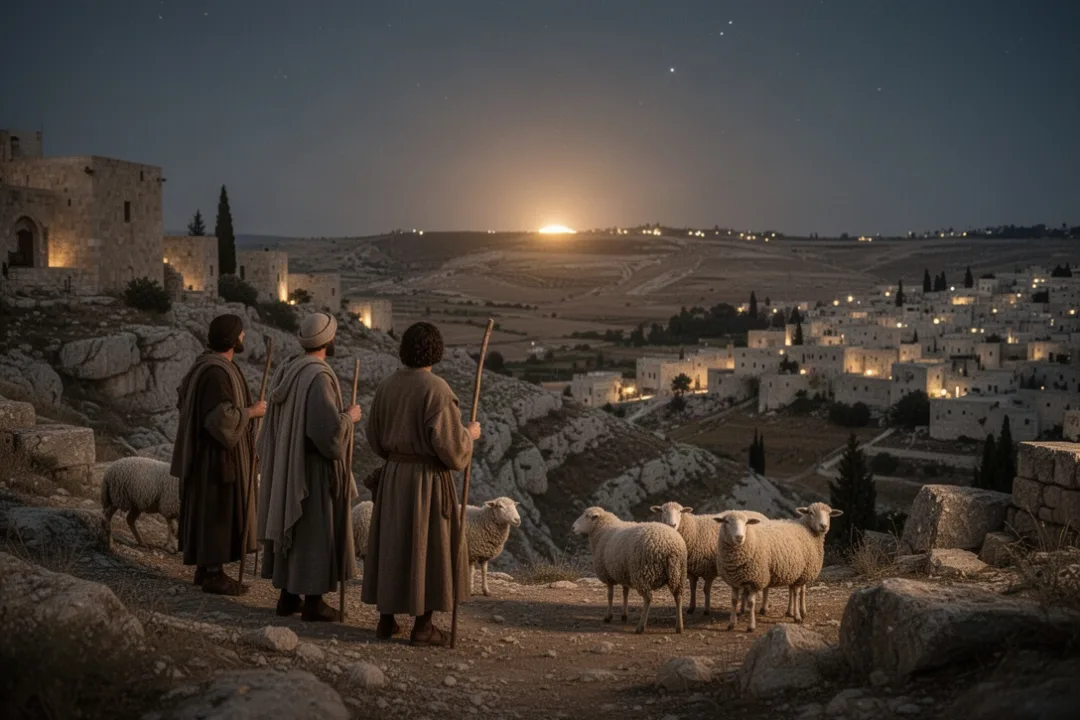
The setting also helps explain why shepherds are the first visitors named in the birth account. They are outside at night caring for their flocks when an angel appears. The announcement describes Jesus as Savior, Messiah, and Lord, titles that carry religious and royal significance. Yet the sign given to the shepherds is not a palace or military display. They will find a baby lying in a manger.
Why the shepherds matter in Luke’s account
The shepherds react first with fear, but the angel tells them not to be afraid and announces good news of great joy for all the people. A multitude of heavenly beings then praises God and declares peace connected with his favor. Luke presents heaven as celebrating what appears on earth to be a quiet and vulnerable birth.
After the angels leave, the shepherds go quickly to Bethlehem. They find Mary, Joseph, and the child exactly as described, then tell others what they have heard. Their testimony amazes those who listen, while Mary keeps these things and reflects on them.
The shepherds’ place in the story fits Luke’s broader pattern. They are working people with limited social prestige, yet they become the first public witnesses to Jesus’ birth. Luke repeatedly shows God giving important roles to people whom powerful institutions might overlook.
The angels receive the announcement from heaven.
The shepherds hear and investigate it.
The shepherds report what they witnessed.
Mary reflects on the events rather than treating them casually.
Those who hear the shepherds are surprised and affected by their message.
What Jesus’ presentation at the temple reveals
After Jesus is born, Mary and Joseph follow the requirements associated with the purification of the mother and the presentation of the firstborn. Luke places this event in Jerusalem at the temple, which becomes a major location throughout his Gospel and the book of Acts.
At the temple, Luke introduces Simeon, a righteous and devout man waiting for Israel’s consolation. The Holy Spirit has revealed that he will see the Lord’s Messiah before dying. When Simeon sees Jesus, he takes the child in his arms and praises God because he has seen the promised salvation.
Simeon’s prophecy expands the scope of Jesus’ mission. Jesus is not only glory for Israel; he is also a light for the nations. Luke will continue developing this universal mission, showing the good news moving from Jerusalem outward to the wider world.
Simeon also warns Mary that her son will become a point of division and that sorrow will touch her deeply. This detail prevents the birth narrative from becoming a story of uncomplicated celebration. Jesus’ mission will reveal people’s inner responses, and his path will eventually involve rejection and suffering.
Luke also names Anna, an elderly prophet who spends her time worshiping, fasting, and praying at the temple. She gives thanks and speaks about the child to people waiting for Jerusalem’s redemption. Like Elizabeth, Anna demonstrates that women are important witnesses in Luke’s opening account.
What the childhood scene in the temple means
Luke’s final scene in chapter 2 takes place when Jesus is twelve years old. Mary and Joseph travel to Jerusalem for the Passover festival, and on the return journey they discover that Jesus is not with their group. After searching, they find him in the temple among teachers, listening and asking questions.
Those who hear Jesus are amazed at his understanding and answers. Mary expresses the distress caused by his disappearance, and Jesus responds by asking whether they understood that he had to be in his Father’s house or involved in his Father’s concerns. The exact wording varies among Bible translations, but the meaning centers on Jesus’ unique relationship with God.
His parents do not fully understand his response. Even so, Jesus returns with them to Nazareth and remains obedient to them. Luke holds two truths together: Jesus possesses a distinctive divine calling, and he grows within an ordinary family structure.
The chapter ends by saying that Jesus grows in wisdom, physical development, and favor with God and people. This closing description matters because Luke does not portray Jesus as pretending to be human while bypassing ordinary development. He grows, learns, and lives within a community while remaining the person whose mission began before his birth.
Major themes in Luke 1 and 2
God keeps promises across generations
Luke connects the births of John and Jesus with promises made long before their arrival. Zechariah refers to Abraham and David, Mary recalls God’s mercy to Israel, and Simeon waits for the comfort of God’s people. The chapters teach that waiting does not mean God has forgotten.
The timing is often surprising. Elizabeth has waited into old age, Mary receives an unexpected calling, and Simeon has spent years looking toward a promise. Luke presents fulfillment as both reliable and different from what people might have planned.
The Holy Spirit guides recognition and prophecy
The Holy Spirit appears repeatedly in these chapters. John is connected with the Spirit before birth, Elizabeth speaks under the Spirit’s influence, Zechariah prophesies after being filled with the Spirit, and Simeon is guided to the temple at the right time.
This pattern shows that recognizing Jesus requires more than observing outward events. The shepherds see a baby, but the angels interpret the child’s significance. Simeon sees an infant, but the Spirit enables him to recognize God’s salvation.
God notices humble and overlooked people
Luke gives sustained attention to people whose social power is limited: women, the elderly, shepherds, the childless, and a family without access to comfortable lodging. Their importance does not come from wealth or public influence. It comes from God’s attention and their willingness to respond.
This emphasis does not suggest that every wealthy person is rejected or every poor person is automatically faithful. It challenges the assumption that social prominence proves spiritual importance. In Luke 1 and 2, humility and dependence on God are more significant than status.
Joy and suffering appear together
The chapters are full of joy: John’s birth brings gladness, Mary praises God, the angels announce good news, and the shepherds return glorifying God. Yet Luke also includes fear, uncertainty, danger, social vulnerability, and Simeon’s warning about future sorrow.
This combination gives the narrative emotional honesty. God’s salvation brings joy, but the arrival of Jesus does not remove every hardship immediately. The chapters invite readers to understand joy as confidence in God’s work rather than denial of pain.
How Luke 1 and 2 differ from Matthew’s birth account
Luke and Matthew both describe Jesus’ birth, but they emphasize different people and events. Matthew focuses more on Joseph, the visit of the Magi, Herod’s threat, and the family’s flight to Egypt. Luke focuses more on Mary, the annunciations, shepherds, the temple, Simeon, Anna, and Jesus’ childhood visit to Jerusalem.
These accounts should not be blended carelessly into one scene. Luke does not mention the Magi, and Matthew does not include the shepherds or the temple prophecies found in Luke. Each writer shapes the material to emphasize particular truths about Jesus.
Luke’s distinctive emphasis is especially clear in the prominence of women and in the repeated movement toward the temple. His opening chapters prepare readers for a Gospel in which salvation reaches the poor, outsiders, women, Gentiles, and people seeking mercy.
Questions to ask when studying these chapters
A personal or group study of Luke 1 and 2 becomes more useful when it moves beyond asking what happened. The chapters are designed to make readers consider God’s character, human response, and the identity of Jesus.
What does each person believe about God’s ability to keep a promise?
How do Mary, Zechariah, Elizabeth, the shepherds, Simeon, and Anna respond differently?
Which people receive important knowledge, and why might Luke have highlighted them?
How do the temple scenes connect Jesus with Israel’s worship and hope?
What does the contrast between royal titles and humble circumstances reveal?
Where do you see waiting, fear, praise, obedience, or reflection?
How does Luke present Jesus as connected to Israel and also significant for the nations?
One practical approach is to read each scene twice. During the first reading, follow the events and identify the speakers. During the second, mark repeated words and ideas such as joy, salvation, Spirit, praise, promise, Lord, and peace. Then compare the responses of the characters.
What Luke 1 and 2 mean for Christian faith
For Christians, these chapters establish that Jesus’ identity is central from the beginning. He is not merely a wise teacher who later becomes important. Before his birth, he is described as Savior, Messiah, Lord, Son of the Most High, and the one who brings light to the nations.
The chapters also present salvation as God’s initiative. Mary does not arrange the announcement, the shepherds do not create the message, and Simeon does not force the promise to happen. People respond to what God has begun. Their responses still matter, but they are responses to grace rather than attempts to earn it.
Luke 1 and 2 also give a model for faithful attention. Mary listens and reflects. The shepherds act on what they hear. Simeon waits with hope. Anna continues worshiping and speaking about redemption. Their examples suggest that faith may involve trusting, moving, waiting, praising, and bearing witness in different seasons.
The chapters finally direct attention beyond the birth itself. Jesus grows in Nazareth, enters the temple, and begins the path that will lead to his public ministry. The manger is not the endpoint of Luke’s story. It is the first visible sign of a mission that will bring forgiveness, restoration, and God’s salvation to the world.
Frequently asked questions
Who wrote Luke chapters 1 and 2?
The Gospel is traditionally attributed to Luke, a companion of Paul and a careful investigator of the events he records. The opening says the account was assembled from reports handed down by eyewitnesses and earlier ministers of the message. Luke addresses a person named Theophilus and explains that his purpose is to provide an orderly and reliable account.
Why are Zechariah and Mary compared in Luke 1?
Both receive announcements from Gabriel about miraculous births, but their reactions are presented differently. Zechariah asks for assurance because the promise seems impossible given his and Elizabeth’s age. Mary asks how her announcement will happen, then accepts God’s will. The contrast highlights different responses to divine promises.
What is the significance of the shepherds visiting Jesus?
The shepherds are the first named visitors in Luke’s birth narrative, and their social position makes their inclusion meaningful. They are working outdoors at night, yet angels give them the announcement and they become witnesses who tell others. Their visit reinforces Luke’s emphasis on God revealing salvation to humble and unexpected people.
What does Simeon mean by Jesus being a light to the nations?
Simeon recognizes that Jesus’ mission extends beyond Israel. Jesus is presented as the fulfillment of God’s promises to Israel while also bringing revelation and salvation to Gentiles. This statement anticipates Luke’s wider Gospel narrative, in which the message about Jesus eventually reaches people throughout the nations.
















Leave a Reply