Elizabeth in the Bible: Her story and significance
Elizabeth in the Bible: Her story and significance
Have you ever wondered who Elizabeth was when Mary visited her during pregnancy? Elizabeth is the mother of John the Baptist, the prophet who prepared people for Jesus’ ministry. Her story appears mainly in Luke 1, where an older woman who had long been unable to have children receives an unexpected answer to prayer.
Elizabeth’s account is brief, but it carries several important themes: faithfulness during disappointment, God’s ability to fulfill promises, the joy of recognizing his work, and the meaningful relationship between Elizabeth, Mary, and their unborn sons. She is also one of the first people in Luke’s Gospel to respond to Jesus with spiritual insight.
Elizabeth was the wife of Zechariah, a Jewish priest who served in the temple. Luke describes both of them as descendants of Aaron, the first high priest of Israel. They belonged to a priestly family, and their lives were shaped by worship, religious service, and obedience to God.
Luke presents Elizabeth and Zechariah as people who sincerely followed God. He says they were righteous before God and careful to live according to the Lord’s commands and requirements. This description does not mean they were sinless. It shows that their faith was genuine and that their childlessness should not be interpreted as proof of personal wrongdoing.
Elizabeth had been unable to have children, and she and Zechariah were both advanced in age. In the culture of their time, childlessness could bring deep sorrow, social pressure, and unjust assumptions. Children were often viewed as a family blessing, so Elizabeth’s situation would have been a painful and visible source of grief.
Luke does not tell readers how long Elizabeth had waited or whether she had prayed for a child throughout her life. He does show that the situation appeared humanly impossible by the time the angel Gabriel announced that she would conceive. Her age and infertility create the setting for a miracle, much as Sarah’s old age did in the story of Isaac.
Elizabeth’s name is related to a Hebrew name often understood as meaning “my God is an oath” or “my God is promise.” The Bible does not pause to explain the meaning of her name, but the idea of promise fits her story. Her pregnancy becomes part of God’s larger promise to send a forerunner before the Messiah.
A helpful distinction: Elizabeth, the mother of John the Baptist, should not be confused with Elisheba, the wife of Aaron mentioned in Exodus. The names are related, but the Bible presents these as different women who lived in different periods.
What happened to Elizabeth and Zechariah
Zechariah was serving in the temple when Gabriel appeared to him. The angel announced that Elizabeth would have a son and that the child would be named John. Gabriel also explained that John would have a special calling: he would help turn people back to God and prepare them for the Lord’s coming.
The announcement connected Elizabeth’s future child with the promises found in Israel’s Scriptures. John would be marked by the Spirit of God from before birth and would minister with the kind of prophetic strength associated with Elijah. His work would involve calling people to repentance and preparing them to receive the Messiah.
Zechariah struggled to believe the message because he and Elizabeth were old. As a sign, Gabriel told him that he would be unable to speak until the promise was fulfilled. The loss of speech was temporary, but it affected the rest of the temple service and the couple’s private life during Elizabeth’s pregnancy.
After Zechariah returned home, Elizabeth conceived. Luke says that she remained secluded for five months. The passage does not give a definite reason for her withdrawal. She may have wanted quiet privacy after years of disappointment, or she may simply have been living apart for a period connected with her pregnancy. The text emphasizes her response rather than explaining every practical detail.
Elizabeth recognized the change in her life as an act of God’s mercy. She understood that the Lord had taken away the disgrace she had experienced among her people. Her words reveal both personal relief and a renewed sense of dignity. She was not merely carrying a promised child; she was seeing God answer a long-standing sorrow.
John’s birth was significant because he would serve as the immediate forerunner of Jesus. His mission was not to draw attention to himself as the final answer, but to direct people toward the One who was coming after him. Elizabeth’s pregnancy therefore belongs to the opening movement of the Gospel story.
Luke places Elizabeth’s pregnancy alongside Mary’s announcement to show that God was beginning two connected works. Elizabeth would give birth to the prophet who prepared the way. Mary would give birth to Jesus, the promised Savior. The two pregnancies were miraculous in different ways, and their children would have different identities and missions.
John was conceived by Elizabeth and Zechariah within their marriage, even though the pregnancy was impossible because of their age and long infertility. Jesus’ conception was different: Mary conceived while still a virgin through the work of the Holy Spirit. Keeping that distinction clear helps readers understand both miracles as Luke presents them.
Elizabeth’s meeting with Mary
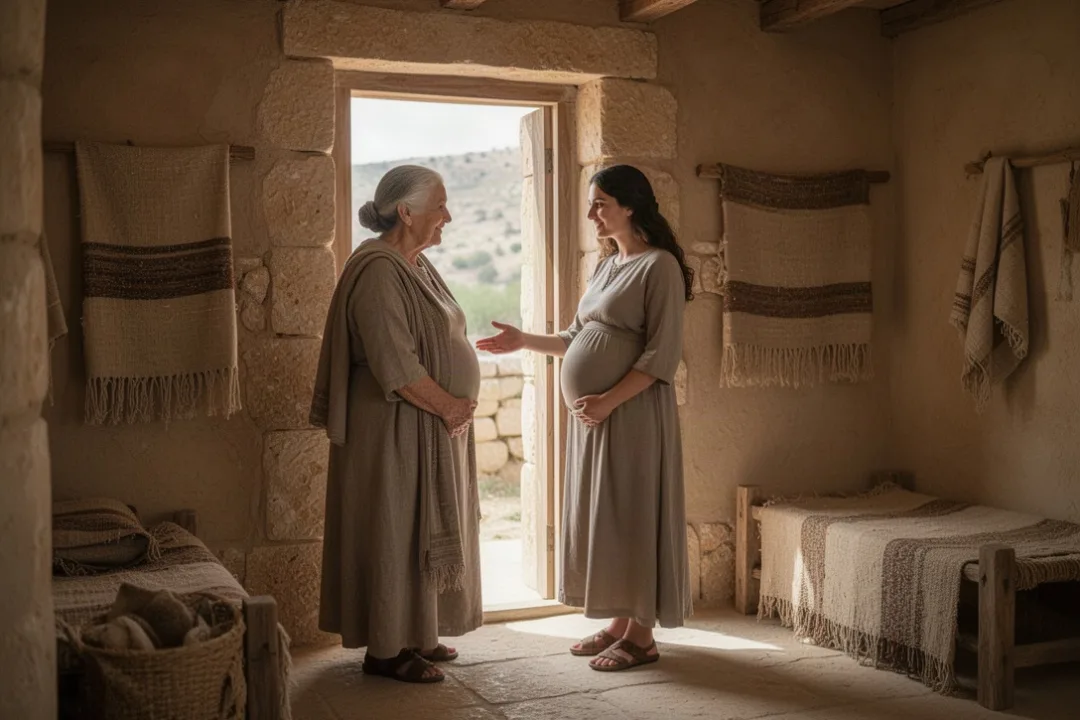
After Gabriel spoke to Mary, Mary traveled to visit Elizabeth in the hill country of Judea. Luke does not give the exact location. The journey likely required effort and planning, and Mary entered Elizabeth’s home with news that would have been difficult to explain to anyone who did not share her faith.
When Mary greeted Elizabeth, the unborn John moved within Elizabeth’s womb. Luke describes this movement as a response to Mary’s arrival and connects it with Elizabeth being filled with the Holy Spirit. Elizabeth then spoke with insight about Mary, her child, and the faithfulness of God.
Elizabeth called Mary blessed among women and blessed the child Mary was carrying. She also expressed amazement that the mother of her Lord had come to visit her. These words are important because Elizabeth recognized Jesus’ significance before his birth. Her understanding was not based on public evidence or Jesus’ later miracles; it came through God’s revealed work.
Elizabeth also praised Mary’s faith. She recognized that Mary had trusted the Lord’s message and would see it fulfilled. Mary was not honored because she had achieved status or power. She was honored because she believed God’s promise and accepted the costly calling placed before her.
The encounter is a meeting between two women facing extraordinary circumstances. Elizabeth had endured years of childlessness and had conceived in old age. Mary was a young woman whose pregnancy could expose her to shame and misunderstanding. Their conversation gives them mutual support rather than rivalry.
John’s movement in the womb also shows the different relationship between the two children. John would later point people toward Jesus, and even before birth he responds to the arrival of the Messiah. Luke uses the scene to show that Jesus is the greater one, while John’s role is honored precisely because it is directed toward Jesus.
Elizabeth’s response shows that genuine faith can recognize God’s work before the surrounding world understands it.
What Elizabeth says to Mary
Elizabeth’s speech includes several ideas that make the meeting spiritually important:
She blesses Mary among the women, recognizing the unusual grace given to her.
She blesses Mary’s child, identifying him as her Lord.
She recognizes the baby’s movement as meaningful rather than ordinary.
She praises Mary’s faith in believing God’s promise.
She receives Mary with joy, not suspicion or resentment.
Luke does not record Elizabeth asking Mary to prove her story. Instead, Elizabeth responds with welcome and spiritual understanding. That does not mean she knew every detail of what would happen. It means she recognized enough of God’s purpose to encourage Mary at a vulnerable moment.
Elizabeth’s character and faith
Elizabeth is described as righteous, but the most memorable evidence of her character appears in the way she responds to God’s work. She does not treat her late pregnancy as a reason for pride. She gives credit to the Lord and speaks of his kindness toward her.
Her story also shows that faithfulness does not prevent hardship. Elizabeth and Zechariah were devoted to God, yet they experienced years of unanswered longing. The Bible does not explain why their child came late. It simply shows that their faithful lives included pain that they could not solve for themselves.
Elizabeth’s experience challenges the assumption that difficult circumstances always reveal a person’s spiritual failure. Luke specifically describes the couple as faithful before telling readers about their infertility. Personal suffering is not automatically evidence of divine disapproval.
She also demonstrates humility. Elizabeth could have focused entirely on her own miracle, especially after years of shame. Instead, when Mary arrived, Elizabeth celebrated what God was doing through someone else. She welcomed Mary’s calling and honored Mary’s child.
Her faith is active rather than abstract. Elizabeth interprets events, speaks encouragement, and participates in the joy of God’s unfolding plan. She does not merely receive a blessing privately. Her words strengthen Mary and help confirm the significance of the child Mary carries.
Elizabeth’s account may also speak to people whose prayers have not been answered in the way they hoped. The text does not promise that every delayed hope will eventually be granted. Her story is specific and connected to God’s redemptive plan. Still, it shows that waiting does not make a person forgotten, worthless, or excluded from meaningful service.
John the Baptist’s birth and naming
Elizabeth gave birth to a son, and neighbors and relatives shared her joy. Because childbirth was a family and community event, those around her recognized the significance of the long-awaited birth. They expected the child to be named after Zechariah, following a familiar family pattern.
Elizabeth corrected them and said the child would be called John. Her relatives objected because that name was not the expected family name. They then turned to Zechariah, who still could not speak, and asked him to communicate his decision.
Zechariah wrote that the child’s name was John. At that moment, his speech returned, and he praised God. The naming confirmed that the child belonged to God’s purpose rather than simply continuing a family tradition. John’s identity was tied to his calling from the beginning.
Zechariah then spoke a prophecy about God’s salvation and his son’s role in preparing the way. The prophecy celebrates God’s faithfulness to Israel and describes John as a prophet who would give people knowledge of salvation through forgiveness. John would prepare people to recognize the mercy of God shown through the coming Messiah.
News of these events spread through the surrounding region. People wondered what the child would become because God’s power was clearly associated with his birth and naming. Luke later says that John grew physically and spiritually and lived in the wilderness before beginning his public ministry.
Elizabeth is not mentioned much after John’s birth. The Gospel does not describe her later years, her death, or her relationship with John during his ministry. Later religious traditions sometimes offer additional details, but those claims should not be presented as biblical facts.
What Elizabeth’s story means for readers today
Elizabeth’s life offers a careful picture of hope. Hope in the Bible is not simply positive thinking or certainty that life will follow your preferred timeline. Elizabeth had lived for years with disappointment, and her story shows that God’s purposes can unfold after a long period of silence.
At the same time, her experience should not be used to pressure people who are dealing with infertility. Elizabeth’s pregnancy was a unique part of the story leading to John and Jesus. The Bible does not teach that infertility always ends in pregnancy, nor does it make childbirth the measure of a woman’s worth.
Her response to Mary provides a model for encouraging another person’s faith. Elizabeth listened, recognized God’s work, and spoke words that strengthened Mary. She did not compete for attention or compare the two women’s callings. Her joy became a source of support.
Elizabeth also shows how private faithfulness can matter within a much larger story. She was not a public preacher like John or a central apostle. Yet her obedience, hospitality, and Spirit-filled words appear at a crucial moment in Luke’s Gospel. Her role was significant even though the record about her is short.
Readers can also see the value of waiting without romanticizing it. Elizabeth’s long delay caused real pain. The passage does not tell her to pretend the pain was pleasant. When God answered, she named the relief and mercy she had received. Honest faith can acknowledge both sorrow and gratitude.
For personal reflection: Read Luke 1:5-25 and Luke 1:39-45 slowly. Ask what Elizabeth says about God, how she treats Mary, and how the passage distinguishes between a person’s worth and the circumstances they are waiting through.
Practical lessons from Elizabeth’s example
Remain faithful without pretending disappointment is easy. Elizabeth’s righteousness existed alongside years of grief.
Give God credit for what he does. She understood her pregnancy as mercy rather than personal achievement.
Celebrate another person’s calling. Elizabeth welcomed Mary and honored the child Mary carried.
Use your words to strengthen people. Her speech gave Mary confirmation and encouragement.
Do not confuse a short biblical account with an unimportant life. Elizabeth’s few recorded actions have lasting significance.
Elizabeth’s story also helps explain how Luke presents women as important witnesses in the opening chapters of his Gospel. Elizabeth receives divine insight, speaks prophetically, and identifies Jesus’ significance before his birth. Her testimony is not treated as incidental family conversation; it is part of the Gospel’s announcement.
She stands at the meeting point of the Old Testament promises and the arrival of the New Testament Messiah. Her family connects with Israel’s priestly heritage, while her son belongs to the prophetic preparation for Jesus. Through Elizabeth, Luke shows that God’s work is both new and deeply connected to his earlier promises.
The Bible’s account of Elizabeth ends with John’s birth and the beginning of his preparation for ministry. It leaves many ordinary details unknown, but the central message is clear: God saw Elizabeth, kept his purpose, and used her life in the story of salvation. Her faith was expressed through endurance, discernment, humility, and joyful encouragement.
Frequently asked questions
Was Elizabeth related to Mary?
Yes. Luke says Elizabeth was Mary’s relative, but he does not specify the exact family connection. Some Bible translations use “cousin,” while others use a broader term such as “relative.” The biblical text does not provide enough information to identify whether they were cousins, aunt and niece, or related through a more distant family line.
How old was Elizabeth when she became pregnant?
The Bible does not give Elizabeth’s exact age. Luke says that she and Zechariah were advanced in years and that she had previously been unable to have children. Her pregnancy is presented as miraculous because of her age and long infertility, not because the text records a specific number.
Was Elizabeth the mother of Jesus?
No. Elizabeth was the mother of John the Baptist. Mary was the mother of Jesus. Their sons were related through the women’s family connection, and Elizabeth recognized Mary’s unborn child as her Lord when Mary visited her during their pregnancies.
What is Elizabeth best known for?
Elizabeth is best known for becoming the mother of John the Baptist in old age and for recognizing the importance of Jesus before his birth. During Mary’s visit, she praised Mary’s faith, welcomed her with joy, and spoke through the Holy Spirit about the child Mary was carrying.















Leave a Reply