If you are looking for Elizabeth Seton because you encountered her name at a Catholic school, parish, or shrine, the short answer is this: she was a New York-born wife, mother, convert, educator, and religious founder who helped establish the American Catholic school tradition.
Born in 1774 as Elizabeth Ann Bayley, she lived through personal loss, financial uncertainty, religious searching, and the demanding work of raising five children. After becoming Catholic, she founded a community of women religious and helped create one of the first American free Catholic schools for girls.
Seton was canonized by Pope Paul VI on September 14, 1975. She became the first native-born citizen of the United States to be declared a saint. Her life remains especially meaningful to people who are balancing family responsibilities, grief, education, service, and questions about faith.
Who Elizabeth Seton was before she became Catholic
Elizabeth Ann Bayley was born on August 28, 1774, in New York City, shortly before the American colonies became independent. Her father, Richard Bayley, was a respected physician, while her mother, Catherine Charlton Bayley, came from an established New York family. Elizabeth was raised in the Episcopal tradition and grew up in a household shaped by medicine, learning, and Christian practice.
Her childhood was marked by loss. Elizabeth’s mother died when she was still young, and her father later remarried. These changes affected her deeply, but they also helped form the steady concern for vulnerable people that appeared throughout her adult life. She developed habits of prayer, reading, and personal reflection rather than treating religion as only a public custom.
In 1794, Elizabeth married William Magee Seton, a member of a prominent merchant family. The couple lived in New York and eventually had five children. William’s business interests included international trade, and the family initially enjoyed a comfortable life. Elizabeth managed a busy household while remaining attentive to charitable work and the needs of people around her.
Her marriage also brought her into close contact with serious illness. William developed tuberculosis, then often called consumption. Hoping that a warmer climate might help him, the couple traveled to Italy in 1803 with their eldest daughter, Anna Maria. William died there in December of that year, leaving Elizabeth a young widow with several children to support.
The journey to Italy became a turning point for reasons beyond grief. While waiting in quarantine near Livorno, Elizabeth and Anna Maria were welcomed by members of the Filicchi family, Italian Catholics who had done business with William. Their hospitality gave Elizabeth time to observe Catholic devotion, especially reverence for the real presence of Christ in the Eucharist.
Elizabeth returned to the United States carrying grief, financial concerns, and a growing attraction to Catholic belief. Her decision was not simply the result of one conversation or one emotional moment. She studied, prayed, and considered the religious questions carefully, even as she faced pressure from relatives and uncertainty about how conversion would affect her children and livelihood.
Why Elizabeth Seton converted to Catholicism
Elizabeth was received into the Catholic Church on March 14, 1805. Her conversion placed her within a religious tradition that was still a small minority in the United States. For a widowed mother dependent on family relationships and practical support, becoming Catholic could bring social and financial complications.
Her attraction to Catholicism centered on several connected convictions. The Eucharist was central, because she came to believe that Christ was truly present in the sacrament rather than present only as a symbol. She was also drawn to the Church’s sacramental life, its continuity with historic Christianity, and its practice of prayer through the saints.
Elizabeth did not abandon her responsibilities when she converted. She continued caring for her children, seeking stable work, and responding to the needs of people around her. Her faith became a way of organizing ordinary duties rather than an escape from them. This combination of devotion and practical responsibility remains one of the clearest features of her example.
A useful way to understand her conversion: Elizabeth Seton’s religious change grew through grief, hospitality, study, prayer, and repeated reflection. It was a gradual decision made within the pressures of family life, not a detached intellectual exercise.
After returning from Italy, Elizabeth faced opposition and financial hardship. Some relatives were concerned about her conversion, and she needed a dependable way to support her children. She began considering education as both a vocation and a means of earning a living. Her experience as a mother gave her a practical understanding of children’s needs, while her own education prepared her to teach.
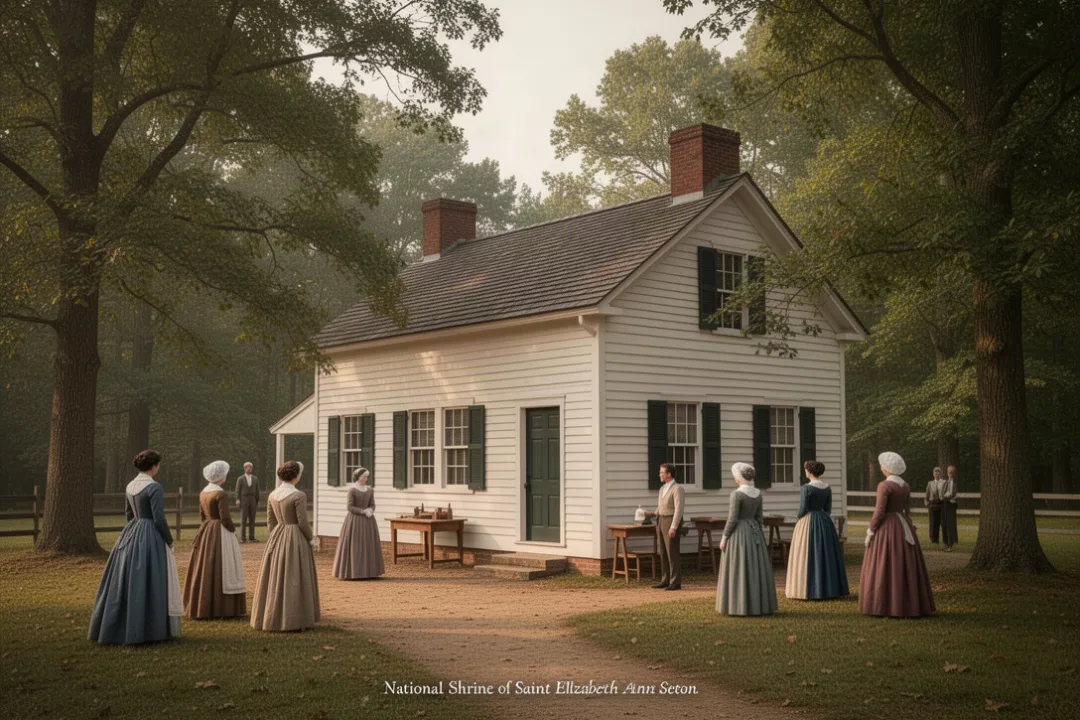
In 1808, Elizabeth moved to Baltimore, Maryland, where she joined a Catholic educational effort supported by Sulpician priests. The next year, she settled in Emmitsburg, Maryland, and began the work that would define her public legacy. Her school welcomed girls, including children whose families could not afford a conventional education.
How Elizabeth Seton founded American Catholic schools
Seton’s educational work in Emmitsburg was not limited to classroom instruction. She helped build a community that combined faith formation, academic learning, discipline, and care for children. The school became associated with St. Joseph’s Free School, often regarded as the first free Catholic school for girls in the United States.
The phrase “free school” mattered because education was not equally accessible. Many children, especially girls and children from families with limited income, had few opportunities for structured schooling. Seton’s school offered instruction in a setting where religious formation and ordinary subjects belonged together.
Students learned skills appropriate to the period, including reading, writing, arithmetic, and domestic subjects. The specific curriculum changed as the school developed, but the larger purpose remained consistent: children should be prepared for responsible lives through intellectual, moral, and religious education.
Seton’s approach was shaped by her own experience. She understood that a school had to be organized around real people, not just ideals. Children arrived with different abilities, family circumstances, and emotional needs. Teachers needed patience, clear expectations, and a willingness to serve beyond the formal lesson.
Her educational vision included several practical principles:
Education should be accessible to children who might otherwise be excluded.
Teachers should form the whole person, including judgment, character, and responsibility.
Religious instruction should connect with daily conduct, not remain separate from ordinary choices.
Schools should serve families by supporting children’s long-term development.
Charity should be organized and dependable, rather than based only on occasional personal generosity.
Seton’s school also helped establish a model that spread through the work of women religious. Catholic schools later became a major part of American religious and educational life, particularly in communities where immigrant families wanted their children to receive both academic instruction and Catholic formation.
Her role should not be exaggerated into the claim that she single-handedly created the entire American Catholic school system. Many priests, religious communities, teachers, parents, and lay supporters contributed to that development. Still, Seton was a foundational figure whose school and community demonstrated how Catholic education could serve children on a broad scale.
What religious community Elizabeth Seton established
In Emmitsburg, Elizabeth and the women who gathered around her formed a new religious community. The group became the Sisters of Charity of St. Joseph’s, founded in 1809. It was the first religious community for women founded in the United States, and its members combined education with direct service to people in need.
The community’s life required more than personal piety. Members taught children, cared for the sick, supported the poor, managed household responsibilities, and developed a shared rule of life. They had to create structures for prayer, work, training, leadership, and financial sustainability while serving a young nation with limited Catholic institutions.
Seton served as the community’s first superior and guided its development through letters, instruction, prayer, and daily example. She wrote reflections and correspondence that revealed both her spiritual confidence and her awareness of weakness. Her life was not free from frustration, disagreements, illness, or fatigue.
The community was influenced by the French Daughters of Charity, whose tradition combined religious life with active service. The American sisters did not simply copy a European institution in identical form. They adapted their work to local conditions, including the needs of American schools, parishes, hospitals, and growing Catholic communities.
Over time, communities connected to Seton’s foundation expanded their work. Sisters of Charity served as teachers and nurses, operated schools and hospitals, assisted orphaned children, and supported people facing poverty. Several later religious congregations trace their origins or inspiration to the community associated with Seton.
Seton’s leadership also complicates narrow ideas about religious vocation. She was a mother, widow, educator, administrator, writer, and founder. Her ministry developed through responsibilities that were already present in her life. Rather than separating compassion from organization, she treated planning, teaching, housekeeping, correspondence, and prayer as parts of one vocation.
How motherhood shaped Seton’s work
Elizabeth Seton’s five children remained an important part of her story. She knew firsthand the cost of illness, bereavement, limited income, and educational uncertainty. Her concern for children was not abstract; she had spent years making decisions about their health, safety, formation, and future.
Her family life also involved painful choices. Her daughters and sons had different needs, and the demands of community leadership sometimes competed with her responsibilities as a parent. Seton’s writings and surviving accounts show a woman who sought to meet both obligations faithfully, even when no option was easy.
This is one reason many people find her relevant outside formal religious settings. Her example does not depend on having an ideal schedule or unusually simple circumstances. She worked within grief, limited resources, and competing duties. Her contribution came through persistent service carried out under ordinary human constraints.
What Elizabeth Seton believed about service and daily faith
Seton’s spirituality joined prayer with concrete action. She believed that love of God should shape how people treated children, patients, neighbors, students, and fellow members of a community. The work of teaching or caring for someone was not secondary to religious life; it could be a direct expression of it.
Her Catholic practice included the Eucharist, personal prayer, examination of conscience, spiritual reading, and devotion to the Virgin Mary and the saints. She also valued the guidance of priests and the discipline of a shared religious rule. These practices gave structure to her days and helped her respond to hardship without relying solely on mood or personal energy.
Seton’s letters are valuable because they show how spiritual ideals met daily problems. She wrote to family members, friends, priests, and sisters about illness, education, finances, community decisions, and grief. Her words often combined affection with practical judgment.
She also understood that service could become disordered if it lacked humility or discipline. A person might want to help but still need training, supervision, rest, and accountability. Her community’s rules were intended to protect the quality of its ministry and to help members serve consistently.
Several themes stand out in her approach:
Faith should be practiced through ordinary duties, including care for family and neighbors.
Education is a form of service because it strengthens children and communities over time.
Compassion needs structure so that good intentions become dependable help.
Grief can coexist with hope without being dismissed or rushed.
Religious commitment includes perseverance when results are slow or circumstances are difficult.
Seton also wrote prayers and meditations that reflected a strong sense of divine providence. For her, providence did not mean that suffering was insignificant or that every hardship was easy to explain. It meant that a person could continue seeking faithfulness even when the future was unclear.
Her example can be applied in modest ways today. A parent may choose a more patient response during a difficult evening. A teacher may give extra attention to a struggling student. A parish may organize consistent assistance instead of relying on emergency appeals. A person grieving a loss may maintain small habits of prayer and connection rather than expecting immediate emotional recovery.
For practical reflection: Ask where your existing responsibilities already create opportunities to serve. Seton’s model begins with faithful attention to people in front of you, then builds the habits and structures needed to help them well.
Elizabeth Seton died on January 4, 1821, in Emmitsburg, at the age of 46. She had lived only a few years after founding the Sisters of Charity, but the institutions she helped establish continued to develop after her death. Her feast day is observed on January 4.
The Catholic Church declared her venerable, then beatified her in 1963. Pope Paul VI canonized her on September 14, 1975, making her the first person born in what became the United States to be canonized. Her canonization recognized both her personal holiness and the significance of her work in American Catholic history.
Her canonization process included recognition of miracles attributed to her intercession, as required in the Catholic Church’s procedures for canonization. These claims are evaluated through a formal process involving medical and theological review. The spiritual meaning of her canonization, however, extends beyond the individual reports: it presents her life of family care, education, and service as a model of Christian holiness.
The National Shrine of Saint Elizabeth Ann Seton in Emmitsburg preserves the site associated with her life and work. Visitors can learn about her family, conversion, school, religious community, writings, and influence. The shrine is also a place of prayer and pilgrimage.
Her legacy continues through Catholic schools, colleges, hospitals, charitable organizations, and communities of women religious connected with the Sisters of Charity tradition. Her name appears on schools and educational programs throughout the United States because she is closely associated with Catholic education and the vocation of teaching.
Seton’s influence also reaches beyond Catholic institutions. Her life raises broader questions about how communities respond to poverty, how education can serve the public good, and how a person can remain responsible to family while pursuing a demanding vocation. Her story is especially relevant to anyone who has had to rebuild after bereavement or make significant choices without certainty about the outcome.
Remembering Elizabeth Seton does not require treating her life as flawless or simple. She experienced sorrow, disagreement, illness, money problems, and the limitations of her historical setting. Her importance lies partly in the way she worked through those realities while creating durable forms of education and service.
For Catholics, she is a saint and an intercessor whose life points toward the Eucharist, prayer, charity, and trust in God. For educators, she represents the connection between learning and human dignity. For parents and caregivers, she offers an example of love expressed through persistence. For anyone facing a major change, her story shows how a new vocation can emerge from loss without erasing the pain that came before.
Frequently asked questions
What is Elizabeth Seton best known for?
Elizabeth Seton is best known for founding the Sisters of Charity of St. Joseph’s in Emmitsburg, Maryland, and helping establish Catholic education for girls in the United States. She also became the first native-born American to be canonized by the Catholic Church. Her work joined teaching, care for the poor, family responsibilities, and religious community life.
When did Elizabeth Seton become Catholic?
Elizabeth Seton entered the Catholic Church on March 14, 1805, after returning from Italy. Her interest in Catholicism developed through contact with an Italian Catholic family, personal prayer, and reflection on the Eucharist. At the time, conversion affected her family relationships and financial circumstances, so the decision involved serious practical as well as spiritual consequences.
Did Elizabeth Seton have children?
Yes. Elizabeth Seton had five children with her husband, William Magee Seton. She was widowed in 1803 after William died in Italy from tuberculosis. Her experience as a mother strongly influenced her educational work and her concern for children, especially those whose families had limited resources or access to schooling.
Where can people learn more about Elizabeth Seton?
The National Shrine of Saint Elizabeth Ann Seton in Emmitsburg, Maryland, preserves important sites connected with her life and provides historical and religious information. Catholic schools, religious communities, and diocesan archives also hold materials about her. Her letters, spiritual writings, and biographies offer different perspectives on her family life, conversion, and ministry.














Leave a Reply