Female Catholic saints show that holiness can take many forms: prayer, scholarship, service, courage, family life, religious leadership, and faithfulness during suffering.
Some were queens, teachers, mystics, missionaries, doctors, artists, or mothers. Others lived quietly and became known only after their deaths. Their stories span the early Church, the Middle Ages, the modern era, and cultures across the world. Together, they offer more than inspirational biographies: they reveal how Catholic Christians understand a life shaped by love of God and love of neighbor.
What the Catholic Church means by calling a woman a saint
In Catholic teaching, a saint is a person who lived in close friendship with God and now shares eternal life with him. The Church formally recognizes some saints through a process called canonization. Canonization does not make someone a saint; it confirms that the person is worthy of public devotion and may be held up as an example for the whole Church.
The process usually involves a detailed examination of a candidate’s life, writings, reputation for holiness, and reported miracles. A person may first be called a Servant of God, then Venerable, and later Blessed before canonization. The exact process can vary, especially for ancient saints whose historical records are limited.
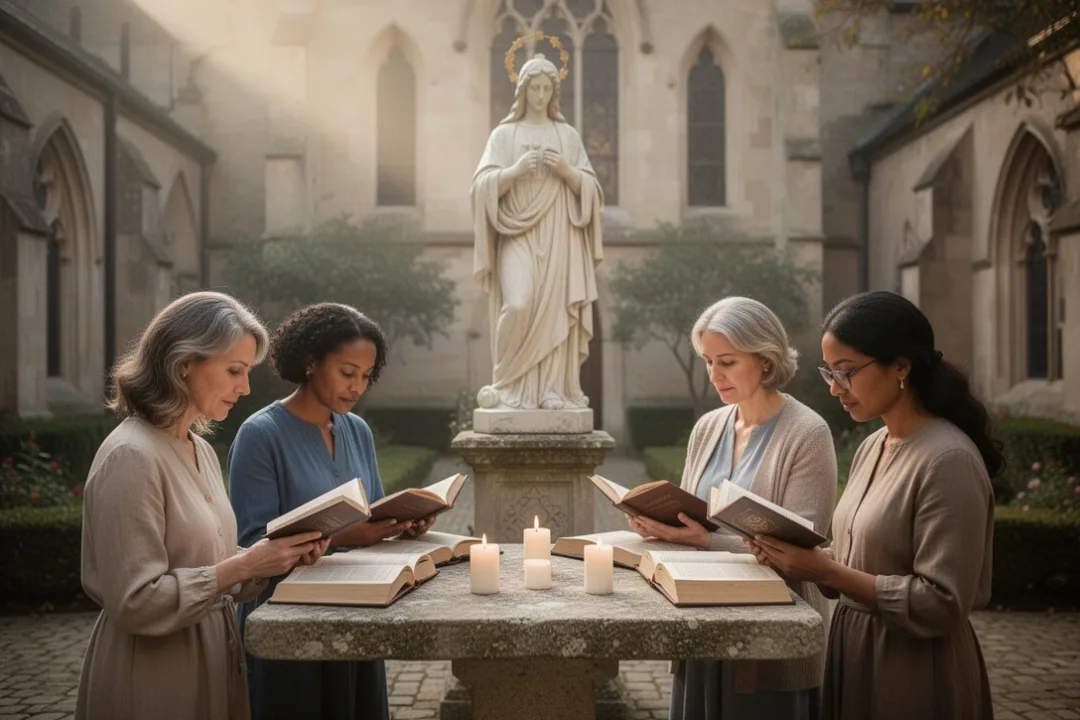
Catholics do not worship saints. Worship belongs to God alone. Instead, Catholics honor the saints, ask for their prayers, and study their choices because the saints point beyond themselves to Jesus Christ. Mary, the mother of Jesus, receives unique honor as the greatest of the saints, although Catholics do not usually describe her as having been canonized through the ordinary process.
A useful distinction: Catholics ask saints to pray for them in much the same way they might ask a trusted Christian friend to pray. The saint is not treated as a replacement for God or as an independent source of divine power.
Why female saints matter in Catholic history
Women have shaped Catholic history in every period, even when their opportunities for formal education, public leadership, or church office were limited. Female saints founded communities, defended the poor, preserved Christian teaching, advised rulers, cared for the sick, and challenged religious complacency.
Their influence was not always public. St. Monica, for example, is remembered for years of persistent prayer for her son Augustine, who later became one of Christianity’s most influential theologians. St. Gianna Beretta Molla was a twentieth-century physician, wife, and mother whose life connected professional service, family responsibility, and sacrificial love.
Other women exercised authority through writing and spiritual insight. St. Teresa of Ávila reformed the Carmelite order and wrote carefully about prayer. St. Catherine of Siena advised popes and political leaders while serving the sick and poor. St. Hildegard of Bingen wrote about theology, music, natural knowledge, and spiritual experience in the twelfth century.
These examples make the history of female saints broader than a single ideal of piety. A saint might be contemplative or active, married or celibate, wealthy or poor, highly educated or largely self-taught. Holiness is not limited to one personality type or social role.
Mary, the apostles, and the earliest female saints
Mary holds a unique place among Catholic saints. Catholics honor her as the mother of Jesus, the woman who accepted God’s call at the Annunciation, and a model of trusting discipleship. The Gospels present her as present at key moments in Jesus’ life, including his death and the beginnings of the apostolic community.
Mary Magdalene is honored as a prominent disciple and a witness to the risen Christ. Catholic tradition often calls her the “apostle to the apostles” because she was sent to announce the Resurrection to Jesus’ disciples. Her story is not best reduced to a former sinner rescued from disgrace; the Gospel accounts present her as a faithful follower who supported Jesus’ ministry and remained near him during his Passion.
The early Church also remembers women who gave their lives during Roman persecution. St. Perpetua and St. Felicity were imprisoned and killed in Carthage in the early third century. Perpetua was a young mother from a privileged family, while Felicity was an enslaved woman who gave birth while imprisoned. Their witness is remembered as an example of courage and solidarity across social divisions.
St. Agnes, another early martyr, became associated with courage, purity, and steadfastness. St. Lucy is honored as a martyr of Syracuse and is especially associated with light, sight, and faithful endurance. Accounts of these ancient saints combine historical memory with traditions that developed over time, so details should be read with care rather than treated as equally certain.
Female saints known for prayer and mystical theology
Several female Catholic saints made lasting contributions to the Church’s understanding of prayer. Their writings often describe prayer as a relationship marked by honesty, love, discipline, and surrender rather than as a technique for obtaining whatever a person wants.
St. Teresa of Ávila, who lived in sixteenth-century Spain, was a Carmelite nun, reformer, and writer. In works such as The Interior Castle, she described the soul’s growth in prayer through images of rooms, movement, struggle, and increasing intimacy with God. Her practical advice remains valuable because she acknowledged distraction, dryness, fatigue, and the need for perseverance.
St. Catherine of Siena lived in fourteenth-century Italy and became a Dominican tertiary. She served the sick, dictated spiritual writings, and corresponded with church and civic leaders. Her Dialogue presents a theological vision centered on God’s mercy, human freedom, repentance, and love expressed through service.
St. Thérèse of Lisieux entered a Carmelite convent as a young woman and developed what she called her “little way.” Her approach emphasized small acts of love, confidence in God’s mercy, and faithfulness in ordinary responsibilities. Her spirituality can be misunderstood as passive or sentimental; in reality, it involved discipline, self-knowledge, and trust during serious spiritual suffering.
St. Hildegard of Bingen combined contemplative prayer with writing, preaching, music, and correspondence. Her works reflect the intellectual world of the twelfth century and include theological visions, liturgical compositions, and observations about the natural world. They should be understood in their medieval context rather than judged as if they were modern scientific texts.
These four women—Teresa of Ávila, Catherine of Siena, Thérèse of Lisieux, and Hildegard of Bingen—are recognized as Doctors of the Church. That title means the Church considers their teaching especially valuable for Christian understanding, not that every statement in their writings functions like a scientific or historical claim.
Female saints who served the poor, sick, and vulnerable
Many women became saints through sustained service to people whom society ignored. Their work included nursing, education, care for abandoned children, advocacy for prisoners, and direct assistance to people living in poverty. They remind readers that Catholic holiness is measured not only by private devotion but also by practical charity.
St. Elizabeth Ann Seton was the first native-born citizen of the United States to be canonized. After becoming Catholic, she founded the Sisters of Charity and helped establish a system of Catholic education for children. Her life included widowhood, conversion, financial hardship, and the demands of raising a family.
St. Vincent de Paul’s companion St. Louise de Marillac helped organize the Daughters of Charity, a community devoted to serving the poor and sick. Her example shows how careful administration, formation, and cooperation can support long-term charitable work. Service did not depend only on spontaneous generosity; it also required training and structure.
St. Katharine Drexel, an American heiress, used her wealth to support Black and Native American communities. She founded the Sisters of the Blessed Sacrament and promoted education and evangelization. Her legacy also invites honest reflection about the complicated history of missionary work, cultural power, and Catholic institutions in the United States.
St. Teresa of Calcutta founded the Missionaries of Charity and served people who were dying, abandoned, or living in extreme poverty. Her public reputation for compassion exists alongside records of profound spiritual dryness in her private life. Her example illustrates that a person may continue serving faithfully even when prayer does not feel consoling.
St. Marianne Cope served people with leprosy in Hawaii after many religious communities had declined the request for volunteers. Her work included nursing, education, and the creation of a more dignified community for patients. The story of her ministry emphasizes presence: care often begins by refusing to treat a suffering person as untouchable.
Female Catholic saints who showed courage under persecution
Martyrdom is one of the oldest forms of Christian witness, and female martyrs appear throughout Catholic history. Their stories often involve pressure from political authorities, threats to family relationships, imprisonment, violence, or demands to renounce their faith.
St. Joan of Arc led French forces during part of the Hundred Years’ War after reporting religious visions. She was captured, tried by an ecclesiastical court, and executed as a heretic in 1431. Her conviction was later overturned, and she was canonized centuries afterward. Her story includes both religious devotion and political conflict, so it should not be reduced to a simple tale of battlefield heroism.
St. Edith Stein, also known by her religious name Teresa Benedicta of the Cross, was a Jewish-born philosopher who became Catholic and later entered the Carmelite order. She and her sister Rosa were killed at Auschwitz during the Holocaust. Her life connects philosophical inquiry, Christian faith, Jewish identity, and the catastrophe of Nazi persecution.
St. Josephine Bakhita was born in Sudan, kidnapped as a child, and sold into slavery before eventually gaining freedom in Italy. She joined the Canossian Daughters of Charity and became known for her forgiveness and gentle service. Her life should never be used to romanticize slavery; her holiness emerged amid grave injustice, not because that injustice was acceptable.
St. Kateri Tekakwitha, a seventeenth-century Mohawk woman, converted to Catholicism and faced opposition from some members of her community. She later joined a Christian settlement near Montreal. Her story deserves respect for both her personal faith and the broader historical realities of colonialism, cultural disruption, and Indigenous identity.
Female saints who lived family and professional vocations
Catholic saints are not limited to members of religious orders. Some lived as wives, mothers, daughters, professionals, or lay leaders. Their lives can be especially meaningful to people who want to connect prayer with work, marriage, parenting, and ordinary responsibilities.
St. Monica remained committed to prayer and family life through years of uncertainty. Her witness is often associated with patient concern for loved ones, but it should not be interpreted as a promise that every prayer will produce the outcome someone desires. Her son Augustine’s conversion came through a long and complicated process.
St. Gianna Beretta Molla practiced medicine, married, and raised children. During her final pregnancy, she faced a serious medical condition and chose treatment that sought to protect her unborn child, accepting the grave risks involved. Her story is frequently discussed in Catholic teaching about the dignity of life, but it should not be turned into a universal medical prescription for every pregnancy.
St. Margaret of Scotland was a queen and mother who supported education, religious renewal, and care for the poor. St. Elizabeth of Hungary was a noblewoman who used her resources to care for people experiencing poverty and illness. Their examples show that social position can become an opportunity for responsibility rather than merely personal privilege.
St. Zélie Martin, the mother of Thérèse of Lisieux, was a lace maker, wife, and mother. She and her husband, Louis Martin, are honored as a married couple. Their canonization offers a reminder that holiness can grow through work, marriage, parenting, grief, and the daily effort to love people close to you.
What female saints teach about strength and weakness
The saints were not flawless personalities. Some struggled with illness, fear, anger, grief, loneliness, or uncertainty. Their holiness does not mean they avoided every mistake; it means they repeatedly turned toward God, accepted correction, practiced charity, and remained faithful amid difficulty.
St. Teresa of Ávila wrote candidly about distraction and spiritual struggle. Thérèse of Lisieux experienced serious illness and a painful period of spiritual darkness. Edith Stein confronted the limits of human understanding in the face of persecution. Such accounts can help readers distinguish genuine faith from the expectation that religious people should always feel calm or confident.
Female saints also demonstrate different forms of strength. Perpetua’s strength appeared in martyrdom. Elizabeth Ann Seton’s appeared in rebuilding life after loss. Josephine Bakhita’s appeared in surviving abuse without allowing hatred to define her. Gianna’s appeared in medical service, family love, and a difficult moral decision.
Read difficult stories carefully: Suffering is not automatically holy, and abuse should never be excused because someone endured it patiently. The saints’ courage can inspire a person to seek justice, protection, medical care, counseling, or help from a trusted community.
Common mistakes when learning about female Catholic saints
Stories of saints have often been simplified in popular retellings. A careful reader can honor a saint while also asking what is historically documented, what comes from later tradition, and how a story has been interpreted over time.
Assuming every detail is equally certain: Ancient accounts may preserve a real memory while including symbolic or legendary elements added by later generations.
Reducing a saint to one trait: Calling Joan of Arc only a warrior, or Thérèse only “sweet,” leaves out their theology, discipline, intelligence, and struggles.
Treating a saint’s private decision as a universal rule: A saint’s vocation or sacrifice may not be the right model for every person facing a similar situation.
Romanticizing suffering: Catholic tradition honors courageous endurance, but it does not require anyone to remain in danger or accept abuse.
Ignoring historical context: Missionary activity, colonialism, slavery, gender restrictions, and political conflict shaped many saints’ lives.
Confusing intercession with magic: Prayer to a saint is a request for help and companionship in faith, not a formula that guarantees a particular result.
How to choose a female patron saint for prayer
You do not need to find a saint whose biography matches your life exactly. A patron saint may be someone whose virtues you want to develop, whose struggles resemble your own, or whose work connects with your responsibilities. You can also choose a saint connected with your name, profession, country, family, or a particular cause.
Spend time with a reliable biography, the saint’s own writings when available, and the prayers or readings used on her feast day. Notice not only what seems attractive but also what challenges you. A saint’s example should encourage growth rather than become a reason to compare yourself harshly with an idealized image.
Identify a concern or vocation: Consider family life, teaching, medicine, justice, prayer, grief, poverty, creativity, or another area that matters to you.
Read two different sources: Compare a short devotional biography with a more historically careful account.
Learn the saint’s actual context: Ask what social pressures, church structures, and cultural circumstances shaped her choices.
Pray simply: Ask the saint to intercede for you and to help you imitate a particular virtue.
Choose one practical action: Turn admiration into service, reconciliation, study, generosity, or a more faithful daily habit.
For example, someone caring for an elderly relative might pray with St. Marianne Cope’s example of compassionate presence. A student interested in philosophy might read Edith Stein. A parent under strain might find encouragement in Zélie Martin or Elizabeth Ann Seton. Someone discerning religious life might study Teresa of Ávila, Clare of Assisi, or another founder whose writings speak to that vocation.
Ways to learn from female saints without idealizing them
Begin with the historical person rather than a polished statue or a short quote on social media. Ask what she actually did, what she wrote, whom she served, and what limitations or controversies surrounded her work. This approach does not weaken devotion; it makes admiration more truthful.
It can also help to study saints in pairs or groups. Compare a contemplative such as Clare of Assisi with an active servant such as Vincent de Paul’s Louise de Marillac. Read a martyr such as Perpetua alongside a married lay saint such as Gianna Beretta Molla. The differences make clear that Catholic holiness is not a single lifestyle.
Finally, allow the saint to direct your attention toward people who need care now. If a saint served the poor, consider a concrete act of generosity. If she defended truth, practice honesty without cruelty. If she prayed for reconciliation, take a measured step toward peace while maintaining appropriate boundaries. The purpose of devotion is not merely to collect names; it is to become more loving and faithful in real life.
Where to begin with female Catholic saints
A manageable starting list might include Mary Magdalene for faithful discipleship, Clare of Assisi for poverty and contemplative life, Teresa of Ávila for prayer, Catherine of Siena for courageous service, Thérèse of Lisieux for small acts of love, Elizabeth Ann Seton for family and education, Josephine Bakhita for dignity after enslavement, and Edith Stein for intellectual honesty and courage.
You might choose one saint for a month rather than trying to learn dozens at once. Read a trustworthy account, mark her feast day, keep a short prayer, and ask how her example could affect one decision or relationship. Over time, the communion of saints becomes less like a list of distant figures and more like a diverse family of witnesses accompanying the Church.
Frequently asked questions
Who is the most important female Catholic saint?
Mary, the mother of Jesus, holds the highest place among Catholic saints because of her role in salvation history and her unique relationship with Christ. Catholics honor her above all other saints, while still distinguishing her veneration from the worship given to God. Other women, including Mary Magdalene, Teresa of Ávila, and Catherine of Siena, have different forms of importance based on their witness and teaching.
Are all female saints Catholic nuns?
No. Many female saints were religious sisters or nuns, but others were married women, mothers, queens, physicians, teachers, widows, converts, and lay leaders. Examples include Gianna Beretta Molla, Zélie Martin, Elizabeth Ann Seton, Margaret of Scotland, and Monica. Their varied lives show that Catholic holiness is possible through family life, professional work, public responsibility, and religious vocation.
Can Catholics pray directly to female saints?
Catholics may address a saint in prayer by asking for her intercession, meaning they ask her to pray to God for them. This differs from worship, which Catholics reserve for God. A person can also pray directly to God while remembering a saint’s example. The purpose of asking a saint’s prayers is communion and companionship in faith, not treating the saint as a divine power.
Which female Catholic saints are associated with healing?
Several saints are connected by tradition with care for the sick or prayers for healing, including St. Agatha, St. Lucy, St. Peregrine’s fellow traditions aside, and St. Marianne Cope. Catholics may ask for a saint’s intercession while also seeking qualified medical treatment. A healing devotion should support responsible care, not replace diagnosis, medication, counseling, or emergency help.












Leave a Reply