Saints from Italy: lives, places, and lasting influence
Saints from Italy: lives, places, and lasting influence
Italy has produced and preserved an extraordinary number of Christian saints, whose lives reflect prayer, scholarship, service, reform, and care for the poor.
The phrase “saints from Italy” can mean several things. It may refer to people born in the territory of modern Italy, saints who lived most of their lives there, or holy figures closely connected with Italian cities, monasteries, and churches. That distinction matters because political borders changed over time, and some famous saints associated with Italy were born elsewhere.
What “saints from Italy” means in historical context
Italy was not a single nation for most of the early Christian and medieval periods. The Roman Empire, independent city-states, kingdoms, the Papal States, and other political territories governed different parts of the peninsula. A person born near Assisi, Siena, Milan, or Naples might be described as Italian today even though the country of Italy did not yet exist.
Christianity also reached the Italian peninsula very early. Rome became a central Christian community, while cities such as Milan, Ravenna, Aquileia, Naples, and Palermo developed their own traditions. Monasteries, convents, hospitals, universities, and parish churches helped shape religious life across the region.
Some saints were born in Italy and spent their lives there. Others arrived from another country but became deeply associated with an Italian city. Saint Anthony of Padua, for example, was born in Lisbon but spent much of his religious life in Italy. He is included in many discussions of Italian saints because Padua became the place most closely linked with his ministry and burial.
A useful distinction: “from Italy” usually describes origin or strong association, while “patron saint of Italy” refers to a particular national title. Saints can be connected with Italy in several different ways.
How to identify the most important saints from Italy
A helpful way to study Italian saints is to begin with their locations, historical periods, and forms of service rather than trying to memorize a long list of names. The following steps organize the subject clearly.
Start with the historical period. Roman-era martyrs, medieval monastics, Renaissance reformers, and modern spiritual figures faced different circumstances.
Locate the saint’s main city or region. Assisi, Siena, Padua, Milan, Rome, and Pietrelcina each provide important context.
Identify the saint’s principal vocation. A saint may have been a monk, nun, bishop, preacher, scholar, mystic, missionary, or charitable worker.
Separate birthplace from lasting association. Birth in Italy, ministry in Italy, and burial in Italy are not always the same thing.
Look for a central spiritual concern. Poverty, peace, education, contemplation, care for the sick, and church reform appear repeatedly in Italian Christian history.
Connect the life with a place or practice. A basilica, monastery, feast day, prayer tradition, or charitable institution can make the saint’s influence easier to understand.
This approach also prevents a common mistake: treating every famous religious figure connected with Italy as though that person had been born there. Historical precision adds meaning rather than taking anything away from a saint’s connection to the country.
Saint Benedict of Nursia and the foundations of Western monasticism
Saint Benedict of Nursia was born in the Italian town of Norcia, probably in the late fifth century. He became one of the most influential figures in Christian monastic history, especially through the Rule of Saint Benedict, a guide for communal religious life that emphasizes prayer, work, moderation, obedience, hospitality, and stability.
Benedict first sought a life of solitude, but his reputation for holiness attracted others. He eventually established communities, most famously at Monte Cassino, south of Rome. The monastery became a major center of religious and intellectual life, although it experienced destruction and rebuilding over the centuries.
The Benedictine pattern joined spiritual discipline with ordinary responsibilities. Members of a community prayed at set times, worked together, welcomed guests, cared for the vulnerable, and pursued learning. The principle often associated with Benedictine life is summarized as “pray and work,” although the Rule presents a much broader and more detailed vision of communal balance.
Benedict’s importance is not limited to monasteries. His approach influenced education, agriculture, manuscript preservation, hospitality, and the development of European institutions. His sister, Saint Scholastica, is also remembered as a major early monastic figure and is traditionally associated with a religious community near Monte Cassino.
Saint Francis of Assisi and a life of simplicity
Saint Francis of Assisi was born in Assisi around the beginning of the thirteenth century. The son of a prosperous cloth merchant, he experienced a profound religious conversion and chose a life marked by poverty, preaching, humility, and service rather than commercial success or social status.
Francis gathered companions who became the foundation of the Order of Friars Minor, commonly known as the Franciscans. His movement emphasized direct imitation of Christ, care for people living in poverty, reconciliation, and a joyful willingness to serve. He also became known for his deep reverence for creation.
Francis’s relationship with nature is often remembered through the Canticle of the Creatures, a prayer-poem that praises God through images of the sun, moon, water, fire, earth, and other elements. The work does not treat nature as divine; instead, it presents creation as part of a relationship of gratitude and responsibility.
Francis also encouraged new forms of devotion. Tradition connects him with the development of the Christmas nativity scene at Greccio, where the birth of Jesus was presented through a living religious display. He traveled to meet Sultan al-Malik al-Kamil during the period of the Crusades, an encounter often remembered as an example of peaceful dialogue across religious boundaries.
Francis died near Assisi in 1226 and was buried in the Basilica of Saint Francis. His legacy extends through religious orders, environmental movements, peacemaking efforts, and the many churches, schools, and charities that bear his name.
Saint Clare of Assisi and the strength of contemplative poverty
Saint Clare of Assisi came from a noble family but rejected the expected path of marriage and wealth. Inspired by Francis, she left home as a young woman and established a community at San Damiano, near Assisi. Her followers eventually became known as the Poor Clares.
Clare defended the community’s commitment to poverty and dependence on God. At a time when religious institutions often held property and received substantial support from patrons, she sought permission for her sisters to live without owning possessions as a community. Her persistence helped secure a form of religious rule that reflected this ideal.
Her letters to Agnes of Prague reveal a spirituality centered on looking toward Christ with love and becoming transformed by that relationship. Clare’s life also included practical leadership. She guided her community through illness, financial pressure, family conflict, and the demands of organizing a stable religious house.
Clare is the patron saint of television and media in Catholic tradition, a title connected with a story that she was able to perceive or spiritually witness a Christmas liturgy while ill and unable to attend. Her principal feast is observed on August 11, and her basilica in Assisi remains an important destination for visitors.
Saint Catherine of Siena and spiritual counsel
Saint Catherine of Siena was born in Siena in 1347. A member of a large family, she pursued a life of prayer from a young age and eventually became a Dominican tertiary. Although she did not live as a cloistered nun, she developed a demanding spiritual practice and attracted disciples known as the “Caterinati.”
Catherine was a mystic, writer, nurse, peacemaker, and adviser. Her major work, the Dialogue, presents theological reflections in the form of a conversation between God and the soul. Her letters address popes, rulers, clergy, religious communities, and ordinary people, often urging courage, reform, mercy, and deeper commitment.
She played a role in encouraging Pope Gregory XI to return the papal court from Avignon to Rome. Her involvement in church and political affairs was unusual for a woman of her time, but her influence rested on a combination of religious authority, personal discipline, and a willingness to speak directly.
Catherine died in Rome in 1380 and was buried in the Dominican church of Santa Maria sopra Minerva. She was declared a Doctor of the Church, a title recognizing the importance of her teaching, and is one of the patron saints of Europe and Italy.
Saint Ambrose of Milan and the tradition of Christian teaching
Saint Ambrose is one of the most important bishops in the history of Milan. He was born in Trier, in the Roman Empire, rather than in the Italian peninsula, but his ministry and legacy are inseparable from Milan. He became bishop in the fourth century after serving as a Roman administrator.
Ambrose was known for preaching, theological writing, pastoral leadership, and his defense of the church’s independence in serious disputes with imperial power. He also helped guide Saint Augustine of Hippo before Augustine’s conversion and baptism in Milan, making Ambrose an important figure in Augustine’s spiritual development.
Ambrose influenced Christian worship through hymns and helped strengthen the liturgical tradition associated with Milan, often called the Ambrosian Rite. His example shows why a simple birthplace-based list cannot capture the full history of saints associated with Italy.
The Basilica of Sant’Ambrogio in Milan remains closely connected with his memory. His feast is celebrated on December 7, the day before the feast of the Immaculate Conception.
Saint Thomas Aquinas and the Italian intellectual tradition
Saint Thomas Aquinas was born in the early thirteenth century at Roccasecca, in the region of present-day Lazio. He joined the Dominican Order despite opposition from members of his family and became one of the most influential theologians and philosophers in Christian history.
Thomas taught at major centers of learning, including Paris and Naples, and wrote extensively on theology, philosophy, ethics, law, scripture, and the sacraments. His best-known work, the Summa Theologiae, organizes complex questions through a method of presenting objections, responses, and reasoned conclusions.
His thought drew on Aristotle while remaining grounded in Christian theology. Thomas argued that faith and reason are not enemies, though they answer some questions in different ways. He also developed influential accounts of virtue, natural law, human purpose, and the relationship between grace and human action.
Thomas is honored as a Doctor of the Church and patron of Catholic schools, colleges, and universities. His life is especially relevant for readers interested in how Italian religious history contributed to education and intellectual inquiry.
Saint Anthony of Padua and the importance of spiritual association
Saint Anthony of Padua was born in Lisbon, Portugal, but Italy became the central setting of his religious life. He first joined the Augustinian Canons and later became a Franciscan. After arriving in Italy, his preaching ability became widely recognized.
Anthony preached against corruption and exploitation and encouraged people to return to Christian practice. He was known for theological learning as well as his ability to communicate with ordinary audiences. His final years were spent near Padua, where he died in 1231.
The Basilica of Saint Anthony in Padua holds his tomb and receives pilgrims from around the world. Anthony is often invoked as the patron of lost items, a devotion that grew from stories about his preaching and concern for people in practical need. His example demonstrates how a saint may become deeply Italian by ministry, burial, and public memory even without being Italian by birth.
Saint Rita of Cascia and hope amid difficult circumstances
Saint Rita of Cascia lived in Umbria during the late medieval period. She married and raised a family before entering the Augustinian monastery at Cascia after becoming a widow. Her life is remembered for enduring family conflict, bereavement, and religious discipline with perseverance.
Rita is widely known as the patron saint of impossible causes. This title reflects devotion that grew around the severe and apparently unresolvable situations associated with her life. She is also associated with marriage difficulties, abuse, widowhood, and the protection of families.
The basilica and monastery at Cascia remain important pilgrimage sites. Devotion to Rita is especially strong among people who feel trapped in circumstances they cannot quickly change. Her story is not a promise that every problem will disappear; it is a reminder that prayer, moral courage, forgiveness, and patient action can coexist with suffering.
Saint Philip Neri and joyful service in Rome
Saint Philip Neri was born in Florence in 1515 and spent most of his ministry in Rome. He became a priest and created a community centered on prayer, confession, spiritual conversation, music, education, and care for the poor. This community eventually developed into the Congregation of the Oratory.
Philip worked with people from different social backgrounds and encouraged frequent confession and personal conversion. He also supported the education of young people, including children who lacked stable opportunities. His spirituality combined serious prayer with a warm, approachable style of pastoral care.
His influence can still be seen in the Oratorian tradition, which developed in different countries while retaining a focus on community life without monastic vows. Philip is particularly relevant to anyone interested in urban ministry, spiritual direction, and the practical needs of people living in a large city.
Saint Padre Pio and modern Italian devotion
Saint Pio of Pietrelcina, commonly called Padre Pio, was born in Pietrelcina in southern Italy in 1887. He became a Capuchin Franciscan friar and priest and spent much of his ministry at San Giovanni Rotondo, where people sought his pastoral counsel, confession, and prayer.
Padre Pio’s life included intense physical suffering and controversial reports of mystical phenomena. These accounts should be approached with care and within the context of Catholic investigation and discernment. His lasting reputation rests not only on extraordinary stories but also on his dedication to prayer, confession, and care for the sick.
He helped establish a major hospital, the Casa Sollievo della Sofferenza, near San Giovanni Rotondo. The institution reflects his conviction that spiritual concern should be accompanied by concrete medical and human care. Padre Pio died in 1968 and was canonized in 2002.
Other notable saints connected with Italy
Italy’s Christian history includes many additional figures whose lives represent different regions, vocations, and periods. A broader list includes:
Saint Mark the Evangelist, traditionally associated with Venice, although the historical details of his life are complex and ancient Christian traditions differ.
Saint Lawrence, a deacon and martyr of Rome whose feast is especially important in the city’s early Christian history.
Saint Agnes of Rome, an early martyr honored for her courage and dedication to Christian faith.
Saint Januarius, the patron saint of Naples and a bishop remembered especially in southern Italian devotion.
Saint Gemma Galgani, a modern Italian mystic associated with Lucca and a life of prayer and suffering.
Saint Maria Goretti, a young martyr from the early twentieth century whose story is connected with forgiveness and mercy.
Saint John Bosco, born near Turin and known for educating and serving poor and disadvantaged boys through the Salesian movement.
Saint Joseph Moscati, a physician from Naples who combined medical practice, scientific learning, and charitable service.
These figures should not be reduced to a single Italian religious character. They include martyrs, physicians, teachers, monks, mystics, parents, bishops, and social reformers. Their differences show how sanctity has been expressed through many forms of ordinary and extraordinary responsibility.
How Italian cities shape the stories of their saints
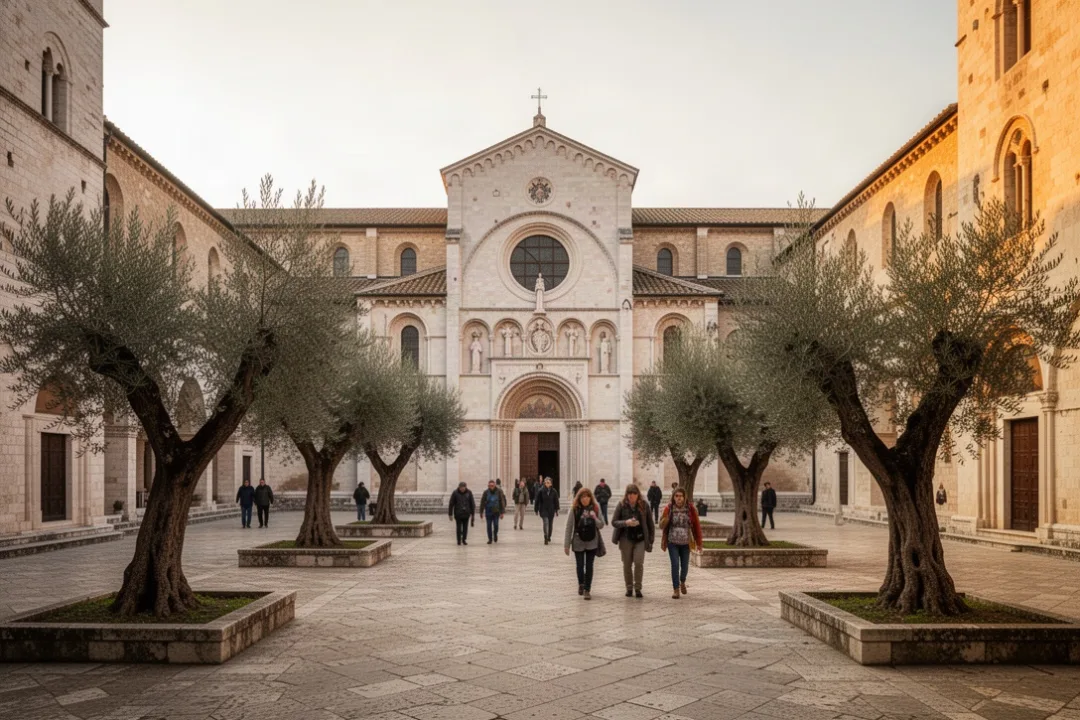
Place is unusually important when studying saints from Italy. Assisi evokes Francis and Clare, Siena evokes Catherine, Padua evokes Anthony, Milan evokes Ambrose, and Rome connects with countless martyrs, bishops, missionaries, and reformers. The surrounding landscape often explains part of a saint’s vocation.
Assisi’s hills and medieval streets help visitors understand Franciscan simplicity and Clare’s close connection with San Damiano. Siena’s civic identity and political pressures provide context for Catherine’s letters and public influence. Padua’s university culture and busy religious life help explain the setting for Anthony’s preaching.
Rome contains layers of Christian history, from catacombs and ancient basilicas to Renaissance churches and modern shrines. Visiting a place connected with a saint can be meaningful, but the buildings should be viewed as part of a larger story involving communities, institutions, conflict, prayer, and service.
For a respectful pilgrimage: learn the site’s history, observe local customs, allow time for silence, and remember that many churches are active places of worship rather than tourist attractions alone.
Common themes in the lives of Italian saints
Although these saints lived centuries apart, several recurring themes appear in their biographies. The first is service that takes a practical form. Benedict organized communities, Francis served the poor, Catherine advised church and civic leaders, Anthony preached, and Moscati treated patients.
A second theme is reform. Many Italian saints challenged comfortable habits within religious or social institutions. They did not all seek change in the same way, but they commonly connected personal holiness with responsibility toward other people.
A third theme is the integration of contemplation and action. Prayer was not presented as an escape from human need. For many of these figures, prayer shaped preaching, medicine, education, hospitality, reconciliation, or care for people facing poverty.
Finally, Italian saints often worked through community. Even highly individual mystics depended on families, religious orders, lay companions, students, patients, parishioners, or supporters. Their influence usually continued because others carried their practices into new places.
Ways to learn about saints from Italy today
You can explore the subject through biographies, church history, art, local museums, pilgrimage, or personal prayer. Choose an approach that matches your interest rather than trying to study every saint at once.
For medieval history: begin with Benedict, Francis, Clare, Catherine, and Thomas Aquinas.
For church architecture: explore the basilicas of Assisi, Padua, Milan, Rome, and Cascia.
For social service: study John Bosco, Joseph Moscati, Padre Pio, and Francis.
For women’s religious history: read about Clare, Catherine, Rita, Scholastica, and Maria Goretti.
For theology and education: compare Ambrose, Benedict, Thomas Aquinas, and Philip Neri.
For pilgrimage planning: verify opening hours, liturgical schedules, dress expectations, accessibility, and local transportation before traveling.
When reading a saint’s biography, separate the earliest evidence from later devotional traditions. Some details come from eyewitness testimony, letters, official records, or the saint’s own writings; others developed through stories repeated by later generations. Both can reveal how a community understood the saint, but they do not carry exactly the same historical weight.
Why saints from Italy continue to matter
The enduring interest in Italian saints comes from more than the beauty of their churches or the age of their traditions. Their lives raise practical questions about wealth, responsibility, education, illness, forgiveness, public leadership, and the treatment of people who are overlooked.
Francis asks what simplicity and care for creation might require. Catherine shows how spiritual conviction can enter public life. Benedict demonstrates the value of stable community, while Joseph Moscati presents professional skill as a form of service. Their examples remain relevant because they connect belief with concrete choices.
Studying saints from Italy also reveals the diversity of Christian history. There is no single model of holiness: a saint may be a monk, parent, physician, scholar, preacher, bishop, mystic, or young person. The common thread is not one occupation but a life directed toward God and the good of others.
Frequently asked questions
Who is the most famous saint from Italy?
Saint Francis of Assisi is often regarded as the best-known saint born in Italy, especially because of his dedication to poverty, peace, care for creation, and service to marginalized people. Saint Catherine of Siena, Saint Benedict of Nursia, and Saint Padre Pio are also internationally recognized. The answer can vary depending on country, religious tradition, and whether public influence or historical importance is being considered.
Are all saints associated with Italy Italian by birth?
No. Saint Anthony of Padua was born in Lisbon, and Saint Ambrose was born in Trier, yet both became strongly connected with Italian cities through their ministry and lasting influence. “Associated with Italy” may refer to birthplace, residence, work, burial place, or the location of a major shrine. Checking each saint’s biography gives a more accurate picture.
Which Italian saint is associated with animals and the environment?
Saint Francis of Assisi is most closely associated with animals, nature, and environmental concern. His spirituality viewed creation as a gift that should inspire gratitude, humility, and responsible care. Many churches hold blessings of animals around his October 4 feast day, although local customs differ. Francis is also associated with peace, poverty, and service to people living on the margins.
What Italian saint is known as the patron saint of lost items?
Saint Anthony of Padua is traditionally invoked when something has been lost. He was born in Portugal, but he spent important years preaching in Italy and is buried in Padua. The devotion grew from stories about his concern for people and his powerful preaching. Many people pray to him for help finding objects, while others look to him for broader spiritual and practical guidance.











Leave a Reply