Nicholas of Tolentino was a 13th-century Augustinian friar known for compassionate service, strict devotion, and prayer for the souls in purgatory. He lived most of his religious life in Italy and became one of the best-known saints of the Order of Saint Augustine.
Born around 1245 in Sant’Angelo in Pontano, in the Marche region of central Italy, Nicholas grew up during a period when mendicant religious orders were shaping Christian life across Europe. He spent his ministry preaching, hearing confessions, helping the poor, and caring for people who sought spiritual or physical assistance.
The Church celebrates his feast day on September 10. He is especially associated with the Augustinians, the souls in purgatory, the sick, and the traditional Bread of Saint Nicholas, a blessed food connected with devotion to him.
Nicholas of Tolentino was a member of the Order of Saint Augustine, also called the Augustinian Order. Unlike a monk who remains primarily within a secluded monastery, a mendicant friar lives in a community while serving people through preaching, pastoral care, prayer, and works of mercy.
His importance comes less from political influence or academic writing than from the way his life joined personal discipline with practical charity. Accounts of Nicholas describe a friar who fasted, prayed for long periods, served the sick, and remained attentive to people who were poor, lonely, or burdened by guilt.
He is often called Saint Nicholas of Tolentino because the Italian town of Tolentino became the main place of his ministry and the center of his veneration. He was not born there, but he spent many years there and died in the town in 1305.
The central idea: Nicholas of Tolentino is remembered as a saint whose prayer was directed outward—toward the poor, the sick, struggling families, and the dead who were commended to God’s mercy.
Early life and the call to the Augustinian Order
Nicholas was born to Compagnonus and Amata, according to traditional accounts, in Sant’Angelo in Pontano. Later devotional stories connect his birth to his parents’ prayer at the shrine of Saint Nicholas of Myra, which they visited while asking for a child. This story helped explain the name Nicholas and became part of the saint’s devotional tradition.
As a young man, Nicholas heard an Augustinian friar preach a passage from Scripture. The sermon reportedly affected him deeply and encouraged him to consider religious life. He joined the Augustinians while still young and was eventually ordained a priest.
The historical details of his early years are less complete than the later traditions surrounding his ministry. Medieval biographies often combine documented events with stories intended to show a saint’s virtues. A careful account can respect those traditions while recognizing that not every detail can be verified with the same level of certainty.
His formation took place within an order that emphasized the spiritual teaching associated with Saint Augustine: community life, prayer, study, interior conversion, and service to the Church. These themes remained visible throughout Nicholas’s ministry.
How Nicholas of Tolentino served people in Tolentino
Nicholas served in several Augustinian communities before arriving in Tolentino. There, he became known as a preacher and confessor. People came to him not only because he was a priest but also because they believed he listened with patience and treated their suffering seriously.
Accounts of his life emphasize his attention to people whom society could easily overlook. He gave food to the hungry, visited the sick, comforted those in distress, and offered spiritual counsel. His charity was not presented as an occasional gesture; it was understood as a regular part of his religious vocation.
Traditional biographies also describe a demanding personal routine. Nicholas practiced fasting and other forms of bodily discipline, but these practices were meant to support prayer and generosity rather than replace them. His austerity had meaning within the religious culture of his time, where self-denial was often understood as a way to resist selfishness and remain focused on God.
The main features of his ministry can be outlined clearly:
Preaching: He taught Christian faith and encouraged repentance, hope, and trust in God.
Confession: He served people seeking reconciliation and spiritual direction.
Care for the poor: He shared resources and responded to immediate material needs.
Prayer for the dead: He developed a lasting reputation for interceding for souls in purgatory.
Care for the sick: His compassion made him a continuing figure of prayer for those facing illness.
The meaning of Nicholas of Tolentino’s devotion to the dead
Nicholas is particularly associated with prayer for the souls in purgatory. In Catholic teaching, purgatory refers to the purification of those who die in friendship with God but still need to be purified before entering the fullness of heaven. It is not understood as a second chance after death, but as a state of preparation and purification within God’s saving mercy.
Prayer for the dead was an important part of Nicholas’s spiritual identity. Traditional accounts say that people came to him with requests to pray for deceased relatives, and that he offered Masses and other prayers for them. Stories of visions and miraculous assistance reinforced this connection.
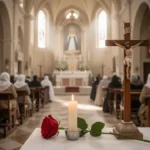
His devotion also reflects a broader Christian belief: love does not end at death. Praying for someone who has died expresses hope in God’s mercy and acknowledges the continuing bond between the living and the dead. It can also help the living face grief with faith rather than treating death as a subject that must be avoided.
People who pray through Nicholas may ask him to intercede for deceased family members, friends, or forgotten souls. They may also include prayers for those who have no one else to remember them. The emphasis is not on treating the saint as a source of power independent of God. Instead, the saint is asked to pray with and for the faithful.
The miracles and signs traditionally connected with him
Many miracles are attributed to Nicholas of Tolentino in devotional biographies and later testimony. These accounts include healings, protection from danger, assistance for people in distress, and help for souls after death. Some stories are tied to the period of his life, while others arose as devotion to him spread after his death.
One of the most familiar traditions concerns bread associated with Saint Nicholas. According to the story, Nicholas became seriously ill and was given a small piece of bread after praying. He recovered, and the practice of blessing or distributing small loaves developed in connection with his intercession.
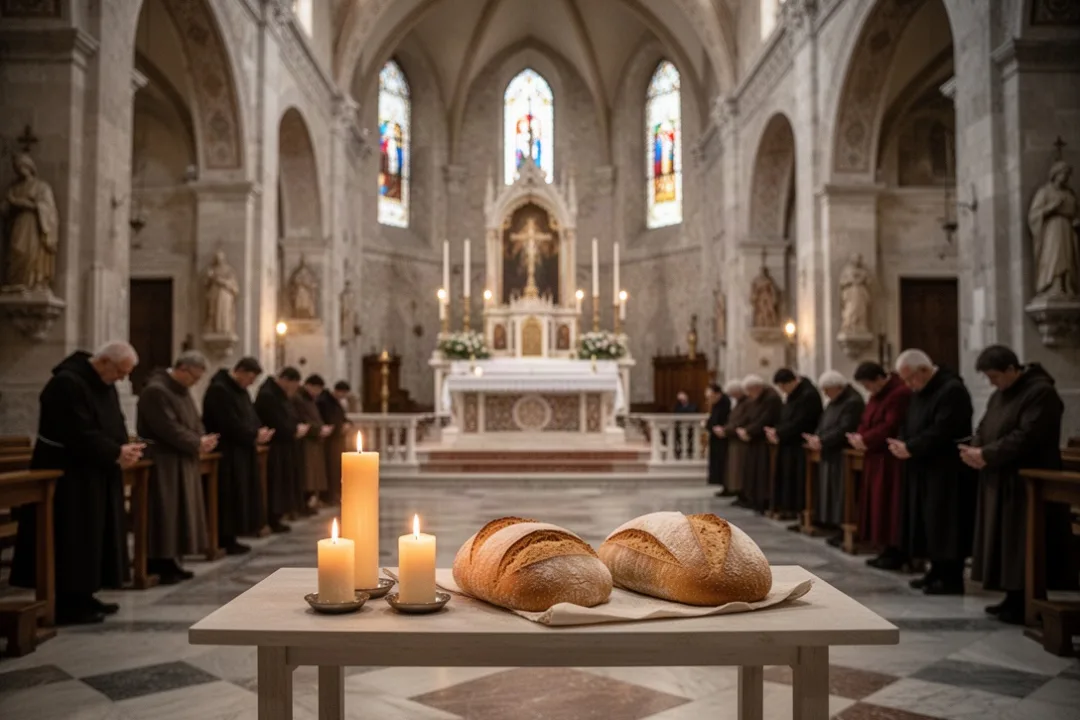
The bread is sometimes called panettini di San Nicola, or small breads of Saint Nicholas. Customs vary by place. In some communities, people receive the bread after prayer and take it home for family members who are ill or in need. The bread is a religious sign, not a magical object, and its meaning rests on prayer, gratitude, and trust in God.
Another well-known tradition involves roasted birds. A devotional account says that Nicholas, who had been given meat during an illness, returned the birds to life after praying. The story is often represented in art with small birds near the saint. As with other medieval miracle stories, it belongs to the tradition of his veneration and should not be confused with a modern medical or historical report.
A practical distinction: Devotional stories can express the Church’s understanding of a saint’s holiness, while formal historical claims require separate evidence. Nicholas’s legacy does not depend on treating every traditional miracle story as a scientifically verifiable event.
Why the bread of Saint Nicholas remains meaningful
The Bread of Saint Nicholas is one of the most recognizable customs connected with him. In some parishes and religious communities, the bread is blessed on or near his feast day and shared with those who ask for the saint’s intercession. The practice is especially associated with prayer for healing, family needs, and protection.
Its meaning can be understood through several connected ideas:
Daily dependence: Bread represents ordinary nourishment and the recognition that basic needs matter.
Charity: Sharing food reflects Nicholas’s concern for people who were hungry or poor.
Prayer: The blessing directs attention toward God rather than toward the object itself.
Hope: Families may use the custom to express trust during illness or hardship.
Someone who receives this bread may pray for a sick person, share it with a household, or offer it to someone who needs food. The custom is strongest when it leads to concrete generosity. A devotional practice connected with Nicholas should echo his concern for people in need rather than remain only a personal keepsake.
Nicholas of Tolentino’s canonization and recognition
Nicholas died in Tolentino on September 10, 1305. His reputation for holiness continued to grow after his death, and pilgrims visited his burial place. Reports of miracles and the persistence of public devotion contributed to the formal process by which the Church recognized him as a saint.
Pope Eugene IV canonized Nicholas in 1446. He is widely regarded as the first member of the Augustinian Order to be canonized. This recognition strengthened devotion to Nicholas and helped establish his feast and cult across Augustinian communities and beyond.
Canonization does not mean that every popular story about a saint has the same historical status. It means that the Church proposes the person as an example of Christian holiness and permits or encourages public veneration according to established norms. For Nicholas, that veneration developed around his prayer, charity, penitential discipline, and concern for the dead.
The Basilica of Saint Nicholas in Tolentino
The Basilica of Saint Nicholas in Tolentino became the principal shrine associated with him. The church and its Augustinian community preserve his memory through liturgy, art, relics, preaching, and pilgrimage.
Religious art in the basilica and in other churches often presents Nicholas wearing the black habit of the Augustinians. Common symbols include a star, lilies, a book, bread, or birds. These images can refer to stories from his life, his religious identity, or aspects of his spiritual reputation.
The star is especially connected with a tradition that a bright star appeared over Nicholas’s heart or marked his holiness. The meaning is symbolic: it points to a life illuminated by faith. The lilies can represent purity, while the book may refer to religious teaching and the Scriptures.
The basilica’s importance is not limited to architecture. A shrine becomes a place where people bring grief, thanksgiving, illness, family worries, and prayers for the dead. In that setting, Nicholas is remembered not simply as a figure from medieval history but as a patron whom people continue to approach in prayer.
Symbols used to identify Nicholas of Tolentino
Knowing his traditional symbols can help you recognize Nicholas in paintings, statues, and stained glass. Artists may use different combinations, but several images appear repeatedly.
The Augustinian habit: He is commonly shown in the dark habit of his religious order.
A star: This recalls the star associated with his holiness and spiritual light.
Bread: It points to the Bread of Saint Nicholas and his care for people in need.
Birds: These refer to the story of the roasted birds restored to life.
A lily: The flower can symbolize purity and dedication to God.
A cross or book: These identify his preaching, prayer, and priestly ministry.
Some images show Nicholas with a child or with souls rising from purgatory. These scenes highlight his reputation as an intercessor for the dead and a protector of vulnerable people. Artistic details vary by country and period, so not every image includes all of the traditional symbols.
What people ask Nicholas of Tolentino to pray for
Devotion to Nicholas is especially appropriate when prayer includes both spiritual trust and practical concern. People may ask for his intercession in situations that resemble the needs he served during his life.
Common intentions include:
Prayer for deceased relatives and friends.
Comfort for families grieving a recent death.
Support for people who are sick or recovering.
Help for those facing hunger, poverty, or unstable housing.
Peace for people troubled by guilt, fear, or spiritual discouragement.
Strength for caregivers and those who serve vulnerable neighbors.
Guidance for Christians seeking a deeper life of prayer and charity.
A simple prayer may mention the person or situation directly, ask God for mercy, and request Nicholas’s intercession. Catholics may also attend Mass, receive the sacraments, pray for the dead, or perform an act of charity as part of their devotion.
Those outside the Catholic tradition may still find value in studying Nicholas as a historical example of religious service. His life raises enduring questions about how communities care for the poor, how people remember the dead, and how private prayer can shape public acts of compassion.
How to observe the feast of Nicholas of Tolentino on September 10
The feast day offers a practical way to remember Nicholas without reducing devotion to a single ceremony. The best observance combines prayer, remembrance, and an action that benefits another person.
Set aside time for prayer. Ask God to receive the prayers of Nicholas for the dead, the sick, and people in need.
Remember someone who has died. Name a deceased relative or friend and entrust that person to God’s mercy.
Attend Mass or another service. If you belong to a church that observes his feast, take part in its liturgy or prayer service.
Share food. Give groceries, a meal, or the Bread of Saint Nicholas to someone who would benefit from it.
Visit or contact someone who is sick. A thoughtful call or practical help can reflect Nicholas’s compassionate ministry.
Learn about the Augustinians. Explore the order’s work in preaching, education, parish ministry, and service.
If your parish distributes blessed bread, receive it respectfully and follow the community’s guidance. It should be treated as a sign connected with prayer and charity, not as a guarantee that a particular outcome will occur.
How Nicholas compares with Saint Nicholas of Myra
Nicholas of Tolentino and Saint Nicholas of Myra are different saints. Saint Nicholas of Myra was a bishop who lived centuries earlier in the region of Lycia, in Asia Minor, and became associated with generosity and care for children. His traditions later influenced the figure known as Santa Claus.
Nicholas of Tolentino was an Italian Augustinian friar who lived in the 13th and 14th centuries. Although his name honors Saint Nicholas of Myra in the traditional account of his birth, he developed his own identity, symbols, feast, and devotional following.
The distinction matters because the two saints have different histories and patronages. When a prayer, artwork, or church refers to Nicholas of Tolentino, the Augustinian habit, bread, star, birds, and prayers for the dead can help identify the intended saint.
Lessons from Nicholas of Tolentino’s life
Nicholas’s example can be reduced to several connected commitments rather than one isolated virtue. He treated prayer and service as inseparable. His concern for the dead did not turn him away from the living; it deepened his attention to those who needed food, care, forgiveness, and companionship.
His life also shows how local ministry can have a lasting reach. Nicholas did not become known because he held public office or traveled widely as a political leader. He became known through repeated acts of pastoral care in the communities where he lived.
For modern readers, his example may suggest practical questions:
Do your prayers include people who are grieving or forgotten?
Can a religious custom lead to an act of generosity?
How can your community care for the sick without isolating them?
What would it mean to remember the dead with hope and responsibility?
Are spiritual practices shaping the way you treat people who need help?
Nicholas of Tolentino remains a significant figure because his devotion connects the ordinary and the eternal. Bread, illness, grief, confession, community, and prayer all appear in his story. His feast invites people to remember that faith is expressed not only through words but also through the patient care of neighbors and the faithful remembrance of those who have died.
Frequently asked questions
When is the feast day of Nicholas of Tolentino?
The feast day of Nicholas of Tolentino is September 10. Churches and Augustinian communities may mark the day with Mass, prayers for the dead, devotional services, or the distribution of blessed bread. Local customs vary, but the observance commonly focuses on his charity, prayer for souls in purgatory, and care for people who are sick or poor.
What is Nicholas of Tolentino the patron saint of?
Nicholas of Tolentino is especially associated with the souls in purgatory, the sick, and people experiencing hardship. His intercession is also sought for deceased relatives, grieving families, and those who need spiritual encouragement. Patronage lists can differ by region, so local churches may emphasize particular needs connected with his ministry.
What is the Bread of Saint Nicholas?
The Bread of Saint Nicholas is a blessed bread or small loaf distributed in some places through devotion to the saint. It recalls a traditional healing story and symbolizes nourishment, charity, and trust in God. It is not considered a magical object or a substitute for medical treatment, prayer, or practical assistance.
Was Nicholas of Tolentino the same person as Santa Claus?
No. Nicholas of Tolentino was an Italian Augustinian friar who lived in the 13th and 14th centuries. Santa Claus traditions are primarily connected with Saint Nicholas of Myra, a much earlier bishop. The shared name reflects devotion to Saint Nicholas but does not mean the two saints were the same person.













Leave a Reply