Rita of Cascia was an Italian Augustinian nun remembered for enduring family violence, widowhood, loss, and religious hardship with persistent faith. Catholics often ask for her intercession in situations that seem impossible, especially family conflicts, reconciliation, grief, and difficult marriages.
Her feast day is May 22. Rita is also associated with the rose and the thorn: the rose represents hope and God’s care, while the thorn recalls the suffering she accepted in union with Christ. Her shrine and incorrupt body are located at the Basilica of Saint Rita in Cascia, Italy.
Rita was born Margherita Lotti in the Umbrian village of Roccaporena, near Cascia, around 1381. She grew up in a Christian household and is traditionally described as having desired religious life from an early age. Her parents arranged her marriage to Paolo Mancini, a man whose violent temperament made her home life difficult.
Rita remained in the marriage for many years and was known for seeking peace rather than responding to violence with more violence. Her story does not make abuse acceptable or suggest that a person must remain in danger. A responsible reading of her life recognizes both her patience and the need to protect people from harm.
After Paolo was killed, Rita faced another painful loss. Her two sons died not long afterward, traditionally from illness. With her immediate family gone, she sought admission to the Augustinian monastery of Saint Mary Magdalene in Cascia. She eventually became a religious sister and spent the rest of her life in prayer, service, penance, and care for others.
Practical reminder: Asking Rita’s intercession is not a substitute for safety planning, medical care, counseling, legal help, or support from trusted people. Anyone facing abuse should seek immediate protection and professional assistance.
Why Rita is called the patron saint of impossible causes
Rita became associated with impossible causes because her life is remembered as a series of circumstances that appeared beyond human resolution. She lived with an abusive spouse, suffered the death of her husband, lost her children, and faced obstacles when she tried to enter religious life. Her response was not passive optimism; it was a long practice of prayer, forgiveness, and faithful action.
People commonly turn to her when a family relationship seems beyond repair, when grief has changed daily life, or when a serious problem has no clear solution. Some also pray with her during legal, medical, financial, and vocational crises. The title does not mean that every request receives the exact result someone hopes for.
In Catholic practice, a saint is asked to pray with and for the person, not treated as a magical source of outcomes. Rita’s example encourages trust in God while leaving room for honest lament, practical decisions, and results that may unfold differently from the original request.
Rita of Cascia’s life in seven important stages
Birth in Roccaporena: Rita was born near Cascia in Umbria, a region of central Italy. Her birth name was Margherita Lotti.
Marriage and family life: She married Paolo Mancini and became a mother. Traditional accounts describe the marriage as marked by her husband’s harsh and violent behavior.
Forgiveness and peacemaking: Rita sought to end hostility within her household and community. Her forgiveness is central to the way the Church remembers her.
Widowhood: Paolo was murdered during a period of local conflict. Rita grieved him and resisted the cycle of revenge that threatened to divide the family.
Loss of her sons: Her sons died after their father’s death, traditionally from illness. This left Rita without her husband or children.
Entrance into the monastery: She became an Augustinian religious sister at the monastery of Saint Mary Magdalene in Cascia after overcoming the barriers that initially stood in her way.
Prayerful religious life: She spent her later years serving the community, praying, practicing penance, and growing in devotion to Christ’s Passion.
These stages help explain why devotion to Rita is connected to more than one kind of suffering. She is remembered as a wife, mother, widow, nun, peacemaker, and person who endured bereavement. Different people recognize different parts of her story.
What happened to Rita’s husband and sons
According to the traditional account, Paolo Mancini belonged to a culture in which family honor and revenge could shape personal decisions. After his murder, relatives may have been tempted to seek retaliation. Rita is remembered as asking that her sons not become involved in vengeance.
Her sons then died before they could carry out such plans, traditionally because of illness. Some versions of the story say Rita preferred their deaths to participation in murder, but this detail must be handled carefully. It should not be used to romanticize loss or suggest that grief is simple. The tradition presents Rita as trusting her children to God during circumstances she could not control.
Her story speaks to families caught in cycles of anger. The lesson is not that reconciliation always happens quickly or that forgiveness removes consequences. Instead, Rita’s example points toward refusing revenge, telling the truth about harm, and choosing actions that prevent further injury.
Rita wanted to enter religious life before her marriage, but she followed the path expected of her at that time. After becoming a widow, she applied to the Augustinian monastery in Cascia. Tradition says the community initially hesitated because of her connection to a family feud and because widows were not always accepted under the monastery’s circumstances.
Rita worked toward reconciliation between the families involved. Once peace was established, she was admitted to the monastery. This part of her story highlights a pattern that appears throughout her biography: she did not treat prayer as an excuse to avoid difficult responsibilities.
At the monastery, Rita lived according to the spirituality of Saint Augustine. Augustinian religious life emphasizes community, interior conversion, shared prayer, study, and love of neighbor. Her vocation was not an escape from suffering but a new setting in which she could serve and deepen her relationship with God.
Rita’s devotion to Christ’s Passion
Rita had a strong devotion to the suffering and death of Jesus. Near the end of her life, she is traditionally said to have asked to share in Christ’s suffering. A thorn wound then appeared on her forehead, interpreted as a physical sign connected with the crown of thorns.
The wound is often called a stigmata, although Rita’s tradition concerns a single wound rather than all of the wounds associated with Christ’s crucifixion. Accounts say that it caused pain and had an unpleasant odor, leading her to live apart from the community for a period. The Basilica of Saint Rita preserves her body, and devotional tradition continues to associate her with this sign.
Christian devotion to the Passion is not an invitation to seek suffering for its own sake. Rita’s example is better understood as compassion for people who suffer and a willingness to remain faithful when life is painful. It should never encourage self-harm, neglect of treatment, or acceptance of abuse.
The meaning of the rose associated with Rita
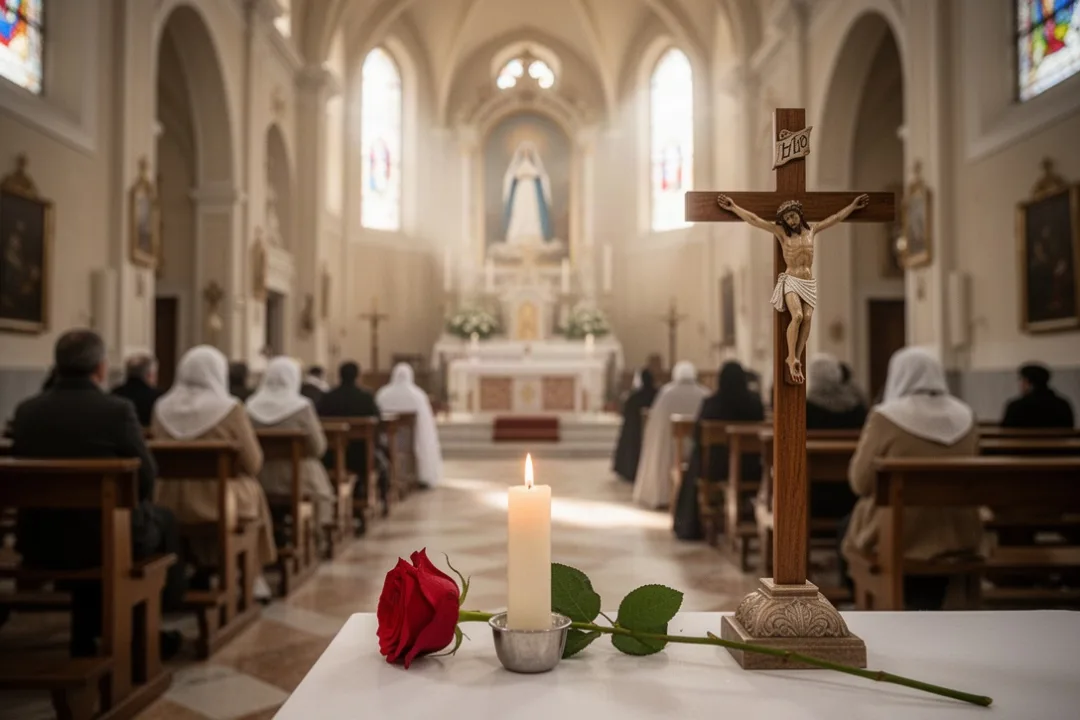
The rose of Saint Rita is one of the best-known symbols connected with her. Near the end of her life, when she was seriously ill during winter, she is said to have asked for a rose from her family home in Roccaporena. A relative found a rose there despite the season and brought it to her.
Whether a person treats this account as a miracle, a devotional tradition, or a symbol, the rose expresses hope in a difficult season. Its fragrance and beauty are linked with Rita’s reputation for bringing comfort amid sorrow. The rose is also used during prayers, feast-day celebrations, and parish devotions.
The thorn and the rose belong together. The thorn recalls suffering, while the rose suggests grace, consolation, and new life. Rita’s devotion does not promise a life without pain. It presents hope as something that can exist alongside grief, uncertainty, and wounds.
How to pray with Saint Rita when a situation feels impossible
You do not need special wording to pray with Rita. A brief, honest prayer can name the situation, ask for her intercession, and place the outcome in God’s care. The following approach can help when emotions make it difficult to know what to say.
Name the problem clearly: Tell God what is happening without softening the facts. You might pray about a broken relationship, serious illness, bereavement, addiction, conflict, or an uncertain decision.
Ask Rita to intercede: Request her prayers for wisdom, courage, protection, healing, reconciliation, or endurance.
Ask for the next faithful step: Rather than demanding a particular outcome, ask for help recognizing what you should do today.
Pair prayer with responsible action: Contact a counselor, doctor, pastor, attorney, support group, or trusted friend when the situation requires practical assistance.
Return to the prayer regularly: You might pray for nine days, on Rita’s feast day, or whenever the concern returns. Consistency can create space for reflection.
Release revenge: If anger is consuming you, ask for freedom from the desire to harm others while still pursuing justice and appropriate boundaries.
A prayer to Rita may be as simple as: “Saint Rita, please pray for me in this impossible situation. Ask God to give me wisdom, protection, courage, and peace, and help me take the right next step.” You can add specific names and circumstances.
When danger is present: Pray for help, but also move toward safety. In the United States, you can contact emergency services in an immediate crisis or a domestic violence resource for confidential support and safety planning.
What to include in a Saint Rita novena
A novena is a prayer practiced over nine days. Many Catholics pray a Saint Rita novena for a particular intention, especially when they feel discouraged or powerless. There is no single required wording for every novena, so you can use an approved prayer from your parish or a simple structure of your own.
A useful nine-day pattern might include these elements:
A short period of quiet and the sign of the cross, if that is part of your tradition.
A clear statement of the intention, using honest language rather than vague promises.
A reading or reflection on forgiveness, perseverance, compassion, or trust in God.
A request for Rita’s intercession and the grace needed for the present day.
A practical action, such as making a safe phone call, apologizing for your own part in a conflict, arranging care, or setting a healthy boundary.
A closing prayer of gratitude, even if the problem remains unresolved.
Some people finish with an Our Father, Hail Mary, and Glory Be. Others use a rosary, Scripture references, silence, or a parish novena service. The value of the practice comes from sincere prayer and changed attention, not from treating the number nine as a guarantee.
Rita’s place in Catholic devotional life
Rita is honored as a saint because of her holiness, perseverance, and union with Christ. Pope Leo XIII canonized her in 1900. Her popularity spread widely through religious communities, prayer groups, parish churches, and families who found hope in her story.
She is commonly invoked for impossible causes, difficult marriages, family problems, peace, abuse survivors, widows, mothers, and people facing painful decisions. Different Catholic communities may emphasize different parts of her life. Some focus on forgiveness, while others concentrate on endurance, grief, or the spiritual meaning of the Passion.
Devotion to a saint is meant to direct attention toward God, not replace worship of God. Catholics may ask Rita to pray for them because they believe the saints remain united to the Church. The prayer is a request for companionship and intercession, similar to asking a trusted Christian friend to pray.
Rita of Cascia’s feast day on May 22
The Catholic Church celebrates Saint Rita on May 22. Parishes may mark the day with Mass, a novena, a procession, a blessing of roses, or a prayer service for difficult intentions. In some communities, worshipers bring roses as a visible reminder of hope and Rita’s traditional story.
Feast-day customs vary by country and parish. Some celebrations are especially connected with people who are grieving or dealing with family hardship. Others gather local communities for devotional prayers and charitable acts. A feast day can be observed quietly at home as well, with a prayer, a visit to someone who is lonely, or an act of reconciliation.
If you attend a service, follow the customs of the parish and remember that devotional practices are not the same as the sacraments. A rose may symbolize prayer, but it has no automatic spiritual power. Its meaning comes from the faith and intention with which it is used.
Visiting the Basilica of Saint Rita in Cascia
The Basilica of Saint Rita stands in Cascia, the Italian town closely associated with her religious life. The complex includes the basilica, the monastery, and devotional spaces connected with her memory. Her body is preserved and displayed in a glass case, and pilgrims visit to pray near her shrine.
Roccaporena, where Rita was born, is also important to pilgrims. Sites connected with her early life include the house traditionally associated with her family and places linked to the rose story. The mountain landscape helps visitors understand the rural setting in which she lived.
Travelers should confirm current opening hours, liturgical schedules, accessibility information, and local visitor guidance before going. A pilgrimage can include prayer, silence, Mass, confession where available, and learning about Rita’s life rather than treating the shrine as a place for guaranteed favors.
What Rita’s example teaches about forgiveness
Forgiveness is one of the most powerful themes in Rita’s story, but it is also one of the most misunderstood. Forgiving someone does not mean denying what happened, pretending trust has returned, or allowing continued access to a person who causes harm.
For someone who has been hurt, forgiveness may take time. It can mean surrendering the desire for revenge while still seeking justice, protection, therapy, accountability, or separation. Reconciliation requires more than one person’s wish; it depends on truth, responsibility, safety, and changed behavior.
Rita’s example can therefore be approached in a careful and compassionate way. She represents the possibility of refusing hatred without refusing reality. Her prayer may help someone ask for freedom from destructive anger while taking firm steps to protect themselves and others.
Rita experienced the loss of her husband and children before entering religious life. For people who are grieving, this makes her a familiar companion. Her story does not erase bereavement or suggest that faith removes sadness. It gives mourners a figure associated with carrying loss over time.
Prayer can be especially difficult after a death. You may feel angry, numb, confused, or unable to form a complete sentence. A short prayer such as “Saint Rita, stay with me and pray for me” can be enough for the moment.
Grief also needs human support. A parish minister, grief counselor, support group, physician, or trusted friend may help with needs that prayer alone does not address. Rita’s compassionate example can encourage you to accept care rather than endure isolation.
Common symbols of Saint Rita
The rose: Hope, grace, and unexpected consolation during a difficult season.
The thorn: Rita’s devotion to Christ’s Passion and the wounds carried through her life.
The crucifix: Her prayerful attention to Christ’s suffering, death, and redeeming love.
The religious habit: Her identity as an Augustinian nun and her commitment to community life.
The forehead wound: The traditional sign associated with her participation in Christ’s Passion.
The book: Prayer, spiritual teaching, and the disciplined life of a religious community.
Artistic representations may show Rita holding a crucifix, a rose, or a thorn. Details differ by region and period. Symbols support devotion, but the central focus remains her relationship with God and her example of faithful endurance.
How to honor Rita without romanticizing suffering
Honoring Rita means more than asking for a favor. You might imitate her concern for peace by ending a cycle of gossip, supporting someone who is grieving, or seeking help for a family conflict. You might honor her through patient prayer combined with practical responsibility.
Healthy devotion also avoids presenting suffering as proof of holiness. People should not be pressured to remain in violent relationships, reject medical treatment, tolerate exploitation, or hide emotional distress. Rita’s life can inspire courage and compassion without making danger or pain into ideals.
A meaningful observance may include these actions:
Pray for someone involved in a painful conflict while maintaining appropriate boundaries.
Donate to an organization supporting survivors of domestic violence or people experiencing grief.
Visit a lonely person or help a family under strain.
Ask forgiveness for harm you have caused and make amends where doing so is safe.
Seek counseling or pastoral guidance for a situation that has remained stuck.
Bring a rose to a church or home prayer space as a reminder of hope and responsibility.
Rita of Cascia remains meaningful because her story holds together suffering and hope, grief and service, forgiveness and truth. Her feast day, symbols, and prayers invite people to seek God’s help in impossible situations while taking the next wise and compassionate step available.
Frequently asked questions
Is Rita of Cascia the patron saint of impossible causes?
Yes. Catholic tradition commonly invokes Saint Rita for impossible or desperate situations, including family conflict, grief, serious illness, and difficult decisions. The title reflects the extraordinary hardships associated with her life, not a promise that every request will have a particular outcome. Prayer to Rita is understood as asking for her intercession and for the wisdom, courage, and grace needed in the situation.
What is the prayer to Saint Rita for impossible causes?
There is no single prayer that every Catholic must use. You can address God directly, ask Saint Rita to intercede, describe the problem honestly, and request guidance, protection, healing, or peace. Many people use a novena or parish prayer, while others pray briefly in their own words. Personal prayer can be appropriate when it is sincere and joined with responsible action.
Why is Saint Rita associated with roses?
A traditional account says that, while Rita was seriously ill during winter, she asked for a rose from her family home. A relative reportedly found one and brought it to her. The rose became a symbol of hope and unexpected consolation. Roses are often brought to churches or blessed during Saint Rita’s feast day on May 22, although the flower itself is not considered magical.
Where is Saint Rita of Cascia buried?
Saint Rita’s body is preserved at the Basilica of Saint Rita in Cascia, Italy, the town where she entered the Augustinian monastery and spent her later life. The basilica and nearby sites in Roccaporena attract pilgrims. Visitors should check current schedules and travel information before going, since access, liturgies, and visitor arrangements can change.











Leave a Reply