Saint Rita of Cascia is best known as the patron saint of impossible causes. Catholics also ask for her intercession in difficult marriages, family conflict, abuse, widowhood, and situations that seem beyond human solutions.
Saint Rita’s most familiar title is patron saint of impossible causes. People turn to her when a problem appears hopeless, when reconciliation seems unlikely, or when ordinary efforts have not brought a resolution. Her reputation does not mean that every request receives the exact result a person wants. Rather, devotion to Rita expresses trust that God remains present even in circumstances marked by grief, violence, injustice, or long waiting.
She is also closely associated with difficult marriages and troubled families. Rita lived through a painful marriage and later lost her husband and sons. Her story has made her a source of comfort for people experiencing domestic conflict, separation, bereavement, or complicated family relationships. Some devotees ask her help when they hope for reconciliation; others pray for the courage and protection needed to leave an unsafe situation.
Saint Rita is commonly invoked as a patron or spiritual companion for:
Impossible or desperate causes that seem humanly unresolvable.
Difficult marriages, family division, and the search for peace.
Abuse survivors and people living with domestic violence or coercion.
Widows and widowers facing life after the death of a spouse.
Parents grieving children or carrying serious family burdens.
People enduring suffering who need patience, protection, or renewed faith.
Safety comes first: Praying to Saint Rita never requires you to remain in an abusive relationship or delay professional, legal, medical, or emergency help. Spiritual support can accompany practical protection; it should not replace it.
Why Saint Rita became associated with impossible causes
Rita’s patronage developed from the way her life brought together several forms of suffering that had no easy answer. She experienced a difficult marriage, the violent death of her husband, the deaths of her two sons, and years of apparent barriers to the religious life she desired. Her later ministry as an Augustinian religious included prayer, service, and identification with Christ’s suffering.
To believers, these experiences show why Rita is approached by people who feel trapped between painful choices. She was not remembered because her life was simple or free from loss. She became beloved because she persevered without allowing suffering to define the whole meaning of her life.
The expression “impossible causes” is a devotional description rather than a promise of a miracle on demand. A prayer through Saint Rita may lead to a changed situation, but it may also lead to endurance, clarity, protection, forgiveness, or the strength to take a necessary step. Catholic prayer asks for God’s help while recognizing that the answer may unfold differently from the original request.
Many people bring Rita concerns such as a marriage that seems beyond repair, a long-standing family disagreement, a serious illness, financial distress, legal trouble, or a loved one’s destructive behavior. The devotion can give those concerns a name and place in prayer. It can also remind a person that asking for help is not a sign of weak faith.
Saint Rita’s life and the experiences behind her patronage
Saint Rita was born Margherita Lotti in the small village of Roccaporena, near Cascia in central Italy. Her birth is traditionally placed around 1381. She grew up in a Christian household and, according to her traditional biography, wanted to become a religious sister. Instead, she married Paolo Mancini while still young.
Accounts of the marriage describe Paolo as a man with a violent temper and a history of conflict. Rita remained committed to her family, and tradition credits her with helping move him toward a more peaceful life. After many years of marriage, Paolo was killed in an act of violence connected with local conflict and long-standing tensions.
Rita became a widow with two sons. Traditional accounts say that her sons later died, possibly during an illness. The details of her early life come through devotional biographies written after her death, so some elements should be treated as tradition rather than independently verified modern history. The central point remains consistent: Rita endured the loss of her spouse and children before entering religious life.
After becoming widowed, Rita sought admission to the Augustinian monastery of Saint Mary Magdalene in Cascia. Tradition says that her first attempts were refused because the community generally accepted women who were unmarried or already religious, not widows with complicated family circumstances. Rita eventually entered the monastery, where she lived as an Augustinian nun for many years.
Her religious life was marked by prayer, humility, service, and devotion to Christ’s Passion. The best-known story about her says that she received a wound on her forehead resembling one caused by a thorn from Christ’s crown. This event is connected with her representation in art, although accounts differ in their details. The wound is one reason she is associated with physical and emotional suffering offered to God.
Rita died in Cascia in 1457, according to the traditional account. She was beatified in 1626 and canonized in 1900 by Pope Leo XIII. Her feast day is celebrated on May 22, and devotion to her has spread widely beyond Italy.
What Saint Rita’s story means for difficult marriages
Rita is often named the patron saint of difficult marriages because her own marriage is remembered as a relationship marked by danger, conflict, and eventual tragedy. Devotees may ask her intercession for a spouse’s conversion, reconciliation between partners, wisdom during separation, or healing after years of resentment.
Her story should not be used to pressure someone into tolerating abuse. A difficult marriage can mean communication problems, grief, infidelity, addiction, cultural conflict, or a long estrangement. Abuse is different: it involves patterns of control, intimidation, threats, assault, sexual coercion, stalking, or other harm. Forgiveness does not require continued access for an abusive person, and reconciliation cannot be genuine without safety, accountability, and meaningful change.
Someone praying through Saint Rita may ask for several kinds of help:
Wisdom to distinguish a repairable conflict from an unsafe relationship.
Courage to tell the truth to trusted people and qualified professionals.
Protection for children and other vulnerable family members.
Strength to establish boundaries or seek a safe place to live.
Grace to release revenge without excusing wrongdoing.
Guidance about counseling, pastoral care, legal advice, or other practical support.
Rita’s example can also speak to people who are not married. Family members may pray for a sibling trapped in an unhealthy relationship, parents may seek wisdom about an adult child, and friends may ask for the patience to support someone without taking control of that person’s decisions.
How Catholics pray to Saint Rita
Catholics do not worship Saint Rita. They ask her to pray with them and for them, just as one might ask a trusted Christian friend to pray. Worship belongs to God; saints are honored as faithful witnesses whose lives point beyond themselves.
A simple prayer can be direct and personal. You might name the situation, describe what you fear, ask for protection and wisdom, and place the outcome in God’s care. There is no required length or special wording for a private prayer. A person may pray in a church, at home, while traveling, or during a quiet moment at work.
A traditional novena to Saint Rita is prayed over nine days. Different versions use different words and intentions, so there is no single mandatory text for every Catholic community. Some people pray a novena before her feast day on May 22; others begin whenever a serious need arises.
A practical prayer routine may include these steps:
Name the need honestly. Avoid minimizing violence, grief, illness, or fear in order to sound spiritually strong.
Ask for a specific grace. This could be safety, discernment, reconciliation, endurance, or freedom from destructive behavior.
Include practical action. Contact a counselor, doctor, advocate, pastor, attorney, shelter, or trusted friend when appropriate.
Pray for everyone involved without excusing harm. You can ask for justice and accountability as well as mercy.
Remain open to an answer that changes your next step. The response may be clarity or courage rather than an immediate change in circumstances.
Some Catholic churches hold a special celebration for Saint Rita, bless roses, or distribute prayer cards on or near her feast day. Customs differ by parish and country. A local church, Augustinian community, or diocesan office can explain which practices are observed in that area.
Roses are among the most recognizable symbols associated with Saint Rita. The connection comes from a traditional story about the end of her life. When Rita was seriously ill in the monastery, she was said to have asked for a rose from her family home in Roccaporena during winter. A rose was reportedly found there, along with figs in some versions of the story.
The rose became a sign of hope appearing in an unlikely season. It does not erase the cold or claim that suffering is pleasant. Instead, it symbolizes a small sign of grace within a life that has known loss. On Saint Rita’s feast day, people may bring roses to church for a blessing or place roses near an image of her.
The rose also reflects the contrast in Rita’s devotion: beauty and pain, tenderness and endurance, prayer and action. The thorn associated with her forehead points toward suffering, while the rose suggests consolation and new life. Together, these symbols help explain why many people approach her during emotionally complicated circumstances rather than only during ordinary difficulties.
Common mistakes when asking Saint Rita’s intercession
Devotion can be meaningful, but certain misunderstandings may make it less helpful. Saint Rita is not a magical solution, and prayer should not be used to avoid truth, responsibility, or needed assistance.
Treating prayer like a guarantee. A novena is not a contract that obliges God to provide a particular outcome on a particular date.
Blaming yourself when circumstances do not change. An unanswered request does not prove that you lacked faith or prayed incorrectly.
Romanticizing suffering. Rita’s endurance should not be interpreted as approval of violence, exploitation, or preventable harm.
Confusing forgiveness with reconciliation. Forgiveness may be a gradual spiritual choice; reconciliation requires trust, responsibility, and safety.
Waiting for a miracle instead of seeking help. Medical care, crisis services, counseling, and legal protection can be part of a faithful response.
Assuming every detail of a popular story is documented history. Saint Rita’s life includes long-standing devotional traditions, and some details vary among sources.
Praying only for another person to change. It can also be valuable to ask for your own discernment, boundaries, healing, and courage.
A balanced intention might be: “Saint Rita, pray that I receive protection, wisdom, and the strength to take the right next step. Help me seek peace without denying the truth.”
When to seek immediate help instead of waiting
Prayer can accompany urgent action, but it should never delay emergency assistance. If someone threatens immediate harm, has been assaulted, is being held against their will, or faces a medical emergency, contact emergency services or a local crisis resource. In the United States, calling 911 is appropriate for immediate danger.
People experiencing domestic violence can contact the National Domestic Violence Hotline through its current phone, text, or online options. If speaking openly could increase danger, use a safer device or contact a trusted advocate when possible. A domestic violence professional can help with safety planning without forcing you to make a decision before you are ready.
People in emotional crisis or considering suicide can contact or call 988 in the United States and Canada through the Suicide and Crisis Lifeline. For other countries, local emergency services or a national crisis line may be the right resource. Asking for urgent help is compatible with faith; protecting life is itself a serious moral responsibility.
A priest, deacon, chaplain, or parish minister may offer spiritual care, but no religious leader should tell an endangered person to return to a violent home, keep abuse secret, or accept harm as a condition of holiness. Good pastoral care supports safety and connects people with appropriate professional resources.
How Saint Rita’s feast day is observed
Saint Rita’s feast day is May 22. Catholics may attend Mass, pray a novena, read about her life, light a candle where permitted, or bring roses for a blessing. Some communities organize processions or special devotions, especially in places with a strong Augustinian or Italian Catholic tradition.
The feast can be a personal day of remembrance for people whose lives resemble parts of Rita’s story. A widow may pray for strength, a family may remember a loved one who died, or someone recovering from abuse may mark a step toward safety. The day does not require a dramatic ceremony. A quiet prayer, a visit to church, or a conversation with a trusted supporter can be enough.
Many people also use May 22 to pray for others facing impossible circumstances. This outward focus can prevent devotion from becoming an attempt to control another person. Instead of demanding that a spouse, relative, or judge act in a certain way, the person praying can ask for truth, justice, healing, and the wisdom to respond well.
What Saint Rita can mean when the answer is uncertain
Saint Rita’s appeal lies partly in the fact that her life does not offer a simple formula. She prayed for peace in her marriage, yet her husband died violently. She became a widow and lost her sons. She eventually entered religious life, but only after obstacles and delay. Her story shows that faithfulness is not the same as receiving an easy path.
For someone facing an impossible cause, this can provide a more realistic form of hope. Hope may mean surviving the next day, telling the truth, accepting support, setting a boundary, grieving honestly, or choosing not to return to a harmful pattern. It may also mean allowing healing to take time rather than expecting one prayer to erase years of pain.
Saint Rita’s intercession is therefore meaningful not only when circumstances change suddenly, but also when a person gains the courage to see clearly. Prayer can help someone recognize trustworthy support, resist despair, and take a step that protects dignity and life. That is why the patron saint of impossible causes remains especially important to people living with problems that cannot be solved quickly.
Frequently used symbols and images of Saint Rita
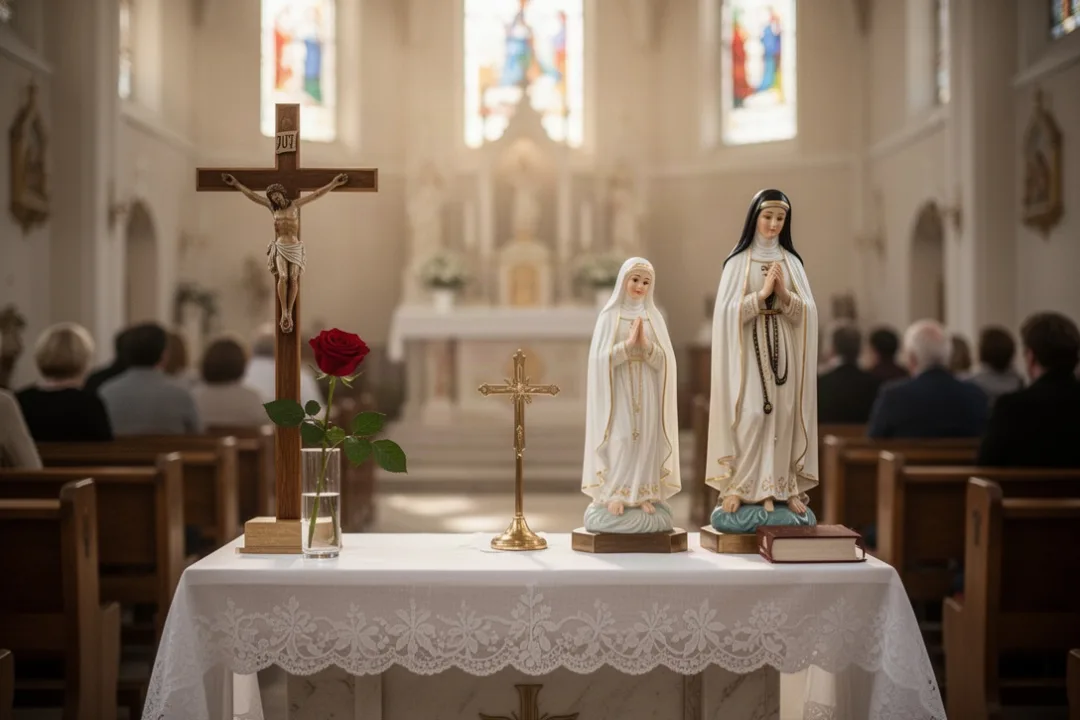
Artists commonly portray Saint Rita wearing the black habit of an Augustinian nun. She may hold a crucifix, a rose, or a small wound on her forehead representing the thorn associated with her traditional life story. Some images show her with a skull or other reminder of mortality, reflecting religious meditation on death and the temporary nature of earthly suffering.
The symbols are devotional aids, not objects with independent power. A medal, statue, prayer card, or rose can remind a person to pray and act faithfully, but none guarantees a result. Their value comes from the meaning the believer attaches to them and from the way they direct attention toward God, compassion, truth, and perseverance.
When choosing a Saint Rita image, look for one that reflects the aspect of her life most relevant to your prayer. A rose may represent hope, a crucifix may represent endurance, and the habit may recall her dedication to community prayer and service. The image can sit in a private prayer space or be used during a novena, provided it supports rather than replaces sincere prayer and practical care.
Frequently asked questions
Is Saint Rita only the patron saint of impossible causes?
No. “Patron saint of impossible causes” is her best-known title, but Catholics also ask Saint Rita’s intercession for difficult marriages, family conflict, widows, abuse survivors, grieving parents, and people enduring serious or seemingly unresolvable problems. Her patronage developed from the hardships she experienced in marriage, widowhood, family loss, and religious life.
What day is Saint Rita’s feast day?
Saint Rita’s feast day is May 22. Catholics may commemorate it with Mass, a novena, private prayer, or the blessing of roses, depending on local custom. Some parishes and religious communities hold special services near that date, while others honor her through ordinary prayer and acts of support for people facing difficult circumstances.
Can I pray to Saint Rita for my marriage?
Yes. You can ask Saint Rita to pray for wisdom, healing, honest communication, reconciliation, or guidance about your relationship. If there is abuse, threats, coercive control, or violence, make safety the priority. Prayer should accompany support from trusted people and qualified professionals, not pressure you to stay in danger or reconcile prematurely.
How do I pray a Saint Rita novena?
A novena usually involves praying for nine consecutive days, using a traditional Saint Rita prayer or your own words. State your intention clearly, ask for her intercession, and include a request for wisdom and strength. You may begin at any time; some people pray the novena before her May 22 feast day. No special formula is required for private prayer.












Leave a Reply