If you have ever faced a problem that seemed impossible to solve, you may have wondered, what is St. Jude the patron saint of? The short answer is desperate, difficult, and seemingly hopeless causes. Catholics and many other Christians turn to him when a situation feels beyond human control, such as a serious illness, a family crisis, financial trouble, or a long period of uncertainty.
St. Jude is also called Jude Thaddeus or St. Judas Thaddeus. He was one of Jesus’ Twelve Apostles and is not the same person as Judas Iscariot, the disciple who betrayed Jesus. His reputation as a patron of difficult cases reflects a long Christian tradition of asking for his intercession when ordinary solutions appear exhausted.
At a glance: St. Jude is traditionally invoked for situations that seem desperate or without a clear answer. His patronage does not mean that every prayer produces the result requested; it points instead to hope, courage, and trust during severe hardship.
St. Jude is best known as the patron saint of desperate cases, hopeless causes, and difficult situations. These descriptions do not refer only to one kind of problem. They may include physical illness, emotional suffering, addiction, broken relationships, unemployment, legal troubles, or any circumstance in which a person feels powerless and discouraged.
The word “hopeless” in this tradition does not necessarily mean that success is impossible in a practical sense. It describes the way a situation feels to the person living through it. A medical diagnosis, for example, may involve uncertain treatment, painful decisions, and fear about the future. Someone who prays to St. Jude may be asking for healing, wisdom, endurance, or peace rather than demanding one specific outcome.
People commonly seek St. Jude’s intercession for:
Serious or long-term illness, including strength for patients and their caregivers.
Family and relationship crises that seem resistant to repair.
Financial hardship, unemployment, debt, or housing insecurity.
Addiction and recovery, especially when repeated efforts have failed.
Grief, loneliness, and emotional distress during a painful season.
Work, legal, or personal problems that have no simple solution.
His patronage can be understood as a response to the human need to keep going when a resolution is not immediate. Devotion to St. Jude encourages a person to bring fear and uncertainty into prayer while still taking responsible action. That might mean seeing a doctor, contacting a counselor, asking a trusted friend for help, or seeking professional financial advice.
St. Jude is sometimes described as the saint of lost causes. This phrase can sound as though prayer replaces practical effort, but that is not the traditional Christian idea. Asking for a saint’s intercession is generally understood as asking the saint to pray with and for you before God, not as using a magical formula or avoiding difficult decisions.
Who St. Jude was and why he is different from Judas Iscariot
St. Jude appears in the New Testament as one of Jesus’ Apostles. The Gospel lists use names such as Judas son of James and Thaddeus, while Matthew and Mark include a disciple named Thaddeus. Christian tradition identifies these references with the same apostle, Jude Thaddeus.
The different names helped distinguish him from Judas Iscariot, the apostle who betrayed Jesus. After the betrayal, the name Judas became strongly associated with that event in many Christian communities. The alternate name Thaddeus, and the shorter form Jude, made it clearer that this was a different disciple.
Some traditions also connect St. Jude with the Letter of Jude in the New Testament. The letter identifies its author as Jude, a servant of Jesus and brother of James. The exact historical identity of the author is discussed by biblical scholars, so it is more accurate to say that the letter has traditionally been associated with Jude than to present every detail as certain.
The New Testament gives only a small amount of information about the apostle himself. Jesus sends the Twelve to proclaim the message of God’s kingdom, care for the sick, and serve others. Jude is not presented through a long personal biography, which is one reason later traditions about his mission and death vary.
According to longstanding Christian traditions, Jude preached the gospel in places such as Mesopotamia and surrounding regions, sometimes alongside St. Simon the Apostle. Accounts of his death commonly describe martyrdom, although the details differ among sources. Churches honor him because of his faithful witness, not because every later story about his travels can be independently verified.
The Letter of Jude, regardless of questions about authorship, emphasizes the need to remain faithful when communities face confusion, false teaching, and moral disorder. That theme fits the way many people understand St. Jude today: a figure associated with steadfastness under pressure and hope when circumstances are spiritually or practically difficult.
A useful distinction: St. Jude is not Judas Iscariot. “Jude,” “Judas,” and “Thaddeus” refer to naming traditions surrounding a different apostle from the one associated with Jesus’ betrayal.
Why St. Jude became associated with desperate causes
The precise historical moment when St. Jude became the patron of desperate cases is not established by a single universally accepted event. His reputation developed through Christian devotion over time. One common explanation is that he was less frequently invoked because his name resembled that of Judas Iscariot. As a result, people who did turn to him came to regard his help as especially powerful in cases others had overlooked.
That explanation belongs to popular tradition rather than a clearly documented historical record. What is certain is that Christians eventually developed a strong devotion to Jude as an advocate for those facing serious trouble. His image, prayers, novenas, churches, and feast-day observances helped spread this devotion across many countries.
A novena to St. Jude usually consists of prayers offered over nine days. The prayers may ask for a particular intention, but they often also ask for faith, patience, wisdom, and the ability to recognize help. A novena is not a guarantee or a transaction. It is a structured way to return to the same concern repeatedly and place it before God.
For many believers, St. Jude’s patronage matters because it gives a name and shape to an experience that can otherwise feel isolating. Saying, “I am praying to St. Jude for this situation,” may help someone acknowledge the seriousness of the problem while resisting despair. The practice can also connect a person with a church community, family tradition, or support network.
Prayer to St. Jude often includes several related requests:
Hope when fear has begun to dominate daily life.
Perseverance when progress is slow or setbacks are repeated.
Wisdom to make sound decisions and recognize trustworthy help.
Compassion for oneself and for other people involved in the crisis.
Acceptance of what cannot be controlled without giving up on what can be changed.
This helps explain why St. Jude is meaningful even when a prayer does not produce the exact outcome a person requested. The devotion can support a deeper form of hope, one that does not depend entirely on a particular result. For some people, that means finding the strength to continue treatment. For others, it means making peace with a difficult reality, repairing a relationship, or asking for help after years of silence.
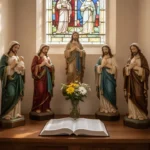
Images of St. Jude often show him holding a medallion of Jesus or a small image of Christ. This symbol is connected with a tradition in which an image of Jesus was associated with healing and with Jude’s mission. The medallion also keeps attention on the central Christian belief that the saint points beyond himself to Christ.
He may also be shown with a flame above his head. This represents the Holy Spirit coming upon the apostles at Pentecost. In some images, Jude carries a club, axe, or other instrument of martyrdom, referring to traditions about how he was killed. Artistic details vary depending on the church, country, and period.
Common visual symbols associated with St. Jude include:
A portrait or medallion of Jesus: a reminder of his relationship with Christ.
A flame: a reference to the Holy Spirit and Pentecost.
A staff or walking stick: sometimes linked with apostolic preaching and missionary travel.
A book or scroll: representing his preaching or the Letter of Jude.
A club, axe, or sword: symbols connected with accounts of his martyrdom.
These objects should be read as religious symbols, not as proof that every detail of a later biography is historically documented. A church statue may combine several traditions to show Jude as an apostle, missionary, teacher, and martyr.
St. Jude is often portrayed with a calm or serious expression rather than as a triumphant figure. That presentation suits his role as a companion in hardship. The image does not promise that life will be easy; it represents faithful presence when a person is frightened, exhausted, or unsure what to do next.
When St. Jude’s feast day is celebrated
The Catholic Church celebrates the feast of St. Jude on October 28, together with St. Simon the Apostle. This date is observed in the Roman Catholic calendar and in various forms by other Christian communities. Churches may mark the day with Mass, special prayers, processions, devotional services, or charitable activities.
October 28 can be a meaningful time to pray for people who are facing difficult circumstances. Some communities hold a novena leading up to the feast. Others gather throughout the year because the needs associated with illness, grief, poverty, and family crisis do not follow a church calendar.
Feast-day observances may include:
Attending worship or receiving the sacraments according to your tradition.
Lighting a candle or spending quiet time in prayer.
Writing down a specific intention for yourself or another person.
Asking a faith leader or trusted community to pray with you.
Making a practical act of mercy, such as visiting someone who is isolated.
Supporting a hospital, shelter, recovery program, or other local ministry.
These practices connect private devotion with care for other people. If someone prays to St. Jude for a person who is sick, that prayer may naturally lead to a hospital visit, a meal for the family, transportation to an appointment, or a phone call to someone who feels alone. Religious devotion is often strongest when it becomes visible through compassion and service.
How to pray to St. Jude during a difficult situation
There is no single required wording for a prayer to St. Jude. You can speak plainly about what is happening, name the people involved, and ask for the kind of help you need. A brief prayer might ask St. Jude to pray for courage, healing, guidance, and the ability to remain hopeful while you take the next responsible step.
A simple pattern can make prayer easier when stress has made it difficult to concentrate:
Name the situation honestly. Say what you fear, what has happened, and what you do not understand.
Ask for St. Jude’s intercession. Invite him to pray for you and the people affected.
Request specific help. This might include healing, patience, wisdom, reconciliation, or protection.
Identify one practical step. Make the call, attend the appointment, seek advice, or ask someone for support.
Return to prayer regularly. A novena or a short daily prayer can provide structure without treating prayer as a formula.
It is also appropriate to pray for someone else. Families may ask St. Jude to intercede for a hospitalized relative, a friend in recovery, a child facing a serious problem, or a person who has stopped attending church. You do not need special religious language. A sincere request spoken quietly can be enough.
Prayer should not replace medical care, mental health treatment, emergency services, legal advice, or other qualified assistance. If you or someone else is in immediate danger, contact emergency services or a crisis resource in your area. A person can pray for help and seek professional support at the same time; those actions are not opposites.
For believers, the deepest meaning of St. Jude’s patronage is not that difficult circumstances are automatically removed. It is that no crisis has to be faced in complete isolation. St. Jude represents faithful endurance, compassion for people in distress, and the possibility of hope even when the next answer is not yet visible.
That is why the question “what is St. Jude the patron saint of?” has both a traditional and a personal answer. Traditionally, he is the patron of desperate and hopeless causes. Personally, he becomes a source of prayer for anyone trying to remain faithful, seek help, and take the next step through a situation that feels overwhelming.
Frequently asked questions
Is St. Jude the same person as Judas Iscariot?
No. St. Jude, also known as Jude Thaddeus, was a different apostle from Judas Iscariot. Iscariot is remembered for betraying Jesus, while Jude is honored in Christian tradition as an apostle and patron of difficult and desperate causes. Different Gospel naming traditions use Jude, Judas, Thaddeus, or Judas son of James, which can make the distinction confusing.
Can I pray to St. Jude if I am not Catholic?
You can learn about or use St. Jude devotion outside Catholic practice, although traditions differ on asking saints to intercede. Some Christians pray directly to God while remembering Jude’s example; others ask Jude to pray for them. You may also discuss the practice with a pastor, priest, or other trusted religious leader in your own community.
What is a St. Jude novena?
A St. Jude novena is a series of prayers traditionally offered over nine days for a particular intention. It may include requests for help in a difficult situation, along with prayers for wisdom, courage, healing, and peace. The repeated schedule creates a period of focused devotion, but it should not be treated as a guarantee or magical formula.
Why do some hospitals and charities use St. Jude’s name?
St. Jude’s association with serious illness and desperate cases has inspired hospitals, clinics, and charitable organizations to use his name. The best-known example is St. Jude Children’s Research Hospital in Memphis, Tennessee, which conducts pediatric research and provides care. Its name reflects the saint’s traditional connection with hope in severe circumstances.

















Leave a Reply