Saint Hedwig: life, feast day, patronage, and prayers
Saint Hedwig: life, feast day, patronage, and prayers
Saint Hedwig of Silesia was a medieval duchess remembered for her deep prayer, practical charity, and care for the poor, sick, and religious communities. Her feast day is October 16, and she is especially honored as the patron saint of Silesia.
Born in Bavaria around 1174, Hedwig married Henry the Bearded, a powerful ruler in the lands that are now parts of Poland. Although she lived in a court, she chose a disciplined life of faith and service. Her story brings together public responsibility, family hardship, generosity, and a serious commitment to Christian prayer.
Hedwig was born into the noble Andechs family in Bavaria. Her relatives included influential church and political figures, so she grew up in a setting where marriage, territory, and religious alliances were closely connected. As a young woman, she married Henry the Bearded, who later became Duke of Silesia and a major ruler in central Europe.
The marriage placed Hedwig in a demanding position. She was not simply a private devotional figure; she was a duchess whose household and decisions affected communities, monasteries, and political relationships. She shared responsibility for a growing territory during a period marked by migration, conflict, disease, and economic uncertainty.
Hedwig and Henry had children, and their family life included both privilege and grief. The death of several children deeply affected them. Their surviving daughter, Gertrude, became abbess of the convent at Trzebnica, a foundation strongly associated with Hedwig’s religious vision.
Hedwig’s spirituality was shaped by the religious practices of the Middle Ages: regular prayer, fasting, almsgiving, penance, and devotion to the Eucharist. These practices were not separate from her public life. She used her position and resources to support people who had little protection, including the poor, prisoners, sick people, and religious communities.
Why Saint Hedwig is associated with Silesia
Silesia was a historical region of central Europe that included areas now located in Poland, Germany, and the Czech Republic. Hedwig became closely connected with the region through her marriage, residence, charitable work, and support for religious foundations. Over time, people came to see her as a spiritual protector of the land and its inhabitants.
Her husband established and expanded towns, churches, and monasteries, while Hedwig supported the religious and charitable life connected with those foundations. She is particularly associated with Trzebnica, where she helped establish a Cistercian convent in the early thirteenth century. The convent became an important center of prayer, education, and service.
Hedwig eventually lived at Trzebnica after Henry’s death. She did not become abbess, but her daughter Gertrude held that office. Hedwig continued to influence the community through her prayer and support while maintaining a disciplined life as a widow.
At a glance: Saint Hedwig of Silesia is remembered for combining the responsibilities of a duchess with a demanding life of prayer, humility, and care for vulnerable people.
Saint Hedwig’s marriage and family life
Hedwig’s marriage to Henry was arranged according to the customs of noble families at the time. The couple’s relationship was connected to political stability, land, and dynastic interests, but religious tradition also presents their marriage as a partnership shaped by faith. They supported churches and monasteries and practiced forms of personal austerity together.
Accounts of Hedwig often emphasize her influence over Henry, particularly when she pleaded for mercy for people facing punishment. This does not mean that every story about their household can be verified in detail. Medieval biographies frequently presented saints through moral examples, so some episodes are best understood as traditional accounts of her character rather than as fully documented conversations.
The loss of children was one of the painful parts of Hedwig’s life. Her devotion was not based on escaping suffering. Instead, she was remembered as someone who carried family grief into prayer and continued to serve others. That aspect of her story can speak to people who are trying to remain compassionate while living with bereavement or disappointment.
After Henry died in 1238, Hedwig became a widow. She spent her remaining years connected to the convent at Trzebnica, where she adopted a more secluded and penitential way of life. She died in 1243 and was buried at the convent church.
Hedwig’s reputation for holiness rests heavily on concrete acts of mercy. She supported hospitals and religious houses, gave assistance to people in poverty, and showed concern for prisoners and the sick. Her charity was not merely an emotion or a public image; it involved the use of wealth and influence for people who could not repay her.
Medieval rulers often had access to resources that could relieve suffering, but charitable work also carried political meaning. For Hedwig, however, tradition portrays mercy as a religious obligation. She saw people who were poor or imprisoned as neighbors deserving dignity, not as problems to be managed.
Stories about her conduct often highlight her willingness to visit people others avoided. She is said to have paid attention to the sick and to have supported women religious who served local communities. These accounts help explain why later generations remembered her as a protector of the vulnerable, not only as a noblewoman.
Her charity also included support for religious formation. Monasteries in the medieval period could provide prayer, education, care for the sick, hospitality, and stability in unsettled areas. By supporting the Trzebnica convent, Hedwig helped create a lasting institution rather than offering only temporary relief.
Care for the poor: She used her household resources to help people facing deprivation.
Mercy toward prisoners: Traditional accounts remember her concern for people suffering punishment or captivity.
Support for the sick: Her charitable reputation includes attention to illness and physical suffering.
Help for religious communities: She supported monasteries and the women who served through them.
Personal involvement: Her example emphasizes seeing people directly rather than treating charity as an abstract duty.
What Saint Hedwig’s humility meant
Hedwig belonged to the nobility, yet she was remembered for rejecting an extravagant lifestyle. She practiced fasting and other forms of self-denial and gave away clothing and valuables that could have reinforced her status. Her humility was expressed through choices that reduced the distance between herself and people living with hardship.
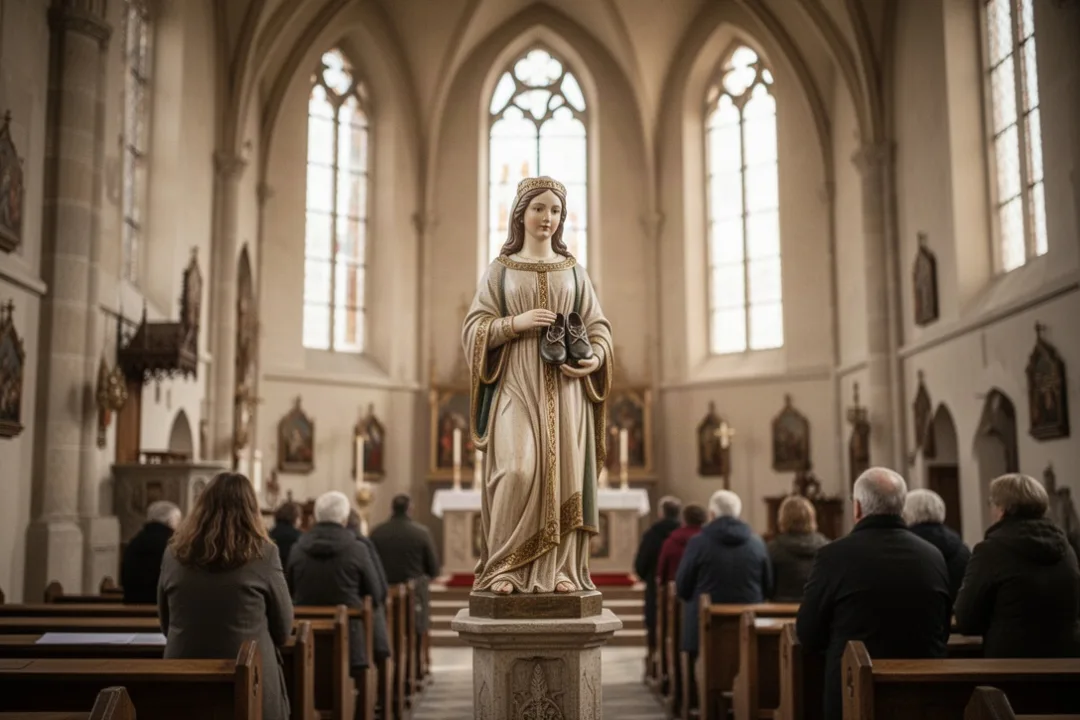
One familiar tradition says that Hedwig often went barefoot. When her confessor instructed her to wear shoes, she carried them in her hands rather than putting them on. The story is usually presented as an example of obedience: she accepted the instruction while retaining her desire for austerity.
Images of Saint Hedwig sometimes show her holding shoes in her hands. This visual detail helps distinguish her from other saints and recalls the traditional story. It should not be treated as a complete biography, but it communicates an important theme: humility must be practiced, and obedience can require a person to moderate even a sincere religious preference.
Hedwig’s humility did not mean neglecting her responsibilities. She continued to act as a duchess and benefactor. Her example suggests that humility is not the same as passivity; it can mean using authority without treating power, wealth, or social position as personal entitlement.
Saint Hedwig’s relationship with prayer and penance
Hedwig’s religious life included regular prayer, fasting, confession, and devotion to the Mass. Medieval sources describe her as deeply committed to the Christian worship of her time. She was also associated with bodily penance, a practice that should be understood within the historical setting of medieval spirituality rather than copied without guidance.
Her prayer was connected to action. She did not treat private devotion as a substitute for justice or mercy. The pattern traditionally associated with her life is simple: pray seriously, accept responsibility, and respond to suffering.
People who pray with Saint Hedwig today may ask for help with family grief, difficult responsibilities, poverty, migration, illness, or the challenge of using authority well. A prayer to a saint is not a magical formula. In Catholic practice, asking for a saint’s intercession means asking that saint to pray with and for the person seeking God’s help.
“Blessed are the merciful” is the theme associated with Matthew 5:7: people who show mercy are themselves recipients of mercy.
That Gospel teaching is especially fitting for Hedwig’s memory. Her reputation rests not only on private devotion but also on mercy that became visible through hospitality, advocacy, generosity, and care for people in distress.
Saint Hedwig’s canonization and lasting devotion
Hedwig was canonized in 1267 by Pope Clement IV, a little more than two decades after her death. The relatively short time between her death and canonization reflects the strength of the devotion that developed around her and the importance of Trzebnica as a religious center.
Her shrine at the Trzebnica Basilica became a major place of pilgrimage. Devotion to her spread through Silesia and beyond, especially among people who valued her connection with family life, widowhood, charity, and the region’s religious identity.
Saint Hedwig is commonly represented wearing the clothing of a duchess or a widow. Artists may show her with a church, a crown, a small model of a church, or shoes. Each symbol points to a different part of her story:
A ducal or noble dress recalls her social position and public duties.
A widow’s clothing represents the years she spent after Henry’s death.
A church or convent points to her support for Trzebnica and religious foundations.
Shoes held in her hands recall the traditional account of her barefoot devotion and obedience.
A crown may represent her noble rank, while also suggesting that holiness is not limited to people without public authority.
Saint Hedwig of Silesia and Saint Hedwig of Poland
Two well-known Catholic saints share the name Hedwig, and they are easy to confuse. Saint Hedwig of Silesia, the subject of this name in most devotional contexts, was the duchess associated with Trzebnica and died in 1243. Her feast day is October 16.
Saint Hedwig of Poland, also called Jadwiga, lived later and became queen of Poland. She died in 1399 and is honored on July 16. She was known for her learning, charitable work, support for the Church, and role in the Christian history of Lithuania and Poland.
The two women were both members of European royalty or nobility and both are remembered for faith and service. Their biographies, however, are different. When looking for a medal, prayer card, church dedication, or historical source, check whether the image or description refers to Hedwig of Silesia or Hedwig of Poland.
Helpful distinction: October 16 belongs to Saint Hedwig of Silesia; July 16 belongs to Saint Hedwig, Queen of Poland. The feast dates help identify which saint a source is describing.
What Saint Hedwig is the patron saint of
Saint Hedwig of Silesia is chiefly associated with Silesia and the town of Trzebnica. Because of her life as a wife, mother, widow, duchess, and benefactor, many people also turn to her in matters involving family responsibilities, grief, poverty, and the wise use of influence.
Some devotional lists identify her as a patron of brides, widows, and difficult marriages. These associations arise from her biography and later popular devotion rather than from one single official list that is identical everywhere. Local churches and communities may emphasize different aspects of her intercession.
People may reasonably ask Saint Hedwig to pray for:
Families facing grief or the death of a child.
Widows and widowers adjusting to life after the loss of a spouse.
People living in poverty or seeking compassionate assistance.
Leaders and officials who need wisdom and a spirit of mercy.
Marriages under strain, while also seeking practical counseling and support.
People connected with Silesia and those far from their homeland.
Intercession does not replace responsible action. Someone praying for a struggling marriage may also need honest communication, pastoral guidance, professional counseling, or protection from abuse. Someone asking for help with poverty may need a housing service, food assistance, medical care, or legal advice. Hedwig’s own example points toward mercy expressed through real help.
How to observe Saint Hedwig’s feast day
On October 16, Catholics may attend Mass, read about Hedwig’s life, visit a church or shrine dedicated to her, or pray for people who are poor, grieving, displaced, or carrying difficult responsibilities. A parish may celebrate her with a special service, procession, charitable collection, or cultural event connected with Silesian heritage.
A meaningful observance does not need to be elaborate. The most fitting practice is one that joins prayer with a deliberate act of mercy. You might contact someone who is grieving, donate useful supplies to a shelter, support a local food pantry, or offer practical help to an older neighbor.
Begin with prayer: Ask God for the humility and compassion associated with Saint Hedwig.
Remember a specific need: Pray for a family, community, or person rather than using only general intentions.
Learn one historical detail: Read about Trzebnica, her family, or her charitable work.
Choose a concrete act of service: Give time, money, food, transportation, or personal attention where it is genuinely useful.
Review the day: Consider whether your response respected the dignity and actual needs of the person you wanted to help.
Common mistakes when learning about Saint Hedwig
Saint Hedwig’s story is surrounded by devotional traditions, regional customs, and similar names. A few simple checks can prevent confusion and help you read older accounts responsibly.
Do not confuse the two Saint Hedwigs: Check the feast date and biography before using a prayer card or image.
Do not treat every legend as a verified detail: Medieval saintly biographies often teach through symbolic stories.
Do not reduce her to a noble title: Her significance comes from how she used privilege for prayer, mercy, and service.
Do not assume patronage lists are universal: Different regions may describe her intercession in different ways.
Do not copy severe penances casually: Her ascetic practices belonged to a specific historical and spiritual setting.
Do not separate prayer from responsibility: Her example joins devotion with practical care for suffering people.
It is also useful to distinguish historical evidence from later interpretation. The broad outline of Hedwig’s life is well established: her noble birth, marriage to Henry, association with Silesia and Trzebnica, widowhood, death, and canonization. Individual stories about miracles, private conversations, or unusual acts of penance may come from later devotional sources and should be read with appropriate care.
A simple prayer inspired by Saint Hedwig
You can pray in your own words, asking God to shape your life according to the virtues associated with Hedwig. A short prayer might ask for compassion without pride, courage in family suffering, wisdom in positions of authority, and generosity toward people who need practical help.
For a fuller prayer, begin by naming a specific person or situation. Ask for the grace to see that person’s dignity, to avoid judgment, and to respond appropriately. Then ask Saint Hedwig to intercede for you and for those in need. End by committing to one action that reflects the prayer.
For example, you might pray: “God of mercy, through the intercession of Saint Hedwig, teach me to use what I have for the good of others. Give comfort to those who grieve, protection to those who are vulnerable, and wisdom to those who carry responsibility. Help me serve with humility and act with courage.”
This kind of prayer reflects the central pattern of Hedwig’s legacy. She was not remembered because she held a title alone, nor because she withdrew from every responsibility. She is remembered because faith shaped the way she treated people, especially those whose suffering could easily be ignored.
Why Saint Hedwig still matters
Hedwig’s life offers a distinctive model of holiness because it includes wealth, marriage, parenthood, political responsibility, bereavement, widowhood, and religious discipline. Her story does not suggest that a person must leave every public role to live faithfully. It asks how authority and resources can be directed toward service.
Her memory also challenges a narrow idea of charity. Charity is not only an occasional donation or a feeling of sympathy. In Hedwig’s tradition, it includes attention, sacrifice, advocacy, hospitality, and steady support for institutions that care for people over time.
For people connected to Silesia, Saint Hedwig can represent home, heritage, and spiritual continuity. For others, she offers a model for living through family loss, making responsible decisions, and responding to poverty with dignity rather than distance.
The clearest way to honor Saint Hedwig is to let her example become practical: pray with seriousness, use influence carefully, accept suffering without becoming hardened, and offer help that meets real needs. Her feast day provides a yearly opportunity to remember that mercy is strongest when it becomes action.
Frequently asked questions
Is Saint Hedwig the patron saint of difficult marriages?
She is associated in popular devotion with marriages, spouses, widows, and family difficulties because of her own marriage, family losses, and reputation for faithful service. However, patronage descriptions can vary by region and devotional tradition. Prayer for her intercession can accompany, but should not replace, honest communication, pastoral guidance, counseling, or safety planning when a relationship is seriously troubled.
Where is Saint Hedwig buried?
Saint Hedwig of Silesia is buried at the Basilica of Saint Hedwig in Trzebnica, Poland. The church is connected with the Cistercian convent she helped establish and became an important pilgrimage site. Her tomb and the surrounding religious complex remain closely linked with her memory and with the history of Silesian Catholic devotion.
What does Saint Hedwig hold in religious artwork?
Artistic depictions may show her holding a church, a crown, or shoes. The church represents her support for religious foundations, while the crown recalls her noble status. Shoes held in her hands refer to a traditional story that she walked barefoot and carried shoes after her confessor instructed her to wear them.
When should someone pray to Saint Hedwig?
There is no required occasion for asking Saint Hedwig’s intercession. People commonly pray to her on October 16, her feast day, or during family grief, widowhood, financial hardship, and difficult leadership decisions. Her example is especially relevant when prayer needs to be joined with practical mercy, such as supporting a shelter, visiting someone who is sick, or assisting a person in crisis.
















Leave a Reply