Saint Colette: life, prayers, feast day, and patronage
Saint Colette: life, prayers, feast day, and patronage
Are you looking for a saint connected with prayer, motherhood, and renewal? Saint Colette was a French religious reformer who brought fresh discipline and spiritual purpose to the Poor Clare tradition while remaining deeply attentive to ordinary human needs. Her feast day is March 6, and many people turn to her when praying for children, pregnancy, family life, or a more faithful religious vocation.
Saint Colette lived from 1381 to 1447 in France. Born Nicolette Boellet, she became known as Colette, a familiar form of her baptismal name. After losing her parents, she embraced a life of severe prayer, became an anchoress, and eventually entered the Franciscan world. She went on to establish and reform communities of Poor Clare nuns known for poverty, silence, penance, prayer, and Eucharistic devotion.
At a glance: Saint Colette is remembered as the founder of the Colettine reform of the Poor Clares. Her liturgical feast is March 6, and she is especially associated with expectant mothers, childbirth, sick children, and people seeking a faithful new beginning.
Saint Colette was born in Corbie, Picardy, a region in northern France. Her parents were Robert and Marguerite Boellet. Her father served as an administrator connected with the Benedictine abbey at Corbie, and her family appears to have provided a stable Christian home. According to her traditional biography, her parents had prayed for a child for many years before her birth, which helped shape later devotion to her as a patron of families hoping for children.
Her original name was Nicolette. “Colette” developed as a shorter form, and both names remain associated with her. As a child and young woman, she showed an unusual attraction to prayer, simplicity, and care for people in need. She also had a practical temperament: her holiness was not only about private religious experiences but about creating communities with a clear rule of life.
Colette’s life unfolded during the Western Schism, a period when rival claimants to the papacy divided the Church. This complicated political and religious setting affected the religious orders as well. Colette’s reform work took place within that unsettled environment, requiring persistence, travel, negotiation, and strong support from Franciscan authorities.
How Colette became a religious woman
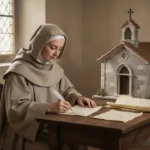
Colette lost both of her parents when she was still young. After their deaths, she considered several forms of religious life, including communities associated with the Beguines and Benedictines. None of these paths fully answered her desire for a demanding life of prayer and enclosure. In 1402, she became an anchoress, living enclosed beside a church according to the spiritual customs of the time.
An anchoress was not simply a person who preferred solitude. Enclosure represented a formal commitment to prayer, penance, and separation from ordinary social life. Colette’s cell was connected with the church, allowing her life to center on the liturgy and the Eucharist. People also sought spiritual counsel from anchoresses, so her solitude did not necessarily mean complete isolation from the needs of others.
During this period, Colette became convinced that she should help renew the Order of Poor Clares, the women’s branch of the Franciscan movement founded in the spirit of Saint Clare of Assisi. She wanted the communities to live more strictly according to Clare’s original emphasis on poverty and enclosure. Her goal was not to create a separate spirituality disconnected from Saint Clare, but to recover and strengthen the order’s original ideals.
What the Colettine reform changed
Colette’s work produced a reform within the Poor Clares that became known as the Colettine reform. She emphasized a demanding communal life shaped by poverty, manual work, silence, fasting, prayer, and strict enclosure. The sisters were to depend on God and the generosity of others rather than accumulating property as a community. This way of life required careful organization as well as personal devotion.
With approval from Pope Benedict XIII, Colette began establishing and reforming monasteries. She worked with Franciscan leaders and supporters who helped her navigate ecclesiastical structures. Her communities spread in parts of France and beyond, and the reform continued after her death among Poor Clare monasteries that adopted her observance.
The reform was demanding, but it was not based on harshness for its own sake. Colette understood religious discipline as a way to protect the central purpose of a monastery: loving God through prayer and self-giving. Poverty was intended to free the sisters from dependence on possessions. Silence created space for attention to God. Enclosure made the monastery a stable place of prayer rather than a rejection of the dignity of ordinary people.
Her approach also reflected Saint Clare’s influence. Clare had defended the Poor Clares’ right to live without owning property, and Colette sought to preserve that spirit. For Colette, reform meant returning to a demanding foundation rather than continually relaxing the community’s commitments.
Where Saint Colette lived and worked
Colette’s ministry required far more movement than many people might expect from someone associated with enclosure. She traveled to found, inspect, and guide monasteries, often working with church officials, religious superiors, benefactors, and local communities. Her reform became established in places such as Besançon, Auxonne, Poligny, Le Puy, and Ghent.
She did not simply write instructions and leave others to apply them. Colette helped shape daily life in the communities she founded or reformed. Her leadership included spiritual direction, practical administration, formation of new members, and efforts to preserve the community’s relationship with the Franciscan order.
Tradition also remembers Colette as a woman of intense mystical prayer. Stories about visions, miracles, and special experiences surround her life. Such accounts should be read within the devotional writing of her period rather than treated as the only reason for her sanctity. Her more visible legacy is the lasting religious reform that gave many women a disciplined setting for prayer and service.
Saint Colette’s connection with motherhood and children
Saint Colette is commonly invoked by expectant mothers, women hoping to conceive, and parents concerned about a sick child. This patronage is connected partly with the story of her own birth after her parents had prayed for a child. It also reflects the way popular devotion often grows around saints whose lives or reported miracles touch family concerns.
Her association with childbirth does not mean that prayer to her guarantees a particular medical result. A prayer can express hope, fear, gratitude, and trust while medical care addresses physical needs. Someone facing infertility, pregnancy complications, or a child’s illness can ask Saint Colette’s intercession and still seek qualified doctors, emergency help, counseling, and pastoral support.
For families, Colette can represent a form of faith that takes both longing and uncertainty seriously. Her story includes waiting, loss, demanding choices, and work that developed over many years. Those themes can make her a meaningful companion for people whose prayers do not receive quick or simple answers.
For health concerns: Devotion to Saint Colette belongs alongside appropriate medical care, not in place of it. A short prayer can accompany an appointment, a difficult diagnosis, a labor and delivery plan, or support for a sick child.
Saint Colette’s feast day and religious calendar
The feast of Saint Colette is celebrated on March 6. The date recalls her death in Ghent in 1447 and is used by Catholics to remember her life, intercession, and reform of the Poor Clares. Parish communities, religious houses, and individuals may mark the day with Mass, prayer, a novena, or a reading about Franciscan spirituality.
Colette was canonized in 1807 by Pope Pius VII. Canonization formally recognizes a person as a saint for the universal Church and permits public veneration according to the Church’s liturgical norms. Her recognition came centuries after her death, reflecting the long development of devotion to her and the continuing importance of the communities connected with her reform.
Some calendars and communities may emphasize her feast differently, especially where a local patron or religious founder has a particular place. If you want to attend a liturgy, check your parish or diocesan calendar because local observances can vary.
What Saint Colette’s symbols can mean
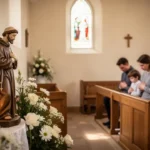
Religious art may portray Saint Colette in the habit of a Poor Clare nun, often with a cross, a book, or an image associated with the Eucharist. Artists and devotional traditions do not always use the same symbols, so an image can vary by country, church, or religious community.
The cross points to her willingness to accept sacrifice and perseverance. A book can represent the rule of life that guided her communities and her careful commitment to religious formation. Eucharistic imagery reflects the central place of the Mass and prayer in her spirituality. When she is shown with a child or in a scene connected with motherhood, the image usually reflects her popular patronage rather than a central event from her own daily life.
Her religious habit also matters. It identifies her with the Franciscan family and with the Poor Clare tradition. Saint Colette’s identity cannot be separated from Saint Clare of Assisi, whose ideals she sought to renew. The image of Colette is therefore not only an image of a private mystic; it is also an image of a builder of communities.
How to pray with Saint Colette
You do not need a long or elaborate prayer to ask for Saint Colette’s intercession. Begin by naming the intention honestly. You might be praying for conception, a safe delivery, a sick child, fidelity to a vocation, a religious community, or courage to repair a neglected part of your spiritual life.
Many people find it helpful to connect prayer with a practical act of attention. A parent might pray before calling a pediatrician. Someone discerning a vocation might speak with a trusted priest or religious sister. A person seeking renewal might set aside a regular time for quiet prayer rather than making a promise that cannot be sustained.
A simple prayer can follow this pattern:
Address God and state your intention clearly.
Ask Saint Colette to pray with you and for you.
Offer your fear, hope, or uncertainty without pretending to control the outcome.
Ask for wisdom to take the next responsible step.
End with gratitude, even if the answer remains unknown.
You can also pray with a passage of Scripture by reading the reference and reflecting on its meaning. For example, Luke 1:37 is often associated with trust in God’s power, while Matthew 11:28-30 invites people carrying heavy burdens to turn toward Christ. Read the text in a Bible you trust, then connect its message with Saint Colette’s example of patient, disciplined faith.
Common mistakes when learning about Saint Colette
Saint Colette’s story is sometimes reduced to a list of patronages or extraordinary legends. That can leave out the central part of her vocation: she was a religious reformer and founder who created structures that helped other women live a demanding spiritual life. Her significance is broader than a single prayer intention.
Confusing Colette with another saint: Her full name was Nicolette Boellet, and she is also called Saint Colette of Corbie.
Assuming she founded the entire Poor Clare order: Saint Clare of Assisi founded the order; Colette later led an important reform within it.
Treating patronage as a promise: Asking for intercession is not a guarantee of a specific medical, family, or personal outcome.
Ignoring the historical setting: Her work took place during the Western Schism, which shaped her relationships with church authorities and religious leaders.
Reducing holiness to mystical stories: Her perseverance, administration, obedience, and care for religious communities are essential parts of her legacy.
Leaving out professional help: Prayer for pregnancy, infertility, or illness should accompany competent medical and emotional support.
Another common mistake is assuming that strict religious observance automatically means a lack of compassion. Colette’s communities practiced severe discipline, but the purpose was a deeper dedication to God and to the needs of the Church. Her example invites careful discernment: a commitment is valuable when it forms love, humility, steadiness, and responsibility.
March 6 can be observed simply, privately, or as part of a parish community. You might attend Mass, read about the Poor Clare tradition, or spend a few minutes praying for a family member. A feast day does not require an elaborate event; attention and sincerity matter more than scale.
Pray for mothers, children, couples hoping for a child, and families facing medical uncertainty.
Learn about Saint Clare of Assisi and the relationship between her original rule and Colette’s reform.
Contact a local Poor Clare monastery, where appropriate, to learn about prayer requests or vocation information.
Give practical support to a parent, child, or family carrying a difficult responsibility.
Set aside a regular period of silence and use it to examine where your own life needs renewal.
Ask for the grace to make one specific, responsible change rather than promising many vague improvements.
Families can also remember Colette by praying together for children and for those who care for them. Keep the prayer age-appropriate and avoid presenting the saint as a magical solution. Children can learn that saints are people who point toward God through the way they lived, served, endured, and prayed.
What Saint Colette teaches about renewal
Colette’s life offers a practical view of renewal. She did not respond to spiritual decline with slogans or temporary excitement. She returned to a clear purpose, accepted demanding responsibilities, and worked patiently to build communities that could continue after her death.
That lesson can apply outside a monastery. You may need to renew a prayer routine, repair a family relationship, reconsider a vocation, or restore order to a commitment you have neglected. Colette’s example suggests beginning with truthful examination, steady practice, and support from a community rather than relying on willpower alone.
Her story also shows that hidden prayer and visible work belong together. The anchoress who sought solitude later became a founder who traveled and organized. The woman devoted to silence still had to speak with officials, guide communities, and make difficult decisions. Saint Colette therefore represents both contemplation and action: a life rooted in prayer and expressed through faithful responsibility.
For someone asking what Saint Colette means today, the answer is not limited to a particular need. She is a companion for people seeking renewal in a serious way, especially when that renewal requires patience, discipline, trust, and care for others.
Frequently asked questions
What is Saint Colette the patron saint of?
Saint Colette is especially associated with expectant mothers, women hoping to conceive, childbirth, sick children, and family concerns. She is also relevant to Poor Clare communities and people seeking renewal in religious life. Patronage expresses a tradition of asking for a saint’s intercession; it does not promise a particular medical or personal result.
When is Saint Colette’s feast day?
Saint Colette’s feast day is March 6. It commemorates her death in 1447 and is observed by Catholics through Mass, personal prayer, devotional reading, or other local customs. The way her feast is celebrated can differ among dioceses, parishes, and religious communities.
Is Saint Colette the founder of the Poor Clares?
No. Saint Clare of Assisi founded the Poor Clare tradition. Saint Colette later led a major reform within the order, seeking a stricter return to poverty, enclosure, prayer, fasting, and communal discipline. The communities shaped by her work are known as the Colettine Poor Clares.
What is a simple prayer to Saint Colette?
You can ask Saint Colette to pray for your intention in your own words. Name the person or situation, ask for wisdom and strength, and place the outcome in God’s care. If the prayer concerns illness, infertility, pregnancy, or a child’s health, continue with appropriate medical and pastoral support.













Leave a Reply