Saint Clare of Assisi was an Italian religious founder who gave up a wealthy life to follow Christ in radical poverty and prayer. Born in Assisi around 1194, she became the spiritual companion of Saint Francis and founded the Order of Poor Ladies, now commonly called the Poor Clares.
Clare is remembered for her devotion to the Eucharist, her courageous leadership, and the rule she wrote for her community. The Catholic Church celebrates her feast day on August 11, and she is the patron saint of television, eye disorders, embroiderers, and laundry workers.
Who Saint Clare of Assisi was and why she is remembered
Clare was born into the noble Offreduccio family in Assisi, a hill town in central Italy. Her family expected her to marry advantageously, as was customary for a young woman of her social position. Instead, Clare was drawn to a life centered on prayer, simplicity, and service.
As a young woman, she heard Saint Francis of Assisi preach. Francis had already become known for abandoning wealth and rebuilding his life around the Gospel. Clare recognized in his example a way of living that matched her own desire to belong entirely to God.
On the night of Palm Sunday in 1212, Clare left her family home and went to the church of Saint Mary of the Angels, known as the Porziuncola. Francis received her, cut her hair as a sign of religious consecration, and helped her begin a new life. Her family tried to bring her back, but Clare firmly resisted their efforts.
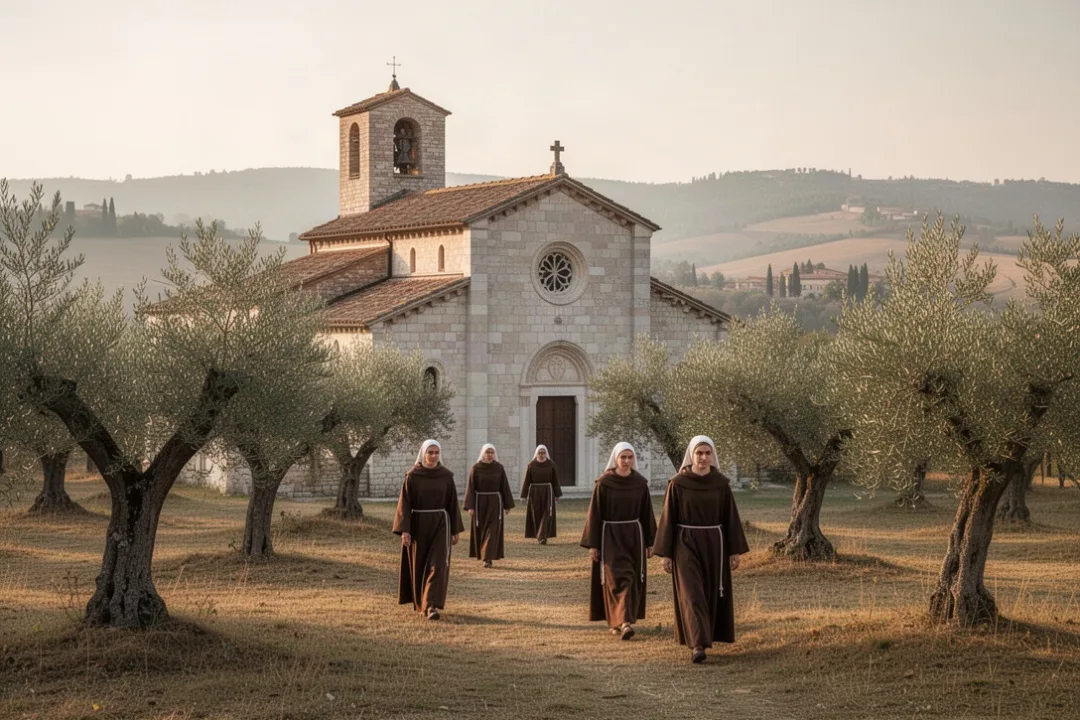
She first stayed with Benedictine women and later moved to San Damiano, a small church outside Assisi that Francis had repaired. Other women joined her there, including her sister Agnes. The community became known for its prayer, work, humility, and strict dependence on God rather than property or financial security.
Clare spent more than four decades at San Damiano. Although she lived in seclusion, her influence reached far beyond Assisi. Women across Europe sought to imitate her way of life, and communities connected with her became known as the Poor Clares.
The central idea: Clare believed that poverty was not simply having fewer possessions. It was a way of relying on God, sharing life with others, and refusing wealth that would weaken the community’s freedom to follow the Gospel.
How Clare followed Saint Francis and founded the Poor Clares
Clare and Francis shared a vision of Christian life marked by poverty, humility, penance, and compassion. Their movements were connected, but Clare was not merely a follower who repeated Francis’s work. She developed a distinct community for women and exercised genuine spiritual and administrative leadership.
The women at San Damiano were first called the Poor Ladies. Their daily life included communal prayer, manual work, silence, fasting, and care for one another. They also welcomed spiritual guidance from Francis and the friars, while Clare increasingly became responsible for protecting the community’s identity and organizing its life.
Clare’s most difficult challenge concerned property. Medieval religious communities often needed land, buildings, endowments, and income to survive. Clare feared that accepting permanent possessions could change the character of her community and make the sisters dependent on wealth rather than mutual support and divine providence.
She therefore sought an official permission known as the Privilege of Poverty. This permission allowed the sisters to live without owning property, either individually or as a community. Clare treasured the privilege because it protected the form of life she believed Christ had given her to pursue.
Church authorities sometimes worried about whether such strict poverty was practical or responsible. Clare, who governed a real community with sick sisters, aging members, and daily needs, did not treat poverty as an abstract ideal. She understood its cost and still believed that voluntary simplicity could be a powerful witness.
The Poor Clares developed over time, and their communities have not all followed exactly the same customs. Some later houses adopted more moderate forms of enclosure or property arrangements. Even so, Clare’s name remains associated with contemplative prayer and evangelical poverty.
What life at San Damiano involved
San Damiano was not a retreat from responsibility. Clare served as abbess and cared for the sisters’ physical and spiritual needs. Accounts of her life describe her attention to the sick, her concern for the poor, and her willingness to perform humble tasks rather than place herself above the community.
The sisters worked with their hands and depended partly on assistance from outside the monastery. Their prayer was central, but it was joined to practical duties. A community could not survive through spiritual ideals alone; it also needed food, clothing, care for illness, and disciplined relationships.
Prayer: The sisters gathered for the Church’s liturgical prayer and private contemplation.
Work: Manual labor supported the community and gave structure to daily life.
Shared poverty: Possessions were held simply, and resources were distributed according to need.
Mutual care: The sisters were expected to support the sick, elderly, and vulnerable members.
Enclosure: A protected setting helped the community preserve its contemplative vocation.
Clare’s teachings on poverty, prayer, and contemplation
Clare’s spirituality is especially visible in her letters to Agnes of Prague, a Bohemian princess who entered religious life and founded a community of Poor Clares. These letters show Clare encouraging Agnes to remain faithful to a life of poverty and to keep Christ at the center of her attention.
Clare often used the language of looking, contemplating, and becoming transformed by what one loves. For her, prayer was not only the recitation of words. It was a sustained turning of the heart toward Jesus Christ, especially Christ in humility, suffering, and self-giving love.
Her writing encourages Agnes to consider Christ as a mirror. That image means that prayer reveals both who Christ is and who the believer is called to become. The person praying learns to see divine love more clearly and then to shape her choices around it.
Clare’s approach to poverty was also deeply personal. She did not praise deprivation for its own sake. She saw poverty as participation in Christ’s humble life and as a form of freedom from possessions that can control a person’s priorities.
Her spirituality joined contemplation with action. A sister who prayed deeply was also expected to show patience, humility, forgiveness, and practical charity. Spiritual insight had to become visible in the way the community treated its members.
Clare’s surviving works include four letters to Agnes of Prague, a rule for her community, a testament, and a blessing. Together, these writings present a woman who was both contemplative and precise. She cared about the inner life, but she also understood the importance of clear guidance for a community that needed to endure.
Why Clare’s rule mattered
In 1253, Pope Innocent IV approved Clare’s rule for the monastery of San Damiano. Clare was the first woman known to have written a formal rule for a religious community that received papal approval. This achievement matters because it shows her authority as a founder and spiritual legislator.
The rule addresses prayer, fasting, clothing, silence, work, community discipline, leadership, and the treatment of sisters. It also protects the community’s commitment to poverty. Clare’s rule reflects her effort to preserve the original inspiration of San Damiano while giving the sisters a stable pattern for daily life.
Clare died on August 11, 1253, only two days after her rule was approved. She was canonized in 1255 by Pope Alexander IV. Her writings and the communities that continued after her death made her one of the most influential women religious figures of the medieval Church.
Clare’s example presents holiness as a life of focused love: choosing what matters most and allowing that choice to shape every ordinary duty.
Stories about Saint Clare’s courage and Eucharistic devotion
Several stories about Clare have been preserved in early biographies and devotional tradition. They portray her as a woman of remarkable courage, particularly when San Damiano faced danger. Some accounts describe her carrying the Blessed Sacrament to the convent’s boundary while praying for protection.
According to this tradition, the attackers withdrew after encountering Clare and the Eucharist. The story is commonly interpreted as a sign of her trust in Christ’s presence. It should be read within the devotional style of medieval saints’ biographies, which often used dramatic events to express a person’s spiritual character.
Another well-known tradition says that Clare was unable to attend the celebration of Christmas Mass because of illness. She is said to have experienced the liturgy mystically from her room, perceiving the celebration taking place at a distance. This story contributed to her later association with television.
The Church does not teach that every popular detail in a saint’s biography must be treated as a historical report in the same way as a documented event. Devotional stories can still communicate what a community recognized in a holy person. In Clare’s case, the stories emphasize prayer, courage, and devotion to the Eucharist.
Clare’s strength was not aggressive or self-promoting. It appeared in her ability to remain faithful under pressure, defend the sisters’ vocation, and govern with patience. Her leadership shows that gentleness and firmness are not opposites.
Saint Clare’s feast day, symbols, and patronage
The Catholic Church celebrates Saint Clare of Assisi on August 11. Her feast day is observed with Masses, prayer services, religious celebrations, and gatherings connected with Poor Clare monasteries. Some communities also mark the day with special attention to her writings and the contemplative vocation.
Artists commonly portray Clare wearing the habit of a Poor Clare and holding one of several symbols. The most recognizable is a monstrance, the vessel used to display the consecrated Eucharist. This image recalls her devotion to the Blessed Sacrament and the story of San Damiano’s protection.
Other images show Clare with a book, referring to her rule and writings, or with a crozier, representing her role as abbess. A lamp or lily may also appear in religious art, reflecting themes of virginity, prayer, and spiritual light.
Clare is widely known as the patron saint of television, a patronage connected with the traditional account of her seeing or hearing Christmas Mass while ill. She is also associated with eye disorders, embroiderers, goldsmiths, laundry workers, and some groups whose work involves light or vision.
Patronage can vary by region and devotional tradition. A person may ask Clare’s prayers for a number of intentions, especially those related to vision, media, contemplative life, religious vocations, or the courage to live simply.
August 11: Saint Clare’s annual feast day.
Monstrance: A symbol of her Eucharistic devotion.
Book: A reminder that she wrote a rule and other spiritual works.
Poor Clare habit: A sign of her community and its contemplative vocation.
Television: A patronage associated with the traditional vision of Christmas Mass.
How to pray with Saint Clare’s example today
Praying with Clare does not require joining a monastery or imitating every medieval practice. Her life can guide anyone who wants to examine the role of possessions, attention, prayer, and service in ordinary life.
Begin by asking what receives your most consistent attention. Clare’s spirituality challenges the habit of allowing possessions, status, or constant distraction to determine what matters. Her example invites a more deliberate relationship with time, money, technology, and work.
Her devotion can also shape Eucharistic prayer. A Catholic might spend a few quiet minutes before the tabernacle or during Eucharistic adoration, asking for the grace to see Christ more clearly and to treat other people with greater patience. Those who cannot attend adoration can still pray with a Gospel passage and reflect on Christ’s humility.
Clare’s community life offers another practical lesson. Holiness is not measured only by private feelings. It is tested in how you respond to inconvenience, illness, disagreement, and the needs of people who depend on you.
A simple prayer practice: Read one of Clare’s letters to Agnes of Prague, sit quietly for several minutes, and ask, “What would it mean to place Christ at the center of this decision?” End by choosing one concrete act of patience, generosity, or simplicity.
You can also remember Clare through acts that reflect her values:
Set aside quiet time for prayer without a phone or other interruption.
Review one possession or expense and consider whether it serves a real need.
Support a contemplative community through prayer, supplies, or a donation.
Care for someone vulnerable through a practical act rather than a vague intention.
Pray for courage when faithfulness requires a difficult but honest choice.
A traditional prayer may ask Saint Clare to intercede for purity of heart, freedom from excessive attachment, and deeper love for Christ. You may also speak to God in your own words, using Clare’s life as a guide. The point is not to copy her historical circumstances exactly, but to receive her witness as an invitation to focused love and faithful simplicity.
Where Saint Clare’s legacy continues
Communities of Poor Clares continue to live contemplative religious life in many countries. Their daily routines differ, but they generally preserve Clare’s emphasis on prayer, community, enclosure, and service. Monasteries may support themselves through work such as baking, making altar bread, handicrafts, or other forms of labor, depending on local needs.
Clare’s influence also appears in the wider Franciscan family. Her life reminds Christians that women have not merely received spiritual traditions; they have interpreted, organized, defended, and transmitted them. Her rule demonstrates that a woman religious leader could articulate a demanding vision and secure its recognition within the Church.
Her witness remains relevant because it addresses questions that are not limited to the thirteenth century: How much is enough? What deserves your attention? How can a community protect its weakest members? What does leadership look like when it is based on service rather than control?
Saint Clare of Assisi answered those questions through a life that united contemplative prayer, disciplined community, courageous poverty, and love for Christ. Her legacy is found not only in statues and feast-day celebrations, but also in every person who chooses a simpler, more attentive, and more generous way of living.
Frequently asked questions
Was Saint Clare of Assisi related to Saint Francis of Assisi?
No. Clare and Francis were not relatives. They came from different families in Assisi, but Francis became Clare’s spiritual mentor after she chose religious life. He helped receive her into her new vocation, and the two established closely connected Franciscan communities: the Friars Minor for men and the Poor Ladies for women.
What is the difference between Poor Clares and Franciscans?
The Poor Clares are a community of women religious founded by Clare, while the Franciscans began as a community of men founded by Francis. Both traditions share a commitment to Christ, poverty, prayer, and service, but Poor Clare monasteries generally have a contemplative and enclosed form of religious life.
Did Saint Clare write any books?
Clare did not write a modern book, but several important works by her survive. They include four letters to Agnes of Prague, her Testament, a blessing, and the rule she composed for the community at San Damiano. These writings explain her understanding of poverty, prayer, community life, and devotion to Christ.
Why is Saint Clare the patron saint of television?
Her patronage of television comes from a traditional account that, while seriously ill and unable to attend Christmas Mass, Clare perceived the celebration from her room. Because this story involves seeing a liturgy at a distance, she later became associated with television and other forms of visual communication.














Leave a Reply