Francis of Assisi: his life, teachings, and lasting legacy
Francis of Assisi: his life, teachings, and lasting legacy
Francis of Assisi chose a life of poverty, peace, and service after abandoning wealth and status to follow the teachings of Jesus. His example shaped Christian spirituality, inspired religious communities, and continues to influence conversations about compassion, peace, and care for the natural world.
Born in Assisi, Italy, in the late twelfth century, Francis lived during a period marked by social inequality, military conflict, and growing commercial wealth. He began life as the son of a successful cloth merchant and expected to enjoy the privileges of his family. Instead, a series of experiences gradually redirected his ambitions toward service among the poor, prayer, and a simpler way of living.
Francis is remembered as a Catholic saint, the founder of the Franciscan movement, and the companion of Saint Clare of Assisi. His feast day is observed on October 4. The Catholic Church also celebrates the Season of Creation around this period, partly because Francis has become closely associated with gratitude for the earth and responsibility toward living creatures.
How Francis of Assisi changed direction from wealth to service
Francis was born Giovanni di Pietro di Bernardone, probably in 1181 or 1182. His father, Pietro Bernardone, was a prosperous cloth merchant who traded across Europe. During Francis’s childhood, his family’s wealth gave him access to comfortable clothing, education, social connections, and the possibility of an influential future.
According to the traditional accounts of his life, Francis enjoyed music, fine clothes, feasts, and the company of friends. He was not initially known for religious seriousness. He wanted the honor associated with knighthood and took part in the conflicts between Assisi and neighboring cities.
His military ambitions were interrupted when he was captured during a battle and held prisoner for roughly a year. After returning to Assisi, he became increasingly dissatisfied with the life he had imagined. Prayer, illness, and encounters with people living in poverty gradually altered his understanding of success.
One of the best-known turning points involved a leper. Francis had previously found leprosy frightening and repulsive, yet he later described meeting a leper, dismounting from his horse, and offering assistance. The experience did not simply represent an act of charity; it changed what he considered beautiful, valuable, and worthy of attention.
Francis also spent time praying in abandoned churches outside Assisi. At San Damiano, a small church in poor condition, he believed he received a call to repair the Church. At first, he understood this in a practical sense and used goods from his father’s business to help restore the building. The conflict with his father soon forced him to clarify the direction of his life.
In a public confrontation before the bishop of Assisi, Francis returned his clothing and renounced his claim to his father’s property. The episode became a symbol of his decision to depend on God rather than family wealth. His later poverty was not merely an absence of money; it was a deliberate way to live without control, prestige, or protection based on possessions.
A helpful distinction: Francis did not reject work, responsibility, or human dignity. He challenged the belief that wealth and status should determine a person’s worth, and he sought a life in which service came before possessions.
After this break with his former life, Francis repaired churches, cared for lepers, worked with his hands, and begged when necessary. His choices attracted attention because they were visible and concrete. He did not present poverty as an abstract theory; he shared the vulnerability of people who had little security.
What Francis believed about poverty, peace, and community
Voluntary poverty stood at the center of Francis’s spiritual vision. He believed his followers should own little, avoid luxury, and trust God for their daily needs. This was connected to his understanding of Jesus’s life and to his desire to remain close to people who were poor, excluded, or treated as socially insignificant.
Francis’s approach differed from simply admiring poverty from a distance. He wanted his brothers to live among ordinary people, work when possible, accept hospitality with humility, and avoid building a powerful institution around themselves. The ideal was a community of lesser brothers, a phrase that expressed humility and solidarity rather than social superiority.
His followers became known as the Friars Minor, or “Lesser Brothers.” They preached, served the sick, helped in local communities, and moved from place to place. Francis did not want them to imitate the wealth and political influence of established religious institutions. Their credibility was meant to come from their conduct.
Francis also emphasized obedience, humility, and mutual care. A brother who had fallen away from the community was not to be treated as an enemy. The Rule of the Order called for patience, forgiveness, and respect, especially when a member was weak or difficult. Such instructions reveal that Francis understood community life as demanding daily discipline, not merely shared enthusiasm.
Peace was another defining part of his message. Francis taught his followers to greet people with peace and to resist the cycle of retaliation. His commitment did not mean ignoring injustice or pretending that conflict was harmless. It meant refusing to make violence the default answer to fear, rivalry, or disagreement.
Francis’s meeting with Sultan al-Malik al-Kamil during the Fifth Crusade is often remembered as an example of peaceful encounter across religious boundaries. Francis traveled to Egypt around 1219, when Christian and Muslim armies were engaged in war. The precise details of their conversation are uncertain, but the meeting demonstrates his willingness to approach a religious and political adversary without treating him as less than human.
That encounter should not be simplified into a modern dialogue program. Francis remained a Christian missionary, and his goal was connected to his faith. Yet his conduct showed that conviction and respectful contact were not opposites. He sought conversation in a setting where suspicion and violence dominated.
Live simply: use possessions as tools rather than measures of identity or status.
Serve directly: meet people in need with personal attention, not only distant concern.
Choose peace: resist humiliation, revenge, and language that turns opponents into enemies.
Practice humility: accept dependence, correction, and the limits of personal control.
Build community: make room for patience, forgiveness, and practical mutual care.
Francis’s poverty should also be understood within its medieval setting. His way of life was demanding and sometimes severe, and not every person is called to imitate every physical practice associated with him. The lasting question is not whether everyone must own exactly what Francis owned. It is how possessions, ambition, and comfort affect the way you treat other people.
How Francis founded the Franciscans and supported Clare
Francis’s first companions joined him after hearing him read passages from the Gospel and observing his way of life. The group grew quickly. In 1209, Francis and his early companions traveled to Rome to seek approval for their form of life from Pope Innocent III. The pope gave an initial approval, and the movement continued to expand.
The community eventually became one of the major mendicant orders of the medieval Church. Unlike monastic communities that generally lived in a fixed monastery, the friars traveled, preached, worked, and served among the population. Their presence in cities helped them respond to the needs of a changing society.
The formal Rule of Saint Francis received papal approval from Pope Honorius III in 1223. The Rule established a framework for the friars’ life, including poverty, prayer, obedience, preaching, and service. Francis’s original ideals had to be interpreted for a large and diverse order, creating tensions between strict poverty and the practical needs of a growing institution.
Francis did not lead the movement as a conventional political administrator. He was a spiritual founder whose authority came from his example and vision. As the order grew, other leaders handled many organizational responsibilities. This created an enduring challenge: how could a community preserve the founder’s radical simplicity while serving thousands of members across different countries?
One of Francis’s closest collaborators was Clare of Assisi. Clare came from a noble family but rejected a marriage arranged for her and chose a life of prayer and poverty. Francis supported her vocation, and she established a community at San Damiano that became known as the Poor Clares.
Clare’s community had its own identity and leadership, even though it was closely connected to Francis and the friars. She developed a rule for her sisters that defended their commitment to poverty. Her role matters because Franciscan history is not only the story of one male founder; it also includes a woman who exercised spiritual authority and helped define the movement’s understanding of simplicity.
The wider Franciscan family later included several branches and forms of membership. The First Order refers broadly to communities of friars, while the Second Order is associated with the Poor Clares. Lay people also became part of Franciscan movements through forms of the Third Order, now commonly called the Secular Franciscan Order.
These communities differ in organization and practice, but they share a connection to Francis’s central concerns: Gospel-centered living, humility, service, fraternity, and care for people who are vulnerable. Their presence today can be found in parishes, schools, hospitals, universities, missions, shelters, and social service programs.
Why Francis is associated with animals and creation
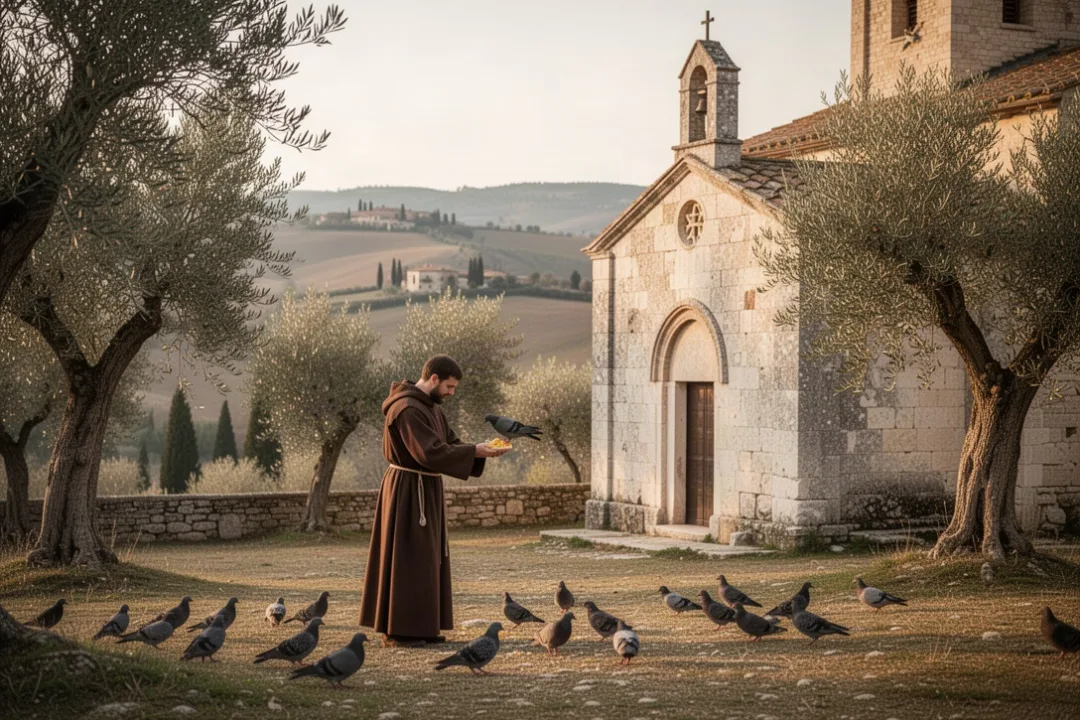
Francis is often pictured with birds or other animals, and many churches hold pet blessings near his feast day. These customs reflect stories about his relationship with animals, but they also express a broader theological vision: creation is not merely a collection of objects for human use. It is a gift that directs attention toward God and calls people to gratitude.
His best-known work on creation is the Canticle of the Creatures, a poem of praise composed near the end of his life. It gives thanks for elements of the natural world, including the sun, moon, wind, water, fire, and earth. Francis addresses them as relatives or companions, which conveys intimacy and kinship rather than domination.
The Canticle does not present nature as divine. Francis remained firmly committed to worship of the Creator. Instead, he viewed the created world as capable of revealing goodness, dependence, order, beauty, and generosity. The natural world became a teacher of humility because human beings rely on air, water, soil, food, animals, and one another.
Francis’s attitude toward creation included practical restraint. A person who owns little has fewer opportunities to consume wastefully or treat resources as unlimited. His community’s habits of simplicity, shared use, and gratitude offer a moral framework for considering environmental responsibility, even though medieval Francis could not have addressed modern industrial problems directly.
Modern environmental language can sometimes make Francis sound like a contemporary ecological activist. That description captures part of his legacy but not all of it. His concern for creation came from a deeply Christian understanding of worship, poverty, humility, and the relationship between God, humanity, and the rest of creation.
In 2015, Pope Francis published Laudato Si’, an encyclical on care for our common home. Its title comes from the opening words of the Canticle of the Creatures in an Italian form. The document presents Francis of Assisi as an inspiration for ecological conversion, concern for the poor, and resistance to a culture that treats people and nature as disposable.
Practical application: Franciscan care for creation begins with attention. Repair what can be repaired, reduce unnecessary consumption, treat animals responsibly, protect shared resources, and connect environmental choices with concern for people most affected by pollution and climate-related hardship.
What happened during Francis’s final years and how he is remembered
Francis’s later years were marked by illness, physical suffering, and difficulties within the growing order. He gradually withdrew from some administrative responsibilities, though he continued to pray, write, encourage his brothers, and seek ways to remain faithful to the movement’s original spirit.
In 1224, while praying on Mount La Verna, Francis experienced what Christian tradition calls the stigmata: bodily wounds or marks associated with the crucifixion of Jesus. Accounts describe this as a profound spiritual experience. The stigmata became one of the most distinctive features of his biography, although the meaning of the event belongs to religious faith and cannot be reduced to a simple historical measurement.
Francis also composed or dictated spiritual writings during his final period. The Canticle of the Creatures is especially significant because it joins praise with an acceptance of suffering and death. Rather than treating death only as an enemy, the poem places it within a larger relationship of dependence on God.
Francis died at the Portiuncula near Assisi on October 3, 1226. He was canonized by Pope Gregory IX in 1228, only a few years after his death. His basilica in Assisi became an important destination for pilgrims, and the town remains closely connected with his memory.
Artists have represented Francis in many forms: preaching to crowds, embracing a leper, receiving the stigmata, blessing animals, or standing among birds. Some images emphasize his gentleness, while others portray his austerity and physical suffering. Together, these representations show why he has appealed to different generations and cultures.
Francis is honored across Christian traditions, though his influence is especially strong in Roman Catholicism. He is associated with poverty and peace, interreligious encounter, service to people who are marginalized, and reverence for the natural world. His name has also been adopted by institutions, schools, charities, parishes, and organizations committed to these values.
The Franciscan legacy is not free from tension. Religious communities founded on poverty have had to manage property, education, buildings, finances, and institutional responsibilities. Francis’s example therefore remains a question as much as a model: how can a community serve effectively without allowing comfort, wealth, or authority to replace its original purpose?
For many people, Francis’s importance lies in the connection between inner conversion and outward action. Prayer led him toward the poor; humility changed his relationship with possessions; love of God shaped his treatment of creation; and his commitment to peace affected the way he approached strangers and opponents.
His life can be read as an invitation to examine ordinary choices. You might ask whether your spending reflects your values, whether you notice people who are excluded, whether you respond to disagreement with contempt, and whether your use of the natural world includes gratitude and restraint. Francis did not offer a formula that removes every difficulty. He offered a demanding pattern of attention, dependence, and service.
How to understand Francis’s message today
Francis of Assisi is sometimes reduced to a gentle figure surrounded by animals, but that image leaves out the more challenging parts of his life. He deliberately surrendered privilege, accepted insecurity, confronted social exclusion, and insisted that spiritual devotion had to become visible in relationships.
His message can be approached through several connected practices:
Examine attachment: identify possessions or ambitions that have begun to control your time, attention, or relationships.
Move toward need: replace distant sympathy with a respectful, practical response to someone facing poverty, illness, loneliness, or exclusion.
Use peaceable speech: disagree without humiliating people or assigning entire groups the identity of an enemy.
Recover gratitude: notice the people, resources, and natural systems that sustain ordinary life.
Choose durable simplicity: make changes that can be practiced consistently rather than pursuing dramatic gestures that quickly disappear.
Francis’s spirituality was thoroughly communal. He did not seek holiness as private self-improvement separated from other people. He gathered companions, accepted correction, cared for the sick, and created structures that could carry his ideals beyond his own lifetime.
That balance helps explain his continuing influence. His life was intensely personal, yet it produced a worldwide movement. It was rooted in medieval Christianity, yet its concerns remain recognizable: the damage caused by greed, the loneliness of the excluded, the temptation to answer conflict with force, and the need to treat the earth as more than a warehouse of supplies.
Francis of Assisi remains memorable because his convictions were embodied. He did not merely praise humility, peace, or creation; he reorganized his life around them. For readers who admire him, the enduring challenge is to move beyond admiration and ask what those values require in daily conduct.
Frequently asked questions
Was Francis of Assisi the first pope named Francis?
No. Francis of Assisi was a medieval friar and the founder of the Franciscan movement. Pope Francis, elected in 2013, chose his name to honor him, particularly because of his concern for the poor, peace, and care for creation. The pope has also connected the name with Francis’s humility and willingness to serve rather than seek status.
What is Francis of Assisi the patron saint of?
Francis is commonly recognized as the patron saint of animals, ecology, merchants, and Italy. He is also associated with peace, poverty, and people who work to protect creation. Patronage traditions can vary by community, but these associations reflect major themes in his life: simple living, compassion for living creatures, service to the poor, and reverence for the natural world.
Did Francis of Assisi write the Prayer of Saint Francis?
The prayer commonly called the Prayer of Saint Francis was not written by Francis himself. It appeared in print centuries after his death and was later linked with his name because its themes strongly resemble Franciscan ideals. Its requests for peace, forgiveness, understanding, and service capture part of his spiritual legacy, even though the authorship is not Francis’s.
Why do people bless animals on or near his feast day?
The custom reflects stories about Francis’s affection for animals and his belief that all creation can lead people toward gratitude for God. A blessing is not intended to make an animal religious or guarantee a particular outcome. It is a prayer of thanksgiving and care, reminding people that responsible treatment of animals belongs with respect for the wider created world.













Leave a Reply