You may know Saint Francis of Assisi, but the name Francis of Paola belongs to another important Catholic saint. He was a fifteenth-century Italian hermit, reformer, and founder whose life centered on prayer, severe simplicity, service to the poor, and trust in God.
Francis was born in Paola, Calabria, around 1416. He became known for living as a hermit, attracting disciples, and establishing the Order of Minims. Later in life, he traveled to France at the request of King Louis XI and became a trusted spiritual adviser to the royal court. The Catholic Church canonized him in 1519, and his feast day is observed on April 2.
His story is especially meaningful if you are interested in saints who combined solitude with practical responsibility. Francis did not remain isolated from the needs of society. His prayer, fasting, and humility shaped a community that cared for the poor and challenged powerful people to live more responsibly.
Who Francis of Paola was and why he became a hermit
Francis was born to Giacomo Martolilla and Vienna, a couple remembered for their Christian devotion. According to the traditional account, his parents prayed for a child and later dedicated Francis to Saint Francis of Assisi. A serious illness during his childhood also influenced his religious development: after his recovery, his family fulfilled a promise by having him spend time with the Franciscan friars.
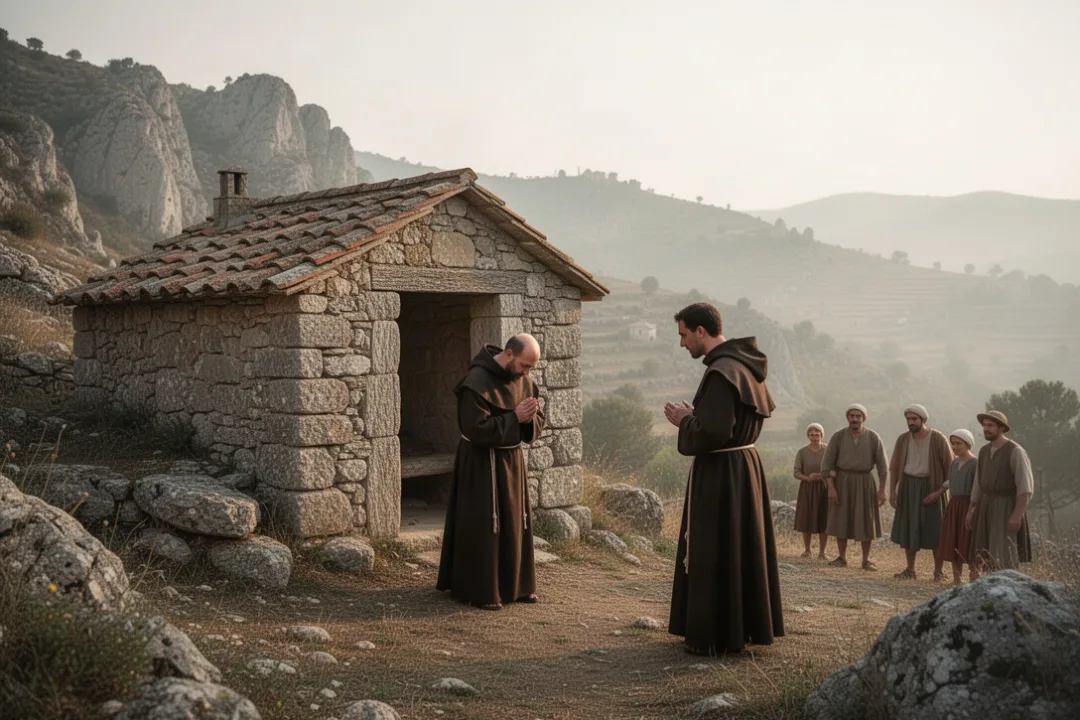
That experience introduced him to a disciplined religious life, but Francis did not become a conventional friar. As a young man, he spent time visiting religious places and then returned to Calabria, where he chose a life of solitude and penance. He settled in a simple shelter near Paola and devoted himself to prayer, fasting, and manual work.
People in the area soon noticed his way of life. Some came to ask for advice or prayer, while others wanted to imitate his commitment. Over time, a small group gathered around him. What began as one person’s hermitage developed into a religious community.
Francis’s decision to live as a hermit did not mean that he rejected people. His solitude gave him a place for prayer, but his reputation brought him into contact with farmers, travelers, the sick, local officials, and people facing poverty. He became known as a person who could speak directly and compassionately about both spiritual and practical concerns.
Several features defined his early life:
Prayer: He maintained a demanding rhythm of worship and contemplation.
Fasting: He practiced strict abstinence as a form of spiritual discipline.
Manual labor: He worked with his hands and did not treat physical labor as beneath religious life.
Service: He welcomed people seeking counsel and assistance.
Humility: He avoided comfort, status, and personal wealth.
His approach reflected a belief that Christian holiness required more than private religious feeling. For Francis, prayer should produce self-control, generosity, and concern for people who were vulnerable. His strict lifestyle was not intended as a performance. It was meant to free him from unnecessary possessions and make him more available to God and to others.
A useful distinction: Francis of Paola was not a member of the Order of Friars Minor founded by Francis of Assisi. He honored the earlier Franciscan tradition but founded his own community, the Order of Minims.
As his followers increased, Francis faced a practical question: how could a movement based on hermit spirituality remain faithful to its origins while providing a stable communal life? The answer led to the formation of the Minims, whose name expresses their desire to be “the least” in humility and service.
How the Order of Minims began and what it required
The community that formed around Francis eventually became the Order of Minims, formally known as the Order of Minims of Saint Francis of Paola. “Minim” refers to someone who is very small or least. The name points to a central ideal: members were to regard themselves as humble servants rather than as people seeking influence or recognition.
The Minims followed a rule shaped by prayer, community discipline, poverty, and penance. Their way of life developed from Francis’s hermitage, but it was not simply a collection of solitary individuals. The order established houses where members could worship together, welcome visitors, work, and support the needs of local communities.
One of the order’s most distinctive practices was the “Lenten life”. Members were expected to observe a permanent form of abstinence, traditionally excluding meat, eggs, and dairy products. This discipline went beyond the seasonal fast observed by many Christians. It expressed the Minims’ commitment to self-denial and remembrance of Christ’s suffering.
The rule also emphasized the moral responsibilities that come with religious authority. A Minim was not supposed to use poverty as an excuse for laziness or fasting as a reason for pride. Discipline had to be connected with charity, patience, and obedience. A harsh practice that produced arrogance would contradict the humility the order was meant to embody.
The community’s ideals can be understood through several connected commitments:
Permanent abstinence: Food restrictions served as a daily reminder of penance and dependence on God.
Community prayer: Members supported one another instead of treating holiness as a purely private achievement.
Care for the poor: The order developed a reputation for serving people with limited resources.
Simple living: Members were expected to avoid luxury and unnecessary possessions.
Moral courage: Francis encouraged truthful counsel, even when speaking to wealthy or powerful people.
Francis’s spirituality was demanding, but it was not centered on suffering for its own sake. He understood fasting and poverty as ways to reduce self-importance and create room for compassion. A person who has practiced restraint may become more attentive to another person’s hunger, debt, illness, or fear. That connection between personal discipline and social concern became a lasting feature of the Minim tradition.
The order spread beyond Calabria as new communities were established. Its members served in parts of Italy and later in other European countries. The Minims also became associated with preaching, pastoral care, education, and the spiritual direction of laypeople.
Francis’s reputation brought both admiration and scrutiny. Extreme religious practices can attract attention, but they can also be misunderstood. His influence rested not only on fasting or reported miracles. People trusted him because they saw consistency between his words, his lifestyle, and his treatment of the poor.
What Francis of Paola is known for, including miracles
Francis is remembered as a miracle worker, and many stories about him appear in the traditions surrounding his life and canonization. These accounts describe healings, prophetic knowledge, extraordinary acts of charity, and events that seemed to exceed ordinary human ability.
One of the best-known traditions concerns his crossing of the Strait of Messina. According to the story, Francis and his companions wanted to travel but could not pay the required fare. When a boatman refused to carry them, Francis is said to have spread his cloak on the water and crossed by this means. The episode contributed to his later association with travelers and seafarers.
Another famous tradition concerns a fire. Francis is said to have entered or approached a burning kiln connected with construction at a Minim house and emerged unharmed. Stories like this helped establish his reputation for supernatural protection, although the details belong to devotional tradition rather than to modern historical documentation.
Other accounts describe Francis restoring health to sick people, multiplying food, or recognizing hidden circumstances in a person’s life. Such stories were recorded and repeated because they expressed how contemporaries understood his holiness. They also helped explain why people from distant places sought his prayers and advice.
When considering these accounts, it helps to separate three questions:
What does the tradition say? Saints’ lives often preserve stories of extraordinary events associated with prayer.
What can historians verify? Documentation varies, and devotional biographies may present events differently from modern historical studies.
What did the story mean to believers? Miracle accounts often communicate trust, compassion, protection, or divine care.
The miracles connected with Francis should not be reduced to special effects. Their religious meaning lies in the values attached to them. A healing story highlights care for the sick. A story about food points toward generosity. A crossing over water suggests protection for travelers and people exposed to danger.
Francis also had a reputation for confronting injustice. He criticized corruption and warned people against greed, including members of the ruling class. His influence did not come from wealth or an official political position. It came from the credibility of someone who lived simply and could not easily be accused of seeking personal advantage.
Remember the focus: Catholic devotion to Francis does not require treating every miracle story as a laboratory report. These accounts are part of the saint’s religious tradition and are read alongside the clearer historical record of his communities, reforms, and public service.
His patronage developed from these traditions. Francis of Paola is especially associated with seafarers, travelers, and people in danger at sea. He is also invoked by people seeking healing and by those who admire his commitment to fasting and humility. Statues and images may show him in the dark habit of the Minims, often with a staff or the word “Charitas,” meaning charity.
Why Francis was sent to France and advised King Louis XI
The later part of Francis’s life moved him far from Calabria. King Louis XI of France, who was seriously ill and afraid of death, asked that Francis come to the royal court. The king hoped that the holy man’s prayers might bring healing or at least prolong his life.
Francis did not initially want to leave Italy. He was advanced in age, deeply connected to the Minim communities, and accustomed to a life of retreat. The pope and other authorities, however, encouraged him to accept the mission. Francis traveled to France and arrived at the court in 1483.
The king’s illness was not cured in the way he desired. Francis could not simply reverse the course of nature, and his presence did not give Louis XI the immortality he feared losing. Instead, Francis urged him to prepare for death with repentance, reconciliation, and a more honest spiritual life.
This encounter reveals one of the most significant aspects of Francis’s character. He was willing to speak to a king, but he did not flatter him. His counsel challenged the assumption that political power could protect a person from mortality. The message was uncomfortable but consistent with Francis’s own life: wealth, rank, and influence do not remove the need for humility.
After Louis XI died, Francis remained in France during the reign of Charles VIII. He lived at the royal residence of Le Plessis-lez-Tours, where he continued guiding the king and supporting the growth of the Minim order. He did not become a court official. His role was primarily spiritual, and he maintained a disciplined religious routine.
His time in France helped the order expand outside Italy. Communities were established in France, and Francis’s reputation spread across Europe. His presence also placed the Minims in a position to serve people beyond their original Calabrian setting.
Francis spent his final years near Tours. He died on April 2, 1507, at Le Plessis-lez-Tours. His death occurred during Holy Week, a detail that later devotional accounts regarded as fitting for a man whose spirituality emphasized penance and devotion to Christ’s passion.
The Church canonized him in 1519 under Pope Leo X. His recognition as a saint confirmed the importance of his religious community and the broad devotion that had developed around him. The Minims continued to preserve his rule, spirituality, and memory after his death.
What Francis of Paola’s symbols and feast day mean
Images of Francis often include symbols that make his identity immediately recognizable. The most important is the word “Charitas”, usually understood as “charity” or “love.” It reflects the central message of his spirituality: strict prayer and fasting have value only when they lead to love of God and neighbor.
He is commonly shown wearing the dark habit of the Minims. His long beard and simple clothing emphasize his identity as a hermit and religious founder rather than a court figure. Some images include a staff, representing his pilgrim life, leadership, or support for the sick and weak.
Scenes involving water recall the tradition of his crossing the Strait of Messina. These images help explain why sailors and people who travel by sea have regarded him as a patron. Churches connected with the Minims may also display scenes of his preaching, miracles, or encounters with rulers.
His feast day is April 2. For Catholics who observe it, the day offers an opportunity to remember several themes:
Choosing simplicity instead of unnecessary consumption.
Making prayer part of a regular daily rhythm.
Practicing self-restraint without becoming judgmental toward others.
Speaking honestly to people who hold power.
Serving the poor through concrete, respectful action.
Francis’s spiritual legacy also includes the idea that a religious community can remain faithful to a demanding rule while responding to changing circumstances. The Minims carried a hermit’s values into towns, courts, parishes, and international communities. Their work shows how solitude and public service can belong to the same vocation.
How Francis of Paola’s example applies to life now
You do not need to imitate Francis’s extreme fasting or become a hermit to understand his example. His life raises practical questions about what you consume, how you use power, and whether your spiritual practices make you more attentive to other people.
His emphasis on abstinence can be approached as a discipline of freedom. That might mean observing a traditional fast, simplifying meals, limiting unnecessary purchases, or setting boundaries around habits that make you less present to family and community. The purpose is not to prove moral superiority. It is to become more deliberate.
His treatment of the poor offers another practical lesson. Francis did not separate spiritual concern from material need. Prayer, in his tradition, should be accompanied by actions such as sharing resources, visiting someone who is isolated, supporting a food pantry, or advocating for fair treatment.
His relationship with rulers also remains relevant. Francis demonstrates that respectful counsel does not require flattery. When you have access to a person with authority, you can speak with courtesy while still naming injustice, dishonesty, or harm. Moral credibility grows when your own lifestyle supports the standards you ask of others.
A simple way to reflect on his example is to ask:
What possession, habit, or convenience could I limit for a meaningful purpose?
Does my spiritual practice make me more patient and generous?
Whom do I overlook because their needs are inconvenient?
Can I offer truthful counsel without anger or self-righteousness?
How can I turn concern for the poor into a specific action this week?
Francis of Paola remains memorable because his life joined apparent opposites: solitude and public influence, severe discipline and compassion, humility and courageous speech. His legacy is not only the collection of extraordinary stories associated with him. It is also the enduring challenge to live with less, pray with greater seriousness, and use whatever influence you have in service of others.
Frequently asked questions
Is Francis of Paola the same person as Francis of Assisi?
No. They were different Italian saints who lived about two centuries apart. Francis of Assisi founded the Order of Friars Minor in the thirteenth century. Francis of Paola lived in the fifteenth and sixteenth centuries and founded the Order of Minims. Francis of Paola admired the earlier saint but established a separate religious community with its own rule and traditions.
What is Francis of Paola the patron saint of?
Francis of Paola is especially associated with seafarers, travelers, and people facing danger on the water. He is also invoked by people seeking healing and by those devoted to fasting and penitential spirituality. His connection with sailors comes largely from the tradition that he crossed the Strait of Messina without paying for passage.
What does the word “Charitas” mean in images of Francis of Paola?
“Charitas” is a Latin word meaning charity or love. It is a prominent symbol associated with Francis and the Minims. The word expresses the belief that prayer, fasting, and poverty must lead to genuine love of God and practical concern for other people, especially those who are poor or suffering.
When is the feast day of Francis of Paola?
His feast day is April 2. The date marks the anniversary of his death in 1507 at Le Plessis-lez-Tours in France. Catholics may observe the day through prayer, Mass, reflection on simplicity, or acts of charity connected with Francis’s example.















Leave a Reply