Saint Catherine of Bologna: life, writings, and legacy
Saint Catherine of Bologna: life, writings, and legacy
If you are searching for Saint Catherine of Bologna, you may be wondering why a 15th-century nun remains especially connected with artists, writers, and Bologna. The short answer is that Catherine Vigri combined a disciplined spiritual life with unusual gifts as a painter, musician, author, and teacher. She also helped establish a Poor Clare monastery in Bologna and left behind writings that describe the practical struggles of prayer.
Saint Catherine of Bologna was born in Ferrara in 1413 and died in Bologna in 1463. She belonged to the Poor Clares, the contemplative branch of the Franciscan family founded in the tradition of Saint Clare of Assisi. The Catholic Church canonized her in 1712, and her feast is celebrated on March 9.
Catherine was born Catherine Vigri on December 8, 1413, in Ferrara, a prominent court city in northern Italy. Her father, Giovanni Vigri, served the Este court, and her family had connections to the ruling household. This background gave Catherine access to an education that was unusual for many girls of her time.
As a child and teenager, she learned subjects associated with courtly culture, including reading, writing, music, and painting. She also became familiar with Latin religious texts and the devotional practices of the period. Her early education did not simply prepare her for religious life; it shaped the artistic and intellectual abilities that later became part of her ministry.
When Catherine was still young, she served at the court of Nicholas III d’Este as a companion to Princess Margaret d’Este. Court life exposed her to music, literature, formal manners, and visual art. At the same time, she experienced the tension between a polished public environment and her growing desire for prayer, simplicity, and religious commitment.
After leaving court, Catherine joined a religious community in Ferrara associated with the Corpus Domini movement. The group developed from a community of women who sought a more dedicated spiritual life and later followed the rule of the Poor Clares. Catherine’s transition shows that her vocation developed gradually rather than through a single dramatic change.
She eventually became a Poor Clare nun at the Corpus Domini monastery. There, her daily life centered on the ordinary work of a convent: communal prayer, silence, study, domestic tasks, service to the community, and obedience to religious superiors. Her later writings repeatedly return to the idea that spiritual growth takes place through patience in ordinary duties, not only through extraordinary experiences.
Helpful distinction: Saint Catherine of Bologna is not the same person as Saint Catherine of Siena. They lived in different parts of Italy and different centuries, although both became influential women saints associated with prayer and Christian teaching.
How Catherine became connected with Bologna
In 1456, Catherine was chosen to lead a group of Poor Clare sisters from Ferrara to Bologna. Their purpose was to establish a new monastery there. The move required more than spiritual leadership: Catherine had to help organize a community, guide its members, and adapt their religious life to a new city and setting.
The monastery became known as Corpus Domini. Catherine served as its first abbess, giving her responsibility for the community’s prayer, discipline, internal relationships, and practical needs. Her leadership was not based on public influence or political power. It was exercised through personal example, instruction, and steady administration.
Bologna already had a strong religious and academic culture, and the new convent became an important center of devotion. Catherine’s reputation grew among people who sought her advice, although the enclosure of a Poor Clare monastery limited her public activity. Her influence came largely through correspondence, spiritual counsel, and the example of the community she formed.
Leading a convent in the 15th century involved demanding practical work. An abbess had to oversee food, clothing, buildings, finances, relationships with church authorities, and the spiritual welfare of the sisters. Catherine’s writings indicate that she understood religious leadership as a form of service rather than personal status.
Her time in Bologna also explains why the city remains central to her memory. She died there on March 9, 1463, and the Corpus Domini monastery became closely identified with her life. The city honors her as its patron saint, while artists and creative workers remember her for the way she joined artistic ability with religious devotion.
Catherine’s ministry was not built around a large public preaching career. Instead, it grew through the stability of a religious house and the credibility of a woman who practiced what she taught. Her example appealed to people who wanted a faith that included work, self-discipline, compassion, and perseverance.
What Saint Catherine of Bologna wrote about prayer
Catherine is best known for The Seven Spiritual Weapons, a devotional work that describes the tools Christians can use in the struggle to live faithfully. The title reflects a common medieval image: spiritual life involves resistance against temptation, discouragement, pride, and distraction. Catherine’s “weapons” are not physical force but habits and truths that strengthen the soul.
The work is often associated with Catherine’s advice to her fellow sisters. It presents spiritual practice in a direct, practical way. Rather than treating holiness as a vague feeling, Catherine describes it as a disciplined response involving self-knowledge, prayer, humility, and trust in God.
The exact wording and organization can vary among editions and translations, but the work is commonly understood through themes such as careful attention to one’s faults, the remembrance of Christ’s life and suffering, obedience, and resistance to discouragement. Catherine does not present spiritual struggle as evidence that prayer has failed. She treats difficulty as part of the work of becoming faithful.
One of her recurring concerns is the danger of relying on spiritual feelings. A person may pray with enthusiasm one day and experience dryness the next. Catherine’s approach encourages continued faithfulness even when prayer feels difficult. This makes her writing useful to readers who assume that a lack of emotion means they are doing something wrong.
Her spiritual advice includes several practical habits:
Examine your motives instead of assuming that every religious desire is pure.
Remember that humility involves accepting the truth about your weaknesses without giving in to hopelessness.
Use prayer to turn toward God rather than merely to seek comfort or success.
Stay faithful to necessary duties when enthusiasm fades.
Ask for help when temptation, fear, or discouragement becomes difficult to manage alone.
Catherine also wrote about the importance of reflecting on Christ. Medieval Christian devotion often emphasized meditation on the events of Jesus’ life, including his suffering, death, and resurrection. For Catherine, this reflection was not meant to encourage despair. It was a way to cultivate gratitude, compassion, repentance, and confidence.
Her work is valuable because it combines high spiritual ideals with an awareness of human weakness. She understood that people can become distracted, impatient, proud, or discouraged even when they sincerely want to pray. Her answer was not perfectionism but a return to the basic practices of faith.
“Nothing is so bitter that it cannot be made sweet by love of God.”
This short saying, often attributed to Catherine in English devotional sources, captures the direction of her spirituality. The claim is not that suffering becomes pleasant or that serious problems should be ignored. It means that love can change how a person carries hardship, giving it a different spiritual meaning.
Readers should also approach medieval mystical writing with care. Catherine’s language reflects the religious culture of her time, including its strong emphasis on sin, spiritual warfare, and bodily discipline. Her ideas can be read thoughtfully without copying every historical practice. The lasting question is how her emphasis on honest self-examination and persistent prayer might apply to a person’s own circumstances.
Why Saint Catherine is remembered as an artist
Catherine was not only a nun who happened to paint. Art formed part of her education and remained one of the ways she expressed devotion. Surviving works and traditions connected with her include paintings, drawings, and illuminated manuscripts. Her artistic activity is especially significant because it challenges the assumption that a cloistered religious woman had no intellectual or creative life.
Her paintings are associated with devotional subjects, particularly images of Christ, the Virgin Mary, and saints. As with many artworks from the 15th century, attribution can be complex. Some pieces may be connected with her workshop or community rather than identified with absolute certainty as works by her own hand. It is therefore better to speak carefully about works attributed to Catherine and the artistic culture around her.
Accounts of her life also connect her with music. She had received musical training during her years at court, and music remained compatible with the prayer and worship of her religious community. Her artistic gifts were not treated as a separate identity competing with her vocation. They were placed at the service of devotion, teaching, and the life of the monastery.
This combination makes Catherine unusual among medieval women remembered as saints. She is presented not only as a visionary or abbess but also as a creator who used visual and musical skills within a religious setting. Her example suggests that artistic work can be both technically serious and spiritually purposeful.
People interested in Catherine’s art should keep several points in mind:
Some attributions are traditional rather than fully established by modern art historians.
Religious art from the period was often produced within communities, workshops, or collaborative settings.
The surviving record does not preserve every work Catherine may have made.
Her paintings should be considered alongside her writings and leadership, not treated as an isolated part of her life.
Catherine’s connection with artists also developed after her death. In 1712, Pope Clement XI canonized her, and she later became recognized as a patron of artists, particularly in Bologna. A patron saint does not function as a guarantee of artistic success. Rather, the designation points to a person whose life and example have become a source of prayer, identification, or inspiration for a particular group.
For a contemporary artist, Catherine’s significance may lie in the integration of creativity with disciplined practice. She did not separate beauty from responsibility or imagination from moral character. Her life presents art as something that can require attention, patience, study, and humility—qualities that also shaped her religious vocation.
What happened to Catherine’s body after her death
Catherine died in Bologna in 1463 at the age of 49. Her body was buried after her death, but reports of unusual preservation led to a decision to place it in a more visible setting. Today, her preserved body is associated with the Corpus Domini church and monastery in Bologna.
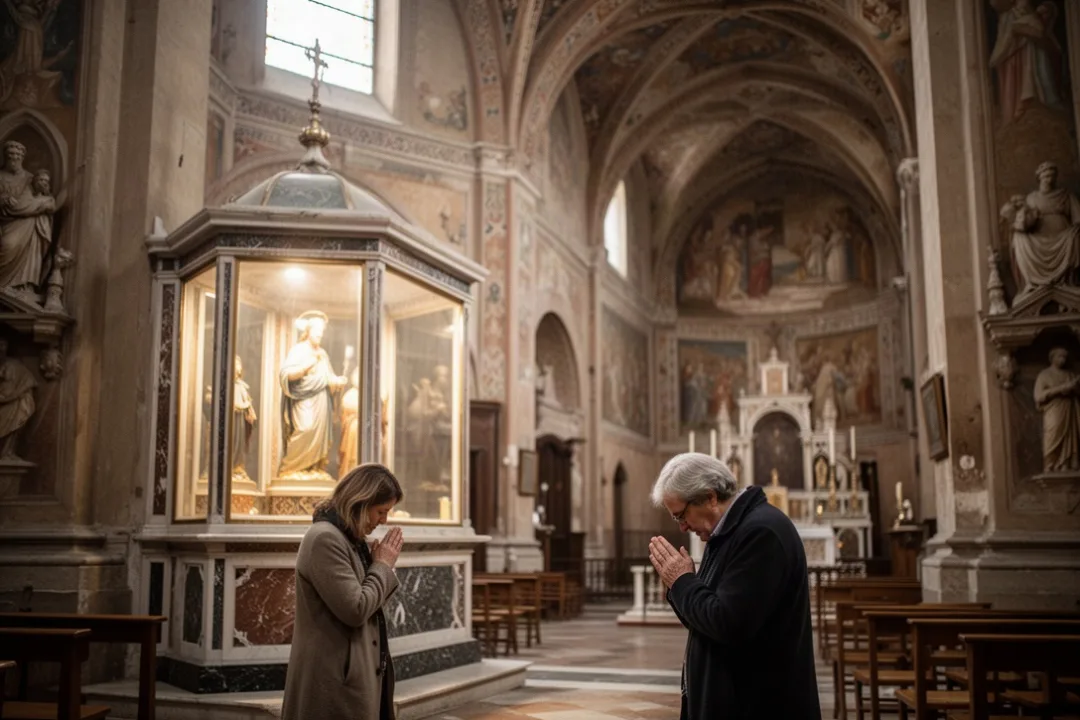
Visitors have traditionally seen Catherine seated in a glass case in a chapel connected with the church. The body is dressed in the habit of a Poor Clare. This display can be startling to people who have not encountered the custom before, so it helps to understand that the preservation and public veneration of saints developed within a particular Catholic devotional culture.
The Catholic Church sometimes describes a saint’s body as incorrupt when it has not decomposed in the expected way. Such a claim concerns the physical condition of the remains and the history of devotion surrounding them. It does not mean that every question about preservation has been settled by a supernatural explanation, nor does it require visitors to treat the display as a scientific demonstration.
For Catholics, the body is honored because the person it belonged to is believed to have lived a holy life. This practice is connected with the Christian belief in the dignity of the body and the future resurrection, not with the idea that the remains themselves are magical. The purpose of a shrine is to direct attention toward the saint’s relationship with God and example of Christian life.
If you visit the site, a respectful approach includes learning the church’s customs, observing any restrictions on photography, and remembering that it remains a place of prayer. The display may be meaningful to pilgrims and unfamiliar to others. Both groups can approach it with seriousness and sensitivity.
For visitors: The Corpus Domini site is a religious place as well as a historic one. Check current opening arrangements before traveling, since access, schedules, and visitor policies can change.
The preservation of Catherine’s body has contributed greatly to her continuing visibility. Many medieval figures are known mainly through books or paintings, while Catherine is also encountered through a physical shrine. That presence helps explain why devotion to her remained strong in Bologna long after her canonization.
How Saint Catherine of Bologna is honored today
Saint Catherine’s feast day is March 9. Churches and religious communities may mark the day with Mass, prayer, readings from her writings, or reflection on her work as an abbess and artist. Devotion to her is particularly associated with Bologna, the Poor Clare tradition, and people involved in the arts.
She is often invoked by painters, musicians, writers, and other creative workers. Her patronage is relevant because she had firsthand experience of artistic practice rather than being linked to art only through a later symbol. At the same time, her story is broader than a patronal title. She offers an example of a person who continued learning, created within the limits of her vocation, and accepted responsibility for a community.
People may turn to Catherine when they are dealing with creative discouragement, spiritual dryness, or the challenge of combining work with prayer. Her writings do not offer a quick method for eliminating these problems. They encourage a slower response: identify what is happening honestly, reject despair, continue with faithful practice, and seek wise guidance.
A simple way to observe her feast day might include:
Read a reliable selection from The Seven Spiritual Weapons or a biography of Catherine.
Spend a few minutes examining where pride, fear, or discouragement affects your work.
Pray for artists and craftspeople whose work serves their communities.
Visit a church dedicated to the Poor Clare tradition, if one is nearby.
Make a small act of patient service instead of waiting for a dramatic spiritual experience.
Her example also speaks to people outside formal religious life. Catherine’s central concerns—how to remain faithful, how to handle weakness, how to use talent responsibly, and how to lead without seeking recognition—are not limited to a convent. Her life gives these questions a concrete historical shape.
Saint Catherine of Bologna is remembered because several parts of her identity remain together: Franciscan nun, abbess, writer, artist, and patron of creative people. Her legacy is strongest when these parts are considered as one life rather than separated into unrelated achievements. She used education, artistic skill, and spiritual discipline in the service of a community, and her writings continue to offer practical language for the difficult work of prayer.
Frequently asked questions
Is Saint Catherine of Bologna the patron saint of artists?
Yes. Saint Catherine of Bologna is traditionally honored as a patron saint of artists, especially because she herself practiced painting and had training in music and courtly arts. Her patronage is also connected with her role as a religious writer and abbess. Artists may ask for her intercession when seeking patience, integrity, and perseverance in their creative work.
Where can Saint Catherine of Bologna’s body be seen?
Her preserved body is traditionally displayed in a seated position inside a glass case at the Corpus Domini church and monastery in Bologna, Italy. The site is a place of Catholic devotion, so visitors should check current access arrangements and follow local rules regarding prayer, photography, and respectful conduct.
What is Saint Catherine of Bologna’s most famous book?
Her best-known work is The Seven Spiritual Weapons. It offers guidance for resisting discouragement, temptation, pride, and spiritual distraction. The writing reflects medieval Christian devotion, but its practical emphasis on self-examination, humility, persistent prayer, and trust can still make it meaningful to modern readers.
When is Saint Catherine of Bologna’s feast day?
Saint Catherine of Bologna’s feast day is March 9, the anniversary of her death in 1463. Churches may commemorate her with worship, readings, prayers, or reflections on her work as a Poor Clare abbess, artist, author, and patron of artists. She is especially honored in Bologna and within the Franciscan tradition.













Leave a Reply