Saint Catherine of Alexandria: life, symbols, and feast day
Saint Catherine of Alexandria: life, symbols, and feast day
Saint Catherine of Alexandria is a Christian martyr traditionally believed to have lived in Alexandria, Egypt, during the early fourth century. She is remembered for her learning, courage in defending her faith, martyrdom, and the distinctive spiked wheel associated with her story.
She is honored as one of the Fourteen Holy Helpers and is a patron saint of philosophers, students, librarians, scholars, unmarried women, and several occupations connected with wheels or sharp tools. Her feast day is observed on November 25 in traditions that include her in the liturgical calendar.
Why Saint Catherine of Alexandria remains important
Catherine’s story combines several themes that have kept her memory alive for centuries: intellectual conviction, spiritual devotion, moral courage, and faithfulness under pressure. She is traditionally described as a well-educated young woman from a noble family who became a Christian and refused to deny her beliefs.
Much of the detailed account of her life comes from later Christian tradition rather than contemporary historical records. As a result, readers should distinguish between what the tradition teaches about Catherine and what can be independently confirmed about a specific person in ancient Alexandria.
For many Christians, that distinction does not erase her religious significance. Her image, feast, prayers, churches, and patronages reflect the way generations have understood her as a model of wisdom joined to courage.
A helpful distinction: Catherine’s traditional biography is widely known, but the surviving historical evidence for the details of her life is limited. Her importance comes from both the devotional tradition surrounding her and the values her story represents.
The traditional story of Saint Catherine’s life
According to the traditional account, Catherine was born into a wealthy or noble household in Alexandria, a major center of learning in the ancient Mediterranean world. She was said to have received an excellent education and to have studied philosophy, literature, rhetoric, and other subjects associated with an elite intellectual formation.
The story presents her as unusually wise and independent-minded. After becoming a Christian, she is said to have dedicated herself to Christ and rejected the expectation that she should marry according to her social status. Later devotional writings describe this commitment through the symbolic idea of a mystical marriage to Christ.
When the Roman emperor began a public persecution of Christians, Catherine supposedly went to challenge him. The emperor’s identity varies in later versions of the story, although Maxentius is commonly named. Catherine is said to have argued that worshiping pagan gods was wrong and that Christian faith offered the truth she had come to accept.
The emperor reportedly summoned philosophers to debate her. Instead of defeating Catherine, the group was converted by her reasoning and Christian witness. The tradition says that these philosophers were then condemned, adding to Catherine’s reputation as a protector of scholars and a symbol of fearless learning.
When persuasion failed, the authorities supposedly tried to break her through imprisonment and torture. She refused to abandon her faith. The account ends with her execution by beheading, traditionally dated to the early fourth century.
The story of Catherine’s wheel and martyrdom
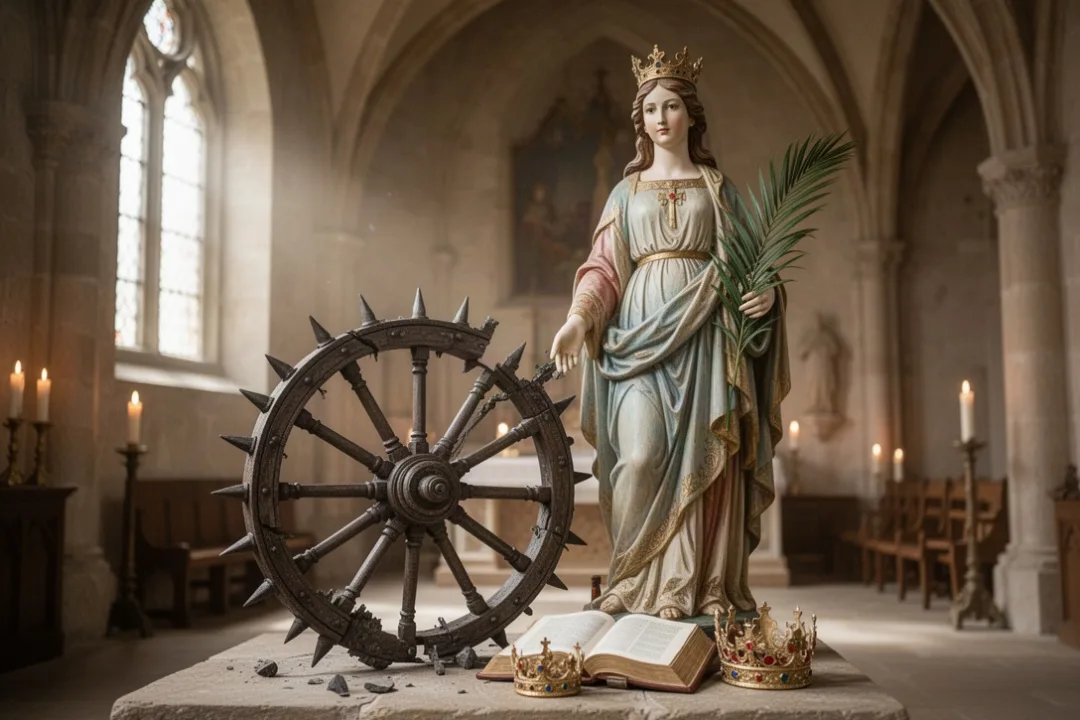
The most recognizable object connected with Catherine is a wheel fitted with spikes or blades. According to the legend, her torturers prepared the wheel to crush or tear her body. Before it could be used, however, the wheel broke apart through divine intervention.
This object is often called Catherine’s wheel. In art, it may appear beside her, beneath her feet, or held as a smaller attribute. Some images show a single broken wheel, while others include two wheels to suggest the attempted torture.
The wheel is a symbol of both suffering and deliverance. It recalls the violence Catherine was expected to endure, but its broken form also represents the failure of that violence to force her into renouncing her beliefs. In churches and paintings, the wheel allows viewers to identify her even when the scene contains no written name.
After the wheel failed, the traditional account says that Catherine was beheaded with a sword. For this reason, she may also be shown with a sword, a martyr’s palm, or both. The palm represents victory through faithfulness rather than military success.
How to recognize Saint Catherine in religious art
Artists use a group of recurring symbols to identify Catherine. Each one points to a particular part of her traditional story or to a quality associated with her devotion.
The spiked wheel: This refers to the torture device that supposedly broke before it could harm her.
The sword: This represents the beheading that ended her earthly life and identifies her as a martyr.
The martyr’s palm: The palm is a traditional Christian sign of victory over persecution and death.
A crown: A crown may indicate her noble birth, her status as a virgin martyr, or her heavenly glory.
Books: Books represent her learning, philosophical knowledge, teaching, and defense of Christian belief.
A ring: In scenes of her mystical marriage, a ring symbolizes her spiritual union with Christ.
A royal garment: Rich clothing can point to her noble background, although artistic styles vary.
Not every image includes all these objects. A painting of Catherine debating philosophers may emphasize her books and confident posture, while a devotional statue may focus on the wheel and palm. The surrounding figures can also provide clues: philosophers, an emperor, angels, or scenes of martyrdom often appear in narrative artwork.
What Catherine’s symbols mean for her devotees
Catherine’s symbols are more than identification tools. They express a particular understanding of holiness. Her books suggest that learning can support religious conviction rather than weaken it. Her wheel shows that suffering may be remembered without being glorified. Her crown and palm connect earthly status with a higher spiritual identity.
The combination of book and martyr’s palm is especially significant. Catherine is not portrayed only as someone who suffered, nor only as someone who argued. Tradition presents her as a person who used disciplined thought, clear speech, and personal courage together.
Her sword also carries more than one meaning. It recalls her execution, but it may also suggest the decisive separation between truth and falsehood in the medieval imagination. Modern readers may approach that symbol more carefully, understanding it as an image of martyrdom rather than a command to hostility.
When interpreting an image: Start with the wheel, then look for the sword, palm, books, crown, and ring. Their combination usually identifies Catherine and reveals whether the artwork emphasizes her scholarship, royal status, mystical devotion, or martyrdom.
Why she is the patron saint of scholars and students
Catherine’s reputation as a patron of scholars comes primarily from the debate in her traditional biography. She is said to have answered learned opponents so effectively that they became Christians. This made her a natural figure for universities, schools, libraries, philosophers, and people pursuing serious study.
Her patronage does not mean that academic achievement alone makes a person holy. Instead, Catherine represents the disciplined search for truth and the responsibility to use knowledge with integrity. Her example encourages students to develop both intellectual skill and moral seriousness.
Libraries and educational institutions have sometimes honored her because her legend gives learning a spiritual dimension. A book associated with Catherine is not merely a sign that she was educated. It suggests that reflection, careful reasoning, and the courage to speak honestly can serve a larger purpose.
People may turn to her when they need help with:
Preparing for an examination or difficult course of study.
Finding clarity during a serious intellectual or ethical disagreement.
Using education in service of truth, justice, or the community.
Remaining calm when their convictions are mocked or challenged.
Balancing scholarship, work, family obligations, and spiritual practice.
Praying with Catherine in this context does not replace studying, seeking advice, or doing careful work. Devotion can accompany those actions by helping a person ask for patience, honesty, courage, and sound judgment.
Other groups connected with Saint Catherine
Catherine has several patronages that arise from different parts of her tradition and from the way communities have interpreted her symbols. She is often associated with unmarried women, especially because of the story of her dedication to Christ and her refusal to marry for worldly advantage.
She is also linked with librarians, teachers, philosophers, theologians, and students. In some places, guilds and workers whose crafts involve wheels, blades, or machinery have claimed her as a patron. These connections reflect the wheel in her legend as well as the practical culture of medieval religious communities.
Her patronages may differ by country, denomination, and local custom. A church named for Catherine might celebrate her chiefly as a virgin martyr, a scholar, a protector of young women, or a local spiritual ancestor. The same saint can therefore carry different emphases without losing her central identity.
Saint Catherine’s connection with the Fourteen Holy Helpers
The Fourteen Holy Helpers are a group of saints who became especially popular in parts of medieval Europe. Christians invoked them together because each was associated with particular needs, illnesses, dangers, or forms of protection. Catherine is commonly included among them.
The group is not a single biblical list, and its members were not all connected during their lifetimes. It developed through popular devotion, especially in regions where communities sought heavenly help during disease, hardship, and uncertainty.
Catherine’s place among the Holy Helpers reflects her identity as a strong intercessor and martyr. She is often associated with protection against sudden death, though the exact list of needs connected with the group can vary. Devotional customs are not always uniform, so local churches may emphasize different prayers or companions.
Her inclusion also places her alongside other well-known early Christian martyrs. Together, the Holy Helpers present a broad picture of Christian courage: some are associated with healing, some with protection, and others with endurance under persecution.
When is Saint Catherine’s feast day?
November 25 is traditionally observed as Saint Catherine of Alexandria’s feast day. Churches and communities that honor her may mark the date with Mass, prayer services, processions, lectures, art exhibitions, or celebrations connected with schools and universities.
Feast-day practices differ widely. Some communities focus on her martyrdom and symbols, while others highlight education, women’s witness, or the local history of a church dedicated to her. In some Christian calendars, her observance has changed over time, and not every denomination includes her in the same way.
A simple personal observance might include reading a reliable account of her tradition, visiting a church or museum image of her, praying for students and teachers, or setting aside time for study guided by honesty and patience.
Begin with a short prayer asking for wisdom and courage.
Read a brief account of Catherine’s life while keeping tradition and historical evidence distinct.
Identify the symbols in an image of her, such as the wheel, sword, palm, or book.
Pray for a student, teacher, scholar, or person facing pressure because of conscience.
Choose one practical act of learning or service that reflects her example.
What historians can and cannot establish about Catherine
The historical evidence for Catherine is much less secure than the later popularity of her legend might suggest. There is no broadly accepted contemporary record that confirms all the details found in medieval accounts. The names of the emperor, the philosophers, the torture scenes, and the precise circumstances of her death belong to a tradition that developed over time.
Some scholars have questioned whether the story preserves memories of a historical martyr, combines features from more than one figure, or grew through devotional storytelling. These questions are part of responsible historical study and do not need to be treated as an attack on people who honor her.
Religious tradition and historical research often ask different questions. Historical research asks what evidence can establish about a person and a period. Devotion asks what a saint’s witness means for prayer and Christian life. A careful account can respect both questions without presenting legend as documented fact.
When reading about Catherine, look for language such as tradition says, according to later accounts, or she is believed to have. Such wording is not evasive. It accurately signals the difference between a longstanding devotional narrative and a claim supported by contemporary evidence.
Catherine’s place in Christian spirituality
Catherine is often understood as a saint of conscience under pressure. Her traditional story asks what a person should do when authority demands silence or participation in practices that violate deeply held belief. Her answer is portrayed as firm but reasoned rather than impulsive.
That emphasis makes her relevant beyond the historical setting of her legend. Students may think of her when facing pressure to cheat. Professionals may remember her when honesty threatens convenience. People who belong to a minority faith may see in her story the challenge of remaining respectful without hiding what they believe.
Her example should not be used to encourage needless confrontation. Catherine’s traditional courage is better understood as a commitment to truth, disciplined speech, and the willingness to accept consequences. The aim is not to win every argument but to avoid betraying conscience for comfort or approval.
Her story also gives dignity to intellectual work. The saint is not portrayed as choosing between faith and thought. She is portrayed as someone whose study strengthened her ability to explain and defend her convictions. That combination continues to appeal to teachers, researchers, writers, and readers.
How to pray with Saint Catherine of Alexandria
There is no single required prayer that every Christian must use. A person may speak to God in ordinary language while asking Catherine to intercede for a particular need. The prayer can be brief and concrete rather than highly formal.
You might ask for wisdom before speaking, courage during criticism, patience while studying, or strength when a difficult decision affects your conscience. You can also pray for people who are persecuted, imprisoned, excluded, or pressured because of their faith or ethical commitments.
Name the situation that requires wisdom or courage.
Ask for Catherine’s intercession as a faithful witness.
Request the grace to act honestly, peacefully, and responsibly.
End by committing yourself to one practical, truthful action.
For example, someone preparing for an exam might pray for clear understanding and perseverance, then make a realistic study plan. Someone facing a moral conflict might pray for courage, seek wise counsel, and consider the consequences of each possible choice. Devotion becomes meaningful when it shapes conduct as well as words.
How schools, libraries, and churches honor her
A school or library dedicated to Catherine may use her feast day to connect education with character. Events can include a lecture, a discussion of women in intellectual history, a display of books about Alexandria, or a service praying for teachers and students.
Churches may display an image of Catherine with her wheel and books. Some include her in a group of martyrs, while others show her receiving a ring in a mystical marriage scene. The setting often reveals the community’s preferred emphasis: scholarship, virginity, martyrdom, royal dignity, or heavenly intercession.
Art museums and historic churches may preserve paintings of Catherine because her legend was especially influential in European religious art. Comparing different images can show how artists adapted the same symbols to local styles, devotional needs, and changing ideas about women’s education and authority.
Common misunderstandings about Saint Catherine
One misunderstanding is that every detail of her popular biography has the same historical status. The story of the wheel, the debate with philosophers, and the names of rulers are central to her legend, but the evidence for these details is not equally strong.
Another is that her patronage of scholars means she is only a saint for academics. Her wider significance includes moral courage, fidelity, prayer, and compassionate concern for people facing pressure. A person does not need to work in a university or library to seek her intercession.
It is also easy to treat the wheel as a decorative emblem without considering its meaning. The broken wheel reminds viewers that Catherine’s story centers on resistance to coercion. It represents suffering, but it also represents the failure of violence to determine what a person believes.
Finally, Catherine should not be confused with other saints named Catherine, particularly Saint Catherine of Siena. They lived in different periods and places, and their symbols and biographies are distinct. The wheel and Alexandria identify Catherine of Alexandria, while Catherine of Siena is often shown with symbols connected to her own life and Dominican spirituality.
What Saint Catherine of Alexandria represents today
For contemporary readers, Catherine can represent the meeting point of faith, education, and courage. Her traditional biography asks you to consider how knowledge should shape your character and how conviction should influence your choices when honesty carries a cost.
Her story also invites careful thinking about historical memory. A saint can be spiritually important even when the details of the surviving narrative are difficult to verify. Reading with both respect and accuracy allows the tradition to be appreciated without claiming more evidence than exists.
Whether you encounter her in a church statue, a medieval painting, a school emblem, or a prayer, look for the ideas behind the symbols. The book points toward thoughtful learning, the wheel toward endurance, the palm toward faithful witness, and the sword toward martyrdom. Together they present Catherine as a figure remembered for refusing to separate truth from courage.
Frequently asked questions
Was Saint Catherine of Alexandria a real historical person?
Her existence as a Christian martyr is part of longstanding tradition, but the detailed accounts of her life are difficult to verify from contemporary evidence. Historians debate how her story developed and whether later writings preserve memories of a historical figure. It is most accurate to describe the familiar biography as a devotional tradition rather than as a fully documented ancient record.
Why is Saint Catherine shown with a wheel?
The wheel represents the torture device that, according to her traditional story, was prepared to kill her but broke through divine intervention. Artists may show it as a broken wheel, a spiked wheel, or two wheels. It identifies Catherine as a martyr and symbolizes both the suffering she faced and the failure of violence to make her renounce her faith.
What can students ask Saint Catherine to help with?
Students may ask for wisdom, concentration, perseverance, honesty, and courage when facing academic pressure. Her traditional identity as a learned woman and defender of Christian belief makes her a fitting patron for study. Prayer does not replace preparation, so it can be paired with practical steps such as organizing assignments, seeking instruction, and completing work with integrity.
How is Saint Catherine of Alexandria different from Saint Catherine of Siena?
They are different saints from different periods. Catherine of Alexandria is the traditional early Christian virgin martyr associated with a wheel, sword, books, and Alexandria. Catherine of Siena was a fourteenth-century Italian Dominican tertiary, mystic, writer, and church adviser. Their names are similar, but their lives, symbols, and historical settings are not the same.















Leave a Reply