St. Catherine: life, prayers, feast days, and meanings
St. Catherine: life, prayers, feast days, and meanings
St. Catherine most often refers to Catherine of Siena, a 14th-century Dominican mystic, reformer, writer, and Doctor of the Church.
Her life is remembered for an unusual combination of deep prayer and direct public action. Catherine cared for people affected by illness and poverty, advised clergy and political leaders, urged peace among Christian communities, and wrote extensively about love of God and the spiritual life.
The name can also refer to other important saints, especially Catherine of Alexandria and Catherine Labouré. Understanding which Catherine you mean helps explain the correct feast day, symbols, prayers, and traditions associated with her.
Catherine of Siena was born in Siena, Italy, in 1347. She grew up in a large family and showed an early desire to dedicate her life to God. Rather than entering a traditional enclosed convent, she became a Dominican tertiary, a lay member associated with the Dominican Order who could remain active in ordinary society.
Her religious vocation developed through prayer, service, and close involvement with people around her. Catherine cared for the sick, including those whom others feared or avoided. She also helped the poor, visited prisoners, supported clergy, and counseled people who came to her for spiritual guidance.
Her influence grew beyond Siena. Catherine corresponded with popes, bishops, rulers, religious communities, and ordinary believers. Her letters urged church leaders to pursue reform, live with greater integrity, and work toward peace. She did not treat spirituality as something separate from public responsibility; she believed sincere love of God should shape the way people govern, serve, and treat one another.
Catherine traveled and worked during a period of serious conflict in the Italian city-states and deep division within the Western Church. The papacy had been based in Avignon for decades before returning to Rome under Pope Gregory XI. Catherine strongly encouraged that return, although the broader church crisis continued after his death.
She died in Rome in 1380 at the age of 33. The Catholic Church later recognized her as a saint, and in 1970 Pope Paul VI named her a Doctor of the Church. This title is given to saints whose teaching has particular importance for Christian theology and spiritual life.
The central idea in Catherine’s life: Prayer was not an escape from responsibility. For her, prayer led to compassionate service, moral courage, reconciliation, and a willingness to speak truthfully to people with power.
What Catherine of Siena taught about prayer and love
Catherine’s spiritual teaching centers on love of God expressed through love of neighbor. She wrote about the human person’s need to know both God and the truth about oneself. This self-knowledge was not meant to produce shame; it was meant to encourage humility, gratitude, and a more honest relationship with God.
One of her best-known themes is that people should remain rooted in God while facing the demands of life. Catherine used the image of a soul traveling by a bridge toward God, emphasizing that Christ is the path connecting humanity with divine love. Her writing repeatedly returns to the need for faith, patience, courage, and charity.
She also wrote about spiritual growth as a movement away from selfishness. A person who becomes less controlled by fear, pride, anger, or the desire for approval can become more available to serve others. Catherine did not present holiness as a personality type. Instead, she connected it with the steady practice of choosing truth and love.
Begin with honest prayer rather than pretending to feel more faithful than you do.
Examine your motives, especially when you are angry, afraid, or seeking control.
Serve people in concrete ways instead of limiting compassion to good intentions.
Speak truth with charity, avoiding both cruelty and passive indifference.
Return to prayer when discouragement makes action feel pointless.
Catherine’s spirituality is also strongly connected to the Catholic understanding of the Church and the sacraments. She had an intense devotion to the Eucharist and to Christ’s suffering, while also emphasizing the Church’s need for renewal. Her criticism of church leaders came from a desire for greater faithfulness, not from detachment or contempt.
Her major spiritual work, The Dialogue, presents a conversation between God and a soul. The work addresses divine mercy, sin, virtue, prayer, discernment, and the responsibility of Christian leaders. Although its medieval language and imagery may feel unfamiliar, its central questions remain recognizable: How should a person respond to suffering? What does genuine love require? How can prayer change conduct?
Catherine’s teaching consistently joins contemplation with action: love becomes credible when it changes the way a person lives.
Why St. Catherine of Siena is important today
Catherine is remembered not simply because she had mystical experiences, but because she used her spiritual convictions in service of other people. Her life shows how a person without formal political office or academic rank could still influence leaders through clarity, persistence, and moral seriousness.
She is especially meaningful to people who are trying to combine prayer with work in healthcare, social service, ministry, public life, or advocacy. Catherine did not wait for perfect circumstances before helping. She responded to the needs she encountered and encouraged others to do the same.
Her example can also speak to people facing conflict within families, churches, workplaces, or communities. Catherine valued reconciliation, but she did not confuse peace with silence. Her letters often call for truthful correction alongside forgiveness and patience.
She is recognized as a patron saint of Italy and Europe. She is also associated with nurses, nursing, firefighters, people who work for peace, and those seeking protection from illness. Different Catholic communities may emphasize different aspects of her patronage.
People often turn to Catherine when they need help with:
Finding courage to address injustice or conflict
Serving someone who is sick, poor, isolated, or overlooked
Discerning a difficult vocation or responsibility
Remaining faithful during church or community disagreements
Balancing a demanding public role with a serious prayer life
Her example should not be misunderstood as a demand to take on every problem personally. Catherine’s service grew from a disciplined spiritual life and from cooperation with others. A modern application of her example includes healthy boundaries, wise counsel, and practical care, not reckless self-sacrifice.
Her writings can be challenging because they use strong imagery and direct moral language. Readers who are new to her may find it helpful to begin with selected passages, a reliable biography, or a guided study of The Dialogue. The goal is not to imitate every medieval expression, but to understand the enduring principles beneath it.
St. Catherine’s feast day, symbols, and common prayers
The feast day of St. Catherine of Siena is April 29. Before the Roman Catholic calendar was revised, her feast was commonly observed on April 30. April 29 is now the date used in the Roman Catholic liturgical calendar.
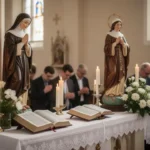
Artists often portray Catherine wearing the black and white habit of the Dominican Order. She may appear with a lily, a cross, a book, a crown of thorns, or a heart. These symbols reflect her purity, religious identity, writing, devotion to Christ, and mystical spirituality.
Some traditional images show a ring or depict Christ giving Catherine a ring. This represents a mystical marriage between Christ and the soul. It is symbolic religious art, not a claim about an ordinary legal marriage.
Another familiar image may show Catherine holding a heart or standing near a book. The book points to her letters and theological writing, while the heart suggests her teaching that love must transform the whole person.
There is no single prayer that every Catholic must use when asking for Catherine’s intercession. A prayer can be simple and personal. You might ask her to help you act with courage, serve someone who is suffering, seek peace without avoiding truth, or grow in love of God and neighbor.
A short prayer inspired by her example could be:
St. Catherine of Siena, pray that I may seek truth with humility, serve others with compassion, and remain faithful when courage is difficult.
When praying with a saint, Catholics are asking the saint to pray with and for them; they are not treating the saint as a substitute for God. Many people combine a prayer for Catherine’s intercession with a period of silence, a reading from the Gospels, or a practical decision to help someone in need.
A simple observance for her feast day might include:
Read a short passage from Catherine’s letters or The Dialogue.
Pray for church leaders, civic leaders, and people involved in conflict.
Contact someone who is isolated or needs practical support.
Ask where fear, pride, or resentment may be limiting your ability to love.
Choose one concrete act of service and complete it quietly.
Prayer and action belong together in Catherine’s spirituality. A feast-day devotion is most faithful to her example when it leads to a specific act of mercy, reconciliation, truth-telling, or service.
Other saints named Catherine
“St. Catherine” does not always mean Catherine of Siena. Several saints with that name have distinct histories and feast days. If you are researching a church, school, medal, painting, or prayer card, the symbols shown may help identify the correct saint.
St. Catherine of Alexandria
Catherine of Alexandria is traditionally described as a Christian martyr from the early centuries of Christianity. Historical details about her life are limited, and many accounts come from later traditions. She is commonly shown with a sword and a wheel, referring to the manner of her martyrdom in the traditional story.
She is associated with philosophers, students, scholars, librarians, and young women. Her traditional feast day is November 25. The famous Catherine wheel, a circular firework device, takes its name from the wheel connected with her legend.
Her identity is different from Catherine of Siena’s. Catherine of Alexandria belongs to the early Christian martyr tradition, while Catherine of Siena was a documented 14th-century religious figure whose letters and writings survive.
St. Catherine Labouré
Catherine Labouré was a French religious sister who lived from 1806 to 1876. She is associated with reported visions of the Virgin Mary in Paris and with the Miraculous Medal. The medal’s design includes images and words connected with Mary’s intercession and Christian devotion.
Her feast day is November 28. She is often shown in the habit of the Daughters of Charity, the community she joined. Catherine Labouré’s life was marked by humility, service to the poor, and a long period of quiet work after the events associated with the medal.
St. Catherine of Bologna
Catherine of Bologna was an Italian Poor Clare nun, artist, writer, and abbess who lived from 1413 to 1463. She is recognized as a patron saint of artists and is remembered for combining religious life with painting, music, writing, and community leadership.
Her feast day is March 9. She is a useful reminder that Christian religious vocation has included creative work and intellectual discipline, not only preaching or public leadership.
St. Catherine of Genoa
Catherine of Genoa lived from 1447 to 1510 and is known for her work among the sick and poor, especially in connection with a hospital in Genoa. Her spiritual writings discuss purification, charity, and the soul’s relationship with God.
Her feast day is September 15. She is sometimes confused with Catherine of Siena because both were Italian women known for mystical spirituality and service, but they lived in different centuries and belonged to different religious contexts.
How to identify which St. Catherine you are looking for
Look first at the feast date, the image, or the institution connected with the name. A Dominican black-and-white habit, a book, or a lily usually points toward Catherine of Siena. A wheel and sword generally suggest Catherine of Alexandria, while a Miraculous Medal points toward Catherine Labouré.
The location can offer another clue. Churches and organizations named “St. Catherine” may honor a local patron, a founding community, or a saint whose feast day was important to the people who established them. The name alone is not enough to identify the dedication.
Use these distinctions as a quick guide:
Catherine of Siena: Dominican tertiary, mystic, reformer, author, feast day April 29.
Catherine of Alexandria: early Christian martyr, associated with a wheel and sword, feast day November 25.
Catherine Labouré: French Daughter of Charity, associated with the Miraculous Medal, feast day November 28.
Catherine of Bologna: Poor Clare nun and artist, feast day March 9.
Catherine of Genoa: Italian mystic and worker among the sick and poor, feast day September 15.
If you are choosing a patron saint, consider the quality of life or mission that most closely matches your situation. Catherine of Siena may resonate with someone called to peacebuilding, reform, healthcare, or courageous service. Catherine of Alexandria may speak to students and scholars, while Catherine Labouré may be meaningful to people connected with the Miraculous Medal or service to the poor.
The saints named Catherine are not interchangeable, but they share a common emphasis on faithful courage. Their stories encourage people to connect belief with conduct, prayer with service, and personal conviction with responsibility toward others.
Frequently asked questions
Is St. Catherine of Siena the same person as St. Catherine of Alexandria?
No. They were different women from different periods. Catherine of Alexandria is traditionally remembered as an early Christian martyr, while Catherine of Siena was a 14th-century Italian Dominican tertiary, mystic, writer, and church reformer. Their feast days, symbols, and patronages are also different.
What is St. Catherine of Siena the patron saint of?
Catherine of Siena is a patron saint of Italy and Europe and is associated with nurses, nursing, firefighters, and efforts for peace. People also seek her intercession when they need courage to address conflict, serve the sick or poor, or speak truthfully while preserving charity.
When is St. Catherine of Siena’s feast day?
Her feast day is April 29 in the Roman Catholic calendar. Older references may list April 30 because that was the date traditionally used before changes to the liturgical calendar. April 29 is also shared with St. Catherine of Siena’s commemoration in many Catholic communities.
What is St. Catherine of Siena best known for?
She is best known for her mystical spirituality, care for the sick and poor, letters to religious and political leaders, and efforts to promote peace and church reform. She also wrote The Dialogue and was named a Doctor of the Church in 1970.















Leave a Reply