Saint Catherine of Genoa: life, teachings, and legacy
Saint Catherine of Genoa: life, teachings, and legacy
Have you ever wondered how a person can move from a comfortable life to years of demanding service without losing sight of prayer? Saint Catherine of Genoa is remembered for precisely that transformation. Born into an influential family, married while still young, and initially absorbed in worldly concerns, she experienced a profound religious conversion that redirected her entire life.
Catherine became known for combining intense mystical prayer with practical care for people who were sick, poor, and dying. Her spirituality centered on the love of God, the purification of the human heart, and the conviction that genuine prayer should shape everyday choices. The Church honors her as a saint, mystic, and patron of hospitals, and her writings remain especially influential in discussions of purgatory and divine love.
Saint Catherine of Genoa was born in Genoa, Italy, in 1447 into the prominent Fieschi family. Her father, Jacopo Fieschi, held an important public position, and her family background connected her with the city’s political and ecclesiastical elite. She received the religious formation expected of a noble girl, but the early details of her life do not suggest that she immediately stood out as a future reformer or mystic.
At about 16 years of age, Catherine married Giuliano Adorno, a member of another influential Genoese family. Their marriage was difficult for many years. Giuliano is often described as financially irresponsible and involved in a lifestyle that created serious strain, while Catherine herself struggled with discouragement and an attachment to the social expectations surrounding her.
The couple had no children. Their household eventually changed significantly after Catherine’s religious conversion, and Giuliano later joined her in a more disciplined Christian life. His change is part of Catherine’s story, but her transformation should not be reduced to the effect of her marriage. Her own encounter with God became the central force in her decisions.
Catherine’s feast day is September 15, the date associated with her death in 1510. Pope Benedict XIV canonized her in 1737. She is also commonly called Catherine of Genoa to distinguish her from other saints named Catherine, particularly Catherine of Siena and Catherine of Alexandria.
At a glance: Catherine lived from 1447 to 1510, served the sick in Genoa, wrote about divine love and purgatory, and was canonized by Benedict XIV in 1737.
How Catherine’s conversion changed her life
Catherine’s conversion is traditionally associated with a powerful religious experience in 1473. Accounts describe her going to confession after a period of spiritual dissatisfaction and encountering a deep awareness of both God’s love and her own need for change. The experience did not simply produce a temporary emotional response. It led her toward a sustained reordering of her priorities.
She began to spend more time in prayer and Eucharistic devotion, to practice self-denial, and to examine her motives with unusual honesty. Her spirituality was not based on trying to earn God’s love through suffering. Instead, she understood discipline as a response to a love that had already reached her and exposed the distance between divine goodness and human self-centeredness.
For Catherine, conversion involved more than private religious feelings. It affected her use of money, her relationships, her schedule, and her view of people whom society overlooked. She gradually turned away from the demands of status and luxury and toward a life of service. Her husband also underwent a conversion, and the two became involved in charitable work together.
That development offers a useful distinction. Catherine did not abandon ordinary responsibilities in order to pursue an isolated mystical existence. She brought prayer into the practical realities of marriage, medical care, poverty, and death. Her example suggests that a spiritual awakening becomes credible when it changes the way a person treats others.
Her life also challenges a common misunderstanding about mystics. A mystic is not necessarily someone who escapes the world or receives constant extraordinary experiences. Catherine’s religious life included demanding work, organizational responsibilities, contact with illness, and the emotional burden of accompanying people near death. Contemplation and service were not separate paths for her.
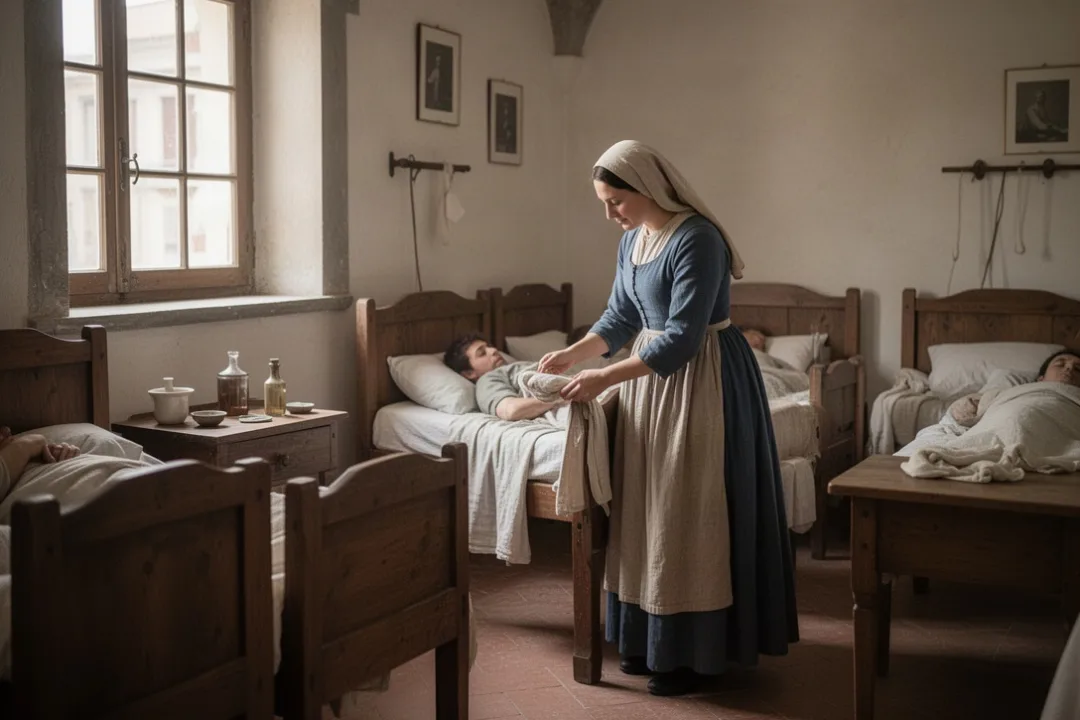
After her conversion, Catherine became closely involved with charitable work in Genoa. She served at the Hospital of Pammatone, one of the city’s major institutions for caring for the sick. Her responsibilities included visiting patients, arranging assistance, helping with practical needs, and giving personal attention to people whose poverty or illness made them easy to neglect.
Her service was especially striking because caring for the sick in the fifteenth century involved risks and hardships that modern readers may underestimate. Hospitals were crowded, medical treatments were limited, and contagious disease could spread quickly. Catherine did not regard the sick merely as recipients of charity. She tried to meet them as persons whose dignity did not depend on health, wealth, or social rank.
She also cared for people who were dying. This work shaped her understanding of the human person and became closely connected with her teachings about purification after death. Catherine saw the final stages of life as a time when fear, regret, dependence, and hope could all be present. Her ministry required both practical competence and patience with spiritual distress.
Catherine’s charitable work was not limited to dramatic acts. Much of it involved persistence: returning to patients, noticing neglected needs, arranging food or care, and remaining present when there was no easy cure. Such service can be physically tiring and emotionally demanding. Her example places mercy and responsibility at the center of Christian discipleship.
She also participated in the management and improvement of charitable care. Although later accounts naturally emphasize her holiness, Catherine was not only a compassionate visitor. She had to deal with resources, staff, institutional expectations, and the complicated realities of serving a large population. Her spirituality therefore included a practical concern for how care was organized.
She visited patients who were sick, poor, or socially isolated.
She assisted dying people with both bodily and spiritual needs.
She supported institutional care through work connected with the Hospital of Pammatone.
She treated service as prayer in action, not as a separate activity reserved for a few specialists.
Her relationship with the hospital also helps explain why she is associated with health care and hospitals. The title does not mean that she was a physician in the modern professional sense. It reflects her sustained ministry among patients and her commitment to serving vulnerable people in a demanding medical setting.
Practical lesson: Catherine’s charity was personal and organized at the same time. She combined compassion for individual patients with the steady work needed to keep a charitable institution serving people well.
What Saint Catherine of Genoa taught about purgatory
Catherine is best known to many readers for her Treatise on Purgatory. The work presents purgatory not mainly through images of external punishment, but through the soul’s encounter with the holiness and love of God. A person who has died in friendship with God may still need purification from the selfishness and disorder that remain within them.
In Catherine’s description, the soul understands with unusual clarity what it was made for: complete union with God. At the same time, it recognizes every attachment that prevents that union. The resulting pain comes from the soul’s desire for God and its awareness that it is not yet fully prepared to enjoy God’s presence.
This perspective gives Catherine’s teaching a distinctive emphasis. Purgatory is a process of purification, not a second chance to choose whether to turn toward God. The person undergoing purification already belongs to God, but still needs to be freed from the habits and attachments that conflict with divine love.
Catherine’s language can sound intense because she takes holiness seriously. She does not treat selfishness, resentment, dishonesty, or indifference as minor imperfections with no spiritual consequences. Yet her account is not meant to encourage despair. The entire process takes place within God’s mercy and saving love.
Her teaching also avoids presenting purgatory as a simple transaction in which someone pays a measurable penalty and then leaves. Instead, purification is described as an inner transformation. The soul becomes increasingly able to receive what it already longs for. This helps explain why Catherine connects suffering with love rather than with arbitrary punishment.
Readers should distinguish Catherine’s personal mystical theology from every popular image associated with purgatory. The Church’s teaching about purgatory has developed within a broader tradition, while Catherine offers one influential spiritual interpretation. Her work uses vivid theological language to express a mystery, not a scientific description of an afterlife location.
Her reflections can still be useful during grief. When someone dies, family members often struggle with questions about unfinished relationships, regret, and the hope that a person is being made whole. Catherine’s vision offers a framework in which God’s justice and compassion are not opposites. Divine love confronts what needs healing while preserving the hope of complete communion.
How Catherine’s view differs from common misconceptions
Purgatory is not presented as damnation. Catherine’s account concerns souls destined for union with God.
Purification is not merely external punishment. The central issue is the soul’s transformation and readiness for divine love.
God is not absent. The pain arises in relation to God’s holiness and the soul’s longing for full union.
The teaching is not a substitute for the Gospel. It belongs within the wider Christian hope of resurrection and salvation.
Her treatment of purgatory also reveals something about her view of ordinary life. Every act of forgiveness, truthfulness, generosity, and self-control can be understood as cooperation with the purification God desires. Catherine was not encouraging people to become fascinated with the afterlife. She was urging them to let divine love begin its work now.
How Catherine understood divine love and self-denial
Catherine’s spirituality can be summarized by the phrase love of God above self-interest, although that phrase needs careful interpretation. She did not teach that a person must despise their human nature or ignore legitimate responsibilities. Her concern was the self that insists on control, recognition, comfort, or advantage at the expense of love.
Her writings describe divine love as a fire that purifies the soul. This image communicates both warmth and intensity. Love comforts, but it also exposes whatever prevents a person from becoming truthful and generous. Catherine’s self-denial was therefore aimed at freedom from disordered attachments rather than at suffering for its own sake.
She believed that a person who has encountered God’s love cannot remain satisfied with a life organized entirely around personal comfort. This conviction explains why she accepted demanding work among the sick and poor. Her service was not an attempt to build a heroic reputation. It was the practical consequence of seeing every human being in relation to God.
Catherine also valued inner honesty. She examined her motives and recognized that apparently religious actions could still contain pride or self-seeking. This does not mean that she trusted feelings alone. She sought direction through prayer, the sacraments, the Christian community, and the responsibilities placed before her.
Her approach can be especially challenging for readers who separate spiritual life from daily behavior. Catherine would likely ask what prayer changes in the way you speak to a spouse, treat a coworker, handle money, respond to illness, or regard someone who cannot repay your kindness. In her thought, love becomes credible through action.
At the same time, her life should not be used to pressure every person into identical forms of sacrifice. Catherine lived in a particular historical setting, with particular responsibilities and gifts. The lasting principle is not that everyone must imitate every outward detail of her life. It is that Christian practice should gradually free people for truth, service, and love.
What sources tell us about Saint Catherine’s life
Much of what is known about Catherine comes through accounts written or compiled by people who knew her and through texts connected with her spiritual experience. Her principal literary works include the Life and Doctrine, the Treatise on Purgatory, and material often associated with her spiritual conversations and instructions.
The Life and Doctrine is not an autobiography in the modern sense. It was assembled by people close to Catherine, including her confessor and other companions, and it combines biographical narrative with theological interpretation. That means readers should recognize both its value and its form. It preserves a portrait of her religious life, but it does not provide a private diary with a complete day-by-day record.
The Treatise on Purgatory is also best read as a work of mystical theology rather than as a literal map of the afterlife. Catherine uses images, contrasts, and descriptions of spiritual experience to express how the soul encounters holiness. Her purpose is to awaken a deeper understanding of love and purification, not to answer every speculative question.
Later generations have sometimes presented saints in simplified ways, emphasizing extraordinary experiences while overlooking ordinary work. Catherine’s story is better understood when both dimensions remain together: mystical insight and institutional service, interior purification and care for patients, contemplation and responsibility.
Historical caution does not weaken her importance. It helps readers appreciate what her tradition actually preserves. Catherine was not important because every later detail about her life can be verified with equal certainty. She matters because a consistent spiritual portrait emerges: a woman transformed by prayer who gave herself to the sick and described purification as the soul’s response to divine love.
Why Saint Catherine of Genoa still matters
Catherine remains relevant because she connects questions that are often separated. She speaks about personal conversion, but she also insists on service. She writes about death and purification, but her teaching directs attention back to how a person lives now. She values contemplation, but she does not treat practical work as spiritually inferior.
Her example can be meaningful for people working in hospitals, hospice care, nursing, chaplaincy, social services, and other forms of caregiving. It recognizes that presence matters when a cure is not possible. A patient may need medicine, but may also need dignity, honest companionship, forgiveness, or someone willing to remain nearby.
Her writings can also help people think more carefully about moral growth. Change is often incomplete and gradual. A person may sincerely desire goodness while still carrying fear, resentment, vanity, or harmful habits. Catherine’s vision offers a demanding but hopeful view: purification is painful because love is real, yet the goal is wholeness rather than rejection.
For Catholics, Catherine’s feast day can be an opportunity to pray for the sick, support hospitals, visit someone who is isolated, or examine whether personal devotion is producing greater charity. For readers from other Christian traditions, her reflections may still provide a substantial meditation on conscience, mercy, death, and the relationship between inward faith and outward service.
A simple way to apply her example is to connect one spiritual practice with one concrete act of care. You might set aside time for quiet prayer and then call someone who is ill, forgive a debt, volunteer, or offer patient attention to a person who is often ignored. Catherine’s legacy points toward a faith that becomes visible through responsible love for real people.
Saint Catherine of Genoa is therefore remembered not only as a visionary who wrote about purgatory. She was a woman whose encounter with God changed her relationship with possessions, marriage, work, suffering, and strangers. Her life proposes that holiness is not an escape from human need. It is a deeper way of entering that need with compassion, truth, and hope.
Frequently asked questions
When is Saint Catherine of Genoa’s feast day?
Saint Catherine of Genoa’s feast day is September 15. The date is associated with her death in 1510 and is observed in the Catholic liturgical calendar. It should not be confused with the feast days of other saints named Catherine, including Catherine of Siena and Catherine of Alexandria.
What is Saint Catherine of Genoa the patron saint of?
She is especially associated with hospitals and hospital workers because of her sustained service at the Hospital of Pammatone in Genoa. She is also linked with people who care for the sick, those facing illness, and spiritual reflection on purgatory and the purification of the soul.
Did Saint Catherine of Genoa write the Treatise on Purgatory herself?
The Treatise on Purgatory is traditionally connected with Catherine’s spiritual teaching, but the surviving text comes through the work of people around her. It is best understood as a record or presentation of her mystical theology rather than an autobiography written in the modern sense.
Was Saint Catherine of Genoa a nun?
No. Catherine was married to Giuliano Adorno and lived her religious vocation through prayer, charitable service, and care for the sick. Her life demonstrates that significant mystical and charitable work can take place outside a monastery or formal religious order.
















Leave a Reply