Saint feast days in November: A date-by-date guide
Saint feast days in November: A date-by-date guide
Saint feast days in November include All Saints’ Day on November 1, Saint Martin of Tours on November 11, Saint Cecilia on November 22, and Saint Andrew the Apostle on November 30. The month also honors saints such as Charles Borromeo, Leo the Great, Frances Xavier Cabrini, Elizabeth of Hungary, and Catherine of Alexandria.
The exact list depends on the Christian tradition and the local calendar. In the Roman Catholic calendar used in the United States, some November observances are celebrated universally, while others are optional memorials, regional celebrations, or dates assigned to blessed people rather than officially canonized saints.
A saint’s feast day usually marks the anniversary of the person’s death, traditionally understood as their birth into eternal life. The date may instead commemorate a major event connected with the saint, the dedication of a church, or a translation of relics. Some saints share a date, especially when a group of martyrs is remembered together.
Catholic calendars classify celebrations by rank. A solemnity is the highest type of celebration and may include special prayers, readings, and hymns. A feast has a significant place in the liturgical year, while a memorial honors a saint within the regular daily structure of worship. Memorials can be obligatory or optional.
November begins with two closely connected observances. All Saints’ Day on November 1 honors every saint in heaven, including those known by name and the many whose lives were never formally recorded. All Souls’ Day on November 2 remembers the faithful departed. It is not technically a saint feast day, but it shapes the prayerful character of the whole month.
Calendar note: Feast-day rankings and local observances can change from one country or diocese to another. If a date matters for Mass, school, or parish planning, check your diocesan calendar or parish schedule.
Major saint feast days from November 1 through November 10
November 1: All Saints’ Day
All Saints’ Day celebrates the entire communion of saints. It includes famous figures such as the apostles, martyrs, monks, missionaries, and teachers, but it also honors ordinary people who lived faithfully without becoming widely known. The day points to the Christian belief that holiness is not limited to a small group of extraordinary public figures.
Many churches mark the solemnity with a special Mass, readings about holiness, and prayers of thanksgiving. Families may also talk about a patron saint, visit a cemetery, or learn about a saint whose life reflects a particular virtue such as courage, mercy, patience, or service.
November 2: All Souls’ Day
All Souls’ Day, also called the Commemoration of All the Faithful Departed, focuses on prayer for those who have died. It is separate from All Saints’ Day, although the two observances are placed next to each other. Churches may display a book of remembrance, invite people to name loved ones, or celebrate a memorial Mass.
Because November 2 is not a saint’s feast day in the strict sense, it should not be confused with a canonized saint’s memorial. It is nevertheless one of the most meaningful dates in the month for Christian families and communities.
November 3: Saint Martin de Porres
Saint Martin de Porres was a Dominican brother in Lima, Peru, during the seventeenth century. He served the poor, sick, enslaved, and abandoned, and became known for his humility and practical care for people and animals. He is often represented with a broom, reflecting the dignity he brought to humble work.
Martin is the first person of African and Indigenous American descent from the Americas to be canonized by the Catholic Church. His memorial can encourage reflection on racial dignity, service, and compassionate care for people living on the margins.
November 4: Saint Charles Borromeo
Saint Charles Borromeo was a sixteenth-century Italian cardinal and archbishop of Milan. He played a major role in implementing reforms associated with the Council of Trent, improving the education of priests, strengthening parish life, and serving communities affected by illness and poverty.
Charles is remembered especially as a reforming bishop and a patron of seminarians, catechists, and spiritual leaders. His feast day is a useful occasion to pray for clergy and for the health of local churches.
November 5: Saint Elizabeth and local observances
November 5 does not have one universally prominent saint celebration in the Roman Catholic calendar used throughout the United States. Some calendars commemorate Saint Elizabeth, the mother of Saint John the Baptist, on this date, while other communities observe regional saints, blesseds, or religious founders.
This is a good example of why a date-by-date list should be read alongside a local calendar. A parish may honor a patron saint on November 5 even when the universal calendar gives the day a different emphasis.
November 6: Saint Leonard of Noblac
Saint Leonard of Noblac was a sixth-century hermit associated with a monastery in what is now France. Medieval devotion connected him with prisoners and captives, and he became a patron of people seeking freedom from imprisonment. Stories about his life vary, so his historical biography should be treated with care.
His feast day can prompt reflection on freedom, rehabilitation, and compassion for prisoners. Churches or charitable groups may use the date to pray for incarcerated people, their families, victims of crime, and those working in correctional settings.
November 7: Saint Willibrord
Saint Willibrord was an English missionary and bishop who worked among the Frisians and helped establish Christian communities in the Low Countries. He is associated with missionary preaching, church organization, and the founding of the see of Utrecht.
His memorial offers a natural opportunity to pray for missionaries and evangelists, especially those who serve across cultural and language boundaries. It also highlights the patience required to build lasting communities rather than measuring ministry only by immediate results.
November 8: Saints and regional calendars
November 8 is not usually marked by one of the best-known universal celebrations in the United States. Depending on the calendar, the day may include optional memorials for saints such as the Four Crowned Martyrs or other regional figures. These variations reflect the long history of local devotion within the wider church.
If you are preparing a parish bulletin, classroom lesson, or prayer service for November 8, verify the name and rank of the observance in the appropriate calendar. A short reading about a local saint can be more meaningful than using an unfamiliar date without explaining its setting.
November 9: Dedication of the Lateran Basilica
The Dedication of the Lateran Basilica commemorates the cathedral church of the Diocese of Rome. The basilica is dedicated to Christ the Savior, and its anniversary is celebrated throughout the Catholic Church because it represents the unity of local churches with the wider church.
Although this is not the feast of a saint, it belongs on a November liturgical calendar. The observance invites Christians to think of the church as both a physical place of worship and a living community made up of people who pray, serve, learn, and celebrate together.
November 10: Saint Leo the Great
Saint Leo the Great was a fifth-century pope, theologian, and preacher. He is remembered for his teaching about Christ and for his leadership during a politically unstable period. His sermons on the meaning of the Incarnation influenced Christian reflection for centuries.
Leo also worked to protect Rome during times of invasion and is associated with meetings intended to limit violence. His feast day emphasizes the responsibilities of pastoral leadership, clear teaching, and peacemaking. He is recognized as a Doctor of the Church.
Saint feast days from November 11 through November 20
November 11: Saint Martin of Tours
Saint Martin of Tours was a Roman soldier who later became a Christian monk and bishop. The best-known story about him describes Martin sharing his cloak with a freezing beggar. The story illustrates his instinct to respond directly to human need rather than waiting for a perfect opportunity.
Martin became bishop of Tours and helped spread Christian faith in Gaul. His feast day is particularly associated with charity, hospitality, and service. In some countries, November 11 includes lantern processions or customs connected with the end of the agricultural season, although those traditions vary widely.
November 12: Saint Josaphat
Saint Josaphat Kuncewicz was a seventeenth-century bishop in the Polish-Lithuanian Commonwealth who worked for unity between Christians of Eastern and Western traditions. He was killed because of conflicts surrounding his ministry and is honored as a martyr for Christian unity.
His memorial can support prayer for ecumenism, reconciliation, and respect among churches with different histories and liturgical traditions. It also raises difficult questions about how religious disagreement can become entangled with politics, identity, and violence.
November 13: Saint Frances Xavier Cabrini
Saint Frances Xavier Cabrini was an Italian-born missionary who founded the Missionary Sisters of the Sacred Heart of Jesus. She served immigrants and established schools, orphanages, and hospitals, especially in the United States and other countries where Italian immigrants needed support.
She became the first United States citizen to be canonized. Her feast day is especially significant for immigrants, educators, health-care workers, and people who serve across cultures. It can also provide a thoughtful occasion to consider how newcomers are welcomed and supported.
November 14: Saint Lawrence O’Toole and local celebrations
November 14 may be associated with Saint Lawrence O’Toole in some calendars, particularly those influenced by Irish Catholic tradition. He was a twelfth-century archbishop of Dublin involved in church reform and mediation during a turbulent period.
Because the observance is not ranked identically everywhere, the date may look different in a parish calendar. Local celebrations often preserve a community’s history, especially when a saint is connected with a parish’s founding families, immigrant heritage, or patronal identity.
November 15: Saint Albert the Great
Saint Albert the Great was a Dominican bishop, teacher, and scholar whose interests included theology, philosophy, natural science, and the study of the world. He taught Saint Thomas Aquinas and helped show that careful learning and Christian faith need not be enemies.
Albert’s feast day is especially relevant to students, scientists, teachers, and researchers. His example encourages intellectual honesty, patient observation, and the responsible use of knowledge for human flourishing.
November 16: Saints Margaret of Scotland and Gertrude
Saint Margaret of Scotland was an eleventh-century queen known for charity, religious devotion, and efforts to strengthen church life. She supported the poor and helped reform practices within the Scottish church. Her life joins public responsibility with personal service.
Saint Gertrude the Great was a thirteenth-century German Benedictine nun and mystic. Her writings focus on prayer, the love of Christ, and the spiritual value of ordinary religious life. Together, these November 16 memorials highlight leadership, contemplation, hospitality, and care for the poor.
November 17: Saint Elizabeth of Hungary
Saint Elizabeth of Hungary was a thirteenth-century noblewoman who used her wealth and position to care for sick and poor people. After her husband’s death, she embraced a life of service and supported a hospital associated with her charitable work.
Elizabeth is one of the best-known patrons of charitable organizations and social workers. Her feast day is a natural time to collect food, volunteer at a shelter, support a hospital ministry, or examine whether charitable efforts protect the dignity of the people they serve.
November 18: Dedication of the Basilicas of Saints Peter and Paul
November 18 commemorates the dedication of the Roman basilicas associated with Saints Peter and Paul. The observance links the two apostles and recalls the importance of their witness to the early Christian community in Rome.
Like the November 9 dedication, this is a church anniversary rather than a saint’s individual memorial. It can help communities reflect on apostolic tradition, unity, and the role of churches as places where generations gather for worship.
November 19 and 20: Regional saints and optional memorials
November 19 and November 20 may feature different saints depending on the national or diocesan calendar. Saint Roque González and his companions, Jesuit missionaries martyred in South America, are associated with November 16 in some calendars, while other saints and blesseds may appear on nearby dates in regional listings. Saint Edmund, king and martyr, is commonly remembered on November 20 in English tradition.
These dates demonstrate why printed calendars may not match online lists. Before preparing a formal liturgy, identify whether the calendar is universal, national, diocesan, religious-order, or parish-specific.
Saint feast days from November 21 through November 30
November 21: The Presentation of the Blessed Virgin Mary
The Presentation of the Blessed Virgin Mary remembers a tradition about Mary’s dedication to God as a child. The story is drawn from early Christian tradition rather than a narrative found directly in the canonical Gospels. The feast has been celebrated in the church’s liturgical life for many centuries.
This observance is not a saint’s feast in the same format as the memorial of a martyr or bishop. It focuses on dedication, spiritual formation, and the vocation of family life. Schools and parishes may use it to pray for children, parents, and those who guide young people.
November 22: Saint Cecilia
Saint Cecilia is an early Christian martyr and the patron saint of music and musicians. Details about her life are difficult to separate from later devotional traditions, but her name has been connected with Christian worship and sacred music for centuries.
Her feast day is an excellent occasion to recognize choirs, instrumentalists, cantors, composers, and music teachers. A parish might include a hymn of thanksgiving, offer a concert, or invite musicians to reflect on how music serves prayer rather than simply performance.
November 23: Saints Clement, Columban, and Blessed Miguel Pro
November 23 brings together several important figures in different calendars. Saint Clement I was an early pope and martyr associated with one of the oldest surviving Christian letters outside the New Testament. Saint Columban was an Irish missionary and monastic founder who established communities across Europe.
Blessed Miguel Pro, a Mexican Jesuit priest and martyr, is also widely remembered on this date, although he has not been canonized. His life is associated with courageous ministry during religious persecution. Together, these observances point to mission, perseverance, and faithfulness under pressure.
November 24: Saints Andrew Dũng-Lạc and companions
Saint Andrew Dũng-Lạc and his companions represent Vietnamese martyrs who suffered persecution over several centuries. The group includes bishops, priests, religious, and lay Christians. Their shared memorial honors the breadth of a Christian community rather than presenting martyrdom as the achievement of only one type of person.
The feast day invites prayer for the church in Vietnam and for communities that face pressure because of religious belief. It also highlights the importance of remembering local witnesses whose names and stories may be less familiar in the United States.
November 25: Saint Catherine of Alexandria
Saint Catherine of Alexandria is traditionally described as a young Christian martyr known for wisdom and steadfastness. Historical details about her life are uncertain, and some modern calendars treat her commemoration differently from older devotional calendars.
She has long been associated with students, philosophers, scholars, and young women. Her traditional image emphasizes intellectual conviction and courage. When presenting her story, use reliable church or historical sources and distinguish established facts from later legends.
November 26: Saint John Berchmans and other calendar variations
Saint John Berchmans was a seventeenth-century Jesuit seminarian known for ordinary faithfulness, community life, and attention to daily responsibilities. His memorial appears on some calendars connected with Jesuit spirituality, while other Roman Catholic calendars assign different observances to November 26.
His example is especially relevant to students and young adults. It suggests that holiness may be expressed through steady habits, respectful relationships, study, prayer, and service rather than only through dramatic public achievements.
November 27 through November 29: Advent preparation and local saints
The final days of November often fall close to the beginning of Advent, so the liturgical focus may shift depending on the year. Local calendars may include saints such as Saint Saturnin, remembered in parts of France and Spain, or other regional patrons and blesseds.
These dates are useful for checking the calendar carefully rather than assuming that every website lists the same celebration. A parish can honor a local saint while still observing the wider season with prayer, Scripture, generosity, and preparation for Christmas.
November 30: Saint Andrew the Apostle
Saint Andrew was one of the apostles and the brother of Saint Peter. The Gospel accounts portray him as one of the early disciples who brought others to Jesus. He is traditionally associated with missionary work in regions around the Black Sea and is honored as the patron saint of several countries and communities.
Saint Andrew’s feast day closes the month with a focus on apostolic witness and invitation. It also commonly marks the beginning of the Advent season or falls very near it, depending on the year. Churches may use the day to pray for missionaries and for people discerning a call to ministry.
Practical ways to observe November feast days
You do not need an elaborate program to mark a saint’s day. A brief prayer, a shared meal, a charitable act, or a few minutes spent learning about a saint can connect the date with real life. Choose an observance that fits your household, school, parish, or community.
Choose one saint each week: Read a short biography, identify the person’s main virtue, and discuss one practical way to imitate it.
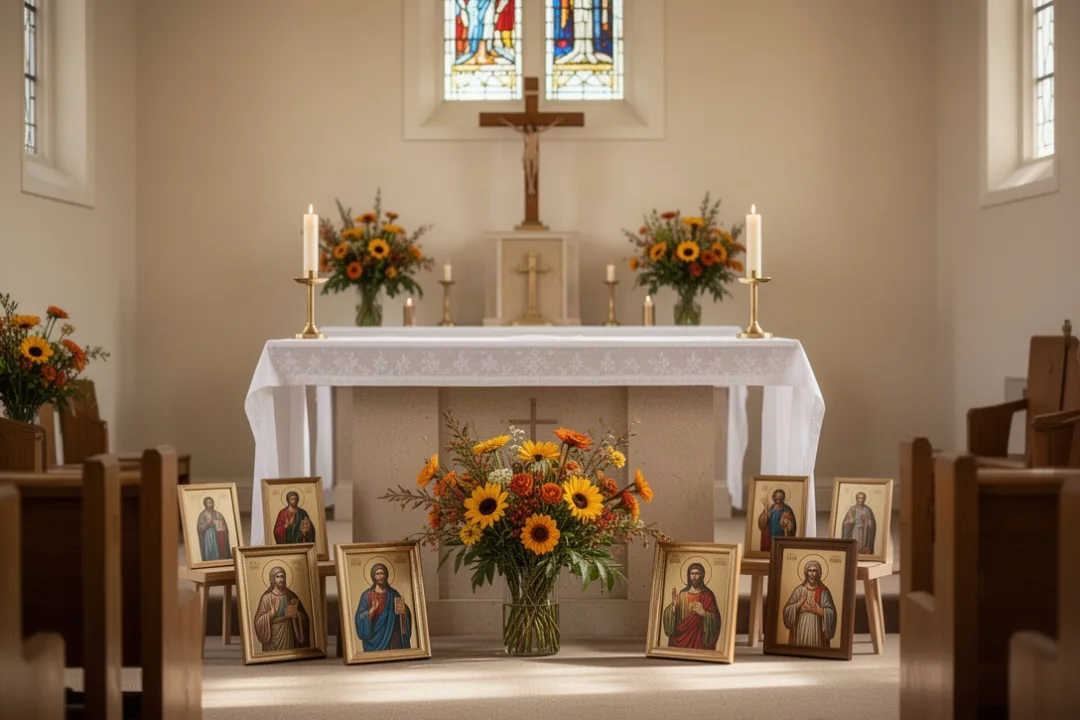
Honor a patron saint: If your name, parish, school, or profession has a patron, display an image or say a prayer associated with that saint.
Connect prayer with service: Follow Saint Martin de Porres or Saint Elizabeth of Hungary by helping a neighbor, donating supplies, or volunteering with a local charity.
Include children: Use age-appropriate stories, coloring pages, music, or a simple saint-of-the-day activity without presenting uncertain legends as proven history.
Support the arts: On Saint Cecilia’s Day, thank musicians and participate respectfully in music that serves worship or community life.
Remember the deceased: During the first week of November, visit a cemetery, pray for loved ones, or share family memories.
Common mistakes when using a November saint calendar
Online lists often combine Catholic, Orthodox, Anglican, and local observances without explaining the differences. A reliable calendar should identify its tradition and country. The same saint may have a different feast date, title, or liturgical rank in another tradition.
Do not treat All Souls’ Day as a saint feast: It honors the faithful departed and has a distinct purpose.
Do not assume every listed person is canonized: Blessed people, venerable figures, and saints may appear together in informal lists.
Do not confuse a church dedication with a saint’s memorial: November 9 and November 18 commemorate basilicas and their significance.
Do not rely on legends alone: Some early saints have biographies shaped by centuries of devotional storytelling.
Do not use a universal list for every parish: National, diocesan, religious-order, and local calendars can add or replace optional memorials.
Do not let the calendar replace the person: Learn what the saint actually did, whom the saint served, and what historical setting shaped the life.
Best practice: For a liturgy or official parish announcement, use the current calendar published or approved by the relevant diocese. For personal devotion, a trustworthy biography can add historical context that a one-line calendar entry cannot provide.
How families and schools can plan a November saint calendar
A useful plan balances major celebrations with lesser-known figures. Begin with All Saints’ Day and All Souls’ Day, then select several people whose lives connect with your community’s interests. A school might feature Frances Xavier Cabrini and Albert the Great, while a parish music program might emphasize Cecilia.
Keep each presentation focused. Share the saint’s time and place, vocation, major act of service, and one question for reflection. For example: What need did this person notice, and how did the person respond? This approach keeps saint stories connected to concrete decisions rather than reducing them to decorative biographies.
Families can create a simple November calendar with the date, name, country or region, and a short prayer intention. Add charitable actions beside the dates: pray for prisoners with Leonard, immigrants with Cabrini, musicians with Cecilia, and people seeking reconciliation with Josaphat.
Why November’s saints emphasize remembrance and service
November’s calendar has a distinctive movement. It begins by celebrating all the saints, turns toward remembrance of the dead, and then presents a series of people whose lives involved service, mission, reform, scholarship, music, charity, and martyrdom.
That pattern gives the month a serious but practical character. The saints are not honored only as historical figures; they are remembered as examples of how faith can take shape through daily work, public responsibility, intellectual effort, hospitality, and care for vulnerable people.
Whether you observe one date or follow the whole month, the most useful practice is to connect a feast day with a concrete response. Learn the story, pray for people associated with the saint’s work, and choose one action that reflects the virtue the day brings to mind.
Frequently asked questions
What is the most important saint feast day in November?
All Saints’ Day on November 1 is the most prominent universal celebration at the start of November. It honors every saint in heaven, both known and unknown. Other major observances include Saint Martin of Tours on November 11, Saint Cecilia on November 22, and Saint Andrew the Apostle on November 30. Liturgical importance can vary by local calendar.
Is All Souls’ Day a saint feast day?
No. All Souls’ Day on November 2 is the Commemoration of All the Faithful Departed, a day of prayer for people who have died. It follows All Saints’ Day and is closely related to it, but it does not celebrate a particular canonized saint or all saints as a group.
Which November saint is the patron of musicians?
Saint Cecilia, celebrated on November 22, is traditionally recognized as the patron saint of music and musicians. Parishes often honor her by recognizing choirs, instrumentalists, cantors, composers, and music teachers. The historical details of Cecilia’s life are limited, so some parts of her traditional biography should be treated as devotional tradition rather than confirmed history.
Why do different websites list different saints for the same November date?
Saint calendars differ because churches use universal, national, diocesan, regional, and religious-order calendars. Some lists also include blesseds, local patrons, or saints from another Christian tradition. Feast-day rankings may change as well. For official worship planning, consult the current calendar approved for your diocese or church community.










Leave a Reply