Feast of St. Christopher: date, meaning, and traditions
Feast of St. Christopher: date, meaning, and traditions
If you are planning a long drive, blessing a new car, or wondering why a St. Christopher medal hangs from a rearview mirror, you may be asking when the feast of St. Christopher is celebrated and what it means. In the Roman Catholic tradition, his traditional feast day is July 25. The date remains widely observed through personal devotion and local church customs, even though St. Christopher is no longer on the universal Roman Catholic calendar of obligatory celebrations.
St. Christopher is honored as the patron saint of travelers, motorists, transportation workers, pilgrims, and people seeking protection on a journey. His story combines a likely early Christian martyr with a later legend about a remarkably strong man who carried the Christ Child across a dangerous river. The historical details are uncertain, but the spiritual meaning of the feast remains clear: ask for safe travel, practice responsibility toward others, and remember that every journey can become an opportunity for service.
The traditional Roman Catholic feast day of St. Christopher is July 25. Churches, families, and devotional groups may mark the day with Mass, prayers, vehicle blessings, processions, or the distribution of medals and holy cards. The exact customs depend on the country, diocese, parish, and religious community.
July 25 is also associated with St. James the Greater in the Roman Catholic calendar. Because calendars and local observances have changed over time, a parish may honor St. Christopher on a nearby weekend or on another locally approved date. If you want to attend a service, check your church’s calendar rather than assuming that every parish will hold a ceremony on July 25.
The feast has a more complicated place in the modern Roman Catholic calendar. During revisions to the General Roman Calendar in the late 1960s, St. Christopher was removed from the universal calendar because the historical evidence about him was considered too uncertain for a mandatory worldwide liturgical celebration. That decision did not erase devotion to him or declare him unworthy of veneration.
Local calendars may still include St. Christopher, and many Catholics continue to celebrate his feast day privately. A saint can remain meaningful in the life of a parish, family, region, or profession even when the saint does not appear on the universal calendar. Other Christian traditions also have their own dates and customs, so the date may differ outside the Roman Catholic context.
Date to remember: July 25 is the traditional feast day most commonly connected with St. Christopher in Western Christianity, but local churches may schedule their observance on a different day.
Who was St. Christopher?
Very little can be established with confidence about the historical St. Christopher. Early Christian sources connect him with martyrdom during the persecution of Christians in the Roman Empire, and his name appears in old calendars and devotional traditions. However, details such as his birthplace, appearance, military career, and the precise circumstances of his death are not securely documented.
The name Christopher comes from the Greek Christophoros, commonly understood as “Christ-bearer.” In a literal sense, the name suggests someone who carries Christ. In a spiritual sense, it describes a Christian who bears Christ through faith, conduct, and service to other people.
Over the centuries, stories about Christopher developed and spread widely. Medieval Christians often learned about saints through popular collections of lives and legends. These accounts were intended to communicate faith and virtue, but they were not always written as modern biographies. As a result, later stories about Christopher should be read with care: they carry religious symbolism, while many narrative details cannot be verified historically.
Some images portray him as a giant carrying a child across water. Others show him leaning on a staff, standing beside a river, or holding a flowering branch. These symbols explain why he became connected with crossing hazards and difficult journeys, even though the familiar story is not a complete historical record.
What the story of Christopher carrying Christ means
The best-known legend tells of a powerful man who wanted to serve the greatest ruler in the world. He first served a king, then left when he learned that the king feared the devil. After discovering that the devil feared Christ, he sought Christ instead. A Christian teacher directed him to help travelers cross a dangerous river.
Christopher made this service his work. One day, a child asked him to carry him across the river. The child grew heavier with each step, and Christopher struggled through the water. Once they reached the other side, the child revealed that Christopher had carried not merely a child but Christ, along with the weight of the world.
The story gives the saint’s name a vivid meaning. Christopher becomes the “Christ-bearer” not because he speaks about greatness, but because he performs a humble task for people in need. The river represents danger, uncertainty, and the limits of human strength. The child’s increasing weight suggests that faithful service can demand more than expected.
For travelers, the legend also offers a practical moral. A journey is not only about arriving safely at a destination. It can involve helping a stranger, carrying someone’s burden, showing patience, and making careful choices when circumstances become difficult. The feast invites people to see ordinary responsibilities as forms of service.
Why St. Christopher is the patron saint of travelers
St. Christopher became associated with travelers because of the river-crossing legend and because his image was believed to offer a reminder of protection. In medieval Europe, roads could be dangerous, journeys were often long, and travelers faced weather, illness, theft, unstable bridges, and unfamiliar terrain. A saint connected with safe passage naturally became important to pilgrims and merchants.
His patronage later expanded to include drivers, motorists, sailors, cyclists, pilots, taxi operators, truck drivers, delivery workers, and transportation professionals. Anyone who spends time on the road may identify with his role as a guardian of people in transit. Families also turn to him when a loved one is beginning a long trip or moving to a new home.
St. Christopher’s patronage is not a promise that accidents, delays, or hardship will never occur. Christian devotion does not replace sound judgment, vehicle maintenance, traffic laws, or emergency preparation. Instead, prayer can help you approach travel with humility, attentiveness, and concern for other people.
A medal or prayer card associated with St. Christopher should therefore be understood as a sign of faith, not as a magical shield. It can remind you to drive patiently, avoid distractions, protect passengers, and ask for help when conditions are unsafe. The symbol has its deepest value when it shapes behavior rather than encouraging overconfidence.
How Catholics observe the feast of St. Christopher
There is no single worldwide ceremony for the feast. Parish observances are shaped by local history and pastoral custom. Some communities celebrate a Mass honoring St. Christopher, while others hold a shorter prayer service or include prayers for travelers during a regular Sunday liturgy.
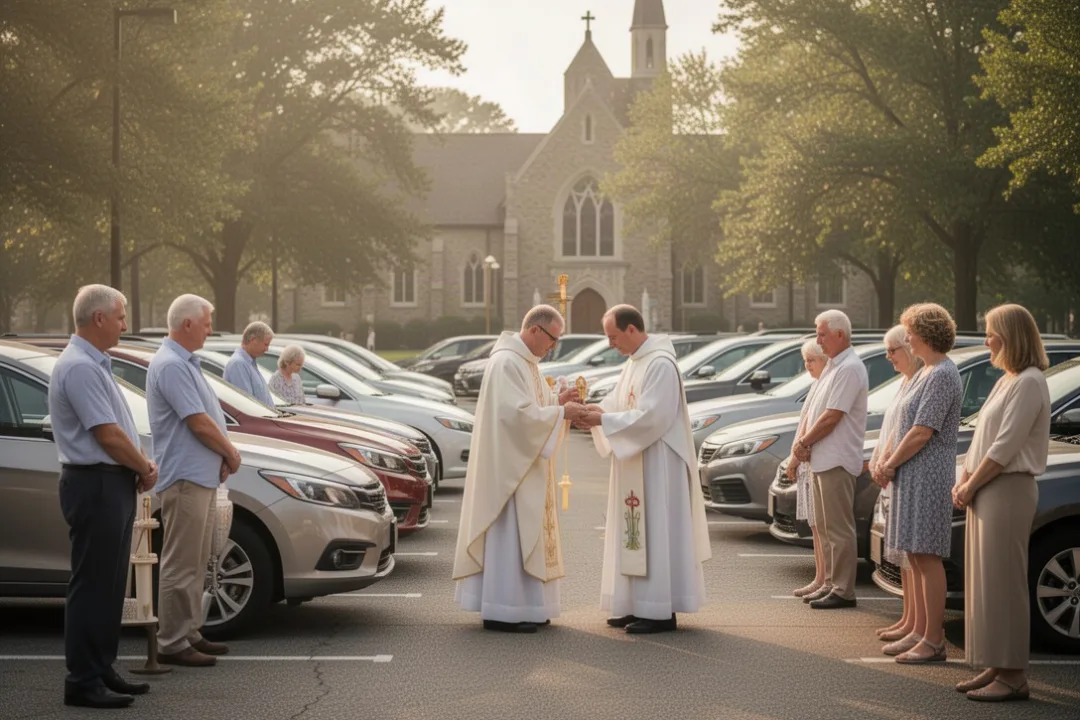
Vehicle blessings are among the most recognizable traditions. A priest or deacon may pray for the people who use the vehicle, asking for wisdom, patience, alertness, and protection. Depending on local practice, the blessing may take place in a church parking lot, at a transportation center, or after a parish service.
A feast-day observance may include:
A Mass or prayer service dedicated to St. Christopher.
A blessing for cars, motorcycles, bicycles, buses, boats, or other vehicles.
Prayers for travelers, road workers, first responders, and transportation employees.
The distribution of St. Christopher medals, holy cards, or devotional booklets.
A procession, especially in communities with a long-standing local devotion.
A collection or service project benefiting people who travel for work or who lack reliable transportation.
Some families mark the day at home by praying before a trip, displaying an image of the saint, or inviting relatives to share a meal. Others visit a church named for St. Christopher or participate in a regional pilgrimage. These customs can be simple; the value lies less in ceremony than in the intention to seek protection and practice responsible care.
What to do if your parish does not celebrate July 25
You do not need a special parish event to honor St. Christopher. If July 25 passes without a public celebration, you can observe the day privately or ask your parish office whether a blessing can be arranged at another time. Many churches are willing to offer a blessing for a vehicle or a traveler even when it is not part of the regular feast-day schedule.
You might also use the day to pray for people whose work places them at risk on the road. Truck drivers, emergency medical technicians, construction crews, delivery workers, public transit operators, and long-distance commuters all face fatigue, weather, traffic, and pressure. Remembering them connects the feast with real people and real responsibilities.
A practical observance can be just as meaningful as a formal one. Inspect your tires, replace worn wiper blades, check emergency supplies, or offer a ride to someone who needs transportation. These actions reflect the saint’s traditional role more faithfully than treating a medal as a guarantee of safety.
Practical ways to honor St. Christopher responsibly
The feast can become a useful annual reminder to combine prayer with preparation. Before traveling, take a few minutes to consider the road, the vehicle, the passengers, and your own condition. A careful driver honors the purpose of the devotion by reducing preventable danger.
Check the vehicle. Look at tire condition, fluid levels, lights, brakes, windshield visibility, and fuel or battery range before a long trip.
Plan the route. Allow extra time, review weather conditions, identify rest stops, and keep an alternative route available when appropriate.
Remove distractions. Set navigation before driving, silence unnecessary notifications, and keep your attention on traffic.
Respect your limits. Do not drive when seriously tired, impaired, emotionally overwhelmed, or unable to see safely.
Protect every passenger. Use seat belts and properly installed child safety seats, and make sure passengers understand basic safety expectations.
Practice patience. Leave space, obey speed limits, and avoid aggressive responses to other drivers.
Pray with honesty. Ask for wisdom and safe conduct rather than treating prayer as permission to take unnecessary risks.
These steps apply whether you drive across town or travel several states away. They also broaden the meaning of patronage. St. Christopher is not only associated with the person behind the wheel; his example can encourage everyone in a vehicle to contribute to a safer, calmer journey.
Common mistakes when observing the feast
Devotion to St. Christopher is generally simple, but several misunderstandings can weaken its meaning. The feast is about Christian trust and service, not superstition or a substitute for responsible action.
Assuming a medal guarantees safety: A medal is a devotional sign, not a protective device or insurance policy.
Ignoring the historical uncertainty: The famous river story is a later legend, so it should not be presented as a fully verified biography.
Believing every parish follows the same calendar: Local schedules may differ because St. Christopher is not observed identically everywhere.
Reducing the feast to vehicle decoration: The deeper themes include service, sacrifice, humility, and care for vulnerable travelers.
Skipping practical preparation: Prayer should accompany, not replace, maintenance, rest, seat belts, and compliance with traffic laws.
Using the saint’s name casually after dangerous driving: Seeking protection while deliberately taking avoidable risks misunderstands the purpose of the devotion.
A thoughtful observance holds faith and responsibility together. You can carry a medal, say a prayer, and attend a blessing while also accepting that safe travel depends on choices made before and during the journey.
Good practice: If you receive a St. Christopher medal, have it blessed if that matters to your tradition, then use it as a reminder to drive attentively and care for everyone sharing the road.
What a St. Christopher medal represents
St. Christopher medals are often worn as necklaces, attached to key rings, placed in wallets, or hung inside vehicles. They may show the saint carrying the child Christ, sometimes with a staff or river behind him. The medal serves as a visible reminder of faith during travel and may also express affection for a family member or respect for a transportation profession.
Many people give these medals to children before a first trip, to students leaving home, to new drivers, or to relatives moving far away. The gift can communicate a prayer for protection and a hope that the recipient will travel with wisdom. It can also invite a conversation about the saint’s story and the responsibilities that come with independence.
Some people keep a medal in a car without belonging to a particular church. That is understandable, since cultural devotion often extends beyond formal religious practice. Still, a medal should not be described as a charm that controls events. Its significance comes from the meaning the wearer attaches to it and the actions it inspires.
Prayers and intentions for the feast day
Prayer on the feast of St. Christopher can be brief and personal. You may ask for safe passage, clear judgment, patience, and protection for yourself and others. You can also pray for people who have been injured in traffic accidents, families grieving a death, and workers who spend long hours traveling.
A personal prayer might include these intentions:
Wisdom for drivers and passengers.
Protection for pedestrians, cyclists, and motorcyclists.
Strength for people traveling through illness, displacement, or hardship.
Safety for pilots, sailors, transit operators, and emergency crews.
Comfort for families separated by distance.
Gratitude for those who provide rides, deliveries, repairs, and roadside assistance.
You may pray at home, in a church, beside your vehicle, or before leaving on a trip. If you are Catholic, you can ask a priest or deacon about an approved blessing for travelers or vehicles. Other Christian communities may use their own prayers, hymns, or forms of intercession.
How the feast connects travel with Christian service
The central image of St. Christopher is not simply a person who arrives safely. It is a person who helps someone else cross a dangerous place. That distinction gives the feast a wider meaning. Travel can expose differences in wealth, ability, language, and access, and a Christian response may involve making the journey easier for another person.
For one family, this might mean driving an older neighbor to an appointment. For a parish, it could mean organizing rides for people who cannot attend worship without transportation. For a transportation worker, it may mean treating passengers with dignity even during a stressful shift. Small acts of practical help fit naturally with the saint’s traditional image.
The feast also acknowledges that not every journey is chosen freely. Refugees, patients traveling for treatment, military families, migrant workers, and people escaping unsafe homes may experience travel as uncertainty rather than adventure. Praying for travelers can therefore include compassion for people who are far from home and support for organizations that provide shelter, transportation, or legal assistance.
St. Christopher’s story asks a lasting question: Whom can you help carry? The answer may involve physical assistance, emotional support, a safe ride, a patient conversation, or a willingness to slow down for someone who needs more time. This is one reason the feast remains relevant even for people who rarely travel by car.
How to explain the feast to children
Children usually understand the feast through the image of Christopher carrying the Christ Child. You can explain that the story is a traditional legend and that its main lesson is about helping others, not about proving that every detail happened exactly as told. Keep the explanation concrete and connect it to everyday behavior.
Ask children how they can help someone cross a difficult place. Their answers might include holding a younger child’s hand, helping an injured person, sharing supplies, or reminding an adult to drive safely. A family prayer before a trip can be short, and a child might help place a medal in a safe location or choose a charitable action for the day.
It is also helpful to teach children that a saint’s medal does not make unsafe behavior acceptable. Seat belts, helmets, careful supervision, and attention to traffic remain necessary. This approach preserves the religious meaning of the feast while teaching sound safety habits from the beginning.
Why the feast still matters today
People continue to observe St. Christopher because travel remains part of ordinary life, yet it still involves vulnerability. Roads, airports, waterways, and public transportation connect families and communities, but they also require alertness, patience, and cooperation. A feast centered on safe passage speaks to anyone who depends on others to reach work, school, worship, medical care, or home.
The traditional date, July 25, offers an annual opportunity to pause and consider how journeys affect other people. You might remember a loved one on the road, thank someone who provides transportation, arrange a vehicle blessing, or review your own driving habits. The most meaningful observance joins prayer, gratitude, service, and responsibility.
St. Christopher’s story also gives language to a universal hope: that people will not face dangerous crossings alone. Whether you understand the account as sacred legend, historical tradition, or family devotion, its image remains powerful. A strong person uses that strength to carry someone else, and a traveler seeks not only arrival but a safe and compassionate way forward.
Frequently asked questions
Is the feast of St. Christopher still an official Catholic feast day?
July 25 remains St. Christopher’s traditional feast day, and many Catholics continue to honor him. However, he is not included on the universal Roman Catholic calendar in the same way as saints with obligatory worldwide celebrations. He may still appear on local diocesan calendars, parish schedules, or devotional observances. Practices vary by region and community.
Can I have my car blessed on the feast of St. Christopher?
Yes, if your parish offers the custom or a priest or deacon is available to provide a blessing. Some churches organize parking-lot blessings around July 25, while others schedule them at another time. A vehicle blessing is a prayer for wise and safe use, not a guarantee against accidents or a replacement for maintenance and careful driving.
What is the difference between the historical saint and the popular legend?
Early Christian tradition connects Christopher with martyrdom, but many details about his life cannot be verified. The famous account of a giant carrying the Christ Child across a river developed later and expresses the meaning of his name, “Christ-bearer.” The story is best understood as a devotional legend with spiritual symbolism rather than a complete modern biography.
Who can ask St. Christopher for intercession?
Anyone may ask St. Christopher to pray for travelers, drivers, passengers, transportation workers, or people facing a difficult journey. Catholic families often do so before a trip, while other Christians may use different forms of prayer. You can also honor his example by offering practical help, arranging a safe ride, or supporting someone who must travel under difficult circumstances.















Leave a Reply