Are you looking for someone to pray to before a flight, road trip, pilgrimage, or long commute? Saint Christopher is traditionally known as the patron saint of travel, particularly travelers, motorists, and people on the road. Many Christians carry a Saint Christopher medal or ask for his prayers before setting out.
Saint Christopher’s story centers on a man who devoted his strength to serving others and became associated with carrying Christ across a dangerous river. The story is partly legendary, but its message remains clear: travel can call for courage, responsibility, and care for people who depend on you. Saint Raphael the Archangel is another important figure connected with journeys, especially because the Book of Tobit describes him accompanying Tobias.
Why Saint Christopher became the patron saint of travel
The name Christopher is commonly understood as meaning “Christ-bearer.” Christian tradition tells of a very tall and powerful man who wanted to serve the greatest ruler in the world. After learning about Christ, he began helping travelers cross a dangerous river that had no dependable bridge.
According to the popular legend, a child asked him to carry him across. As Christopher moved through the water, the child became extraordinarily heavy. Christopher discovered that he had been carrying Christ himself, along with the weight of the world. This encounter led to his Christian faith and to the name by which he is remembered.
The story is not presented by historians as a fully verified biography. Details about Christopher’s life vary, and some parts belong to later devotional tradition rather than securely documented history. That distinction does not prevent Christians from finding spiritual meaning in the account, but it helps you understand why descriptions of him often use words such as traditionally, according to legend, or by popular devotion.
His connection with travelers developed naturally from this story. Christopher is pictured as someone who helps people make a dangerous crossing and carries a vulnerable passenger to safety. Over time, travelers, sailors, drivers, and pilgrims came to ask for his intercession before journeys.
Saint Christopher is often shown carrying the Christ Child while leaning on a staff. This image appears on medals, prayer cards, church art, and dashboard tokens. It is especially familiar among people who travel by car, although his traditional patronage is broader than driving alone.
The short answer: Saint Christopher is the traditional patron saint of travelers. His image represents protection on the road, faithful service, and the responsibility to help others reach their destination safely.
What Saint Christopher’s patronage means for modern travelers
Asking Saint Christopher’s prayers is not a guarantee that nothing difficult will happen during a journey. Christian devotion treats a patron saint as an intercessor: someone whose prayers are requested before God. The practice can help you place your plans, fears, and responsibilities within a spiritual perspective.
For a driver, that perspective includes more than personal safety. A driver’s choices affect passengers, pedestrians, cyclists, and everyone else using the road. Praying with Saint Christopher in mind can reinforce the need for patience, alertness, and consideration rather than encouraging a belief that a medal makes reckless behavior safe.
The same idea applies to air travel, train journeys, cruises, hiking trips, and international travel. A traveler may pray for calm during uncertainty, wisdom when making decisions, strength when plans change, and compassion toward people encountered along the way. The devotion is connected with the whole experience of traveling, not only with avoiding accidents.
Many people also associate Saint Christopher with pilgrimage. A pilgrimage is a journey undertaken for a religious purpose, often toward a church, shrine, holy site, or place connected with a saint. Even when the trip is not formally a pilgrimage, asking for Saint Christopher’s intercession can remind you to travel with attentiveness and gratitude.
Some Christians keep a Saint Christopher medal in a wallet, wear one on a chain, attach one to a key ring, or place one in a vehicle. These objects are signs of faith and reminders to pray. They should not be treated as lucky charms or substitutes for ordinary precautions.
Before driving: check that you are rested, focused, and prepared for the route.
Before flying or taking a train: pray for a calm journey and patience with delays or crowds.
Before a pilgrimage: ask for an open heart, humility, and respect for the people and places you visit.
When traveling for work: remember your responsibilities at home and the people affected by your decisions.
When accompanying someone vulnerable: give special attention to their comfort, needs, and safety.
A short prayer does not need elaborate language. You might ask Saint Christopher to pray for everyone traveling with you, for the people you will meet, and for the wisdom to make careful choices. You can also pray for emergency workers, transportation staff, and families waiting for loved ones to arrive.
How Saint Raphael is connected with journeys
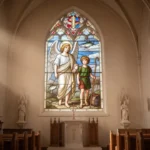
Saint Raphael the Archangel provides a different and distinctly biblical connection with travel. In the Book of Tobit, Raphael accompanies Tobias on a journey, helps him along the way, and brings him safely through important events. Raphael is also associated with healing and guidance.
The Book of Tobit belongs to the Deuterocanonical books accepted as Scripture by Catholics and Eastern Orthodox Christians. It is not included in the Protestant biblical canon, although many Christians know its story through religious art, teaching, or devotional writing. The account makes Raphael especially meaningful to people seeking guidance, healing, and protection during a journey.
Raphael’s role differs from Christopher’s traditional role. Saint Christopher is the familiar patron saint of travelers and motorists, while Raphael is an archangel whose biblical story directly includes accompanying a traveler. Both can be part of a Christian prayer before a trip, but they represent different strands of tradition.
In the Book of Tobit, Tobias does not travel alone. Raphael’s companionship highlights a useful spiritual idea: a journey can involve unseen help, wise guidance, and responsibilities toward family. The story also connects travel with healing and restoration rather than treating movement from one place to another as the only important part.
You might turn to Raphael before visiting a hospital, traveling to receive medical care, accompanying a sick relative, or beginning a trip that carries emotional strain. His traditional association with healing makes him a natural figure for journeys involving illness or recovery.
Other saints may also be meaningful depending on the purpose of your travel. Saint James the Greater is strongly associated with pilgrimage because the Camino de Santiago leads to the shrine traditionally connected with him in Santiago de Compostela. Saint Brendan the Navigator is linked by tradition with seafaring, although stories about his voyages include legendary elements.
These associations do not replace Saint Christopher’s central place as the traditional patron of travel. They simply show that Christian devotion often connects particular saints with specific circumstances, places, occupations, or forms of service.
What the Church teaches about Saint Christopher medals and blessings
A Saint Christopher medal is a sacramental when it is used within Catholic devotional practice. Sacramentals are sacred signs that prepare people to receive grace and encourage them to respond faithfully. They are not sacraments, and they do not work through magic or automatic spiritual power.
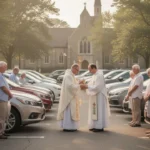
A medal may be blessed by a priest or deacon according to the appropriate rite. The blessing sets the object apart for devotional use and points the person wearing or carrying it toward prayer. Its value lies in the faith it expresses and the reminder it provides, not in the metal, design, or price.
People sometimes misunderstand the role of a religious medal. A medal cannot make speeding safe, prevent every accident, or guarantee a flight will arrive on time. It should never lead you to ignore seat belts, weather warnings, traffic rules, professional medical advice, or instructions from transportation staff.
Use devotion responsibly: A Saint Christopher medal can remind you to pray and act carefully, but it does not replace safe driving, proper preparation, emergency planning, or sound judgment.
In 1969, the Roman Catholic Church revised its universal calendar of saints’ celebrations, and Saint Christopher was among the figures whose celebration was no longer included in the same way on the universal calendar. This change did not mean that devotion to him was forbidden or that his traditional association with travelers disappeared.
His veneration continues in local communities, family practice, parish life, religious art, and popular devotion. The Church’s treatment of a saint’s liturgical celebration and a saint’s devotional popularity are related but not identical. A saint may remain widely honored even when a feast is not observed universally.
When you receive or wear a medal, the most useful question is not whether it provides physical immunity from danger. Ask instead what the image calls you to do: pray before leaving, drive attentively, help someone in difficulty, remain patient when plans change, and remember that every traveler has dignity.
How to pray before a journey with Saint Christopher
A travel prayer can be brief or extended. You may pray alone, with family, with fellow passengers, or silently while waiting at a station or gate. The words can be adapted to your tradition and to the specific journey ahead.
Begin by naming the journey honestly. You may be excited about a vacation, anxious about a flight, tired from repeated commuting, or concerned about reaching a loved one during an emergency. Bringing the actual situation into prayer makes the practice more personal and keeps it from becoming a routine phrase disconnected from your life.
Then ask for the intercession of Saint Christopher. You can ask him to pray for your safety, for the safety of other travelers, and for everyone responsible for transportation. Include the people who will meet you at your destination and anyone depending on you to arrive.
A simple prayer might follow this pattern:
Address God and acknowledge the journey you are about to take.
Ask Saint Christopher to intercede for you and everyone traveling with you.
Pray for wise choices, alertness, patience, and respect for others.
Remember people you will leave behind and those waiting for your arrival.
Ask for help accepting uncertainty while still taking sensible precautions.
You could say: “Saint Christopher, pray for me and for all who travel with me. Ask God to guide our decisions, protect everyone on the road and in the air, and help us treat other people with patience and care. May we arrive safely and use this journey well.” This is an original devotional prayer, not a required official text.
Some travelers pray a decade of the Rosary, read a short passage from Scripture, or make the Sign of the Cross before leaving. Others keep the practice private and silent. The form matters less than the disposition of trust, attention, and responsibility.
Practical ways to honor Saint Christopher on the road
Devotion becomes more meaningful when it influences how you travel. Saint Christopher’s traditional story presents service to others as central, so honoring him can include small choices that make a journey safer and more humane for everyone.
Before a long drive, plan a route, charge your phone, check the weather, and allow enough time that you do not feel pressured to speed. If you become drowsy, stop in a safe location and rest. A prayer for protection should lead to responsible action rather than confidence that danger cannot reach you.
During air or rail travel, follow instructions from the crew and staff, keep necessary medication and identification accessible, and allow extra time when possible. Treat delays as frustrating circumstances, not personal insults directed at the workers trying to manage them.
When traveling with children, older adults, or someone with a disability, plan around their needs. Carry appropriate supplies, confirm accessibility arrangements, and avoid assuming that the person who needs help will ask for it. Care for vulnerable travelers reflects the same spirit of service associated with Christopher’s traditional story.
Wear a seat belt and make sure passengers are properly secured.
Never drive while impaired, dangerously tired, or distracted by a phone.
Keep emergency contacts and essential medical information available.
Respect local laws, customs, and restrictions at your destination.
Offer reasonable assistance without ignoring your own safety.
Allow other people space, especially in crowded stations, airports, and terminals.
You can also honor the patron saint of travel by showing gratitude when you reach your destination. Thank the people who helped you, check in with those concerned about your arrival, and reflect briefly on what the journey taught you. Travel often reveals how much people depend on one another.
For many people, Saint Christopher remains a familiar and comforting companion for the road. Saint Raphael adds a biblical image of guidance during a journey, while other saints may speak to pilgrimage, seafaring, healing, or a particular vocation. The central practice is simple: pray for safe travel, prepare carefully, and let faith shape the way you treat everyone sharing the journey.
Frequently asked questions
Is Saint Christopher officially the patron saint of travelers?
Saint Christopher is widely and traditionally recognized as the patron saint of travelers, motorists, and people on journeys. His patronage remains especially strong in popular Catholic devotion. His feast was not retained on the Roman Catholic Church’s universal calendar after the 1969 calendar revision, but that did not abolish devotion to him or remove his traditional association with travel.
Can I pray to Saint Christopher before flying?
Yes. Saint Christopher’s traditional patronage applies to travel generally, not only to driving. You can ask for his intercession before a flight, train journey, cruise, pilgrimage, or work trip. Your prayer may include passengers, crew members, airport staff, and loved ones waiting for you. A medal or prayer should accompany sensible preparation, not replace it.
What is the difference between Saint Christopher and Saint Raphael?
Saint Christopher is the traditional patron saint of travelers, especially motorists. Saint Raphael the Archangel is connected with travel through the Book of Tobit, where he accompanies Tobias, and he is also associated with healing. Christopher is often chosen for general travel protection, while Raphael may be especially meaningful for journeys involving guidance, illness, or recovery.
Is it necessary to have a Saint Christopher medal blessed?
No. You can pray to Saint Christopher without owning a medal or having one blessed. In Catholic practice, a blessed medal is a sacramental and a visible reminder of faith and prayer. It is not a lucky charm or guarantee of safety. If you want one blessed, ask a priest or deacon; continue to follow ordinary safety precautions.















Leave a Reply