St. Christopher is best known as the patron saint of travelers, including motorists, pilgrims, hikers, and people setting out on difficult journeys. He is also associated with children, transportation workers, sailors, and protection on the road, although these additional patronages developed through regional devotion and popular tradition.
His name is commonly understood to mean Christ-bearer. According to a well-known Christian legend, Christopher carried a child across a dangerous river and discovered that the child was Christ. The story made him a powerful symbol for anyone who carries responsibility, faces danger, or seeks safe passage.
Why St. Christopher is the patron saint of travelers
The connection between St. Christopher and travel comes mainly from the story of his crossing. In the legend, Christopher was a physically powerful man who wanted to serve the greatest possible ruler. After meeting a hermit, he began helping people cross a difficult river. He carried travelers through the water because his strength made him suited to the task.
One day, a small child asked to be carried across. The child became increasingly heavy as Christopher moved through the current. When they reached the opposite bank, the child revealed that Christopher had carried not only a person but also the weight of the world and its Creator. The story connects physical travel with a deeper spiritual responsibility.
The legend explains why Christopher became associated with safe journeys. A river crossing was once a serious and unpredictable undertaking, much as a long road trip, sea voyage, or mountain passage can still involve risk. People began turning to him when leaving home, crossing unfamiliar territory, or traveling toward a religious destination.
Central idea: St. Christopher’s patronage is not based on a promise that accidents cannot happen. His image represents faith, courage, service, and care for people who are traveling.
For many Christians, asking St. Christopher’s intercession means asking God for prudence, protection, and a safe arrival. A traveler may also be asking for patience in delays, alertness behind the wheel, calm in unfamiliar surroundings, and compassion toward other people on the journey.
His role is therefore broader than physical safety. Travel can involve separation from family, uncertainty, illness, financial pressure, or the need to begin again somewhere new. Christopher’s example speaks to people who are carrying others through demanding circumstances, whether or not they are literally crossing water.
What St. Christopher is the patron saint of besides travelers
St. Christopher is most strongly connected with travelers, but several other groups and activities are placed under his patronage. These associations are not all based on a single official list. Some come directly from the river-crossing legend, while others grew from local customs, devotional objects, and the practical realities of modern transportation.
Motorists and drivers: Cars turned St. Christopher into a familiar patron for people traveling on highways and city streets.
Pilgrims: Those traveling toward a sacred destination often see him as a companion for the road.
Hikers and mountaineers: His association with difficult crossings has extended to people traveling through remote or demanding terrain.
Sailors and people who travel by water: The river in his legend makes this connection especially natural.
Transportation workers: Drivers, couriers, pilots, port workers, and others whose work involves moving people or goods may seek his intercession.
Children: In some traditions, he is connected with children because the central story involves carrying Christ in the form of a child.
People facing major transitions: Some believers turn to him when moving homes, beginning a new job, or entering an uncertain stage of life.
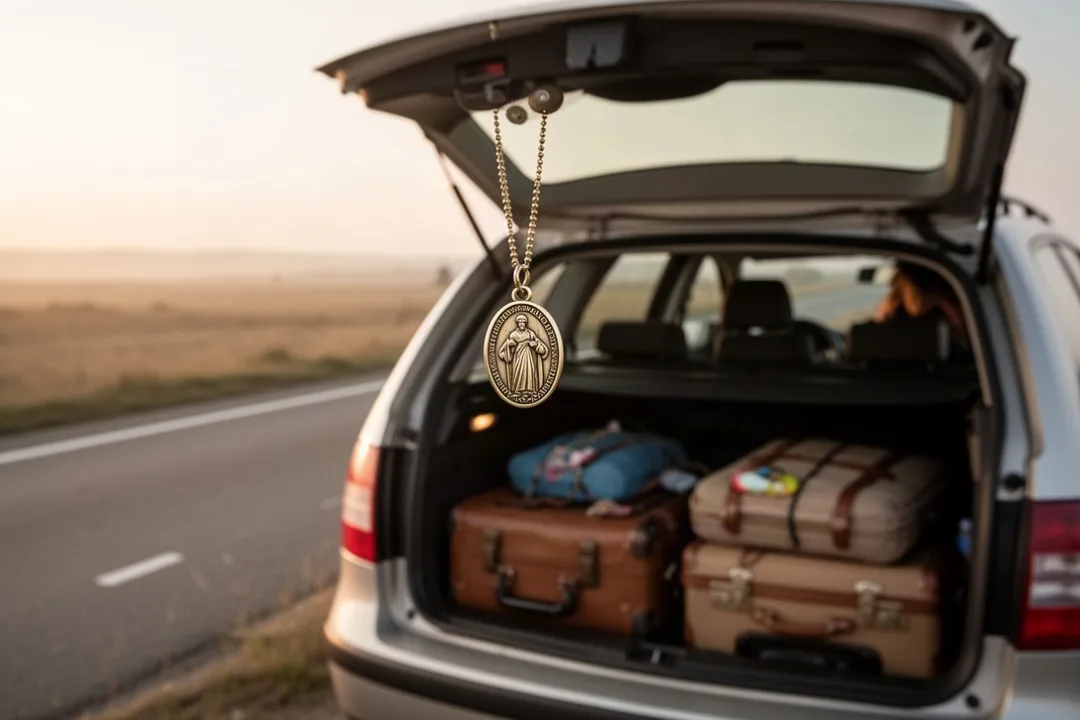
The most widely recognized modern association is St. Christopher as patron saint of motorists. Small medals bearing his image are often placed in vehicles, carried in wallets, or given to someone leaving for a trip. The medal functions as a reminder to pray and drive responsibly, not as a mechanical safeguard or guarantee of a particular result.
His association with transportation has adapted over time. Earlier communities may have prayed before journeys on foot, horseback, or by boat. Modern communities may ask for his intercession before a long drive, a flight, a move across the country, or a daily commute through heavy traffic.
What the St. Christopher legend says about his name and mission
Historical information about Christopher is limited, and much of what people know comes from later stories rather than detailed contemporary records. Christian tradition generally presents him as a martyr from the early centuries of Christianity, but the exact details of his life are uncertain. His popular image should therefore be understood as a blend of early devotion and legendary storytelling.
The name Christopher is commonly explained from Greek roots meaning “Christ-bearer”. That meaning became especially important because the central legend portrays him literally carrying Christ. It also offers a spiritual interpretation: a person can bear Christ through acts of service, protection, humility, and care for vulnerable people.
In the story, Christopher initially looks for a powerful master to serve. He rejects a ruler who fears the devil and then rejects the devil after discovering that the devil fears Christ. His search ends when he learns that true service involves helping ordinary people rather than seeking status or spectacle.
That part of the tradition gives his patronage a practical dimension. Christopher is not remembered only because he was strong. He is remembered because he used his strength for the benefit of people who needed help. The river crossing becomes a picture of responsible service: someone with greater ability helps another person reach safety.
The child’s increasing weight is usually interpreted as a sign of Christ’s greatness and the burden of the world. The story is not a historical travel report. It is a devotional narrative designed to show that faithful service may become heavier than expected, yet still lead to a deeper encounter with God.
St. Christopher’s traditional image points to a person who carries others toward safety and discovers Christ through that service.
Artists often portray him as a tall or giant-like figure carrying a child across water, with a staff or tree branch in his hand. The child may hold a globe or appear to bless Christopher. These details reinforce the themes of strength, movement, water, responsibility, and Christ’s hidden presence.
How Catholics and other Christians honor St. Christopher
Devotion to St. Christopher varies by denomination, country, parish, and family. Some people celebrate his feast day with a church service or blessing for vehicles. Others keep a medal or prayer card without participating in a formal feast. In every case, the purpose is generally to request God’s care through the intercession of a saint, rather than to treat the object itself as magical.
His traditional feast day is July 25. Local churches and communities may observe the day with a procession, a blessing of cars, or a special prayer for travelers. Customs differ, and not every church gives the day the same liturgical status.
In the Roman Catholic Church, St. Christopher’s name was removed from the universal calendar of obligatory celebrations in 1969 because the historical evidence for his life was considered limited. This did not make devotion to him forbidden or erase his place in Christian tradition. Catholics may still honor him privately and in approved local settings, and he remains listed in some local calendars and devotional practices.
Eastern Christian communities also honor a martyr named Christopher, though the imagery and details can differ. In some Eastern icons, he is represented with a canine or animal-like head. This unusual image comes from a separate strand of Christian tradition and should not be confused with the more familiar Western image of a giant carrying the Christ Child.
Common ways people ask for St. Christopher’s intercession
Praying before beginning a long trip or pilgrimage.
Keeping a St. Christopher medal in a vehicle.
Giving a medal to someone who has recently learned to drive.
Asking for a blessing before a family vacation or relocation.
Praying for transportation workers and emergency responders.
Remembering travelers who are sick, stranded, displaced, or separated from home.
Using the feast day on July 25 as a time to reflect on safe and responsible travel.
A person may also make a simple prayer in their own words. It can ask for clear judgment, patient driving, protection for passengers, and consideration for everyone sharing the road. It may also ask for strength to help others who are facing a difficult crossing in life.
Safe-travel reminder: A St. Christopher medal should accompany responsible choices, such as wearing a seat belt, obeying traffic laws, avoiding distracted driving, and never driving while impaired.
What a St. Christopher medal means
A St. Christopher medal usually shows the saint carrying the Christ Child across water. The words around the image may ask for protection or safe travel, and some medals include the saint’s name or feast day. Designs vary widely, from simple metal disks to detailed pendants used as personal devotional items.
People commonly place the medal on a dashboard, attach it to a key ring, wear it as jewelry, or give it to a traveler. The object can serve several purposes: it can prompt prayer, express affection, honor a family tradition, or remind the wearer that other people’s safety matters.
For someone receiving a medal, the most helpful interpretation is “pray for us as we travel”, not “nothing bad can happen.” Christian devotion does not remove the need for good judgment. A medal cannot replace vehicle maintenance, proper rest, weather awareness, a life jacket, or other sensible precautions.
Many people give St. Christopher medals to teenagers who are beginning to drive. In that setting, the medal can carry a message beyond protection. It can remind a new driver to be patient, attentive, sober, and respectful of passengers, pedestrians, cyclists, and other drivers.
Families sometimes pass medals from one generation to the next. The value may be devotional, sentimental, or both. An old medal can represent a relative who traveled frequently, a family member who served in transportation, or a loved one remembered during a significant journey.
How to pray with St. Christopher before traveling
There is no single required prayer for asking St. Christopher’s intercession. You can use a traditional prayer from your church, pray silently, or speak plainly about the journey ahead. The essential elements are trust in God, awareness of responsibility, and concern for other people.
A brief prayer might ask God, through St. Christopher’s intercession, to guide the traveler, protect everyone on the route, and help the driver remain focused and calm. It can also include a request for wisdom when conditions change and gratitude for the people who make safe travel possible.
A longer prayer can remember more than the person leaving home. It may include family members waiting at the destination, people who work on roads or ships, those traveling because of war or disaster, and anyone who has no safe place to return to.
Name the journey: Mention the trip, move, commute, pilgrimage, or responsibility ahead.
Ask for practical virtues: Pray for alertness, patience, self-control, courage, and good judgment.
Include other travelers: Remember passengers, pedestrians, workers, and people sharing the road or route.
Accept responsibility: Commit to following safety rules and avoiding behavior that puts others at risk.
Give thanks on arrival: Express gratitude for reaching the destination and for the people who helped along the way.
The legend of Christopher can also shape how you act during a trip. You might help an elderly passenger, stop to assist someone safely, give a stranded traveler useful directions, or show patience with a person who is lost. These actions reflect the saint’s traditional role as a strong person using his ability to carry and serve others.
St. Christopher is therefore patron saint of travelers in both a literal and symbolic sense. He represents the person who leaves home, the person who helps someone else move forward, and the person who discovers that a seemingly ordinary act of service can have spiritual significance.
How to understand St. Christopher’s patronage today
St. Christopher remains especially meaningful for people whose lives involve constant movement. Commercial drivers, delivery workers, flight crews, sailors, train operators, cyclists, and emergency personnel may see their daily work reflected in his image. His story speaks to anyone responsible for moving people through conditions that may be tiring, unpredictable, or dangerous.
He can also be meaningful to people who do not travel often. Moving to a new city, starting school, leaving an unhealthy situation, entering treatment, or caring for a family member can all feel like a difficult crossing. In these situations, Christopher represents the courage to keep going and the strength to help others along the way.
The tradition also invites a broader understanding of protection. A safe journey is not only one that ends without physical harm. It can be a journey marked by wise decisions, mutual care, reconciliation, and readiness to ask for help. St. Christopher’s legend places service at the center of protection.
For that reason, the most accurate short answer remains simple: St. Christopher is the patron saint of travelers and motorists. His wider associations with pilgrims, sailors, children, transportation workers, and people facing difficult transitions all grow from the same image—a strong person carrying another toward safety while remaining open to Christ’s presence.
Frequently asked questions
Is St. Christopher officially the patron saint of drivers?
Yes, popular Christian devotion commonly recognizes St. Christopher as the patron saint of drivers and motorists. This association became especially strong after motor vehicles transformed everyday travel. A medal or prayer to St. Christopher is meant to encourage protection, alertness, and responsible conduct on the road. It does not guarantee immunity from accidents or replace safe driving practices.
What day is St. Christopher’s feast day?
St. Christopher’s traditional feast day is July 25. The way it is observed varies by church and region. Some communities bless vehicles or pray for travelers on that date, while others honor him through personal devotion. In the Roman Catholic Church, his celebration is not part of the universal calendar as an obligatory observance, though local devotion remains permitted.
Why is St. Christopher shown carrying a child?
Christian legend says Christopher carried a child across a river and discovered that the child was Christ. As the crossing continued, the child became increasingly heavy, symbolizing the weight of the world. This story explains both Christopher’s name, commonly interpreted as “Christ-bearer,” and his connection with travelers, children, service, and dangerous crossings.
Can non-Catholics wear a St. Christopher medal?
Yes. People from various Christian backgrounds, and even people who value the symbol culturally or personally, may wear or carry one. For Christians, it can represent a request for God’s care through a saint’s intercession. The meaning depends on the wearer: it may express faith, family tradition, affection for a traveler, or a reminder to act responsibly.













Leave a Reply