St. Nicholas of Myra is widely regarded as the patron saint of sailors, seafarers, and people whose work depends on the sea. Christian tradition connects him with sailors because stories describe him calming storms, rescuing people from shipwreck, and protecting crews during dangerous voyages.
He is not the only saint associated with maritime life. St. Erasmus of Formiae, also called St. Elmo, has a strong place in Mediterranean seafaring traditions, especially because of the mysterious blue or green glow known as St. Elmo’s fire. Different ports, countries, and Christian communities may honor different protectors, but St. Nicholas is the most broadly recognized answer.
Why St. Nicholas became the patron saint of sailors
St. Nicholas was a Christian bishop who lived in the ancient city of Myra in Lycia, a region of present-day Turkey. Myra stood near the Mediterranean coast and was connected to important trade routes, so the area’s religious culture naturally had close ties to travelers, merchants, and sailors.
Historical information about Nicholas is limited, and many details about his life come from later traditions. He is generally believed to have lived during the third and fourth centuries and to have served as a bishop. Stories about his generosity, courage, and care for people in danger spread widely after his death.
Several legends explain his connection with sailors. In one well-known account, Nicholas prayed during a severe storm and the sea became calm. In another, he appeared to a frightened crew and helped guide their vessel safely through dangerous conditions. These accounts are devotional traditions rather than modern historical reports, but they shaped how generations of sailors understood his protection.
The stories also reflect the real risks faced by ancient and medieval mariners. A sailor could encounter sudden storms, hidden reefs, navigational errors, illness, or a shortage of food and water. Before modern forecasting, engines, radio communication, and satellite navigation, a voyage depended heavily on weather, local knowledge, and good fortune.
Direct answer: St. Nicholas is the most commonly recognized patron saint of sailors because Christian tradition associates him with rescuing crews, calming storms, and protecting travelers at sea.
Devotion to St. Nicholas spread through port cities and trading communities. Sailors carried his stories from one harbor to another, and churches dedicated to him appeared in places connected with commerce and navigation. His reputation crossed language and national boundaries because the dangers he represented were familiar to nearly every coastal community.
His role also became broader than maritime protection. St. Nicholas is associated with children, merchants, travelers, prisoners, and the poor. That wide range of patronage comes from stories emphasizing practical generosity and intervention for people facing hardship.
What the stories of St. Nicholas mean to sailors
The traditional stories about St. Nicholas are not simply tales about supernatural rescue. They express the values that maritime communities often consider essential: courage under pressure, concern for the vulnerable, and responsibility toward one’s companions.
A storm at sea represents a danger that no individual sailor can fully control. Praying to St. Nicholas can therefore express humility as well as hope. The sailor recognizes the limits of human strength while asking for safety, wisdom, and calm judgment.
The stories also place emphasis on collective survival. A crew must respond together when a vessel is damaged or the weather turns dangerous. The saint’s protection is often imagined as covering the entire ship rather than only one person, which helps explain why sailors’ organizations and port communities adopted him as a shared patron.
For many believers, a patron saint is not a replacement for preparation or professional skill. A sailor may pray for protection while still checking equipment, studying weather, following navigation procedures, and listening to experienced officers. Prayer and practical caution serve different purposes and can exist together.
St. Nicholas is also remembered as a person who acted on behalf of people who had little power. That aspect matters in maritime settings, where a crew can include workers far from home, passengers dependent on strangers, and families waiting anxiously on shore. Calling on Nicholas can connect the dangers of a voyage with a wider ethic of care.
Common symbols connected with St. Nicholas
Art depicting St. Nicholas may include symbols that reflect both his religious office and his association with the sea. These details vary by region, but several images appear often:
A bishop’s clothing: robes, a staff, and a mitre identify Nicholas as a bishop.
A ship: the vessel represents sailors, maritime travel, and rescue from danger.
Three gold spheres or bags: these refer to a famous generosity story involving three impoverished young women.
Anchors: an anchor can represent hope, stability, and protection for people at sea.
Children: children recall another group for whom Nicholas is widely honored.
These symbols may appear on church carvings, sailors’ medals, harbor statues, flags, icons, and devotional art. A ship or anchor beside the saint usually indicates a connection with maritime protection, even when the image does not show a specific miracle.
In some traditions, sailors carry a small medal or image of St. Nicholas during a voyage. Others place his icon in a vessel’s wheelhouse, chapel, or home. The object is not thought to function as a mechanical guarantee of safety. Instead, it serves as a reminder of faith, responsibility, and the people waiting for a safe return.
St. Nicholas and other saints associated with the sea
Although St. Nicholas is the best-known patron saint of sailors, maritime devotion is not limited to one figure. Coastal communities often honor saints based on local history, regional customs, a particular miracle, or the work performed by a specific group of seafarers.
St. Erasmus, also called St. Elmo
St. Erasmus is another important patron of sailors, particularly in Mediterranean traditions. He is also known as St. Elmo, a name that became closely associated with sailors and the phenomenon called St. Elmo’s fire.
St. Elmo’s fire is a weather-related electrical discharge that can appear as a glowing light around pointed objects such as masts, spars, or antennas during certain storm conditions. Sailors historically interpreted the glow in religious terms, sometimes viewing it as a reassuring sign that St. Elmo was watching over the ship.
Modern science explains the phenomenon through electrical activity in the atmosphere. That explanation does not erase its cultural meaning. For many sailors, St. Elmo’s fire became a symbol of hope during threatening weather, and the name helped preserve the saint’s maritime association.
St. Erasmus is sometimes shown holding a windlass or a section of rope, referring to the cruel method of martyrdom described in later accounts of his life. Because the symbol can look like nautical equipment, it reinforces his visual connection with sailors.
St. Brendan the Navigator
St. Brendan the Navigator is associated with voyages, exploration, and Christian travel across the Atlantic in Irish tradition. Medieval stories describe a long sea journey undertaken by Brendan and other monks. The accounts combine religious themes with legendary geography, so they should not be treated as straightforward nautical records.
Brendan is especially meaningful to people interested in voyaging, discovery, and spiritual pilgrimage. His tradition often appears in Ireland and among communities with Irish heritage. He may be honored by sailors and travelers, although he is not as universally identified as the patron saint of sailors as St. Nicholas.
St. Peter and Our Lady, Star of the Sea
St. Peter the Apostle has a strong connection with fishing because the Gospels describe him as a fisherman before he became one of Jesus’ disciples. Fishing communities may therefore feel a particular relationship with Peter, especially when their work centers on coastal waters and small boats.
Our Lady, Star of the Sea is a title for the Virgin Mary rather than the name of a separate saint. Under this title, Mary is honored as a guide and protector of sailors, fishermen, and travelers. Churches, schools, naval chapels, and coastal communities in several countries have adopted the title.
These traditions are not necessarily competing answers. A sailor may honor St. Nicholas as the principal patron, pray to St. Erasmus during storms, identify with St. Peter as a fisherman, and ask for Mary’s protection under the title Star of the Sea.
St. Nicholas: widely recognized protector of sailors, travelers, and crews in danger.
St. Erasmus or St. Elmo: strongly associated with Mediterranean sailors and St. Elmo’s fire.
St. Brendan: connected with legendary voyages and Christian navigation.
St. Peter: associated with fishermen and the earliest Christian fishing tradition.
Our Lady, Star of the Sea: a Marian title connected with guidance and protection at sea.
How sailors and coastal communities honor St. Nicholas
Devotion to St. Nicholas takes many forms, from private prayer to large public celebrations. The most visible customs often occur in ports, fishing villages, naval communities, and maritime guilds.
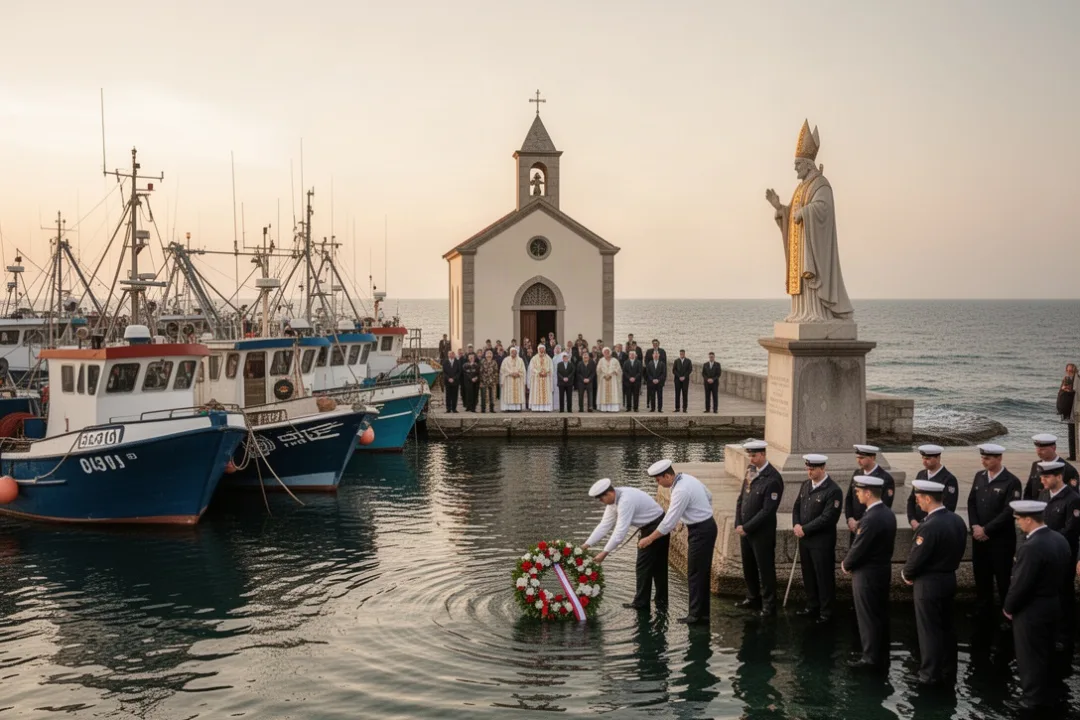
Some communities hold a feast day celebration on December 6, the traditional feast of St. Nicholas. Customs differ by country. A procession may carry an image of the saint through the harbor, onto a boat, or to a church near the water. In some places, vessels sound their horns, crews attend a service, and wreaths are placed on the sea in memory of sailors who died.
A harbor procession can serve several purposes at once. It honors the saint, asks for protection during the coming season, remembers the dead, and brings together families whose lives depend on the water. The event may be religious, cultural, or both.
Churches dedicated to St. Nicholas are especially common in coastal areas and along historic trade routes. A church may stand near a harbor, river crossing, or former commercial center. Its location often reflects the practical needs of travelers who wanted a place to pray before departure or give thanks after returning.
Sailors may also honor him through personal devotional practices. Someone might carry a medal, light a candle before a voyage, attend Mass on his feast day, or say a short prayer for the crew and passengers. These practices vary according to denomination and personal belief, so there is no single required form of devotion.
For a memorial service: A respectful tribute can mention St. Nicholas as a protector of sailors, remember those lost at sea, and recognize the families and crews who continue to live with maritime risk.
Prayers and blessings for a voyage
A prayer to St. Nicholas may ask for safe passage, sound judgment, favorable conditions, and protection from sudden danger. It may also ask for patience among the crew and comfort for families on shore. The wording can be traditional or personal.
Many churches offer a blessing of boats or a blessing of the sea. Such services may include readings, prayers, a procession, and the sprinkling of holy water. The purpose is not to promise that accidents or storms can never occur. It is to place the work of sailors within a spiritual framework and ask for care over everyone connected with the voyage.
A simple personal prayer might name the vessel, crew, passengers, and destination. It can also acknowledge the responsibilities involved in safe navigation. For a Christian sailor, asking St. Nicholas for help may mean seeking the courage to act wisely rather than expecting danger to disappear.
How to choose the right patron for a maritime occasion
If you need a patron saint for a sailor, vessel, maritime organization, or memorial, St. Nicholas is the clearest general choice. His name will be recognized in many countries, and his traditional role directly includes sailors and people traveling by sea.
The best choice can also depend on the setting. A Mediterranean harbor with a long tradition of honoring St. Erasmus may naturally choose St. Elmo. An Irish community celebrating a legendary voyager may prefer St. Brendan. A fishing parish may select St. Peter, while a naval chapel may honor Mary as Star of the Sea.
What kind of maritime work is involved? Fishing, naval service, merchant shipping, research, rescue, and recreational sailing may have different local traditions.
Where is the community located? Regional customs often matter more than a universal ranking of patron saints.
Is the occasion devotional or commemorative? A feast day, boat blessing, memorial, and naming ceremony may call for different language.
Does the sailor have a family or cultural connection? A saint honored by relatives or a home parish can make the choice especially meaningful.
What does the community want to emphasize? Protection, courage, remembrance, guidance, service, or care for families may suggest different imagery.
For a boat name or maritime emblem, St. Nicholas can be represented by a bishop, ship, anchor, or three gold spheres. St. Erasmus may be shown with a windlass or glowing mast, while St. Peter may appear with fishing nets. Symbols should be explained clearly so that people unfamiliar with the tradition understand the connection.
When planning a public event, it is also helpful to distinguish between historical tradition and devotional belief. A program can describe the legends respectfully without presenting them as verified events. This approach allows religious participants, historians, and members of the wider community to take part in a thoughtful way.
What St. Nicholas represents for people who go to sea
St. Nicholas remains meaningful because sailors continue to face uncertainty even with modern equipment. Forecasting, navigation systems, emergency beacons, and improved vessel design reduce many risks, but the ocean is still powerful and conditions can change quickly.
The saint’s maritime role brings together two kinds of protection. One is practical protection: training, inspection, communication, and disciplined decision-making. The other is spiritual protection: prayer, remembrance, hope, and trust in a power beyond the individual.
That combination explains why the tradition survives in both old fishing communities and modern maritime organizations. A sailor can honor St. Nicholas without ignoring technology or safety procedures. The devotion may instead strengthen a sense of responsibility toward crewmates, passengers, families, and the sea itself.
For families, St. Nicholas can represent the hope that a sailor returns safely. For crews, he can symbolize solidarity during difficult work. For communities, he can serve as a link between generations of fishermen, merchants, rescuers, naval personnel, and travelers whose lives have been shaped by the water.
The simplest answer remains the most useful: St. Nicholas of Myra is the patron saint most commonly associated with sailors. St. Erasmus, St. Brendan, St. Peter, and Our Lady, Star of the Sea, add important regional and devotional layers to the broader Christian tradition of protection at sea.
Frequently asked questions
Is St. Nicholas the patron saint of the Navy?
St. Nicholas is commonly honored by sailors and maritime communities, but military branches and individual naval organizations may have their own official patron or patron traditions. His association with sailors makes him a suitable figure for naval chapels, ship services, memorials, and ceremonies. The exact designation depends on the country, denomination, and organization involved.
What is the difference between St. Nicholas and St. Elmo?
St. Nicholas is broadly recognized as a protector of sailors, travelers, and crews in danger. St. Elmo refers to St. Erasmus, whose maritime reputation is especially strong around the Mediterranean. St. Elmo’s fire, a natural electrical glow sometimes seen around ship masts during storms, became linked with his name and was interpreted by sailors as a hopeful sign.
When is the feast day of St. Nicholas?
St. Nicholas is traditionally celebrated on December 6. Communities may mark the day with a church service, harbor procession, boat blessing, charitable activity, or memorial for sailors lost at sea. Customs vary widely, and some regions combine the feast with local winter traditions that emphasize Nicholas’s generosity toward children and people in need.
Can a non-Catholic sailor honor St. Nicholas?
Yes. St. Nicholas is respected across several Christian traditions, including Eastern and Western churches, and many people engage with him as a cultural or maritime figure. A sailor may participate in a public harbor ceremony, carry a commemorative emblem, or remember the tradition without following a specific devotional practice. Local customs usually determine what forms of observance are appropriate.














Leave a Reply