If you are looking for someone to honor before heading onto the water, the answer most commonly given is Saint Peter. He is widely recognized as the patron saint of fishermen because the Gospels describe him as a working fisherman before Jesus called him to become an apostle.
Peter’s connection with fishing is both practical and spiritual. He knew the uncertainty of the water, the physical demands of hauling nets, and the dependence of a family or community on a successful catch. For that reason, fishermen have looked to him for protection, courage, safe travel, and a livelihood connected to the sea and to lakes, rivers, and coastal waters.
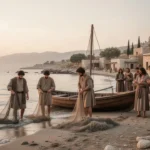
Saint Peter was originally known as Simon and worked as a fisherman in Galilee. The Gospel accounts place him in a fishing family and describe him working with his brother Andrew. Jesus called the brothers while they were engaged in their trade, making Peter’s occupation an essential part of his early story rather than a minor detail.
Several Gospel passages connect Peter directly with boats, nets, fish, and the Sea of Galilee. In Luke 5, Peter takes part in an unusually large catch after following Jesus’ instruction. In Matthew 14, he attempts to walk toward Jesus across the water and becomes frightened during the storm. In John 21, the risen Jesus meets the disciples during another fishing scene and helps turn an unsuccessful night into a large catch.
These stories give fishermen a saint who understood both the work itself and the emotional pressures surrounding it. Fishing can involve patience, risk, disappointment, skill, and dependence on conditions no person can fully control. Peter’s story reflects those realities while also presenting him as a person who made mistakes, learned through hardship, and continued serving others.
Peter is also associated with the image of the Church as a boat. That symbolism gives his role a wider meaning: the fisherman’s boat represents a community facing wind, waves, uncertainty, and the need for steady leadership. For people who work on the water, however, Peter’s original identity as a fisherman remains especially meaningful.
Short answer: Saint Peter is the most widely recognized patron saint of fishermen. Saint Andrew, who was also a fisherman and Peter’s brother, is another important patron for fishing communities and may be honored locally.
What Saint Peter’s life teaches fishermen today
Devotion to a patron saint is not usually based on the idea that the saint replaces practical preparation or guarantees a particular result. Instead, a patron saint serves as a spiritual companion and example. Fishermen may ask Saint Peter to pray for them, remember his working life, and draw encouragement from how he responded to fear and failure.
Peter’s story includes confidence, confusion, loyalty, denial, repentance, and renewed service. That combination can make him feel more approachable than a figure presented as flawless from the beginning. He knew what it meant to be frightened in a boat, to misunderstand a situation, and to return to his responsibilities after a painful failure.
For a fishing family, Saint Peter can represent several hopes:
Safety: protection for people traveling, working, or waiting on the water.
Wisdom: good judgment when weather, equipment, or circumstances change.
Provision: enough work and a fair livelihood for the household and crew.
Perseverance: strength during poor catches, financial pressure, or long seasons.
Community: care for fellow fishermen, families, rescuers, and coastal communities.
His example also encourages humility. In the Gospel stories, Peter does not succeed because he has complete control over the water or because his professional knowledge makes him self-sufficient. His faith develops through experiences that challenge his confidence. That message can matter to anyone whose work depends on conditions that can shift quickly.
Saint Peter’s connection with fishing in the Bible
The Bible does not describe Peter as a symbolic fisherman only after he became an apostle. His work appears at the center of several important scenes. The details help explain why his patronage is so strong and why fishing communities have continued to identify with him.
Peter’s call beside the Sea of Galilee
Matthew 4 and Mark 1 describe Jesus calling Simon Peter and Andrew while they were casting a net. They leave their work to follow Jesus, and the story presents fishing as the setting in which Peter’s public mission begins. Luke 5 gives a fuller account in which Peter and his partners have worked through the night without success.
In Luke’s account, Jesus tells Peter to put out into deeper water and lower the nets again. Peter follows the instruction, and the catch is so large that the fishermen need help from another boat. The episode then shifts from fish to vocation: Peter is told that his future work will involve bringing people into a life of faith.
Christians have often read this scene on two levels. It is a story about trust in the middle of professional disappointment, and it is also a story about a new calling. Fishermen may recognize the first level even when they do not identify with the second. A bad night, an empty net, or a failed plan does not necessarily define the next day.
Peter in danger on the water
Matthew 14 tells of the disciples traveling by boat during difficult conditions. Peter sees Jesus approaching across the water and asks to come toward him. He begins moving forward but becomes afraid when he focuses on the wind and waves, and he needs help.
The passage is often used to discuss faith and fear, but it also contains a realistic picture of how quickly confidence can change on the water. Peter acts boldly, then recognizes the danger around him. His experience can remind fishermen that courage is not the same as ignoring risk. Asking for help is not a spiritual failure; it can be an expression of good judgment and trust.
The fishing scene after the Resurrection
John 21 describes the disciples fishing overnight and catching nothing. At daybreak, Jesus appears from the shore and directs them where to cast the net. The resulting catch leads to recognition and a conversation in which Jesus gives Peter responsibility for caring for others.
This scene is significant because Peter is encountered through ordinary work after a period of grief and uncertainty. He is not separated from his practical identity as a fisherman. The story connects daily labor, restoration, and service, which helps explain why Peter has remained a powerful figure for people whose faith is woven into their working lives.
Saint Peter and Saint Andrew: which patron should fishermen honor?
Saint Peter is the most common answer to the question, but Saint Andrew also has a direct and important connection to fishing. Andrew was Peter’s brother and fellow fisherman, and the Gospel accounts identify him among Jesus’ first followers. He is widely honored as a patron of fishermen as well as a patron of several countries and regions.
There is no need to treat Peter and Andrew as competing choices. A fishing family, parish, harbor, or guild may honor both brothers. Local tradition often determines which saint receives the principal devotion. In some communities, a church, chapel, festival, boat, or fishing association may be dedicated to Saint Andrew even when Saint Peter is recognized more broadly as the principal patron of fishermen.
You may also encounter other saints connected with seafarers, sailors, boat crews, or particular coastal communities. Those roles are related but not identical. Saint Nicholas, for example, is widely associated with sailors and travelers, while Saint Peter’s patronage is especially tied to fishermen through his own occupation and the Gospel narratives.
When choosing a saint for a personal devotion, consider your family or community’s practice rather than searching for one universal rule. A person may pray with Saint Peter because of his fishing background, with Saint Andrew because of family heritage, or with both brothers because their stories belong together.
Symbols associated with Saint Peter and fishermen
Images of Saint Peter often make his identity recognizable through objects linked to his life and mission. These symbols are especially common in churches, harbor shrines, cemetery monuments, fishing boats, and community celebrations.
Fishing nets: a direct reference to Peter’s former trade and to the Gospel stories of abundant catches.
Fish: a sign of his occupation and of the Christian symbolism associated with fish.
A boat: a reminder of Peter’s work, his experiences on the Sea of Galilee, and the Church’s symbolic boat.
Keys: a reference to Matthew 16, where Jesus gives Peter a distinctive role among the apostles.
A rooster: a reminder of Peter’s denial of Jesus and the repentance that followed.
Gray or white hair and a beard: traditional artistic features often used to distinguish Peter in religious images.
Not every image includes every symbol. The keys identify Peter in many church artworks, while nets, fish, and boats make his relationship with fishermen more obvious. A harbor statue may emphasize his role as a protector, whereas a church image may focus on his apostolic leadership.
The rooster can seem unusual in a setting devoted to fishing, but it carries an important message. Peter was not honored because he never failed. His story includes a serious failure followed by remorse and renewed responsibility. For people who have made difficult decisions at sea or struggled under pressure, that part of his story can offer a more realistic form of hope than an image of effortless perfection.
How fishermen pray to Saint Peter
There is no single required prayer for fishermen who honor Saint Peter. Prayer may be formal or spontaneous, private or shared by a crew. Some people pray before departure, while others pray at the dock, in a church, at a family meal, or after returning safely.
A simple prayer can mention the actual circumstances of the day. You might ask Saint Peter to pray for a safe trip, sound judgment, reliable equipment, respectful cooperation, and the well-being of everyone who depends on the crew. You can also remember other boats on the water, families waiting at home, and people involved in search-and-rescue work.
A prayer based on Peter’s Gospel experiences might include these requests:
Help us prepare carefully and recognize danger before it becomes an emergency.
Give the crew patience, clear communication, and respect for one another.
Protect everyone working on the water and those waiting on shore.
Help us accept an uncertain catch without losing gratitude or hope.
Remember fishermen who have died, disappeared, or suffered injury.
Christian prayer does not remove the need for weather checks, safety drills, maintenance, proper flotation equipment, or compliance with local requirements. Those actions are part of responsible care for human life. A prayer to Saint Peter can support that responsibility by encouraging attention, humility, and concern for others.
Safety reminder: Treat devotion as a source of faith and support, never as a substitute for weather information, communication equipment, life jackets, emergency planning, and sound seamanship.
When is Saint Peter’s feast day?
In the Catholic calendar, Saints Peter and Paul are celebrated together on June 29. The feast honors both apostles and their importance in the early Christian community. It is commonly called the Solemnity of Saints Peter and Paul.
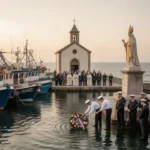
Fishing communities may hold their own observances on a different date, depending on local tradition, parish practice, weather, or the schedule of a harbor festival. These events can include a Mass or worship service, a procession, a blessing of boats, a memorial for fishermen who have died, or a communal meal.
A blessing of boats is a religious ceremony, not a guarantee that a vessel will never face danger. Its purpose is to place the people, their work, and their responsibilities under God’s care while expressing solidarity within the community. The ceremony may also provide an opportunity to remember the families whose income depends on fishing.
If you want to observe Saint Peter’s feast day privately, you could attend worship, display an image of Peter with a boat or net, read the Gospel passages associated with his fishing life, or set aside time to pray for local fishermen. A memorial gesture for people lost at sea can be especially meaningful for communities with a long fishing history.
Practical ways to honor Saint Peter as a fisherman
Honoring a patron saint does not have to involve elaborate objects or a large public event. The most meaningful practice often reflects the actual needs of the fishing community. A family might keep a small image of Saint Peter near the entrance, while a harbor may maintain a larger statue or hold an annual service.
Consider these practical options:
Pray before departure: briefly name the crew, vessel, route, and concerns for the day.
Read the fishing passages: use Luke 5, Matthew 14, or John 21 and reflect on their themes without treating them as a safety forecast.
Remember those lost at sea: include deceased fishermen and grieving families in personal or community prayer.
Support fishing families: offer practical help during illness, injury, poor seasons, or bereavement.
Attend a blessing of boats: participate respectfully in a local tradition connected with Saint Peter or Saint Andrew.
Display meaningful symbols: a net, fish, boat, or keys can identify Peter and prompt regular prayer.
Teach children the story: explain that Peter was a working fisherman who learned through both courage and failure.
These practices keep devotion connected to real life. They also avoid reducing Saint Peter to a decorative figure. His story points toward responsibility, service, and care for people who face uncertainty together.
Common mistakes when choosing a patron saint for fishermen
Several misunderstandings can make the subject more confusing than it needs to be. The following distinctions help you honor Saint Peter accurately and respectfully.
Assuming there is only one tradition: Saint Peter is the most widely recognized patron, but Saint Andrew and local saints may also have strong claims within particular communities.
Confusing fishermen with all seafarers: saints associated with sailors, travelers, or naval service may not have the same specific connection to fishing.
Treating prayer as a guarantee: devotion can express trust and solidarity, but it does not promise a certain catch or eliminate physical danger.
Ignoring Peter’s failures: his denial and fear are part of his story and help explain why many people find him relatable.
Using a feast date without checking local practice: June 29 is the principal Catholic feast of Saints Peter and Paul, but local fishing festivals may follow another schedule.
Focusing only on the boat: Saint Peter’s patronage also includes the families, crews, rescuers, and communities whose lives are affected by fishing.
These points are useful when selecting a statue, naming a vessel, planning a service, or preparing educational material for a church or fishing association. They also help preserve the difference between a universal or widespread Christian association and a custom that belongs to one region.
How Saint Peter can guide a fishing community
Peter’s patronage has meaning beyond individual protection. His story can shape how a fishing community thinks about mutual responsibility. Fishing often requires people to depend on one another, communicate under pressure, and share concern for those at sea and those waiting ashore.
The Gospel accounts present Peter as part of a working network. He fishes with Andrew and other partners, works from boats, and depends on cooperation when the catch is too large to manage alone. That image can encourage communities to value teamwork over individual pride, especially when conditions become difficult.
Peter also offers a model for responding to failure. Empty nets, fearful decisions, and broken trust do not have to end a person’s usefulness. A fisherman who returns after a poor season, an accident, or a personal mistake may need patience and practical support rather than judgment. Peter’s life leaves room for accountability, forgiveness, and a new beginning.
Finally, his story keeps attention on people rather than only on results. A catch matters to a household and a local economy, but a person’s life matters more than the success of a trip. Honoring Saint Peter well means combining hope for a good livelihood with respect for safety, truthfulness, and the dignity of everyone involved.
Choosing an image, medal, or boat name for Saint Peter
If you are selecting a devotional object, choose one that communicates the aspect of Peter most relevant to you. An image with a net or fish highlights his working life. A boat or water scene recalls his experiences on the Sea of Galilee. Keys emphasize his apostolic role, while a rooster can represent repentance and renewed faith.
A medal or small image can be kept in a wallet, vehicle, home, chapel, or personal locker, provided it is treated respectfully and does not interfere with equipment or safety procedures. Some people name a boat after Saint Peter, Saint Andrew, or both brothers as a public expression of faith and family tradition.
The choice does not need to be expensive. What gives the object meaning is the connection between the symbol and the people who use it. A simple image placed near a family photograph, memorial plaque, or harbor noticeboard can become a reminder to pray for those on the water and to care for those on shore.
What makes Saint Peter a meaningful patron today
Saint Peter remains a fitting patron for fishermen because his story begins with ordinary work and continues through uncertainty. He knew the rhythm of nets and boats, the disappointment of an empty catch, and the fear that can arise when the water becomes dangerous. He also knew that skill and experience do not remove the need for humility or help.
For most Christian traditions, Saint Peter is the principal answer to the question of who protects or represents fishermen. Saint Andrew offers a closely related choice, particularly where local custom or family heritage gives him special importance. Either devotion can point toward gratitude for work, care for crews, remembrance of those lost, and responsible service to the wider community.
When fishermen honor Saint Peter, they are not simply asking for favorable conditions. They are remembering a worker who was called from his boat, a disciple who faced fear and failure, and a leader who learned to serve. That combination of practical experience and spiritual growth explains why his name continues to be spoken at docks, in boats, and along the shores where fishing communities make their living.
Frequently asked questions
Is Saint Peter the only patron saint of fishermen?
No. Saint Peter is the most widely recognized patron saint of fishermen, but Saint Andrew is also strongly associated with fishing because he was Peter’s brother and fellow fisherman. Local communities may honor other saints connected with sailors, boats, or regional traditions. The best choice often depends on family custom, parish practice, and the history of the fishing community.
What is the best prayer to Saint Peter before fishing?
There is no single required prayer. A meaningful prayer can ask Saint Peter to intercede for safe travel, sound decisions, good communication among the crew, protection for people on the water, and care for families at home. It is also appropriate to remember rescuers, other boats, and fishermen who have died or disappeared.
What is Saint Peter’s feast day?
The Catholic feast of Saints Peter and Paul is June 29. It honors both apostles together. Fishing communities may observe Saint Peter on that date or hold a local boat blessing, procession, or memorial service on another day. Local parish calendars and community traditions can determine the date of a particular celebration.
Why are boats, nets, fish, and keys shown with Saint Peter?
Nets, fish, and boats refer to Peter’s work as a fisherman and to Gospel scenes involving fishing. Keys refer to the distinctive role Jesus gives Peter in Matthew 16. These symbols help identify him in religious art, although a particular statue or image may include only one or two of them.
















Leave a Reply