St. Nicholas, patron saint of children and sailors
St. Nicholas, patron saint of children and sailors
St. Nicholas is the patron saint of children, sailors, merchants, and travelers. He is also commonly associated with pawnbrokers, prisoners, students, bakers, judges, and people facing financial hardship. His patronages reflect stories about his compassion, protection, and practical generosity rather than a single official list used everywhere.
Known historically as Nicholas of Myra, he was a Christian bishop who lived in the region of Lycia in Asia Minor, in what is now southern Turkey. His feast day is December 6, and traditions connected with that day helped shape the later figure of Santa Claus.
Short answer: If you are asking what St. Nicholas is most famous for, the answer is children and sailors. His other patronages often include merchants, travelers, prisoners, students, and people in financial need.
Why St. Nicholas became a patron saint of children
St. Nicholas is especially remembered for caring about children who were vulnerable or in need. The stories surrounding him describe a bishop who used his resources quietly to protect families, preserve dignity, and give help without seeking public praise.
The best-known story tells of a poor father with three daughters. According to the tradition, the family could not afford the money needed for the daughters to marry. Nicholas is said to have provided the necessary gifts secretly, sometimes described as bags of gold delivered at night or placed near a window.
The story is significant because it presents generosity as a form of protection and responsibility. Nicholas did not merely give presents for entertainment. He helped prevent a family from falling into a more desperate situation, which explains why his example became connected with children, parents, marriageable young women, and people who need discreet assistance.
In many countries, children receive small gifts on St. Nicholas Day. Customs vary widely. Children may place shoes outside a bedroom door, leave footwear near a fireplace, or receive fruit, sweets, books, or small toys. Some traditions also include a reminder to practice kindness and generosity.
These customs are not identical to Christmas celebrations. St. Nicholas Day is a separate feast, although the two traditions eventually influenced each other. The familiar image of a benevolent gift-bringer developed from several sources, including European customs associated with Nicholas.
What St. Nicholas teaches about generosity toward children
The stories of Nicholas emphasize that children deserve protection, attention, and practical care. His example is not mainly about the size of a gift. It is about recognizing a need and responding in a way that preserves the recipient’s dignity.
Give thoughtfully: A useful gift can be more meaningful than an expensive one.
Protect privacy: Help does not need to embarrass the person receiving it.
Notice overlooked needs: Children may need safety, encouragement, clothing, food, or a dependable adult more than another toy.
Connect gifts with character: St. Nicholas traditions often encourage generosity, gratitude, and concern for neighbors.
Why sailors and travelers look to St. Nicholas
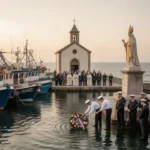
St. Nicholas is one of the most widely recognized patron saints of sailors. He is also invoked by fishermen, maritime workers, boat crews, and travelers. In coastal communities, churches dedicated to him have often stood near harbors or waterways.
Several legends connect him with people at sea. In one account, sailors caught in a dangerous storm prayed for his help, and Nicholas appeared or intervened to calm the waters. Another tradition describes him assisting sailors who were in danger during a voyage. These stories helped establish him as a protector of people exposed to unpredictable weather and the hazards of travel.
The maritime connection also fits the broader character associated with Nicholas. A bishop who defended people in danger and acted quickly on behalf of the vulnerable became a natural figure for those whose safety could depend on immediate help.
Sailors have traditionally carried medals, prayed before voyages, or visited churches dedicated to Nicholas. Some harbor communities celebrate his feast day with processions, blessings of boats, or services honoring people who work at sea. The precise custom depends on local Christian practice.
For sailors and travelers: St. Nicholas is traditionally approached as a protector during dangerous journeys. His patronage expresses trust, but it does not replace practical safety measures such as weather checks, proper equipment, communication, and training.
St. Nicholas as patron saint of merchants and businesspeople
St. Nicholas is also associated with merchants, traders, and businesspeople. Medieval commercial communities often honored saints whose stories emphasized honest dealings, protection from danger, and responsible use of wealth. Nicholas became especially fitting because his reputation centered on generosity and fairness.
His connection with merchants is sometimes linked to the idea that trade requires travel, risk, and trust. Merchants historically moved goods across long distances, faced storms and theft, and depended on agreements that could affect entire families. A patron known for protecting people in difficulty offered a spiritual model for conducting business with integrity.
The traditional stories do not present wealth as wrong. Instead, they suggest that resources carry obligations. Nicholas uses what he has to protect others, especially those who have little power. For business owners today, that principle can mean paying people fairly, keeping promises, treating customers honestly, and supporting the community where the business operates.
Some guilds, markets, and commercial organizations have used St. Nicholas as a patron because of this connection. His example is particularly relevant when business decisions affect employees, families, borrowers, suppliers, or customers who may have limited choices.
Other groups connected with St. Nicholas
The list of people associated with St. Nicholas changes from one region or tradition to another. A church, professional group, or local community may honor him because of a particular legend, a historic dedication, or a long-standing custom.
Pawnbrokers and people facing financial hardship
St. Nicholas is commonly linked with pawnbrokers and financial need. This association connects with the stories about secret gifts of money and assistance to poor families. Pawnbroking involved lending money against pledged property, so it became symbolically related to people seeking urgent financial help.
His example does not mean that every financial problem has a miraculous solution. It points instead to the moral responsibility to respond to hardship with honesty, compassion, and sound judgment. Someone asking for help may need emergency funds, debt advice, food, housing assistance, or protection from exploitation.
Prisoners and people accused unjustly
Another tradition identifies Nicholas as a patron of prisoners and people facing unjust treatment. Stories about his life describe him defending people who were condemned unfairly or at risk of wrongful punishment. These accounts helped establish him as a figure of advocacy and mercy.
This patronage can be meaningful to families separated from loved ones in jail or prison, people awaiting trial, and anyone who feels unheard by an authority. It also carries a responsibility: concern for justice should include care for victims, respect for due process, and compassion for every person affected.
Students and scholars
Students may also ask for St. Nicholas’s prayers, especially in European traditions. This connection reflects the broader role of bishops and teachers in preserving learning and guiding communities. Students who honor him may ask for patience, focus, honesty, and wisdom rather than simply better results.
His example is useful for education because it joins knowledge with service. Learning can be used to gain status, but it can also help people make fair decisions, solve practical problems, and support those who have fewer opportunities.
Bakers and other workers
In some places, bakers and other occupational groups recognize St. Nicholas as a patron. These associations are often local rather than universal. They may come from a church dedication, a guild tradition, or a story that became important within a particular trade.
That variety explains why different reference books may provide slightly different lists. The most consistent associations are children, sailors, travelers, merchants, and people in need. Other patronages should be understood as established regional or occupational traditions, not as a single worldwide register.
How St. Nicholas became connected with Santa Claus
The modern Santa Claus tradition developed gradually from the name and customs associated with St. Nicholas. In several European languages, forms of his name became linked with a seasonal gift-bringer. Dutch traditions used the name Sinterklaas, which later influenced the English name Santa Claus.
Immigrant communities carried St. Nicholas customs to North America, where they blended with Christmas practices, winter imagery, folklore, literature, advertising, and local celebrations. Over time, the religious bishop and the secular Christmas character became related but not identical figures.
Traditional images of St. Nicholas usually show a bishop’s clothing, including a mitre and staff. Santa Claus is more often shown in a red winter suit with a sleigh and reindeer. The two figures share gift-giving traditions, but St. Nicholas remains a Christian saint whose feast day is December 6.
St. Nicholas Day customs can offer families a way to preserve the religious meaning behind gift-giving. A child might receive a small treat while also learning about generosity, the needs of neighbors, and the difference between thoughtful giving and consumer pressure.
What is historically known about Nicholas of Myra
Nicholas was a bishop of Myra in Lycia, a city in Asia Minor under the Roman Empire. He is generally understood to have lived during the fourth century. Much of what people know about him comes from later accounts, so the boundary between documented history and devotional legend is not always clear.
His reputation spread widely after his death. Christian communities remembered him as a defender of the vulnerable and a generous shepherd of his people. Over the centuries, stories about him multiplied and adapted to local concerns, which helps explain the range of groups that claim him as a patron.
Some popular accounts connect Nicholas with the Council of Nicaea, but the details are uncertain and should not be stated as established fact. The strongest consistent tradition presents him as a bishop remembered for mercy, courage, and generous action.
Relics associated with St. Nicholas are venerated in more than one place, including Bari in Italy and Myra, now called Demre. The history of these relics is complex, and different Christian communities describe their significance in different ways.
How to honor St. Nicholas in a meaningful way
Honoring St. Nicholas does not require an elaborate ceremony. The most fitting practice is one that combines prayer or remembrance with concrete generosity. A family, school, parish, or workplace can adapt the tradition to its own beliefs and circumstances.
Learn the local tradition: Find out how your church or community observes December 6.
Choose a practical gift: Give a book, warm clothing, food, school supplies, or another useful item.
Help someone privately: Consider a person who may feel embarrassed asking for assistance.
Support children safely: Donate through a reputable organization that protects children and respects family privacy.
Remember people in dangerous work: Pray for sailors, fishermen, emergency workers, travelers, and their families.
Practice honest generosity: Give without using help to control, shame, or pressure another person.
Some families place shoes outside their doors on the evening before December 6. In the morning, the shoes may contain a small gift, fruit, or candy. Others use the day to make a donation, visit someone who is isolated, or share a meal with neighbors.
Common mistakes when explaining St. Nicholas
St. Nicholas is familiar enough that several misunderstandings are easy to repeat. A careful explanation distinguishes historical evidence, local tradition, and later folklore.
Treating every legend as documented history: Many stories are devotional accounts recorded long after Nicholas lived.
Calling him only a Christmas figure: St. Nicholas has his own feast day and a much older identity as a bishop and saint.
Assuming one patronage list is universal: Different countries and occupations honor him in different ways.
Reducing his example to presents: His traditions focus on protection, justice, generosity, and service.
Confusing St. Nicholas with Santa Claus completely: The figures are historically connected, but they are not identical in meaning or appearance.
Using charity to create embarrassment: Assistance should respect the dignity and privacy of the person receiving it.
It is also better to say that St. Nicholas is traditionally regarded as a patron of certain groups than to imply that every association has the same historical basis. The central themes are more reliable than every individual detail of the legends.
What people ask St. Nicholas to help with
People may turn to St. Nicholas when they are concerned about children’s safety, a difficult journey, financial hardship, or an unfair situation. Sailors and travelers may seek protection before departure. Parents may ask for wisdom in caring for children. Merchants may reflect on honesty and responsibility in their work.
A prayer to a saint is understood by many Christians as a request for intercession, not as worship of the saint. The language and form of prayer differ among Christian traditions. Some people use a formal prayer, while others simply remember Nicholas and ask for help living with courage and generosity.
“Whoever welcomes one such child in my name welcomes me.” — Matthew 18:5, paraphrased
This Gospel reference captures one reason St. Nicholas remains associated with children: care for the vulnerable is treated as a serious spiritual duty. His stories give that duty a personal and memorable form.
Why St. Nicholas still matters
St. Nicholas remains relevant because his traditional identity joins faith with practical action. He is remembered not only for what he believed, but for the help he is said to have given when people faced poverty, danger, accusation, or uncertainty.
For children, he represents generous care. For sailors and travelers, he represents protection on difficult journeys. For merchants and workers, he represents ethical responsibility. For prisoners and the financially distressed, he represents advocacy and compassion.
The strongest way to keep his tradition alive is to practice its central values. Give help that is useful, defend people who are treated unfairly, act responsibly with money, and remember those whose work or circumstances place them at risk. Those actions express why St. Nicholas became a patron saint of so many different people.
Frequently asked questions
Is St. Nicholas the same person as Santa Claus?
St. Nicholas is the historical Christian bishop whose feast day is December 6. Santa Claus developed later from traditions connected with Nicholas, along with other winter and Christmas customs. The figures share gift-giving imagery, but St. Nicholas is usually represented as a bishop and is connected with Christian devotion, while Santa Claus is generally presented as a secular Christmas character.
When is St. Nicholas Day celebrated?
St. Nicholas Day is observed on December 6. In some communities, children receive gifts on the evening of December 5 or the morning of December 6. Customs differ by country, family, and church. Common practices include placing shoes outside, sharing small treats, donating to people in need, and remembering the saint’s generosity.
Why do sailors have St. Nicholas as their patron?
Maritime legends describe St. Nicholas helping sailors during storms and other dangers at sea. Coastal communities therefore came to honor him as a protector of sailors, fishermen, boats, and travelers. His patronage does not replace practical preparation, but it gives religious meaning to the risks faced by people who work or travel on the water.
What is the most important lesson associated with St. Nicholas?
The central lesson is generous action that protects another person’s dignity. Stories about Nicholas emphasize helping families in hardship, defending people who faced unfair treatment, and caring for those in danger. His example encourages people to use money, authority, knowledge, and time responsibly rather than keeping those resources only for themselves.















Leave a Reply