Children's Catholic prayers for everyday family life
Children's Catholic prayers for everyday family life
Children’s Catholic prayers can be short, familiar, and easy to remember. For a simple starting routine, teach your child the Sign of the Cross, the Our Father, the Hail Mary, a mealtime blessing, and a brief bedtime prayer.
Prayer does not need to be long or perfectly recited. A child can speak to God in ordinary words, thank him for one good thing, ask for help, pray for someone who is hurting, or sit quietly for a moment. The goal is to help prayer become a natural part of family life rather than another task to finish.
The Sign of the Cross is a brief prayer and a physical reminder of the Holy Trinity: the Father, the Son, and the Holy Spirit. Help your child make the sign slowly and respectfully.
“In the name of the Father, and of the Son, and of the Holy Spirit. Amen.”
Children can use this prayer when they wake up, before meals, before bed, or whenever they begin another prayer. It can also help them become still when they feel distracted.
The Our Father
The Our Father is the prayer Jesus taught his disciples. It praises God, asks for daily needs, seeks forgiveness, and asks for strength against sin.
“Our Father, who art in heaven, hallowed be thy name; thy kingdom come; thy will be done on earth as it is in heaven. Give us this day our daily bread; and forgive us our trespasses, as we forgive those who trespass against us; and lead us not into temptation, but deliver us from evil. Amen.”
For younger children, explain one phrase at a time. “Give us this day our daily bread” can include food, shelter, care, and everything the family needs. “Forgive us” reminds children to admit mistakes, while “as we forgive” teaches them to show mercy to others.
The Hail Mary
The Hail Mary honors Mary and asks her to pray for us. It is especially familiar to Catholic children who pray the Rosary or participate in Marian devotions.
“Hail Mary, full of grace, the Lord is with thee; blessed art thou among women, and blessed is the fruit of thy womb, Jesus. Holy Mary, Mother of God, pray for us sinners, now and at the hour of our death. Amen.”
You can explain that Catholics do not worship Mary. They honor her as the mother of Jesus and ask for her prayers, just as you might ask a trusted Christian friend to pray for your family.
The Glory Be
The Glory Be is a short prayer of praise to the Father, Son, and Holy Spirit. Its repeated words make it suitable for young children learning to pray with the Rosary.
“Glory be to the Father, and to the Son, and to the Holy Spirit; as it was in the beginning, is now, and ever shall be, world without end. Amen.”
Morning prayers for children before school
A morning prayer gives children a calm way to begin the day. It does not need to mention every concern on the family calendar. A few words asking God for patience, wisdom, and kindness may be enough.
Simple morning prayer: “Dear God, thank you for this new day. Please help me learn, listen, and treat other people with kindness. Keep my family safe and guide me in all I do. Amen.”
Older children may prefer to add a personal intention. They could pray for courage before a test, patience with a classmate, strength during a difficult activity, or wisdom when making a choice.
Prayer to my guardian angel: “Angel of God, my guardian dear, to whom God’s love commits me here, ever this day be at my side, to light and guard, to rule and guide. Amen.”
Many families teach this prayer as a way of remembering God’s care. Explain that the prayer is not a magical protection spell. It expresses trust in God and reminds the child to choose what is good and safe.
Keep morning prayer realistic: If the family is rushing, use one Sign of the Cross and one sentence of prayer. A consistent thirty-second habit is often more effective than an ambitious routine that creates stress.
Mealtime prayers for family gratitude
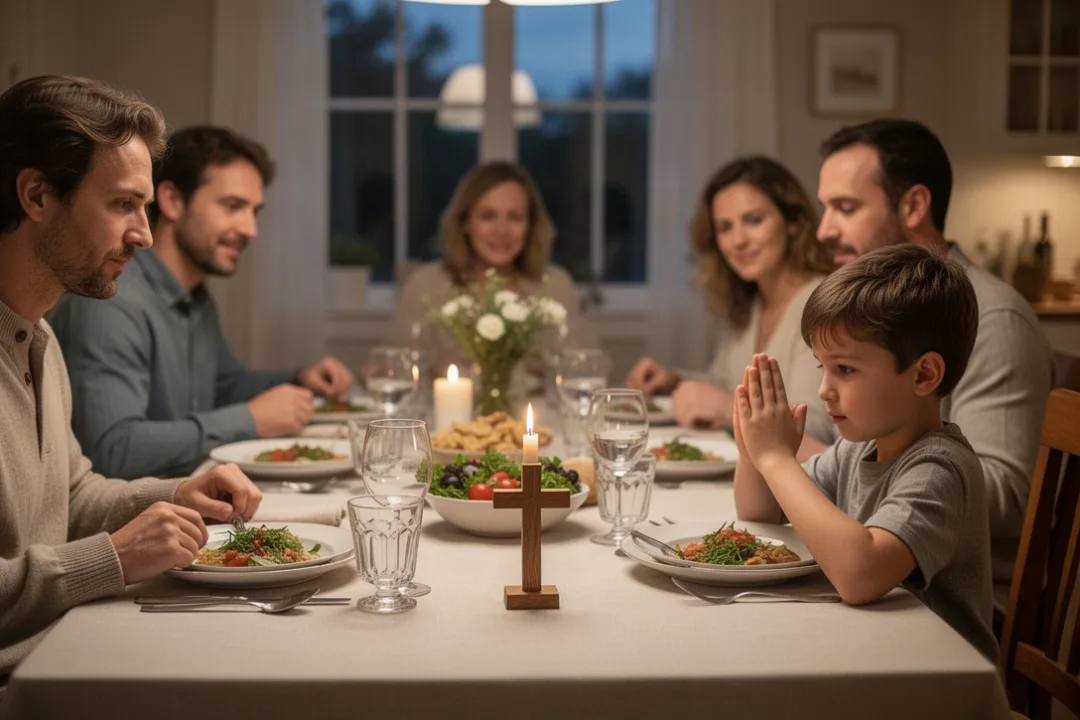
Mealtime is a natural opportunity to thank God for food, the people who prepared it, and everyone gathered around the table. Children can take turns leading the prayer so they learn that prayer belongs to the whole family, not only to adults.
Traditional blessing: “Bless us, O Lord, and these thy gifts, which we are about to receive from thy bounty, through Christ our Lord. Amen.”
Short family blessing: “Thank you, God, for this food and for the people who prepared it. Bless our family and all those who do not have enough to eat. Amen.”
Prayer after a meal: “We give you thanks, almighty God, for all your benefits. You who live and reign forever. Amen.”
Use mealtime prayer to build gratitude without making children feel guilty about food. A child can learn that gratitude includes noticing the work involved in a meal and remembering people who need practical help.
Invite one child to begin with the Sign of the Cross.
Let another child name one thing the family is thankful for.
Pray briefly for people who are hungry, sick, lonely, or worried.
End with “Amen” together so everyone participates.
Bedtime prayers for comfort and forgiveness
Bedtime often brings a quieter moment for children to talk about their day. A bedtime prayer can include thankfulness, sorrow for wrongdoing, forgiveness, and trust. Keep the tone peaceful, especially for a child who is already tired.
Simple bedtime prayer: “Dear God, thank you for caring for me today. I am sorry for the times I chose wrongly. Please forgive me, help me do better tomorrow, and watch over my family through the night. Amen.”
Prayer for family and friends: “Lord Jesus, bless my parents, family, friends, teachers, and everyone who needs your help tonight. Give us peaceful sleep and a kind heart for tomorrow. Amen.”
Act of Contrition for children: “My God, I am sorry for my sins with all my heart. I am sorry for choosing wrong and for failing to do good. Help me to love you and to make better choices. Amen.”
This short form can prepare a child for the Sacrament of Reconciliation, but it should not replace the form taught by the child’s parish or religious education program. Ask the pastor or catechist which wording the parish uses.
Children may also pray silently about a fear or sadness. You can say, “Tell God what is worrying you,” then allow a little quiet. Do not pressure a child to disclose something before feeling ready, and take serious concerns seriously outside the prayer itself.
Prayers for forgiveness and making better choices
Catholic prayer teaches that God’s mercy is always connected with a desire to grow. Children need language that recognizes wrongdoing without making them believe they are bad or beyond forgiveness.
A child’s prayer after an argument: “Jesus, I am sorry for the hurtful words I used. Please forgive me, help me understand how the other person feels, and give me courage to apologize and make things right. Amen.”
A prayer before a difficult choice: “Holy Spirit, help me know what is right and give me the courage to choose it. Help me be honest, patient, and respectful. Amen.”
After a conflict, prayer works best when it leads to a concrete action. A child may need to return an item, tell the truth, write an apology, repair something, or ask how to restore trust.
Explain that forgiveness does not mean pretending harm did not happen. A child should still tell a trusted adult about bullying, abuse, threats, or unsafe behavior. Prayer can support healing, but it is not a substitute for protection or appropriate help.
Prayers for protection, health, and people in need
Children often want to pray when someone is sick, frightened, traveling, or facing a difficult situation. Give them simple words that express care while avoiding the promise that every outcome will be exactly what they want.
Prayer for someone who is sick: “Loving God, please be close to [name]. Give this person strength, comfort, and good care. Bless the doctors, nurses, and family members who are helping. Help us show love in practical ways. Amen.”
Prayer for safety: “God our Father, watch over us today and help us make wise choices. Protect those who are traveling and those who are in danger. Help us notice when someone needs help. Amen.”
Prayer for a worried child: “Jesus, you know what is making me afraid. Stay close to me, help me breathe slowly, and show me the next good step. Give me people I can trust and courage to ask for help. Amen.”
When a child prays for healing, explain that Christians ask God for healing while also accepting medical care and the support of other people. It is honest to say that we do not always understand why suffering happens.
Prayers for the Rosary and Catholic feast days
The Rosary can be adapted for children by beginning with a single decade rather than expecting a young child to pray all five decades. The basic prayers include the Sign of the Cross, the Apostles’ Creed, the Our Father, the Hail Mary, and the Glory Be.
During each decade, the family remembers an event from the life of Jesus and Mary. You can name the mystery in language a child understands, read a short Gospel passage, or simply describe the event before praying the ten Hail Marys.
Joyful Mysteries: events surrounding Jesus’ birth and childhood.
Sorrowful Mysteries: Jesus’ suffering and death.
Glorious Mysteries: the Resurrection and the glory of heaven.
Luminous Mysteries: important moments in Jesus’ public ministry.
Children may also use short prayers connected with the Church year. During Advent, pray for patient preparation. At Christmas, thank God for Jesus’ birth. During Lent, ask for a generous heart. At Easter, celebrate new life and the hope of the Resurrection.
Prayer to Saint Michael: “Saint Michael the Archangel, defend us in battle. Be our protection against the wickedness and snares of the devil. May God rebuke him, we humbly pray; and do thou, O Prince of the heavenly host, by the power of God, cast into hell Satan and all the evil spirits who wander through the world seeking the ruin of souls. Amen.”
Because this prayer uses formal and difficult language, explain its meaning rather than requiring a young child to understand every phrase immediately. It asks for spiritual strength and protection from evil.
How to help children pray in their own words
Memorized prayers give children a foundation, but spontaneous prayer helps them speak honestly to God. A simple pattern is thank you, sorry, please, and praise. You can offer one prompt at a time and let the child answer with a few words.
Thank you: Name a person, gift, experience, or moment of beauty.
Sorry: Admit one choice that hurt someone or turned you away from what is good.
Please: Ask for help for yourself or another person.
Praise: Say something true about God, such as “You are loving” or “You care for us.”
A child might pray, “Thank you for Grandma visiting. I am sorry I yelled. Please help my friend feel better. You are good, God.” That is a complete prayer even though it is short.
Adults can model this kind of prayer without correcting every word. If a child says, “God, I’m mad,” you might respond, “You can tell God that. What do you need help with?” Prayer should make room for honest feelings, including sadness, anger, confusion, and disappointment.
Practical tips and common mistakes when teaching children to pray
The way adults introduce prayer often shapes how children feel about it. A calm, regular example teaches more than a long explanation. Let prayer be connected with ordinary family moments, not only emergencies or misbehavior.
Start small: Choose one prayer and repeat it for several days before adding another.
Use age-appropriate language: Explain unfamiliar words instead of assuming a child understands them.
Pray together: Children learn through hearing a parent, grandparent, or older sibling pray.
Offer choices: Let the child choose between a memorized prayer and a prayer in personal words.
Include movement: A child may hold a cross, light a battery candle, fold hands, or sit quietly.
Respect attention spans: End while the experience is still peaceful rather than forcing unnecessary length.
Connect prayer with action: If you pray for the hungry, consider donating food or helping prepare a meal.
Avoid shame: Do not tell a child that God will stop loving them because they are distracted or forgetful.
Common mistakes include turning prayer into a test, insisting that a child use only adult language, or making prayer a punishment. Another mistake is correcting posture so often that the child becomes focused on performance instead of relationship with God.
Remember the purpose: Catholic prayer helps a child grow in love of God and neighbor. Correct pronunciation and posture have value, but they should serve faith rather than replace a child’s honest relationship with God.
Choosing prayers for different ages
Preschool children
Very young children benefit from repetition, rhythm, and visible cues. Use the Sign of the Cross, a one-sentence prayer, a short guardian angel prayer, or a repeated response such as “Lord, hear our prayer.” Keep the routine predictable and allow the child to participate through a gesture or a single word.
Elementary-age children
Children in elementary school can begin learning the Our Father, Hail Mary, Glory Be, meal blessings, and simple prayers of sorrow. They can also name people to include in intercessions and take turns leading family prayer.
Preteens and teenagers
Older children may want more privacy and more freedom in how they pray. Encourage the Rosary, the Liturgy of the Hours, Eucharistic adoration, Scripture reflection, journaling, or quiet prayer. They may ask difficult questions about suffering, forgiveness, doubt, and unanswered prayer; listen carefully before offering an answer.
The same child may need different forms of prayer at different times. A teenager who resists a spoken family prayer may still appreciate a quiet blessing before a stressful event. A child who knows several memorized prayers may still need help finding words during grief.
Creating a sustainable Catholic prayer routine at home
A family prayer routine works best when it fits the household’s actual schedule. Choose one reliable moment, such as after waking, before dinner, during the drive to school, or just before lights out. The routine can expand during Advent, Lent, or a family crisis without becoming a daily burden.
Keep a small prayer area with a Bible, cross, rosary, saint card, or seasonal item. These objects are reminders, not requirements. What matters most is the family’s attention, kindness, and willingness to place ordinary life before God.
Once a week, ask each person to name one thanksgiving, concern, and person to remember. End with a familiar prayer everyone knows. This structure gives children a dependable way to participate while leaving room for personal needs.
Finally, connect home prayer with the sacramental life of the Church. Take children to Mass, help them prepare for Reconciliation and First Communion, and speak positively about the parish community. Home prayers become stronger when children see that faith includes worship, service, forgiveness, and care for other people.
Frequently asked questions
What is the best Catholic prayer for a young child?
The Sign of the Cross is a useful first prayer because it is brief and introduces the Trinity. A one-sentence prayer such as “Thank you, God, for loving me; help me be kind today” is also suitable. Add the Our Father, Hail Mary, and guardian angel prayer gradually, using repetition rather than expecting the child to memorize everything at once.
How long should children’s Catholic prayers be?
There is no required length for a child’s personal prayer. Preschoolers may pray for less than a minute, while older children may enjoy a decade of the Rosary or several minutes of quiet reflection. A short, attentive prayer is better than a long routine that leaves the child frustrated, distracted, or anxious.
Should children pray only memorized Catholic prayers?
No. Memorized prayers connect children with the wider Church and give them words when they do not know what to say. Personal prayer teaches them to speak honestly with God. Encourage both forms: perhaps an Our Father followed by a few words of thanks, concern, or request in the child’s own language.
What should parents do when a child refuses to pray?
Stay calm and avoid using prayer as a punishment or a test of obedience. Invite the child to sit with the family, listen, or offer one word rather than forcing a performance. Ask gently whether the child is tired, confused, upset, or worried. A consistent example and a welcoming routine usually teach more than pressure.












Leave a Reply