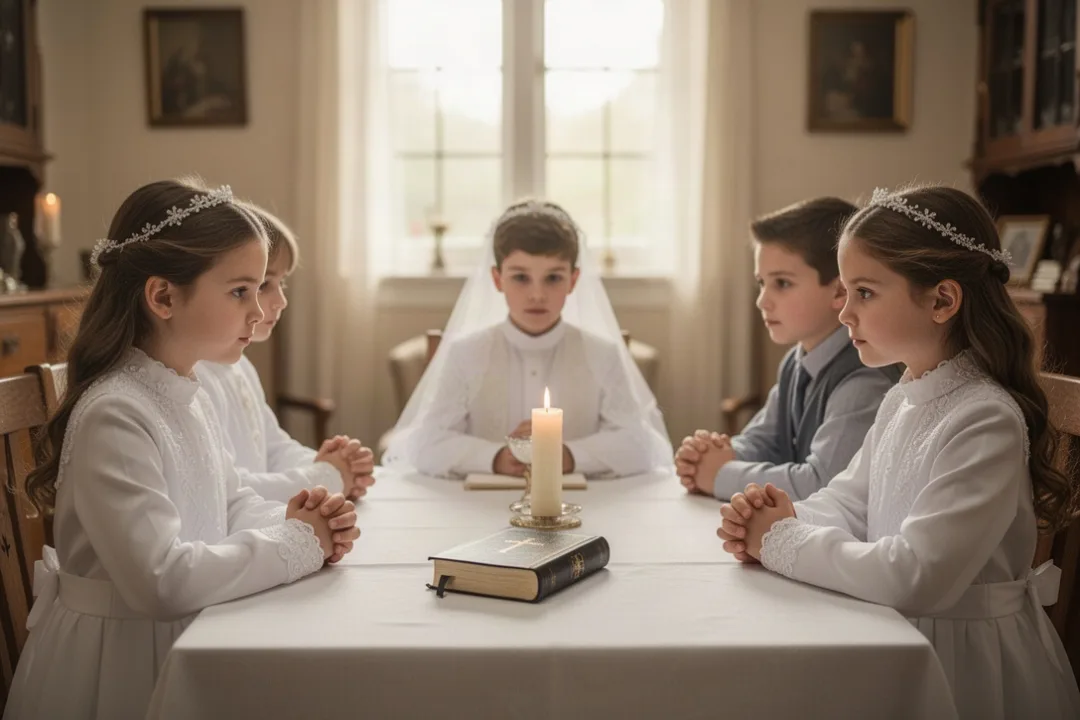
1st Communion prayers help children prepare their hearts to receive Jesus in the Eucharist with faith, gratitude, and reverence.
First Holy Communion is both a joyful celebration and a meaningful step in a child’s spiritual life. The prayers surrounding it can help connect the ceremony with everyday faith, family support, and the child’s growing relationship with God. A good prayer does not need complicated language. It should be <strongsincere, understandable, and suitable for the child’s age.
Some families choose a traditional prayer taught by the parish, while others add a short prayer before the ceremony, a blessing at home, or a thanksgiving prayer after receiving Communion. You can also invite the child to write a few simple lines in their own words. The most useful approach is to combine familiar prayer with moments of personal reflection.
A helpful focus: Teach the child that First Communion is not only a special event to remember. It is an invitation to live with greater love, gratitude, forgiveness, and care for others.
Before First Communion, a child may feel excited, nervous, curious, or unsure about what will happen. A short prayer can provide calm without making the occasion feel like a test. Encourage the child to speak slowly and to concentrate on being present rather than trying to say every word perfectly.
This original prayer is suitable for a child to say alone or with a parent:
Dear God, thank you for bringing me to this special day. Help me understand the gift of the Eucharist and receive Jesus with a loving and respectful heart. Guide me to follow your example by being kind, honest, forgiving, and ready to help others. Amen.
You can make the prayer more personal by adding the names of people who have helped the child prepare. A child might mention parents, grandparents, godparents, catechists, teachers, or members of the parish. Personal details make the prayer feel less like a speech and more like a genuine conversation with God.
A shorter version may work better for a young child:
Jesus, thank you for this special day. Help me welcome you with faith and love. Teach me to share your love with everyone I meet. Amen.
Parents can guide the child with a few quiet questions before praying:
What are you most thankful for today?
Who helped you learn about Jesus and the Eucharist?
What kind action would you like to practice after your First Communion?
What would you like to ask God to help you understand?
These questions are not meant to pressure the child into producing a perfect answer. They simply help the child recognize that prayer can include thanksgiving, requests for help, and honest feelings. A brief prayer said with attention can be more meaningful than a longer prayer repeated without understanding.
Prayers for the First Communion ceremony
The parish usually provides the order of worship and may teach children specific responses or prayers. Families should follow the directions of the parish, especially during the Mass. A personal prayer can be said before the liturgy, after receiving Communion, or at home before leaving for church rather than inserted into the service without permission.
For a child participating in the ceremony, this prayer expresses reverence and readiness:
Lord Jesus, today I come to your table with joy. Thank you for the people who have taught me and prayed for me. Help me receive the Eucharist with faith, remember your love, and carry peace and kindness into the world. May my life show gratitude for this gift. Amen.
A child may also pray for the other children receiving Communion:
God our Father, bless all the children celebrating First Communion today. Give us peaceful hearts, attentive minds, and grateful spirits. Help us support one another and remember that we belong to a loving community. Guide our families and our parish as we continue to grow in faith. Amen.
This kind of prayer broadens the child’s attention beyond personal excitement. First Communion is a community celebration, and praying for classmates helps children recognize that they share the occasion with others. It can also ease nervousness because the child is reminded that no one is facing the moment alone.
If the child is reading a prayer during the Mass, practice should focus on clarity rather than performance. Help the child:
Read the prayer aloud several times at a comfortable pace.
Mark natural pauses without changing the meaning.
Learn the first and last lines especially well.
Stand still, breathe normally, and look up when appropriate.
Remember that a small mistake does not diminish the prayer.
Adults should avoid correcting every minor stumble in front of others. A child who feels supported is more likely to pray with confidence. The purpose is not to deliver a flawless presentation; it is to help the child participate in worship with reverence and joy.
Thanksgiving prayers after receiving Communion
Many people remain quiet after receiving Communion so they can pray personally. Children may need help understanding what to do during this time. Tell them that they can thank Jesus, ask for guidance, pray for someone they love, or simply sit quietly. There is no requirement to use elaborate language.
This prayer offers a simple pattern of gratitude and commitment:
Jesus, thank you for coming close to me in the Eucharist. Thank you for your love and for the people who care for me. Help me remember this gift when I am at home, at school, and with my friends. Give me strength to choose kindness and courage when someone needs my help. Amen.
For an older child who wants a more reflective prayer, use language that connects Communion with daily choices:
Lord Jesus, I am grateful for your presence and for the grace of this sacrament. Help me recognize your love in my family, my parish, and the people I meet. When I am impatient, teach me gentleness. When I hurt someone, help me seek forgiveness. When I see another person in need, make me willing to respond. Amen.
The period after Communion can also include prayer for people who are sick, lonely, grieving, or experiencing hardship. This helps children understand that the Eucharist should lead to compassionate action. Invite the child to name one person silently and ask God to give that person comfort or strength.
For parents: Avoid turning post-Communion prayer into a quiz about what the child felt. A child may experience deep reverence, ordinary quiet, or uncertainty. All three can be met with patience and gentle guidance.
A very short prayer can be enough when the child is tired or overwhelmed:
Jesus, thank you for being with me. Help me live with love. Amen.
Short prayers are valuable because children can remember them during ordinary moments. A child might say the prayer before making an apology, helping a classmate, facing a difficult decision, or preparing for Sunday Mass. In that way, First Communion becomes connected to a continuing habit of prayerful living.
Family prayers for First Communion day
Family prayer can begin before leaving home and continue after the celebration. It gives relatives a chance to bless the child without making the day feel crowded with speeches. Keep the gathering simple: one person may lead, while everyone else listens or joins in the final response.
Loving God, thank you for the gift of this day and for the child who is preparing to receive First Communion. Bless this child with a faithful heart and a generous spirit. Bless the family, friends, and parish community who have offered support. Help us celebrate with gratitude and remember that your love calls us to serve one another. Amen.
Grandparents, godparents, and other relatives can offer a personal blessing:
May God guide you as you grow in faith. May Jesus fill you with peace and teach you to love others. May the Holy Spirit give you wisdom, courage, and kindness. We are grateful for you and will continue to pray for you. Amen.
If several family members want to participate, assign each person one brief part. For example, one person can give thanks, another can pray for the child, and a third can pray for the parish. This keeps the moment organized and allows different generations to take part.
Useful family prayer intentions include:
Gratitude for the child’s preparation and teachers.
Strength for the child to continue attending Mass and learning about faith.
Comfort for family members who cannot attend.
Blessings for the priest, catechists, and parish community.
Guidance for the family to model forgiveness, service, and compassion.
Families may also use a quiet meal prayer after the ceremony. The prayer does not need to repeat every part of the liturgy. Instead, it can thank God for the people gathered together and ask for help in carrying the day’s meaning into family life.
God of love, thank you for bringing our family together. We give thanks for this First Communion and for all who helped make it possible. May our home be a place of prayer, welcome, patience, and forgiveness. Help us remember today with gratitude and continue growing together in faith. Amen.
Traditional Catholic prayers to learn for First Communion
Many Catholic parishes teach children a collection of prayers as part of sacramental preparation. The exact list can differ by parish, diocese, age group, and religious education program. Ask the child’s catechist which prayers should be memorized and which are simply meant to be understood and practiced.
Common prayers associated with Catholic formation may include:
The Sign of the Cross, which invokes the Trinity and marks the beginning of prayer.
The Lord’s Prayer, which asks for God’s care, forgiveness, and help in resisting sin.
The Hail Mary, which honors Mary and asks her to pray for believers.
The Glory Be, a brief prayer of praise to the Father, Son, and Holy Spirit.
An Act of Contrition, expressing sorrow for sin and a desire to change.
The Apostles’ Creed, which summarizes central beliefs of Christian faith.
A prayer before meals or a brief prayer of thanksgiving.
Because wording can vary among approved prayer books and parish materials, use the version supplied by the child’s church. This is especially helpful when children are expected to recite a prayer together. Consistent wording allows the group to pray as one community and prevents confusion during preparation.
Understanding matters as much as memorization. For example, an Act of Contrition is not merely a set of lines to repeat before a sacrament. It expresses honest sorrow, trust in God’s mercy, and a real intention to make better choices. The Lord’s Prayer is not only a prayer for personal needs; it also teaches believers to seek daily provision, forgiveness, and reconciliation.
Parents can explain traditional prayers in ordinary language:
“What does this prayer praise?” Identify the words that honor God.
“What does this prayer ask for?” Talk about help, forgiveness, peace, or guidance.
“How could this prayer change your actions?” Connect prayer with kindness and responsibility.
Do not make memorization a source of shame. Some children learn quickly, while others need repetition, visual prompts, or the support of praying with a group. Reviewing one prayer for a few minutes each day is usually more effective than requiring a long practice session the night before the ceremony.
How to help a child write a personal First Communion prayer
A personal prayer does not need to sound formal. Children can write naturally, using words they would actually say. If an adult rewrites every sentence, the result may sound polished but no longer feel like the child’s prayer. Offer guidance while preserving the child’s own ideas and voice.
A simple structure uses four parts:
Address God: Begin with “Dear God,” “Loving Father,” or “Jesus.”
Give thanks: Mention the Eucharist, the family, the parish, or the people who helped.
Ask for help: Request faith, courage, patience, kindness, or understanding.
Choose a response: Promise to keep learning, forgive others, serve, or pray.
Dear Jesus, thank you for my family and for everyone who helped me prepare for First Communion. I am happy and a little nervous about this day. Help me understand your love and remember it when I am with my friends. Help me be kind, tell the truth, and forgive people. Thank you for being with me. Amen.
The prayer can mention a specific person, concern, or hope. A child might pray for a friend who is ill, a relative who lives far away, or the ability to be more patient with a sibling. Specific details make the prayer meaningful while teaching the child that God can be approached with both big concerns and ordinary daily needs.
Review the prayer gently before the child uses it publicly. Check that it is short enough to read comfortably and that the wording reflects what the child means. Avoid adding theological language the child cannot explain. Clear, heartfelt words are more appropriate than impressive vocabulary.
Children can also keep their prayer in a First Communion Bible, prayer book, or memory box. Reading it again on the anniversary of First Communion can create a quiet opportunity to remember how the child’s faith has developed. The prayer may feel different later, and that change can become part of the child’s spiritual growth.
Choosing the right 1st Communion prayer for different situations
The best prayer depends on who will say it, where it will be used, and how much time is available. A prayer for a child at home can be personal and conversational. A prayer for a parish gathering should be inclusive, clear, and easy for everyone to follow.
Use these guidelines when selecting one:
For a young child: Choose two or three short sentences with familiar words.
For a child reading at Mass: Select a prayer with clear rhythm and practice it aloud.
For family prayer: Include gratitude for the child and the people who supported preparation.
For a parish group: Pray for all children, families, catechists, and the wider community.
For a keepsake: Choose a personal prayer that names the child’s hopes and commitments.
For a child feeling nervous: Use reassuring language about God’s presence and loving care.
Consider the child’s temperament as well. A quiet child may prefer to pray privately, while another may enjoy reading aloud. Neither approach is more faithful. The goal is to create space for genuine participation, not to place every child in the same role.
Families should also be sensitive to relatives and friends from different Christian backgrounds. If the gathering includes people unfamiliar with Catholic language, a brief explanation may help them understand that the prayer is connected with the child’s reception of the Eucharist and continued formation in the Church.
Prayer should remain connected to action after First Communion. Ask the child to choose one practice for the following week, such as saying a brief prayer before school, helping at home without being asked, attending Sunday Mass with the family, or forgiving someone after an argument. These choices help turn a meaningful celebration into a lasting habit of faith expressed through love.
A final prayer for continuing growth can be used at home in the weeks that follow:
Lord Jesus, thank you for the joy of my First Communion. Stay with me as I continue learning and growing. Help me remember to pray, listen, forgive, and serve. When I make mistakes, lead me back to your mercy. May my words and actions show gratitude for your love. Amen.
Frequently asked questions
What should a child say before receiving First Communion?
A child can offer a short prayer of gratitude and readiness, asking Jesus for a loving and respectful heart. The child might thank God for family members, catechists, and the parish community, then ask for help living with kindness and faith. The parish may also provide specific prayers or responses that children should learn before the ceremony.
Can a child write a personal First Communion prayer?
Yes. A personal prayer can be especially meaningful when it uses the child’s own words. Help the child include thanks for the Eucharist and the people who offered support, then add a request for guidance and one way the child hopes to live out Christian love. Keep the prayer brief enough for the child to understand and say comfortably.
What prayer is appropriate after receiving Communion?
A quiet prayer of thanksgiving is appropriate after receiving Communion. The child can thank Jesus for being present, ask for strength to make good choices, and pray for someone who needs help. Silence is also a valid form of prayer. Children do not need to describe a special feeling or use formal language for this time to be meaningful.
Which traditional prayers should children know for First Communion?
The required prayers vary by parish, but preparation commonly includes the Sign of the Cross, the Lord’s Prayer, the Hail Mary, the Glory Be, an Act of Contrition, and sometimes the Apostles’ Creed. Ask the child’s catechist for the official list and wording. Understanding what each prayer means is more valuable than memorizing words without context.











Leave a Reply