Saint Imelda is the name commonly given to Blessed Imelda Lambertini, a young Italian Dominican known for her intense devotion to the Eucharist. Catholics especially remember her as a patron of first Communion because tradition says she received the Eucharist in a miraculous way shortly before her death.
Imelda lived in Bologna, Italy, in the early 14th century. She died as a child, but her story has continued through Catholic schools, religious communities, first-Communion programs, and Eucharistic devotion. Because she was beatified but not canonized, the more precise title is Blessed Imelda, although many people refer to her as Saint Imelda in ordinary speech.
Blessed Imelda Lambertini is traditionally identified as a girl from a noble family in Bologna. Accounts of her life place her birth in 1322, although the surviving details about her childhood are shaped by devotional tradition rather than a modern biography with extensive independent records.
From an early age, Imelda was said to show a strong attraction to prayer and the Christian life. She is traditionally associated with the Dominican Order and entered a Dominican community while still very young. Some accounts describe her as joining the monastery at about nine years old, an age that reflects medieval religious customs and should not be compared directly with modern expectations for religious commitment.
Her life in the community centered on prayer, worship, study, and ordinary duties. The point of her story is not that she performed public works or held a leadership position. Instead, devotion to the Holy Eucharist became the defining feature of her short life.
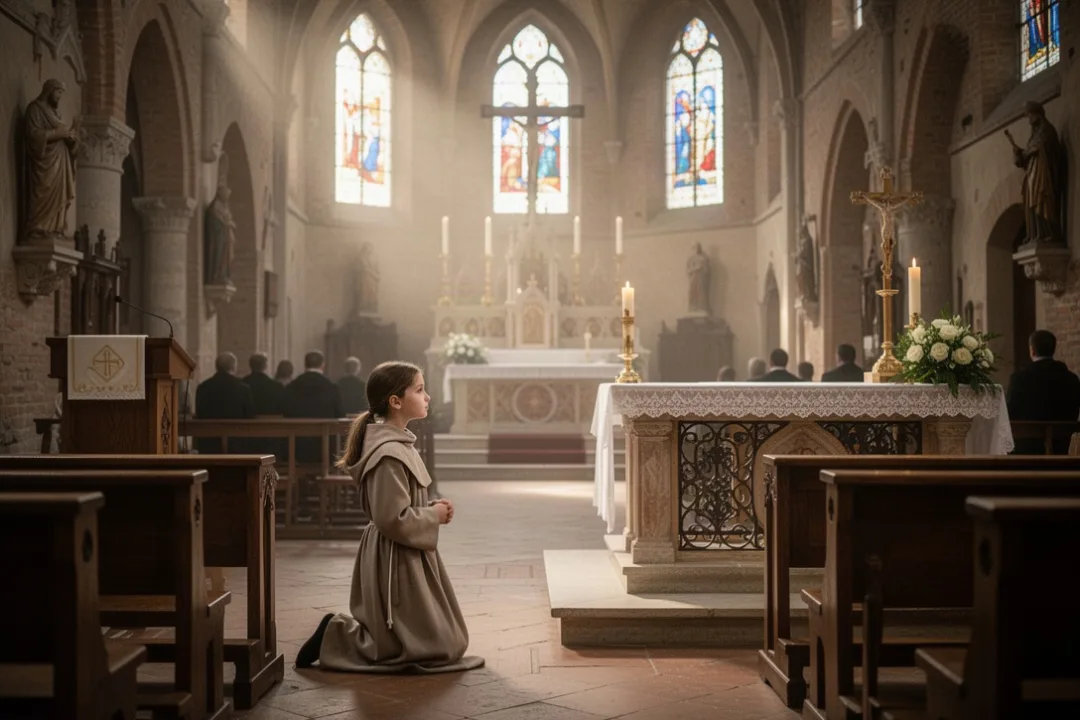
Imelda’s traditional biography presents her as longing to receive Communion. At the time, children generally received the Eucharist later than children commonly do today, and she was considered too young to receive. This detail is central to the story because it highlights her desire for a personal encounter with Christ rather than simply a wish to take part in a ceremony.
Name and title: “Saint Imelda” is a familiar devotional name, but the formal Catholic title commonly used is Blessed Imelda Lambertini. She was beatified, not canonized.
Her traditional feast day is May 12. On that day, Catholics who honor her may attend Mass, pray for children preparing for first Communion, or reflect on the meaning of receiving the Eucharist with faith and reverence.
Why Imelda is connected with first Communion
Imelda is associated with first Communion because tradition says that her deepest desire was to receive the Eucharist. She reportedly asked for permission but was told that she was too young. Her story therefore became closely connected with children who are preparing to receive Communion for the first time.
Her example is not meant to suggest that age, emotion, or extraordinary experiences determine whether someone is ready for the sacrament. Preparation for first Communion normally includes learning about the Mass, understanding the Eucharist according to Catholic teaching, taking part in the life of the Church, and approaching the sacrament with appropriate formation.
Instead, Imelda’s story emphasizes desire, reverence, and love for Christ. A child preparing for first Communion can understand the basic lesson: Communion is not merely a reward for completing classes or a memorable family event. It is a sacred act of worship and participation in the life of the Church.
Her association with children also gives families a way to discuss questions that can be difficult to explain. Young people may ask why Catholics receive Communion, why the Eucharist is treated with special respect, or why the priest handles it carefully. Imelda’s story opens those conversations without requiring children to understand every theological detail at once.
Parents and teachers can use her feast day to encourage practical habits such as:
Taking a quiet moment before Mass begins.
Listening carefully to the Scripture readings and homily.
Learning the responses and prayers used during the liturgy.
Receiving Communion reverently according to local Catholic practice.
Offering a prayer of thanksgiving after Communion.
Children preparing for first Communion may also benefit from seeing that saints and blesseds were not all adults with long public careers. Imelda’s life was short, and her witness was expressed through simple but serious devotion. That can help children recognize that holiness is not limited to a particular age.
What the Eucharistic miracle tradition says
The best-known part of Imelda’s story is a reported Eucharistic miracle. According to the traditional account, she was attending Mass on the feast of the Ascension in 1333. She had not been permitted to receive Communion because of her age, and she remained after the other members of the community had received.
The account says that a consecrated host appeared above her. A priest is said to have approached with a paten, after which the host came to rest on it and was given to Imelda. The story then says that she received Communion and died in an attitude of profound joy or ecstasy.
Different retellings vary in their details. Some focus on the host appearing in the air; others emphasize the priest’s hesitation, the community’s reaction, or the change in Imelda’s condition after she received Communion. These differences are common in accounts that have been transmitted through devotional writing over many generations.
The Church’s treatment of such stories calls for care. A Catholic may find the account spiritually meaningful, but a devotional tradition should not be presented as though every detail has been established by the same kind of evidence used in a modern historical investigation. It is more accurate to say that the Eucharistic miracle is traditionally attributed to Blessed Imelda.
The spiritual meaning of the account is clear within Catholic devotion. It portrays the Eucharist as the fulfillment of Imelda’s longing and presents her death as an encounter with Christ rather than simply the end of a young life. For believers, the story points toward the Catholic teaching that Christ is truly present in the Eucharist.
Imelda’s story centers on a longing to meet Christ in the Eucharist, not on receiving attention for herself.
Her story should also be read with sensitivity. Children are not expected to imitate a miraculous event or to measure their faith by strong feelings during prayer. Some people experience deep emotion at Mass, while others participate quietly and faithfully. Reverence does not require a dramatic experience.
For families: Present the miracle as a traditional account and focus on its meaning: the Eucharist is treated with faith, gratitude, and respect. Avoid suggesting that children must feel something extraordinary for their Communion to be genuine.
What Catholics can learn from Blessed Imelda
Imelda’s example offers several lessons that apply beyond first Communion. The first is the value of spiritual desire. Catholic prayer is not only about completing duties; it also involves turning toward God with attention and love. Her traditional story gives that desire a child’s voice.
The second lesson is patience. Imelda wanted to receive Communion but had to wait according to the rules of her community. That part of the story can help children understand that preparation is not a pointless delay. Learning, practicing, asking questions, and growing in understanding are part of approaching a sacred responsibility.
A third lesson is that quiet faith matters. Imelda is remembered not for public influence but for the seriousness of her inner life. Her story can encourage children who are shy, reflective, or less visible in a group. They do not need to be the loudest participant to take their faith seriously.
Her example can also correct a common misunderstanding about holiness. Holiness does not mean having a perfect personality or never feeling confused. It means allowing love of God to shape the way you pray, worship, treat other people, and respond to the responsibilities of your life.
For adults, Imelda’s story is a reminder that children deserve meaningful religious formation. A child may not be able to explain Eucharistic theology in adult language, but that does not mean the child’s questions or prayer are unimportant. Parents, teachers, priests, and catechists can make room for honest questions while offering clear, age-appropriate answers.
Useful questions for a family discussion include:
What do you think Imelda wanted most?
Why do Catholics prepare before receiving Communion?
What can you do to pay closer attention at Mass?
How can you show gratitude after receiving the Eucharist?
Why might a saint’s age matter to children today?
These questions keep attention on the meaning of the story rather than on the miracle alone. They also connect Imelda’s example with ordinary Christian practice: prayer, participation in Mass, respect for others, and gratitude.
How Imelda’s feast day is observed
Blessed Imelda’s feast day is observed on May 12. The exact customs differ by parish, school, family, and religious community. There is no single required way for every Catholic to honor her.
A parish might mention her during a Mass for children, include a prayer for first communicants, or teach about her during religious education. A Catholic school may use her feast day to discuss the Eucharist, the lives of young saints and blesseds, or the proper way to participate in Mass.
At home, families can mark the day simply. A short prayer, a visit to Mass, or a conversation about preparing for Communion may be more fitting than an elaborate activity. The purpose is to connect Imelda’s memory with a living practice of faith.
A family prayer might ask God to help children approach the Eucharist with faith, humility, and gratitude. It can also pray for parents and catechists, who help children understand what they are preparing to receive. The prayer does not need to use formal language to be sincere.
Families may also read a reliable account of Imelda’s life and discuss the difference between a historical fact, a Church-approved devotion, and a story passed down in religious tradition. That distinction teaches children to respect both faith and careful study.
Those who visit Bologna may encounter places associated with Imelda’s memory and relics, particularly Dominican sites connected with her veneration. Locations and arrangements can change, so visitors should check current information from the relevant church or religious community before planning a visit.
Prayers and devotional practices associated with Imelda
There is no single universal prayer that every Catholic must use for Blessed Imelda. People may pray in their own words, use a parish prayer, or ask for her intercession through a traditional formula. The central request is usually connected with love for the Eucharist and faithful preparation for Communion.
A simple prayer could ask God to help a child listen attentively at Mass, understand the sacrament according to the child’s capacity, and receive Communion with reverence. It could also ask Blessed Imelda to pray for children who are anxious about first Communion or who feel unsure about their place in the Church.
Adults can use her feast day to renew their own Eucharistic practice. That might mean arriving a few minutes early, silencing distractions, reading the Sunday readings beforehand, or staying briefly after Mass for thanksgiving. Small changes can make participation more attentive without turning devotion into a performance.
Some people may choose to pray a novena or use a prayer card featuring Imelda. Such practices can be meaningful when they lead toward Christ and the sacramental life of the Church. They should not be treated as magical formulas or substitutes for Mass, Christian formation, repentance, or charity.
Those seeking Imelda’s intercession often pray for:
Children preparing for first Communion.
Families seeking to make Sunday Mass a faithful habit.
Catechists and teachers who form young Catholics.
People who struggle to pray or feel distracted at Mass.
A deeper understanding of Christ’s presence in the Eucharist.
Her story can be especially helpful when first Communion becomes focused on clothing, photographs, gifts, or a family gathering. Those elements may be part of the celebration, but Imelda’s example redirects attention to the sacrament itself. The central event is receiving Christ in the Eucharist, not creating a perfect ceremony.
When people search for Saint Imelda, they are usually looking for more than a date or a biographical detail. They want to know why a child from medieval Bologna remains connected with the Eucharist today. The answer lies in the enduring picture of a young believer whose deepest wish was to meet Christ in Communion and whose memory continues to encourage reverent, thoughtful preparation.
Frequently asked questions
Was Saint Imelda actually canonized?
No. The formal title is Blessed Imelda Lambertini because she was beatified rather than canonized. Many Catholics still call her Saint Imelda in ordinary devotional language. Using “Blessed Imelda” is the more precise form, especially in educational or church materials.
When is Blessed Imelda’s feast day?
Blessed Imelda’s feast day is May 12. Parishes and Catholic schools may observe it with Mass, classroom instruction, prayers for children preparing for first Communion, or activities focused on Eucharistic devotion. Customs are not identical everywhere.
What is Blessed Imelda the patron of?
She is especially associated with first communicants and children preparing to receive Communion. Her patronage comes from the traditional account that she longed to receive the Eucharist and received it through a reported miracle shortly before her death.
Where did Blessed Imelda live?
Imelda is traditionally connected with Bologna, Italy, and with a Dominican religious community there. Accounts of her life place her in 14th-century Italy. Visitors interested in sites associated with her should confirm current access and location details with local churches or Dominican institutions.










Leave a Reply