John Neumann: life, legacy, feast day, and prayers
John Neumann: life, legacy, feast day, and prayers
Who was John Neumann, and why does his name appear on churches, schools, shrines, and Catholic calendars across the United States? John Neumann was a 19th-century Catholic bishop and Redemptorist priest who served immigrants, organized parish education, and strengthened devotion to the Eucharist. The Catholic Church recognizes him as a saint, with his feast day celebrated on January 5.
His life connected European roots with the religious and social realities of the young United States. Neumann learned several languages, ministered among immigrant families, joined the Redemptorists, and became the fourth bishop of Philadelphia. His work was practical as well as spiritual: he helped establish a more organized Catholic school system, promoted the Forty Hours devotion, and visited communities that often had limited access to priests.
John Neumann was born on March 28, 1811, in Prachatitz, Bohemia, then part of the Austrian Empire and now known as Prachatice in the Czech Republic. He grew up in a Catholic family and developed a serious interest in religious life while still young. His education prepared him for the priesthood, but his path to ordination did not follow the ordinary plan.
Neumann studied theology and was ready to be ordained in his home diocese. A shortage of priests in the United States led him to travel across the Atlantic instead. He arrived in New York in 1836 and was ordained a priest for the Diocese of New York on June 25, 1836, by Bishop John Dubois.
His early ministry took place among scattered Catholic communities in upstate New York. He served German-speaking immigrants and other rural Catholics, sometimes traveling long distances between isolated settlements. These years gave him direct knowledge of the difficulties faced by families who lacked churches, schools, and regular pastoral care.
Neumann entered the Congregation of the Most Holy Redeemer, commonly called the Redemptorists, in 1842. The order was known for preaching missions and serving people who were spiritually or geographically underserved. As a Redemptorist, Neumann continued the missionary work that had shaped his first years as a priest.
At a glance: John Neumann was born in Bohemia, ordained in New York, became a Redemptorist, served as bishop of Philadelphia, and was canonized in 1977.
Why John Neumann came to the United States
Neumann came to the United States because he saw a pressing need for priests. Catholic immigration was increasing, but the country had relatively few clergy compared with its expanding population and enormous geographic distances. Many Catholic families lived far from established parishes and spoke languages that local priests did not understand.
His language skills made him especially effective. He spoke German, English, Italian, French, and other languages to varying degrees, allowing him to communicate with immigrant communities from different parts of Europe. Language was not simply an academic talent for Neumann; it was a pastoral tool that helped him hear confessions, preach, teach, and build trust.
The communities he served often lived with economic uncertainty and social isolation. A priest might travel by horseback or on foot to reach a small settlement, celebrate Mass in a private home, and then continue to another distant group of Catholics. Neumann accepted this demanding routine because he saw the presence of the Church as something that needed to reach people where they lived.
His ministry also reflected the tensions of American Catholic life in the 19th century. Catholics were a minority in a largely Protestant country, and immigrant families often faced prejudice. Parish churches became places of worship, education, mutual support, and cultural continuity. Neumann understood that a strong parish needed to serve the whole person and the whole family.
John Neumann’s work as a Redemptorist priest
The Redemptorists focus on preaching, missions, and service to communities in need. Neumann joined the congregation because its mission matched his own experience among scattered Catholics. He professed his vows and continued traveling, preaching, hearing confessions, and forming local communities.
Redemptorist ministry frequently involved parish missions lasting several days or weeks. These missions invited Catholics to return to the sacraments, repair relationships, and renew their religious practice. Neumann’s approach was direct and pastoral. He emphasized the Eucharist, confession, prayer, and practical Christian living rather than treating religious instruction as separate from daily responsibilities.
He also accepted administrative responsibilities within the order. In 1851, he became the Redemptorist superior in the United States. The role required organization across a growing network of religious communities and missions. His experience with parish needs and religious formation prepared him for the episcopal responsibilities that followed.
Neumann’s spirituality was marked by humility and perseverance. He was not known for seeking public recognition. Instead, he focused on regular service: traveling, teaching, celebrating the sacraments, writing, and responding to requests from priests and laypeople. That steady pattern helps explain why many Catholics see him as a model for ordinary pastoral faithfulness.
Pope Pius IX appointed Neumann the fourth bishop of Philadelphia in 1852. He was consecrated on March 28, 1852, his 41st birthday. The Diocese of Philadelphia covered a large area and included a rapidly growing Catholic population, many of whom were immigrants.
As bishop, Neumann faced challenges that extended beyond parish administration. He needed to support priests, expand churches, organize Catholic education, respond to poverty, and serve people from different linguistic and cultural backgrounds. The diocese also operated in a period of anti-Catholic hostility, including violent conflict directed at Catholic institutions.
Neumann’s response was to strengthen the structures that allowed Catholics to practice their faith consistently. He visited parishes, encouraged religious communities, and promoted schools. He also supported the formation of parish societies and other forms of community life that helped families remain connected to the Church.
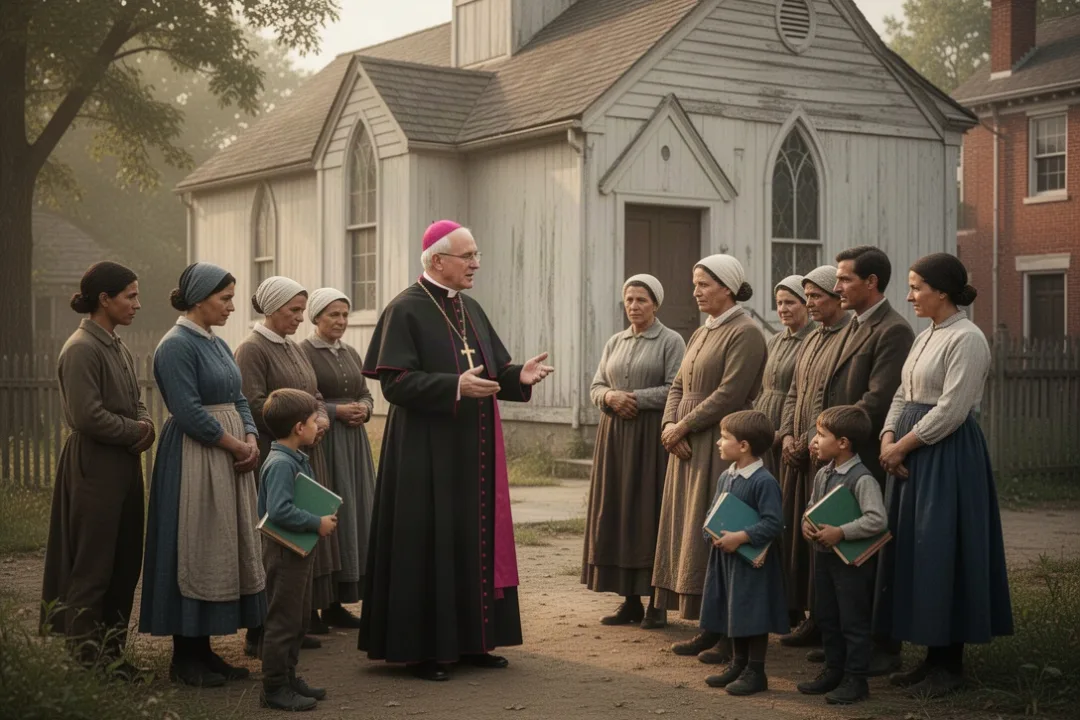
Although he was responsible for a major diocese, Neumann maintained a personal style of ministry. He was known for being approachable and attentive to people who were poor, sick, or overlooked. His small stature and unassuming manner did not lessen his authority. Many people remembered him as a bishop who remained close to the pastoral work of priests and parishioners.
How John Neumann shaped Catholic education
One of Neumann’s most lasting contributions was his organization and expansion of Catholic parish schools in the Philadelphia Diocese. Catholic parents wanted their children to receive religious instruction alongside basic education, especially when public schools did not provide Catholic teaching and sometimes reflected anti-Catholic attitudes.
Before Neumann’s leadership, Catholic schools existed but were not always connected through a consistent diocesan system. He encouraged parishes to establish schools, supported religious sisters and brothers who taught in them, and helped create a more coordinated educational structure. The result was a stronger network of parish-based Catholic education.
Neumann understood that children needed more than occasional catechism lessons. Regular schooling could give them a foundation in Scripture, prayer, doctrine, moral responsibility, and community life. At the same time, Catholic schools offered reading, writing, arithmetic, and other academic subjects needed for daily life.
His work did not mean that every school developed in exactly the same way or that all educational challenges disappeared. Staffing, funding, buildings, and enrollment remained difficult. Still, Neumann helped make Catholic education a central responsibility of the parish rather than an occasional or informal activity.
His influence can be seen in the broader American Catholic school tradition. The parish school became a place where immigrant families could preserve their faith, prepare children for the sacraments, and participate in a supportive community. Neumann’s efforts helped establish patterns that later dioceses would develop on a much larger scale.
The Forty Hours devotion and John Neumann’s Eucharistic ministry
Neumann is closely associated with the Forty Hours devotion, a period of prayer before the exposed Blessed Sacrament. The devotion recalls the traditional period associated with Christ’s body in the tomb and focuses the parish on worship, repentance, and renewed devotion to the Eucharist.
The practice existed before Neumann, but he helped promote and organize it across the Philadelphia Diocese. A parish would arrange a period of Eucharistic adoration, often accompanied by preaching, confession, hymns, and communal prayer. After one parish completed the observance, another could begin, allowing the devotion to continue through a wider region.
This organization mattered because it brought spiritual renewal into parish life in a visible and shared way. Families could spend time in prayer, attend Mass, receive the sacrament of reconciliation, and reflect on the meaning of the Eucharist. The devotion also offered a peaceful response to social disorder and public hostility.
For Neumann, Eucharistic devotion was not separate from service. Prayer at the altar should lead to greater patience, charity, and attention to people in need. His ministry joined sacramental life with practical care for families, immigrants, children, and those living in poverty.
“The Lord has not called me to be successful, but to be faithful.”
This quotation is commonly associated with Neumann’s spiritual outlook, though versions of the wording vary. Its meaning fits the pattern of his life: he measured ministry by faithful service rather than personal prominence or visible achievement.
Neumann’s episcopate lasted less than eight years. He continued traveling and working despite limited health and the heavy demands of his office. His schedule included parish visits, correspondence, pastoral decisions, preaching, and attention to the expanding school system.
On January 5, 1860, Neumann collapsed and died suddenly in Philadelphia at the age of 48. He had been walking along a city street while carrying out his daily responsibilities. His unexpected death shocked the diocese, but Catholics quickly began to remember him as a bishop who had given himself completely to ministry.
He was buried at St. Peter’s Church in Philadelphia, where his remains are now honored at the National Shrine of Saint John Neumann. The shrine is located at the Redemptorist church of St. Peter the Apostle and welcomes pilgrims who come to pray and learn about his life.
How John Neumann became a Catholic saint
The canonization process examines a person’s life, reputation for holiness, writings, and reported miracles. John Neumann’s cause advanced through the Church’s formal procedures, and he was beatified by Pope Paul VI on October 13, 1963.
He was canonized by Pope Paul VI on June 19, 1977. Canonization means that the Catholic Church formally recognizes a person as a saint and proposes that person as an example of Christian holiness worthy of universal veneration. It also confirms that the saint may be honored in the Church’s liturgy.
Neumann is regarded as the first male citizen of the United States to be canonized. The wording can require care because his birthplace was in Bohemia, not in the United States, and he became an American priest and bishop after immigrating. His canonization reflects his lasting connection to American Catholic history and ministry.
The Church recognizes reported healings associated with his intercession as part of the canonization process. Catholics who pray for his intercession do not treat him as a replacement for God. Instead, they ask the saint to pray with them and for them, following the Catholic understanding of the communion of saints.
What John Neumann is the patron saint of
John Neumann is especially associated with Catholic education, immigrants, sick people, and parish life. Different Catholic communities may ask for his intercession in other situations, especially when they are facing the challenges he encountered in ministry.
Teachers, students, principals, and parents may look to him because of his work with parish schools. Immigrants and multilingual families may find a particular connection with a saint who left his homeland, learned languages, and served people from many cultural backgrounds.
People who are ill may also seek his intercession because of the healings associated with his cause for canonization. His broader example is relevant to anyone who serves others in demanding circumstances. He demonstrates that holiness can include organization, travel, administration, education, and persistent attention to small needs.
Teachers and students: Pray for wisdom, patience, and a school community shaped by faith and respect.
Immigrant families: Ask for support during relocation, language barriers, financial stress, or separation from relatives.
Parish leaders: Seek his example when building schools, ministries, and welcoming communities.
People who are sick: Ask for his intercession while also seeking appropriate medical care and pastoral support.
Priests and religious workers: Reflect on his perseverance among communities with limited resources.
How to observe John Neumann’s feast day
John Neumann’s feast day is January 5. The day can be observed through a parish Mass, private prayer, Eucharistic adoration, a visit to a shrine, or a simple act of service. The most fitting practice depends on your circumstances and the traditions of your parish.
If you teach or attend school, you might read about Neumann’s approach to Catholic education and pray for the people responsible for forming children. If you work with immigrants or families in need, you could mark the feast by offering practical assistance. A feast day does not need to involve a large event to have meaning.
A short prayer might ask Saint John Neumann to intercede for families seeking a welcoming parish, children needing wise teachers, or communities trying to preserve their faith through change. Catholics may also ask for the grace to serve faithfully without expecting recognition.
Those who live near Philadelphia can visit the National Shrine of Saint John Neumann. Visitors may pray at his tomb, learn about his ministry, and connect his story with the history of Catholic immigrants and institutions in the United States.
Practical ways to learn from John Neumann’s example
Neumann’s life is useful not only as historical information but also as a pattern for Christian service. His example suggests that large pastoral changes often begin with careful attention to people’s actual needs. He did not separate prayer from administration, or education from evangelization.
Identify a concrete need. Ask whether people around you need transportation, translation, tutoring, food, companionship, or help finding a parish.
Use the abilities you already have. Neumann used languages, education, travel, and organizational skills in service of the Church.
Build something sustainable. A regular school, ministry, prayer schedule, or volunteer system can serve more people than a one-time effort.
Keep worship connected to service. Prayer and the sacraments should shape how you treat families, coworkers, students, and neighbors.
Work with others. Neumann relied on priests, religious communities, teachers, and laypeople rather than trying to carry every responsibility alone.
There are also common misunderstandings to avoid when discussing him. His story is not simply about one heroic individual solving every problem. Catholic institutions required the work of many people, and Neumann’s leadership was effective partly because he encouraged cooperation.
Do not confuse John Neumann with John Henry Newman. John Henry Newman was an English theologian and later a cardinal; John Neumann was a Bohemian-born American bishop and Redemptorist.
Do not reduce his ministry to education alone. Schools were important, but so were immigrant ministry, preaching, parish visitation, Eucharistic devotion, and care for the poor.
Do not treat a saint’s intercession as a substitute for professional help. Prayer for healing can accompany appropriate medical treatment and pastoral care.
Do not assume historical conditions were identical to those of today. Neumann worked in a 19th-century Church with different educational systems, transportation, languages, and social pressures.
Do not overlook ordinary faithfulness. His legacy grew through repeated acts of service, not only through dramatic events.
A practical prayer focus: On January 5, choose one person or group facing isolation—such as a newly arrived family, a sick neighbor, or a struggling student—and pair your prayer with a specific act of help.
Why John Neumann still matters to American Catholics
John Neumann remains relevant because many of the pastoral questions he faced have not disappeared. Parishes still welcome immigrants, schools still form children, communities still need accessible worship, and families still look for places where faith and daily life can meet.
His story also broadens the picture of American Catholic history. The Church in the United States was shaped by people who crossed borders, learned new languages, founded institutions, and served communities far from their original homes. Neumann’s Bohemian background and American ministry show how Catholic life developed through immigration and cultural exchange.
His example is especially meaningful for leaders who must balance spiritual care with practical organization. A parish needs prayer, but it also needs teachers, schedules, buildings, records, transportation, communication, and financial support. Neumann treated those responsibilities as part of pastoral care rather than distractions from it.
For individual Catholics, his life offers a clear pattern: remain close to the Eucharist, serve people directly, educate with patience, and stay faithful when results are slow. Those principles explain why a bishop who died in 1860 continues to be remembered in parishes, schools, and homes throughout the United States.
Where to find John Neumann’s shrine and legacy
The National Shrine of Saint John Neumann is located at St. Peter’s Church in Philadelphia, Pennsylvania. The shrine preserves the place associated with his burial and provides a setting for prayer and pilgrimage. It also helps visitors connect Neumann’s personal story with the growth of Catholic institutions in Philadelphia.
His name appears in many other places, including schools, parishes, religious programs, and charitable ministries. These names are more than memorials. They often express a continuing commitment to the priorities associated with his life: welcoming immigrants, educating children, supporting parish communities, and placing the Eucharist at the center of Catholic worship.
John Neumann’s legacy is therefore both historical and active. He is remembered as a canonized saint, but also as a priest and bishop whose daily work addressed real problems. His life invites a practical question for every parish and Catholic family: how can prayer become organized, patient, and compassionate service?
Frequently asked questions
What is John Neumann best known for?
John Neumann is best known for serving immigrant Catholics in the United States, promoting parish schools, supporting the Forty Hours Eucharistic devotion, and leading the Diocese of Philadelphia as bishop. He is also remembered as a Redemptorist priest who traveled extensively to minister to communities that lacked regular access to clergy.
When is Saint John Neumann’s feast day?
Saint John Neumann’s feast day is January 5, the anniversary of his death in 1860. Catholics may observe it with Mass, prayer, Eucharistic adoration, charitable service, or reflection on his work with immigrants, schools, and parish communities.
Where is John Neumann buried?
John Neumann is buried at St. Peter’s Church in Philadelphia, Pennsylvania. The church is home to the National Shrine of Saint John Neumann, where pilgrims can pray at his tomb and learn about his ministry as a Redemptorist priest and bishop.
Is John Neumann the same person as John Henry Newman?
No. John Neumann was a Bohemian-born Redemptorist priest and bishop of Philadelphia who worked primarily in the United States. John Henry Newman was an English theologian, convert to Catholicism, and cardinal. Their similar first and last names sometimes cause confusion, but they were different people.










Leave a Reply