St. John Chrysostom was a fourth-century Christian bishop, preacher, and writer best known for his powerful biblical sermons and his outspoken concern for the poor. He served as archbishop of Constantinople, was exiled because of conflicts with political and religious authorities, and died away from his see in 407.
The name Chrysostom means “Golden-Mouthed,” a title given because of his extraordinary skill as a speaker. His surviving homilies and letters show a pastor who joined careful biblical interpretation with direct advice about wealth, family life, worship, repentance, and Christian responsibility.
St. John Chrysostom lived during a period when Christianity was becoming increasingly visible in the Roman Empire. Churches were growing, bishops were gaining public influence, and Christian communities were working out how faith should shape life in cities marked by sharp differences between rich and poor.
He was born in Antioch, probably around 349. Antioch was one of the major cities of the eastern Roman Empire and a center of Christian learning. John’s father died while he was young, so his mother, Anthusa, played a major role in his upbringing. His education included the study of rhetoric, the art of persuasive public speaking that was central to elite Roman education.
John studied under Libanius, a famous pagan rhetorician. This training helped form the clear structure, vivid illustrations, and forceful appeals that later made his sermons memorable. He did not treat preaching as entertainment; he viewed it as a serious pastoral duty aimed at changing how people understood Scripture and lived with one another.
After becoming a Christian, John spent time in ascetic study and prayer outside Antioch. His years of disciplined spiritual practice influenced his later teaching, although he eventually returned to public ministry because of the needs of the church. He was ordained a deacon in 381 and a priest in 386 by Bishop Flavian of Antioch.
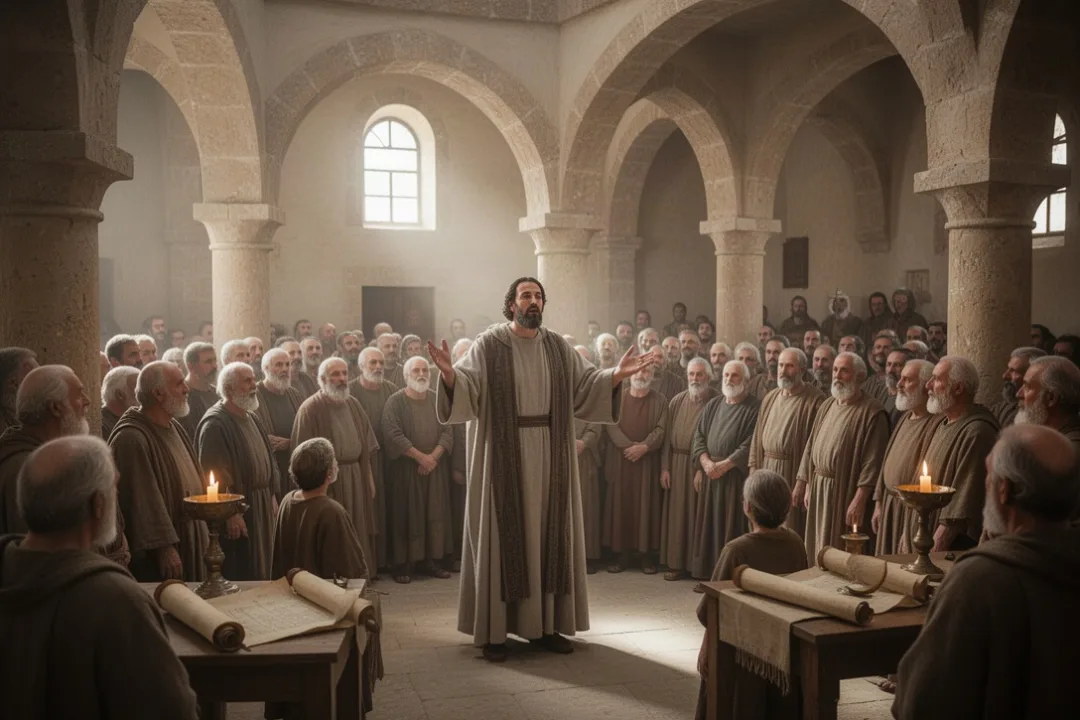
As a priest, John preached regularly in Antioch for roughly a dozen years. His reputation spread because he explained biblical passages in detail while also addressing the habits of ordinary believers. He spoke about attendance at worship, arguments within families, public celebrations, drinking, sexual morality, the treatment of servants, and the use of money.
The central picture: St. John Chrysostom was not only a gifted speaker. He was a pastor who believed that biblical faith had to become visible in daily choices, especially in how Christians treated vulnerable people.
In 398, John was appointed archbishop of Constantinople, the capital of the eastern Roman Empire. The position brought prestige but also placed him close to imperial power, court politics, wealthy patrons, and rival church leaders. His direct style, reforming efforts, and criticism of luxury quickly created opposition.
His conflict with powerful figures led to his removal and exile. Although he was briefly recalled, further disputes resulted in another exile. He died in 407 while being forced to travel to a remote location near Comana in Pontus. According to the traditional account, his final words were a prayer of thanksgiving to God.
How John Chrysostom became a famous preacher
John’s preaching was shaped by the Antiochene approach to Scripture, which generally emphasized the historical and literal meaning of biblical passages. He looked closely at the text, explained its setting, and then drew moral and spiritual implications for the congregation. His homilies often move from interpretation to practical correction.
He preached through substantial portions of individual biblical books rather than limiting himself to isolated sayings. Surviving homilies address Genesis, the Psalms, Matthew, John, Acts, Romans, First and Second Corinthians, Galatians, Ephesians, Philippians, Colossians, First and Second Thessalonians, Timothy, Titus, Philemon, and Hebrews, among other texts.
His method often followed a recognizable pattern:
Explain the passage: John clarified words, images, characters, and events in their biblical context.
Connect Scripture to life: He showed how the reading applied to worship, work, relationships, and public behavior.
Expose self-deception: He challenged listeners who claimed religious devotion while neglecting justice or mercy.
Call for a response: His sermons usually ended by directing hearers toward repentance, generosity, patience, or renewed faith.
John understood that a congregation included people at different stages of spiritual maturity. He sometimes used simple examples from household life, business, farming, or public events. At other times, he developed a theological argument at length. His sermons could be severe, but they also frequently emphasized God’s patience and the possibility of returning to a faithful life.
The title Golden-Mouthed reflects more than elegant wording. It points to the lasting impression of his voice as a preacher. John used repetition, contrasts, questions, dramatic appeals, and carefully arranged arguments. He could praise a virtue in one paragraph and then expose its opposite through a concrete example drawn from city life.
His homilies also preserve evidence of how late-antique Christian communities worshiped and argued. They reveal crowded urban congregations, disagreements about attendance, concern over public spectacles, and tension between Christian teaching and established social customs. They should not be read as neutral reports of every person’s behavior, since sermons are naturally shaped by a preacher’s concerns, but they remain valuable historical witnesses.
His approach to biblical interpretation
John resisted readings that treated every biblical detail as merely symbolic while ignoring the text’s historical sense. At the same time, he believed Scripture had a moral and spiritual purpose. For him, accurate interpretation was not an academic exercise detached from the congregation; it should help people recognize sin, understand God’s mercy, and practice wisdom.
He often explained why biblical figures were shown with weaknesses as well as strengths. Such portrayals, he argued, could encourage humility because Scripture does not present holiness as a performance without struggle. His treatment of biblical characters frequently highlights repentance, perseverance, and the consequences of pride.
John also stressed the role of the listener. A sermon could be carefully prepared, yet its benefit depended on whether hearers received it with attention and acted on it. He criticized people who praised eloquent preaching but did not allow Christian teaching to change their behavior.
What St. John Chrysostom taught about wealth and the poor
Concern for the poor stands among the most recognizable themes in John’s preaching. He repeatedly argued that possessions are not simply private matters. Wealth creates obligations, and Christians must consider whether their abundance exists alongside another person’s hunger, homelessness, illness, or lack of clothing.
John did not reduce generosity to occasional emotional charity. He connected care for the poor with the meaning of worship itself. A person could participate in religious ceremonies, make offerings, and speak piously while still failing to recognize Christ in people who needed help.
His sermons often challenge the display of luxury. He questioned the desire for lavish clothing, expensive furnishings, elaborate banquets, and costly entertainment when neighbors lacked basic necessities. The force of his argument comes from a reversal: wealth is not presented as proof of divine approval, and poverty is not treated as evidence of lesser human worth.
John’s teaching can be summarized through several recurring principles:
Possessions carry responsibility: Material resources should be used for the good of others, not only for personal comfort.
The poor possess dignity: People in need are not obstacles or nuisances but human beings who deserve respect and practical help.
Religious practice requires mercy: Prayer and worship cannot excuse cruelty, exploitation, or indifference.
Excess can conceal injustice: A comfortable lifestyle may depend on labor or resources that others are denied.
Generosity should be concrete: Christian compassion involves food, clothing, shelter, hospitality, and personal attention.
His language can be intense because he wanted wealthy Christians to see economic choices as spiritual choices. He did not speak about the poor only as recipients of kindness. He also criticized the social structures and attitudes that allowed people to remain comfortable while others suffered.
John’s teaching about money remains relevant because it asks questions beyond “How much should I give?” It asks how possessions were acquired, what needs are ignored, whether consumption is excessive, and whether generosity is offered with respect. His concern was not merely the amount of a donation but the moral condition of the giver and the well-being of the person receiving help.
A practical reading of his teaching: When St. John Chrysostom discusses charity, he usually means more than occasional giving. He points toward a pattern of life in which money, time, hospitality, and attention are deliberately directed toward human need.
He also addressed slavery and the unequal social order of his time. His sermons do not provide a modern political program, and they should be read within the world of the Roman Empire. Even so, his insistence that wealth must serve the vulnerable and that every person bears God-given dignity creates a serious challenge to exploitation and contempt.
John’s appointment to Constantinople placed him in a difficult position. The city’s archbishop was expected to interact with the imperial court, but John did not quietly accept the lifestyle and influence of powerful people. He attempted to reform the clergy, curb extravagance, and direct church resources toward people in need.
His criticism of luxury made enemies among members of the court and aristocracy. A major conflict developed with Empress Eudoxia, although the precise details and rhetoric surrounding their dispute have been shaped by later accounts. John’s public denunciations of corruption and excess were understood by some as attacks on the empress and her supporters.
He also faced opposition from other bishops. Critics accused him of acting harshly, exceeding his authority, and mishandling church affairs. A synod held at Chalcedon, commonly called the Synod of the Oak, condemned him in 403. Emperor Arcadius initially sent him into exile, but public unrest contributed to his return.
John continued to criticize what he considered injustice and improper influence. Another crisis followed, and he was removed again in 404. His supporters protested, and unrest affected the city. The emperor’s government then ordered him to leave Constantinople and placed him under guard.
The journey severely damaged his health. He was sent toward the eastern Black Sea region, but the destination was changed to Comana in Pontus. He died there in 407. Later, his remains were transferred to Constantinople during the reign of Theodosius II, an event that helped restore his public honor.
His exile is sometimes described simply as the result of courage, and there is truth in recognizing his willingness to criticize power. Yet the historical situation was more complicated. Ecclesiastical rivalries, imperial politics, accusations about administrative conduct, and disputes over public rhetoric all played a part.
What makes the episode significant is the relationship between pastoral authority and political power. John believed a bishop had a duty to correct wealthy and influential people, not flatter them. His opponents believed his methods were divisive or improper. The conflict shows how difficult it was for church leaders to serve congregations while operating within an imperial court system.
John’s own letters from exile express sorrow over separation from his church but also a determined confidence that circumstances cannot separate a Christian from God. The letters provide a more personal view of the bishop behind the public controversy. They discuss loneliness, fear, friendship, prayer, and the responsibility to remain steady under pressure.
St. John Chrysostom’s major writings and liturgical legacy
Much of John’s surviving work consists of homilies, or sermons delivered to Christian congregations. These writings are extensive and cover biblical interpretation, doctrine, ethics, pastoral care, and the life of the church. They are useful both for theology and for understanding the questions that confronted Christians in late-antique cities.
He also wrote treatises on the priesthood, virginity, marriage, repentance, prayer, suffering, and the Christian life. His work On the Priesthood is particularly influential. Presented as a dialogue, it explores the seriousness of pastoral ministry and the spiritual, intellectual, and moral demands placed on clergy.
John’s writings on the priesthood emphasize that Christian leadership is not a position for prestige. A priest or bishop must teach carefully, care for souls, withstand criticism, and avoid using sacred authority for personal advantage. His standards are demanding because he believed leaders could deeply affect the spiritual health of a community.
He also wrote extensively about marriage and family life. His advice often reflects the assumptions of his historical setting, so modern readers should distinguish enduring pastoral principles from ancient social expectations. Still, his emphasis on mutual responsibility, fidelity, patience, and the moral formation of children remains central to many readers.
John is closely associated with the Divine Liturgy of St. John Chrysostom, used widely in Eastern Orthodox and Byzantine Catholic churches. The name does not mean that John personally composed every part of the liturgy in its present form. Rather, the service developed through the worship tradition associated with Constantinople and was shaped over time, with John regarded as an important contributor and representative.
The liturgy attributed to him is celebrated on most Sundays and many feast days in churches of the Byzantine tradition. It includes prayers, Scripture readings, hymns, the creed, the Eucharistic prayer, and the distribution of Communion. Its association with John reflects his role as a preacher and pastor as well as the continuing memory of his ministry in Constantinople.
He is also associated with the Paschal Homily, traditionally read during Easter celebrations in Eastern Christian communities. The homily announces Christ’s victory over death and invites people to participate in the feast. Questions of authorship and transmission surround some texts connected with John, so individual works should be identified carefully rather than assumed to be securely his simply because tradition attaches his name to them.
His influence extends across Christian traditions. Eastern Orthodox Christians honor him as a hierarch and teacher. Byzantine Catholics use the liturgy associated with him, and many Western Christians read his biblical commentaries and sermons. His feast is observed on different dates in different calendars and traditions.
How to read St. John Chrysostom today
John’s work rewards readers who approach it with both appreciation and historical awareness. His explanations of Scripture can be clear, memorable, and spiritually demanding. At the same time, some passages reflect fourth-century assumptions about gender, Judaism, slavery, public behavior, and social hierarchy that require careful interpretation.
His polemics against Jews and Judaism are among the most serious problems in his legacy. Several homilies delivered at Antioch contain hostile language that contributed to anti-Jewish attitudes among later readers. These texts should not be excused or repeated uncritically. They must be studied in their historical setting while acknowledging the harm such rhetoric has caused and the responsibility of Christians to reject antisemitism.
Reading John responsibly involves holding several truths together:
His biblical insight can be substantial even when parts of his rhetoric are unacceptable.
His defense of the poor is forceful but belongs to a society very different from modern economic systems.
His conflict with authority is instructive without making every criticism of his opponents automatically correct.
His pastoral ideals are demanding and should not be separated from the limits of his historical context.
A good place to begin is with a selected collection of sermons rather than a large technical edition. Choose homilies on a biblical book, read the passage being discussed, and pay attention to how John moves from explanation to application. Then compare his concerns with your own community’s questions about wealth, worship, leadership, and responsibility.
Readers can also approach him through a reliable biography or an annotated translation. Notes are especially helpful for identifying ancient customs, imperial offices, theological controversies, and references to local events. Since many texts circulated in manuscript form and some works have uncertain attribution, scholarly introductions can prevent overconfidence about what John personally wrote or preached.
St. John Chrysostom’s continuing importance rests on the combination of eloquence, biblical seriousness, pastoral urgency, and moral courage. He believed Christian worship should reshape conduct, that leaders should be accountable, and that wealth should be measured by its service to human beings. His legacy is strongest when those convictions are examined honestly rather than separated from the difficult parts of his history.
Frequently asked questions
What does the name Chrysostom mean?
Chrysostom is a Greek title meaning “Golden-Mouthed.” It refers to John’s exceptional ability as a preacher and writer. The title was not his family name, but a description of the clarity, force, and beauty associated with his public speaking. His sermons were remembered for combining detailed biblical explanation with direct guidance about Christian conduct.
Was St. John Chrysostom the author of the Divine Liturgy?
The Divine Liturgy of St. John Chrysostom developed gradually within the worship tradition of Constantinople. John is strongly associated with its form and pastoral setting, but he did not compose every element of the service exactly as it is celebrated today. The title honors his influence and connection with the Byzantine liturgical tradition.
When is St. John Chrysostom’s feast day?
Many Eastern Christian churches commemorate St. John Chrysostom on November 13. He is also remembered on other days connected with the translation of his relics and with the Three Holy Hierarchs. Calendar practices differ between churches, so the local liturgical calendar is the best guide for a particular community.
What can modern readers learn from St. John Chrysostom?
His writings encourage close attention to Scripture, responsible leadership, practical care for the poor, and honesty about the gap between religious language and daily behavior. Modern readers should also assess his historical limitations, including hostile anti-Jewish rhetoric in some sermons, rather than treating every statement as suitable for imitation.










Leave a Reply