Saint Basil: Life, Teachings, Feast Day, and Legacy
Saint Basil: Life, Teachings, Feast Day, and Legacy
If you are searching for Saint Basil, you may be wondering whether he was a bishop, a monk, or the saint associated with a particular church tradition. The name most often refers to Basil of Caesarea, also called Basil the Great, a fourth-century bishop, theologian, monastic leader, and defender of Christian teaching.
Basil lived in Cappadocia, in what is now central Turkey, and became one of the most influential Christian leaders of the early church. He is remembered for explaining the church’s teaching about the Holy Trinity, organizing community life for monks, and insisting that care for poor and sick people belonged at the heart of Christian faith.
His life was brief—he died in 379—but his influence reached far beyond Caesarea. Eastern Orthodox, Byzantine Catholic, and other Christian communities honor him as a bishop and teacher of the church. Many Western Christians also remember him as one of the Cappadocian Fathers.
Who Saint Basil was and why he is called Basil the Great
Basil was born around 329 or 330 in Caesarea, the principal city of Cappadocia. He came from a devout Christian family that produced several notable religious figures, including his sister Macrina the Younger and his younger brother Gregory of Nyssa. Another brother, Naucratius, also pursued a life of Christian service.
His family background shaped Basil’s understanding of faith as something practiced in ordinary responsibilities, not only discussed in schools or churches. The family cared for the vulnerable, pursued disciplined prayer, and treated learning as a means of serving God and neighbor.
Basil received an excellent education. He studied in Caesarea and later in Constantinople and Athens, where he became acquainted with Gregory of Nazianzus. His education included rhetoric, philosophy, medicine, law, and literature. Although he was highly trained in classical learning, he eventually turned away from a conventional professional career and directed his abilities toward Christian ministry.
For a time, Basil worked as a teacher of rhetoric. His sister Macrina challenged him to take his religious commitments more seriously, and he later described this period as a turning point. He was baptized and traveled through parts of Egypt, Syria, Mesopotamia, and Palestine to observe Christian ascetics and learn from their communities.
When Basil returned to Cappadocia, he established a disciplined Christian community near the Iris River. Macrina had already helped form a community for women nearby. Basil’s approach to monastic life emphasized prayer, work, study, hospitality, and service rather than isolation for its own sake.
What “the Great” means: The title honors Basil’s lasting importance as a theologian, bishop, preacher, and organizer of Christian communities. It does not mean that every later tradition uses the title in exactly the same way.
Basil became a priest and later succeeded Eusebius as bishop of Caesarea in 370. As bishop, he combined theological leadership with practical action. He preached against greed, defended Christian teaching during disputes, supported clergy, helped organize charitable care, and confronted political pressure when he believed the church’s beliefs were at stake.
His health was often poor, and his responsibilities were demanding. Basil died on January 1, 379, probably in his late forties. His early death did not end his influence. His letters, sermons, theological works, and monastic writings continued to shape Christian communities for centuries.
Saint Basil’s teaching about the Trinity and the Holy Spirit
Much of Basil’s theological importance comes from his defense of the church’s teaching about the Father, Son, and Holy Spirit. In the fourth century, Christians disagreed sharply about how the Son and the Holy Spirit related to the Father. These debates affected worship, baptism, preaching, and the church’s understanding of God.
Basil argued that the Son is truly divine and that the Holy Spirit also belongs within the divine life. His major work On the Holy Spirit responds to people who treated the Holy Spirit as less than fully divine. Basil did not rely only on abstract argument. He pointed to the church’s baptismal practice, prayers, doxologies, and the witness of Scripture.
His writing helped Christians express a distinction that later became central to orthodox Trinitarian language: God is one essence or nature, existing as three persons. Basil used careful theological terms because vague language could lead to very different beliefs about whether the Son or Spirit was truly divine.
Basil also worked closely with Gregory of Nazianzus and other leaders who defended Nicene Christianity. Their efforts supported the teaching associated with the Council of Nicaea, which had affirmed the full divinity of the Son. Basil’s contribution was especially significant in clarifying the place of the Holy Spirit in the church’s worship and doctrine.
His method was both precise and pastoral. He believed theology should protect the meaning of Christian worship. If Christians baptized and prayed in the name of the Father, Son, and Holy Spirit, then their language about God needed to reflect the unity and divine dignity of all three.
Basil also drew attention to the way Christians should read Scripture. He encouraged believers to seek both the plain meaning of biblical passages and the spiritual wisdom they offer, while avoiding careless interpretations that contradict the broader faith of the church. His approach valued disciplined study rather than speculation detached from worship and moral life.
In his homilies on creation, Basil reflected on the opening chapters of Genesis. These sermons, known as the Hexaemeron, consider the created world, human responsibility, and the goodness of what God has made. Basil was interested in the natural world as a source of wonder and as a subject that could be examined thoughtfully.
He did not treat Christian faith and learning as enemies. Instead, he urged Christians to use education wisely, much as a person selects useful fruit from a tree. Classical literature could form character when read with judgment, but knowledge without virtue could become a source of pride.
How Saint Basil shaped monastic life and Christian community
Saint Basil is one of the most important architects of Eastern Christian monasticism. He did not create monasticism from nothing; ascetic communities already existed in Egypt, Syria, and other regions. His distinctive contribution was to give communal monastic life a practical, theological, and pastoral structure.
Basil questioned the value of extreme individualism when it prevented people from practicing love. A hermit living alone might pursue intense prayer, but a community offered regular opportunities to show patience, generosity, forgiveness, and responsibility. For Basil, these relationships were not distractions from holiness. They were where Christian love could be tested and made visible.
His monastic guidance is preserved especially in collections often called the Longer Rules and Shorter Rules. These writings are presented largely as questions and answers about Christian living. They address prayer, work, obedience, possessions, correction, relationships, hospitality, and the care of people in need.
Basil’s ideal community was not simply a place where people withdrew from society. It was meant to become a center of prayer and service. Monks worked, studied Scripture, welcomed guests, and assisted the poor. Their way of life was organized around shared responsibilities rather than personal prestige.
Prayer: The community prayed regularly and grounded its life in Scripture.
Work: Members contributed through useful labor instead of depending on others unnecessarily.
Shared possessions: Personal wealth was not treated as the measure of status or security.
Hospitality: Visitors and people in distress were received as neighbors deserving care.
Discipline: Correction aimed at healing and spiritual growth rather than humiliation.
Basil’s monastic rules influenced Eastern Orthodox communities for centuries. They also shaped later discussions about Christian community in the West. Unlike a code that answers every possible situation, Basil’s guidance gives principles for building a community where prayer and service support one another.
His understanding of poverty was particularly demanding. Basil argued that possessions are not merely private matters when others lack basic necessities. A person who has more food, clothing, or money than needed has a responsibility toward those who are hungry, exposed, or unable to support themselves.
In a homily on wealth, Basil uses strong language to challenge people who store up resources while others suffer. He interprets the earth’s goods as gifts that carry social obligations. His point is not that every possession is automatically wrong, but that wealth becomes morally serious when it is held without regard for human need.
Basil’s practical test for Christian wealth: Ask not only what you own, but whether your use of money leaves room to respond to people who lack food, shelter, medical care, or dignity.
Saint Basil’s work for the poor, sick, and displaced
Basil’s concern for the poor was expressed through organized service. Near Caesarea, he helped develop a large charitable complex known as the Basileias. Later writers described it as a place that served people who were sick, poor, homeless, or otherwise in need of protection.
The Basileias included care for people with serious illnesses, including leprosy, as well as support for travelers, the elderly, and those without resources. It is sometimes described as an early hospital, although the modern hospital system did not yet exist in the same form. The safest description is a broad Christian center of mercy and care.
This work reflected Basil’s belief that the church should not limit itself to preaching about compassion. Christian communities needed structures that addressed hunger, illness, homelessness, and abandonment. Prayer and practical care belonged together.
He also preached directly about economic injustice. In one well-known sermon on famine, Basil criticized people who hoarded grain while neighbors faced starvation. He treated food as a basic gift and warned that fear, greed, and private accumulation could turn a crisis into a disaster for the vulnerable.
Basil’s preaching often gives the reader a moral question rather than a comfortable general principle. If you have extra clothing and someone nearby lacks clothing, he asks, what does that surplus mean? If you have more food than you can use while another person is hungry, can you honestly claim that your possessions are entirely private?
His language can feel severe because he viewed indifference as a serious spiritual failure. He did not separate love of God from treatment of the poor. For Basil, worship that ignored suffering around it was incomplete.
His charitable work also shows that Christian service requires organization. Good intentions alone cannot feed large numbers of people, care for patients, or provide safe lodging. Basil helped create a community with workers, supplies, buildings, and responsibilities so that mercy could become reliable rather than occasional.
Modern charities, hospitals, and churches do not simply reproduce the Basileias. Medical knowledge, social services, and public institutions have changed greatly. Even so, Basil’s example remains relevant because it connects personal generosity with communal responsibility.
Saint Basil’s writings and the Divine Liturgy associated with him
Basil left a substantial body of writings. His works include theological treatises, sermons, letters, monastic instructions, and guidance for Christian communities. His letters are especially valuable because they show him responding to disputes, illness, church politics, family concerns, and the everyday problems of clergy and believers.
Among his best-known works are On the Holy Spirit, the Hexaemeron, and the rules for monastic communities. His sermons on wealth and famine continue to be read because they address questions that remain recognizable: What do people owe one another? How should money be used? What responsibilities come with abundance?
Many Christians also associate Basil with the Divine Liturgy of Saint Basil the Great. In Eastern Orthodox and Byzantine Catholic worship, this liturgy is celebrated on particular days rather than every Sunday. The exact calendar varies by tradition, but it is commonly used during parts of the Advent and Christmas season, on certain Sundays of Lent, Holy Thursday, Holy Saturday, and the feast of Saint Basil.
The liturgy attributed to Basil is longer than the Divine Liturgy of Saint John Chrysostom, which is more frequently celebrated in Byzantine churches. Its prayers give extended attention to God’s work in creation, salvation, the church, and the human response to divine mercy.
Scholars and church traditions understand Basil’s role in different ways. He likely helped shape and refine the liturgical tradition associated with his name, but the complete form used today developed over time. “Liturgy of Saint Basil” therefore does not necessarily mean that Basil personally wrote every word exactly as it now appears.
For worshippers, the liturgy is a living expression of Basil’s theology. It joins praise with repentance, the mystery of Christ with care for the world, and the church’s prayer with hope for human transformation. Its extended prayers reflect the seriousness and breadth associated with Basil’s teaching.
When Saint Basil is celebrated and what his symbols mean
Saint Basil’s feast day is commonly observed on January 1 in Eastern Christian traditions. In the Roman Catholic calendar, Basil is generally commemorated on January 2, together with Saint Gregory Nazianzen. Local churches may observe additional dates or special services connected with his life and writings.
The January 1 celebration has particular significance in Byzantine Christianity because it falls on the same day as the civil New Year in many places. In Greek tradition, Saint Basil is also associated with gift-giving during the New Year season. The custom connects generosity, hospitality, and remembrance of a bishop known for serving people in need.
In some countries, a New Year cake called vasilopita is prepared in his honor. A coin may be hidden inside the cake, with the person who finds it receiving a blessing or good fortune for the coming year. Customs differ from family to family, and the practice is cultural as well as religious.
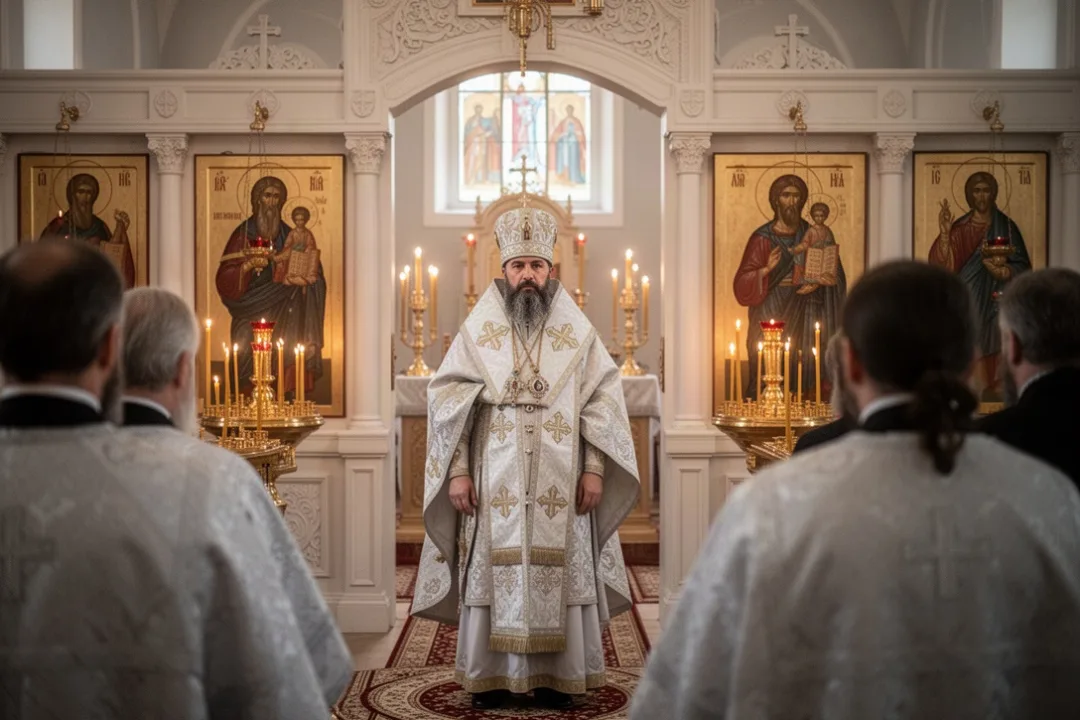
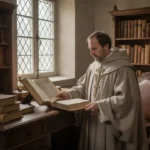
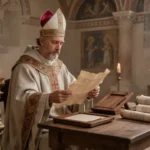
Saint Basil is usually portrayed in the vestments of a bishop. Common elements include a long beard, a book, and pastoral clothing. The book points to his role as a theologian and teacher, while the bishop’s garments represent his leadership of the church in Caesarea.
He may also be shown with imagery connected to monastic life or charitable care. Unlike saints known primarily through one dramatic event, Basil’s visual identity comes from a life of teaching, administration, prayer, and service.
People may turn to Saint Basil when seeking guidance about responsible leadership, Christian education, monastic discipline, the dignity of poor people, or the relationship between worship and practical service. His example does not reduce charity to occasional donations. It asks how families, churches, and communities can arrange their lives so that vulnerable people are not forgotten.
Read one of Basil’s sermons about wealth and ask how it applies to your own spending.
Learn about the charitable work of a local church or community organization.
Pray for people who are sick, displaced, hungry, or isolated.
Use the New Year season to practice hospitality or make a purposeful gift.
Study a reliable explanation of the Trinity alongside the church’s prayers and worship.
Saint Basil remains significant because his faith was both intellectually serious and visibly practical. He defended precise Christian teaching, formed communities of prayer, and built systems of care for people who had little protection. His legacy asks churches and individuals to hold those responsibilities together: think clearly, worship faithfully, and serve generously.
Frequently asked questions
Is Saint Basil the same person as Saint Basil of Ostrog?
No. Saint Basil the Great usually means Basil of Caesarea, the fourth-century bishop and theologian. Saint Basil of Ostrog was a much later Serbian Orthodox bishop and hermit from the seventeenth century. They are separate saints with different lives, feast traditions, and places of veneration.
What is Saint Basil the patron saint of?
There is no single universally accepted patronage list for Basil the Great. He is especially associated with bishops, theologians, monks, Christian teachers, hospitals, charitable work, and people who serve the poor. These connections come from his ministry, writings, monastic guidance, and organization of care for vulnerable people.
Did Saint Basil write the entire Divine Liturgy named after him?
Church tradition connects Basil with the Divine Liturgy of Saint Basil the Great, but the form used today developed over time. He likely helped shape its theological and liturgical tradition rather than writing every current word as a complete, unchanged text.
Why is Saint Basil celebrated on New Year’s Day?
Eastern Christian traditions commonly celebrate Basil on January 1, the date associated with his death. Because the feast coincides with New Year’s Day, some cultures connect him with hospitality, charity, and gift-giving. In parts of the Greek world, families honor him through vasilopita, a New Year cake made for the occasion.












Leave a Reply