St. Wolfgang: the saint, feast day, and places named for him
St. Wolfgang: the saint, feast day, and places named for him
If you have seen the name St. Wolfgang on a church, a calendar, or a travel map, you may wonder whether it refers to a saint, a town, or both. The answer is both: Saint Wolfgang of Regensburg was a 10th-century bishop and missionary, while several places in Central Europe took their names from his religious legacy.
Wolfgang is remembered for combining prayer, learning, pastoral care, and practical reform. He served as bishop of Regensburg in present-day Germany, supported religious education, and became associated with the spread of Christianity in neighboring regions. His feast day is October 31, and he is especially honored in Bavaria, Austria, and parts of Central Europe.
Quick distinction: “St. Wolfgang” may mean the historical bishop, the Austrian lakeside town of St. Wolfgang im Salzkammergut, or the wider pilgrimage tradition surrounding Wolfgangsee. These connections come from the same medieval saint.
St. Wolfgang was born around 934 in the region of Swabia, an area that now lies in southern Germany. Medieval records describe him as a well-educated Christian who received training in the liberal arts and theology before entering church service. His education shaped the way he approached ministry: he regarded learning as a tool for forming responsible clergy and strengthening Christian communities.
Wolfgang first became known through his work as a teacher and church leader. He was connected with important religious centers, including the monastery of Reichenau and the cathedral school at Trier. These institutions were influential places of study, and his experience there prepared him for the demanding responsibilities he would later take on as a bishop.
He eventually entered the Benedictine community at Einsiedeln, in present-day Switzerland. There he developed a reputation for discipline and spiritual seriousness. Rather than treating religious office as a position of prestige, he emphasized personal devotion, community order, and service to others.
In 972, Wolfgang became bishop of Regensburg. Regensburg was one of the major political and religious centers of the medieval German lands, so the office carried considerable responsibility. A bishop in that period was expected to oversee clergy, churches, schools, monasteries, charitable work, and relationships with rulers and neighboring territories.
Wolfgang’s episcopate is associated with reforms intended to improve the quality of religious life. He supported better education for clergy and worked to strengthen discipline within church institutions. He also supported the independence of the Diocese of Prague, a decision that helped establish a separate church structure in Central Europe.
His reputation did not rest only on administrative decisions. Stories about Wolfgang present him as a humble and conscientious shepherd who cared about ordinary people. As with many medieval saints, later accounts include miracles and dramatic episodes, but the central picture is consistent: he was remembered as a bishop who connected intellectual formation with practical service.
St. Wolfgang’s life as a bishop and missionary
Wolfgang lived during a period when Christian institutions were expanding and changing across Central Europe. Missionary work was not limited to preaching in a single village. It could involve founding or supporting churches, training clergy, negotiating with rulers, organizing dioceses, and helping communities adopt Christian practices.
Tradition links Wolfgang with missionary activity in the region east of Bavaria, including areas connected with present-day Hungary. He did not work in isolation. Medieval evangelization depended on networks of monks, priests, teachers, local leaders, and communities. His role was part of a broader effort to build stable Christian institutions.
As bishop of Regensburg, he faced questions that still sound familiar: how should religious leaders be educated, how can institutions remain faithful to their purpose, and how should spiritual ideals be applied to everyday problems? His response emphasized formation rather than display. A healthy church, in his view, required capable teachers, disciplined leaders, and care for people in need.
One reason Wolfgang remained influential is that medieval accounts portray him as willing to give up authority when doing so served the church. The story of his support for Prague’s independence reflects a broader principle: church leadership was not meant to preserve personal power. He could accept a reduction in his own jurisdiction if it helped another Christian community develop appropriately.
His connection with the Salzkammergut region is especially important to later devotion. According to tradition, Wolfgang withdrew for a time to the area around what is now Wolfgangsee. Stories say he lived as a hermit near the lake and that his preaching and presence helped inspire a local pilgrimage tradition.
Some details in these accounts belong to devotional tradition rather than securely documented biography. That distinction does not make them irrelevant. Legends often explain why a landscape, church, or pilgrimage site became associated with a saint, while historical records provide the firmer outline of his life.
Late in life, Wolfgang traveled toward the eastern part of his diocese. He became ill and died at Pupping, in present-day Upper Austria, in 994. His body was later taken to Regensburg, where he was buried at St. Emmeram’s Abbey. The shrine became an important place of veneration.
What St. Wolfgang is known for in Christian tradition
Devotion to Wolfgang focuses on several qualities rather than one single event. He is remembered as a teacher, bishop, missionary, reformer, and monk. These roles are often shown together in religious art, where he may appear wearing episcopal vestments, holding a model of a church, or carrying symbols connected with his legends.
His life is often presented as an example of responsible leadership. Wolfgang held a powerful ecclesiastical office, yet devotional stories emphasize his humility and willingness to serve. That combination has made him meaningful to people who see Christian authority as a duty rather than a privilege.
He is also associated with education and clergy formation. His own background in schools and monasteries influenced his approach as bishop. For this reason, churches and institutions dedicated to him may emphasize study, preaching, teaching, and the careful preparation of religious leaders.
Another theme is reform. In medieval church history, reform could mean restoring discipline, improving standards, correcting abuses, or returning an institution to its religious purpose. Wolfgang’s reputation reflects this practical understanding of renewal. His example suggests that reform begins with habits, training, accountability, and steady work rather than impressive public gestures.
Legends about Wolfgang often include a devil, an axe, or a church-building miracle. One well-known story says that he threw an axe and agreed to build a church wherever it landed. This legend is connected with the church at St. Wolfgang on the shore of Wolfgangsee. Artistic representations sometimes show the saint holding an axe as a reference to the story.
The axe should not be read as a simple historical tool or as proof that Wolfgang worked as a builder. It is primarily a devotional symbol. In art, it can represent the founding of a church, the taming of disorder, or the saint’s link with the local landscape and pilgrimage tradition.
Wolfgang’s image may also include a bishop’s staff, a church model, a book, or a small figure associated with a miracle story. The exact combination varies by region and period. If you see a bishop holding an axe in a medieval or Baroque church, the image may be intended to identify St. Wolfgang.
St. Wolfgang’s feast day, symbols, and patronage
The feast day of St. Wolfgang is October 31. It falls on the eve of All Saints’ Day, which is observed on November 1. Churches and communities dedicated to him may mark the date with Mass, processions, special prayers, music, or local celebrations.
Feast days are more than historical anniversaries. They give a community a regular opportunity to remember a saint’s example and connect it with present life. A celebration of Wolfgang may highlight faithful leadership, education, service, and perseverance, especially in places where his name has been part of local identity for centuries.
He is traditionally regarded as a patron of several groups and needs. The lists differ somewhat between regions, but commonly associated areas include:
Carpenters and woodworkers, partly because of the axe associated with his legend.
Woodcutters and laborers, reflecting the practical imagery connected with forests and tools.
Shepherds and rural communities, especially in Alpine regions where his devotion became established.
People suffering from paralysis or certain illnesses, because of healing traditions attached to his intercession.
Churches and communities seeking good leadership, because of his work as a bishop and reformer.
Patronage should be understood as a relationship of prayer and remembrance, not as a guarantee of a particular outcome. Catholics and other Christians who ask for a saint’s intercession are asking the saint to pray with them and for them before God. Different regions may preserve different customs, prayers, or needs associated with Wolfgang.
The saint’s symbols also help explain why his devotion has lasted. The bishop’s staff points to his office; the book points to teaching and learning; the church model points to Christian community; and the axe points to the story of the church at Wolfgangsee.
If you are looking for a St. Wolfgang medal, statue, or church image, these symbols can help you identify him. He is generally shown as a bishop, often with a short beard and episcopal clothing, although artistic details differ. The presence of an axe or church model is especially useful when distinguishing him from other bishops named Wolfgang.
For prayer or reflection: St. Wolfgang’s example is especially fitting when you are thinking about responsible leadership, teaching, church service, perseverance in difficult work, or the needs of rural communities.
St. Wolfgang im Salzkammergut and Wolfgangsee
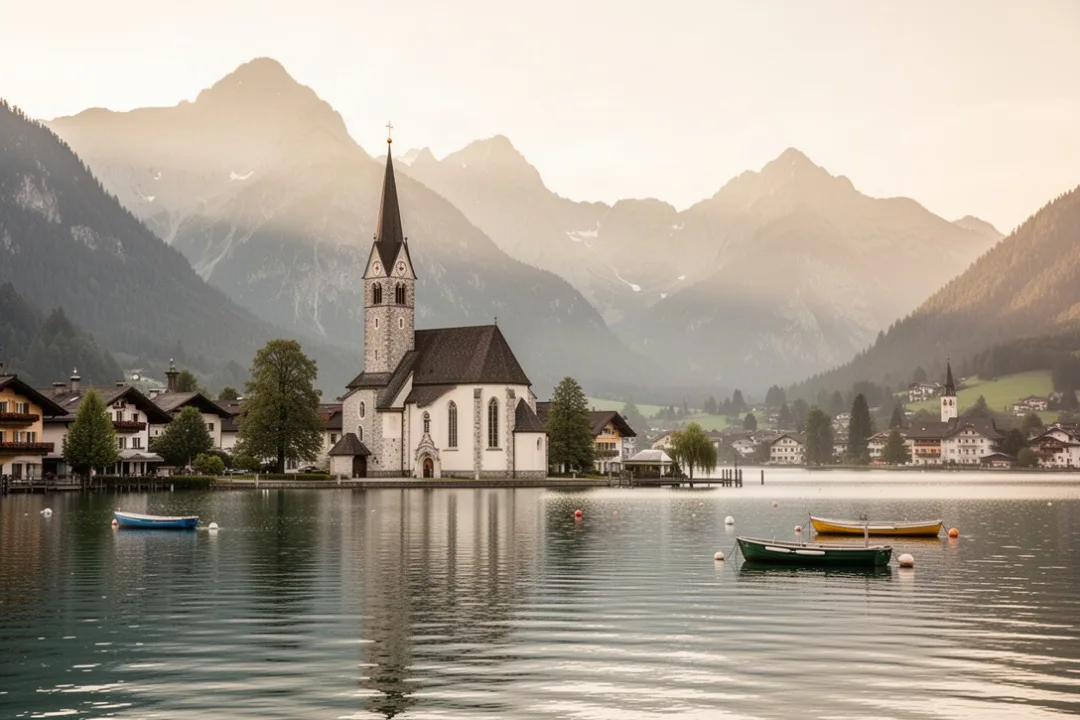
One of the best-known places connected with the saint is St. Wolfgang im Salzkammergut, a town in Austria on the northern shore of Wolfgangsee. It is a historic lakeside community in the Salzkammergut, a region known for mountains, lakes, villages, and long-standing religious and cultural traditions.
The town was formerly known as Abersee and developed around the pilgrimage church dedicated to St. Wolfgang. Its location matters because medieval pilgrims often traveled to places associated with a saint’s life, relics, miracles, or local legends. Over time, the church and settlement became closely identified with Wolfgang’s name.
The Church of St. Wolfgang is particularly important for its art and pilgrimage history. It contains the famous late Gothic winged altar made by Michael Pacher, completed in the 15th century. The altarpiece is recognized for its detailed carving, painting, and ambitious presentation of scenes connected with Christian worship and the life of Christ.
The church also preserves the atmosphere of a working pilgrimage site rather than a monument detached from local life. Visitors may come for art and architecture, while residents and pilgrims may come for worship, personal prayer, or feast-day traditions. That combination is common in European pilgrimage churches.
Wolfgangsee itself was named in connection with the saint. The lake’s name is therefore not a separate reference to a modern figure or a local ruler. It reflects the strength of the pilgrimage tradition around the church and the settlement that grew beside it.
Visitors who want to understand the site should look beyond the scenery. The lake, church, town, and surrounding mountains form a cultural landscape shaped by religious travel, medieval storytelling, local craftsmanship, and Alpine geography. The saint’s identity is inseparable from that landscape.
A visit can include several different interests:
Religious history: explore the pilgrimage church and its connection with medieval devotion.
Art: study the Pacher altar and the church’s other works of sacred art.
Architecture: observe how the church and town developed around a longstanding pilgrimage route.
Landscape: see how the lake and mountains shaped local traditions and travel.
Living worship: attend a service respectfully if the church is open for prayer and liturgy.
Opening hours, worship schedules, transportation, and access arrangements can change by season. If you are planning a visit, check current local information before traveling, especially if your purpose is to attend a feast-day service or view a specific church interior.
You do not need to live near Wolfgangsee or belong to a church named for him to draw on his example. A simple prayer can focus on the needs that his life represents: wisdom for leaders, patience in teaching, courage to reform what is unhealthy, and compassion for people who are sick or vulnerable.
Some people use a traditional prayer to ask for St. Wolfgang’s intercession. Others prefer a quiet period of reflection based on one quality from his life. The form matters less than sincerity and attention. A prayer may be short, especially when you are praying during an ordinary workday or while facing a difficult decision.
You might structure personal prayer in these steps:
Name the concern: describe the person, community, responsibility, or decision that needs help.
Recall Wolfgang’s example: consider his dedication to learning, reform, service, or pastoral care.
Ask for a specific virtue: request wisdom, courage, humility, patience, or compassion.
Choose one practical action: identify something you can do today that reflects the prayer.
End with gratitude: give thanks for guidance, support, or the people who help you.
For someone responsible for a school, parish, business, or community group, Wolfgang’s story can prompt questions about the purpose of leadership. Are people being prepared well? Are decisions serving the community rather than personal status? Are problems being addressed honestly and patiently?
For someone who teaches, studies, or works in ministry, his life highlights the value of careful preparation and lifelong learning. For someone dealing with illness, his patronage offers a traditional way to seek comfort while also encouraging practical medical and personal support.
Prayer to a saint does not replace medical care, professional advice, or responsible action. If you are dealing with paralysis, another serious illness, or a mental health crisis, seek qualified help promptly. Religious devotion can accompany care, but it should not be used instead of it.
St. Wolfgang’s enduring appeal comes from the way several parts of Christian life meet in his story: study and prayer, authority and humility, local tradition and wider mission, spiritual ideals and ordinary work. That is why his name can refer not only to a figure from medieval history, but also to churches, towns, families, and communities that continue to remember him.
Frequently asked questions
When is St. Wolfgang’s feast day?
St. Wolfgang’s feast day is October 31. Churches and communities connected with him may observe it with worship services, processions, prayers, music, or local customs. Because the date falls immediately before All Saints’ Day on November 1, celebrations may be part of a broader period of remembrance honoring Christian saints.
Where is St. Wolfgang buried?
St. Wolfgang was buried at St. Emmeram’s Abbey in Regensburg, Germany, after his death in 994. The abbey became an important place of devotion because of his tomb and relics. The historic site is now associated with the Basilica of the Nativity of Our Lady and St. Emmeram.
Is St. Wolfgang the patron saint of carpenters?
He is traditionally associated with carpenters, woodworkers, and woodcutters. The connection comes largely from the axe shown in his religious imagery and from the legend that links him with the founding of the church at St. Wolfgang on Wolfgangsee. Patronage lists can vary depending on local tradition.
What country is the town of St. Wolfgang in?
St. Wolfgang im Salzkammergut is in Austria, on the shore of Wolfgangsee in the Salzkammergut region. The town grew around a pilgrimage church dedicated to St. Wolfgang. Its historic church, religious art, lake setting, and connection with medieval pilgrimage make it one of the best-known places bearing the saint’s name.










Leave a Reply