Saint Boniface: life, mission, feast day, and legacy
Saint Boniface: life, mission, feast day, and legacy
Saint Boniface was an eighth-century English Benedictine monk and missionary who helped organize Christianity across parts of present-day Germany. Born Wynfrith or Winfrid in the kingdom of Wessex, he became known as Boniface after Pope Gregory II commissioned him to preach in Germanic territories.
He is remembered as the apostle of Germany, although his work extended through several regions and involved preaching, founding monasteries, training clergy, and reforming church life. His feast day is June 5, the date traditionally associated with his martyrdom near Dokkum in Frisia around 754.
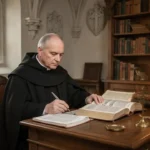
Boniface was born around 675 in Crediton, in Devon, England. His original name is usually given as Wynfrith, Wynfred, or Winfrid because medieval spellings varied. He entered monastic life, studied Scripture and Christian teaching, and was ordained a priest before leaving England for missionary work on the European mainland.
His importance came from more than the number of people he baptized. Boniface worked to create a stable church structure in areas where Christian practice was mixed with older local religious customs. He established monasteries, appointed bishops, encouraged disciplined pastoral care, and kept in contact with the papacy and rulers.
The title apostle of Germany is a traditional description rather than a claim that he single-handedly converted all of Germany. Christianity had reached some Germanic communities before his arrival, and other missionaries worked in the same broad regions. Boniface’s distinctive contribution was the organization and reform of churches across central Europe.
At a glance: Saint Boniface was an English missionary bishop, church reformer, monastery founder, and martyr whose ministry connected local churches in central Europe more closely with Rome.
Saint Boniface’s life in chronological order
Birth and education: He was born in Devon around 675 and received a monastic education in England.
Ordination: He became a priest and developed a reputation for learning and preaching.
First missionary effort: He traveled to Frisia in the early eighth century, though political conflict limited that first attempt.
Roman commission: Pope Gregory II authorized him to continue missionary work and gave him the name Boniface.
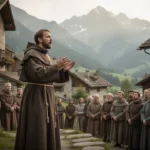
Preaching and church building: He worked in Hesse, Thuringia, and neighboring territories, building communities and strengthening their clergy.
Episcopal leadership: He became a bishop and later archbishop, taking responsibility for wider church administration.
Monastic foundations: He supported monasteries that became centers of prayer, education, manuscript work, and missionary training.
Martyrdom: He and his companions were killed in Frisia, traditionally dated to June 5, 754.
This sequence shows why his legacy includes both missionary courage and institutional work. He was not only a traveling preacher. Much of his influence came from the networks of clergy and monasteries that continued after his death.
Why Boniface left England for the continent
Boniface grew up in a Christian society with established monasteries and schools, but he chose a difficult life abroad. Medieval missionary work involved long travel, uncertain political conditions, language barriers, and the need to build trust with local communities. His decision reflected a common monastic ideal: to serve the church beyond the place where one had been educated.
His first recorded missionary journey to Frisia did not achieve much because of conflict involving the Frisian ruler Radbod and the Frankish kingdom. Boniface returned to England for a time, but he did not abandon the idea of missionary work. He later traveled to Rome, where the pope gave him formal authority for his mission.
That papal connection shaped his career. Boniface could present himself not simply as an independent preacher but as a representative of the Roman church. He also reported on conditions, requested guidance, and sought support for appointing trustworthy leaders.
Where Saint Boniface carried out his mission
Boniface’s work took place across a wide area rather than in one modern nation. Political boundaries in the eighth century did not match present-day borders, and the phrase “Germany” can make his geographical setting seem more uniform than it was.
Frisia: This coastal region, corresponding broadly to parts of the modern Netherlands and northwestern Germany, was connected with both his early mission and his death.
Hesse: Boniface preached and organized churches in central Germany. The story of the oak at Geismar is associated with this region.
Thuringia: He worked to strengthen Christian teaching and address problems among clergy and communities.
Bavaria: His influence reached church organization in Bavaria, even though other Christian workers and local leaders also played important roles there.
Mainz: He served as archbishop of Mainz, one of the major ecclesiastical centers of the Frankish world.
Fulda: The monastery founded by his disciple Sturmi became one of the most important institutions connected with Boniface’s mission.
These places should not be understood as areas converted overnight. Christianization was gradual, uneven, and often shaped by local rulers, existing Christian communities, and the quality of pastoral leadership available after a missionary had moved on.
What the oak at Geismar means
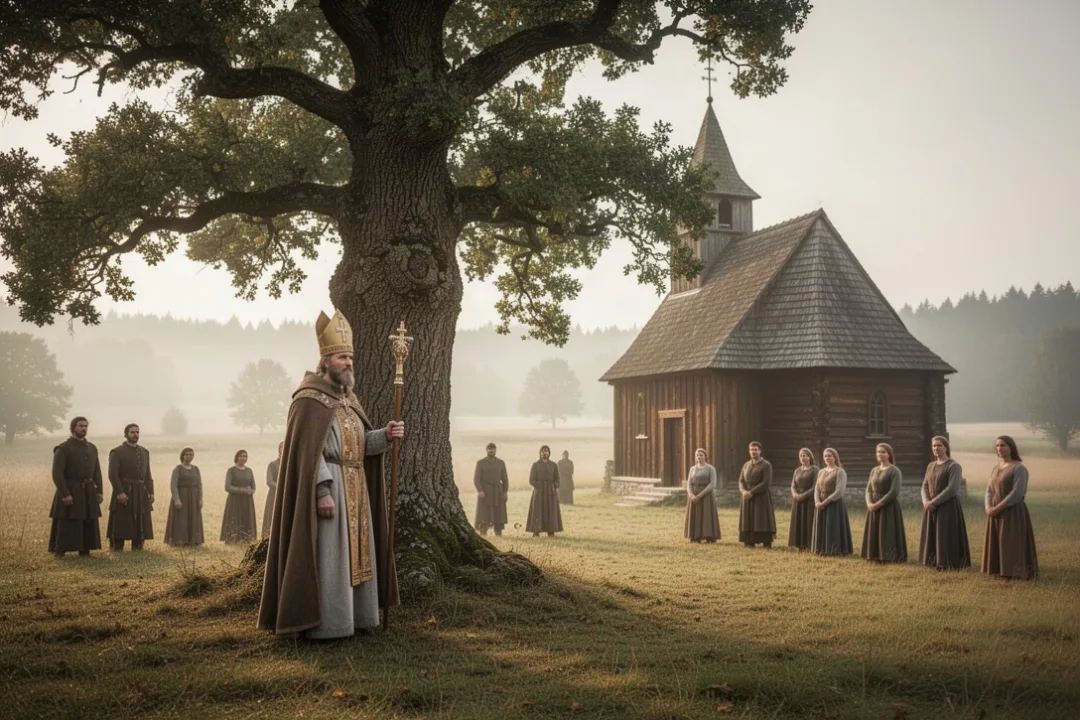
The best-known story about Boniface concerns the Donar Oak, also called the Thor Oak, at Geismar. According to the account written about his life, Boniface cut down a tree associated with the Germanic god Donar to demonstrate that it had no power to prevent its destruction. The episode is often presented as a dramatic turning point in the Christian mission.
The story comes from a medieval biography and became central to Boniface’s popular image. It should be read with care. The surviving account has a religious purpose: it portrays the Christian God as stronger than the local deity and explains why a Christian church was built from, or near, the place connected with the tree.
The event also raises a wider question about missionary methods. Boniface’s preaching challenged established religious practices directly, while his monasteries and clergy offered an alternative community structure. For modern readers, the oak can symbolize his rejection of pagan worship, but it should not erase the complexity of the people and cultures he encountered.
How to describe the oak story accurately: Say that Boniface is traditionally reported to have felled the Donar Oak at Geismar. The episode is preserved in a medieval biography and is central to his legend, but the source should not be treated like a modern eyewitness report.
How Boniface changed church life
Boniface’s work involved church reform as much as conversion. He was concerned about poorly trained clergy, irregular religious practice, and church leaders whose conduct did not match their responsibilities. His letters show a continuing interest in education, discipline, authority, and cooperation between local churches and Rome.
He helped organize church councils and supported the appointment of bishops who could provide consistent leadership. He also promoted standards for clerical life and encouraged the teaching of Christian doctrine. These efforts were part of a broader reform movement in the Frankish kingdoms, where political and religious structures were closely connected.
His reforming work could create tension. Local customs, established leaders, and competing authorities did not always welcome outside oversight. Boniface’s correspondence sometimes reflects frustration with resistance and with the practical difficulties of managing distant communities.
Even so, his work had a long institutional effect. A church could survive beyond the lifetime of a traveling missionary only if it had priests, places of worship, teachers, economic support, and recognized leadership. Boniface invested in those foundations.
Why monasteries mattered to Boniface’s mission
Monasteries served as more than quiet places for prayer. In the eighth century, they could function as schools, farms, libraries, guest houses, and training centers. They gave missionaries a base from which to travel and provided communities with a regular rhythm of worship.
Boniface was connected with several foundations, including monasteries associated with Fritzlar, Amöneburg, Tauberbischofsheim, and Fulda. Some were founded directly under his leadership, while others were established or developed by his associates. The exact role of each foundation differed, but together they helped form a durable church network.
Fulda became especially important. Boniface entrusted its development to Sturmi, one of his disciples, and the monastery later became a major center of learning and remembrance. Its connection with Boniface made it a place where his missionary vision could be preserved and expanded.
Prayer: Monastic communities maintained regular worship and remembrance of the dead.
Education: Monks taught Scripture, liturgy, Latin, and practical skills needed by clergy.
Mission support: Monasteries supplied personnel and resources for outreach.
Record keeping: Written documents helped preserve teaching, correspondence, and institutional memory.
Local stability: A permanent community gave Christianity a visible presence after a missionary left.
Boniface’s relationship with Rome and the Frankish rulers
Boniface worked within two important spheres of authority: the papacy and the Frankish political world. His papal commission gave his mission legitimacy, while cooperation with rulers made travel, property arrangements, and church organization more practical.
He had connections with the Carolingian family, including Charles Martel and later Carloman and Pepin. These leaders controlled territory and could provide protection or support for ecclesiastical reforms. Their political goals and Boniface’s religious goals sometimes overlapped, but they were not identical.
Boniface’s letters also reveal that he did not operate alone. He relied on women and men who served as missionaries, abbesses, teachers, scribes, and administrators. English missionaries such as Lioba, Thekla, and Walburga are associated with the wider movement of religious personnel from England to the continent.
That network matters because the phrase “Saint Boniface’s mission” can hide the collaborative nature of the work. His leadership was significant, but monasteries, local converts, rulers, clergy, and fellow missionaries all contributed to the development of Christian communities.
How Saint Boniface died
Late in his life, Boniface returned to Frisia, the region where his first missionary effort had struggled. He intended to continue preaching and confirming Christian communities. On June 5, traditionally dated to 754, he and a group of companions were attacked near Dokkum and killed.
Accounts of his death describe Boniface carrying books or sacred objects rather than weapons. The detail became part of his image as a missionary prepared to meet violence through faith. The precise circumstances are reported through medieval sources, so individual details should be presented as traditional accounts rather than independently verified modern evidence.
His body was eventually taken to Fulda, where he was buried. The monastery became a principal center of his cult and memory. His death reinforced his status as a martyr, while his burial place helped connect later generations with his missionary work.
Saint Boniface’s feast day and symbols
The feast of Saint Boniface is observed on June 5 in many Christian calendars. Churches and communities may mark the day with Mass or other worship, processions, educational programs, lectures, or local festivals connected with his memory.
Several symbols are commonly associated with him:
An axe: This refers to the story of the Donar Oak and represents his opposition to pagan worship.
An oak tree: The tree recalls the famous episode at Geismar and the transformation of a sacred landscape in the traditional narrative.
A bishop’s staff: This represents his episcopal office and his role in organizing churches.
A book: The book points to Scripture, education, preaching, and the tradition that he faced his attackers with sacred books.
A cross: The cross identifies his Christian mission and martyrdom.
Artwork may show him as an elderly bishop holding an axe, standing beside an oak, or carrying a book. These images are devotional symbols, not photographs of a single historically documented moment.
What Saint Boniface is the patron saint of
Boniface is widely honored as a patron saint of Germany and is strongly associated with the dioceses, cities, and institutions connected with his ministry, especially Mainz and Fulda. He is also remembered as a patron of missionaries and of people engaged in evangelization.
Because patronage traditions can vary by country, denomination, and local custom, it is best to describe him as especially associated with Germany, German Christian history, missionaries, and the church communities shaped by his work. He is not a patron saint because he performed one narrowly defined occupation; his patronage reflects the breadth of his ministry.
People may ask for his intercession when praying for missionary work, Christian education, church unity, courage in difficult service, or the renewal of religious communities. A prayer connected with Boniface can focus on faithful teaching, wise leadership, respect for human dignity, and the strength to serve without seeking personal recognition.
What sources tell us about Boniface
Knowledge of Boniface comes from several types of evidence, including his surviving letters, papal documents, records associated with church councils, and medieval biographies. His letters are especially valuable because they provide direct evidence of his concerns, relationships, and responsibilities, although they still reflect the purposes and conventions of their time.
The main medieval biography was written by Willibald, a monk who gathered information from people connected with Boniface. It is an essential source for the traditional story of his life, including the oak episode and his martyrdom. Like other medieval saints’ lives, it combines historical information with a spiritual interpretation of events.
Careful historical writing separates what is strongly documented from what belongs primarily to later devotional tradition. Boniface’s English origin, papal commission, missionary activity, episcopal leadership, monastic connections, and death in Frisia are central elements of the historical record. Details in dramatic scenes may be less certain, even when they have shaped his image for centuries.
How to remember Saint Boniface today
Remembering Boniface does not require repeating every medieval interpretation without question. His life can be studied through several lenses: the movement of people and ideas across Europe, the growth of monastic education, the relationship between religious and political authority, and the difficult encounter between Christianity and pre-Christian traditions.
For a church or classroom observance, begin with a short account of his life, then locate his mission on a map of central and northern Europe. Discuss why monasteries mattered, examine the difference between a primary letter and a later biography, and consider how symbols such as the oak and axe shape memory.
Read a reliable biography or translated collection of his letters.
Identify what is documented and what is traditional.
Study the role of women and men who worked alongside him.
Consider both the achievements and tensions of missionary expansion.
Mark June 5 through prayer, worship, service, or Christian education.
His legacy is strongest when it includes both his dedication and the complexity of his setting. Saint Boniface remains a major figure because he joined personal missionary commitment with the patient work of building communities that could continue after him.
Why Saint Boniface still matters
Boniface offers a historical example of how religious change is carried through people, institutions, and ideas. Preaching may begin a mission, but schools, monasteries, trained leaders, written teaching, and local relationships determine whether a community endures.
His life also reminds readers that Christian history is not made only in famous capitals. Much of his work took place on roads, in rural settlements, at monasteries, and among communities whose names and boundaries changed over time. His legacy survives through the churches and institutions that connect those local places with a wider tradition.
For Christians, his martyrdom represents steadfastness in service. For historians, his career opens questions about authority, cultural encounter, and the formation of medieval Europe. For anyone seeking the meaning of his feast day, June 5 is an opportunity to remember a missionary bishop whose work combined travel, teaching, reform, and institution building.
Frequently asked questions
Was Saint Boniface German?
No. Boniface was born in Devon, England, and was an Anglo-Saxon by origin. He spent much of his adult life preaching and organizing churches in territories that are now associated with Germany, which is why he is called the apostle of Germany. His identity as an English missionary is an important part of his story.
Did Saint Boniface really cut down the Donar Oak?
A medieval biography of Boniface reports that he felled the oak at Geismar. The story is central to his traditional image, but its details come from a religious biography rather than modern eyewitness documentation. It is safest to describe the event as a longstanding tradition supported by a medieval source.
Where is Saint Boniface buried?
Saint Boniface is traditionally buried at Fulda, Germany, in the cathedral associated with the former monastery he helped establish through his disciple Sturmi. Fulda became a major center for preserving his memory and remains one of the most important places connected with his life and legacy.
Why is Saint Boniface’s feast day June 5?
June 5 is the traditional date of Boniface’s martyrdom near Dokkum in Frisia, generally placed in 754. Christian calendars use that date to commemorate his life, missionary work, and death. Local observances may include worship, educational events, processions, or activities connected with the communities he served.











Leave a Reply