Saint Fidelis of Sigmaringen: Life, martyrdom, and legacy
Saint Fidelis of Sigmaringen: Life, martyrdom, and legacy
Saint Fidelis of Sigmaringen was a Capuchin priest and missionary who was killed in 1622 while preaching in the Swiss region of Graubünden. His life joined legal learning, religious discipline, pastoral service, and a willingness to remain with a divided community even when his work became dangerous.
Fidelis is remembered in the Catholic Church as a martyr for the faith, but his story is more than an account of a violent death. He spent years preparing for ministry, serving people in practical ways, and trying to communicate Catholic teaching during the religious tensions of the Reformation. His example raises enduring questions about courage, conscience, responsible speech, and the cost of serving others in a hostile environment.
Saint Fidelis was born Markus Roy in Sigmaringen, a town in the principality of Hohenzollern in what is now southern Germany. He was born in 1578, although some older accounts give slightly different details about the year. He came from a family with civic connections and received an education that prepared him for law, public service, and eventually the priesthood.
Before becoming a friar, Markus studied at the University of Freiburg. He earned a doctorate in both civil and canon law in 1604. He then worked as a lawyer and teacher, including service as a tutor for young noblemen. His professional experience gave him familiarity with argument, evidence, institutions, and the responsibilities of public life.
That legal career did not become the center of his life. Markus increasingly sought a vocation marked by prayer and direct service. He entered the Order of Friars Minor Capuchin, commonly called the Capuchins, and took the religious name Fidelis. He was ordained a priest around 1612 and began serving as a preacher, confessor, spiritual director, and religious superior.
Why his historical setting mattered
Fidelis lived during the long religious and political upheaval associated with the Protestant Reformation and the Catholic reform that followed it. Many communities in central Europe were divided by competing confessions, and religion was closely connected with local government, education, law, and political allegiance. Arguments about doctrine could therefore affect families, parishes, rulers, and entire territories.
The area now known as the Swiss canton of Graubünden was particularly complicated. It contained communities with different religious identities and political interests. Some valleys and towns were predominantly Catholic, while others had embraced Reformed Christianity. Local alliances and foreign military involvement added further instability.
Fidelis was sent into this environment as part of the Capuchin effort to strengthen Catholic pastoral work. The Roman congregation then known as the Congregation for the Propagation of the Faith had been established to coordinate Catholic missionary activity. Fidelis became closely associated with this mission, and later tradition identifies him as the first martyr connected with its work.
Historical perspective: Fidelis should be understood within a period when religious disagreement often overlapped with political conflict. His death was not an isolated theological dispute; it occurred amid serious local tension and armed unrest.
How Fidelis’s life developed step by step
He received a rigorous education. His studies in Freiburg gave him training in civil and canon law, disciplines that shaped his ability to reason carefully and address public questions.
He practiced law and taught others. Before joining religious life, he worked as a lawyer and tutor. This period exposed him to ordinary responsibilities and the pressures faced by people outside the clergy.
He entered the Capuchin order. Seeking a more dedicated life of prayer and service, he exchanged a promising professional path for the disciplined poverty and communal life of a friar.
He became a priest and preacher. His ministry included preaching, hearing confessions, spiritual guidance, and leadership within the order.
He was assigned to a contested mission. His superiors sent him to the Grisons region, where he worked among communities divided by religious affiliation.
He continued his ministry during escalating danger. Fidelis preached and visited communities even as opposition increased. He did not simply remain in a secure Catholic center.
He was killed at Seewis. In April 1622, after preaching in Seewis, he was attacked and killed. The exact sequence of events is presented differently in historical accounts, but his death is consistently associated with his mission there.
His reputation for holiness spread. Devotion to him developed after his death, leading to beatification in 1729 and canonization in 1746.
What Fidelis did before entering religious life
Fidelis’s early career helps explain why he is often presented as more than a conventional preacher. As a lawyer, he had learned to distinguish claims, examine competing positions, and work within a system of public responsibility. His training did not disappear when he became a friar; it became part of the way he approached preaching and pastoral work.
He also knew the social world of educated professionals and civic leaders. That background could help him speak to magistrates, students, officials, and educated Catholics. At the same time, the Capuchin tradition emphasized simplicity, poverty, preaching to ordinary people, and close contact with those who needed spiritual care.
His transition into religious life therefore combined two qualities that are sometimes treated as opposites: intellectual preparation and practical humility. He was trained to argue carefully, but he also accepted the ordinary duties of a friar, including community discipline, prayer, and pastoral availability.
What the Capuchin vocation meant for him
The Capuchins are a reform branch of the Franciscan family. Their spirituality draws on the example of Saint Francis of Assisi, with strong emphasis on poverty, prayer, fraternity, preaching, and service. For Fidelis, joining the order meant placing his legal and academic abilities at the service of a communal religious vocation.
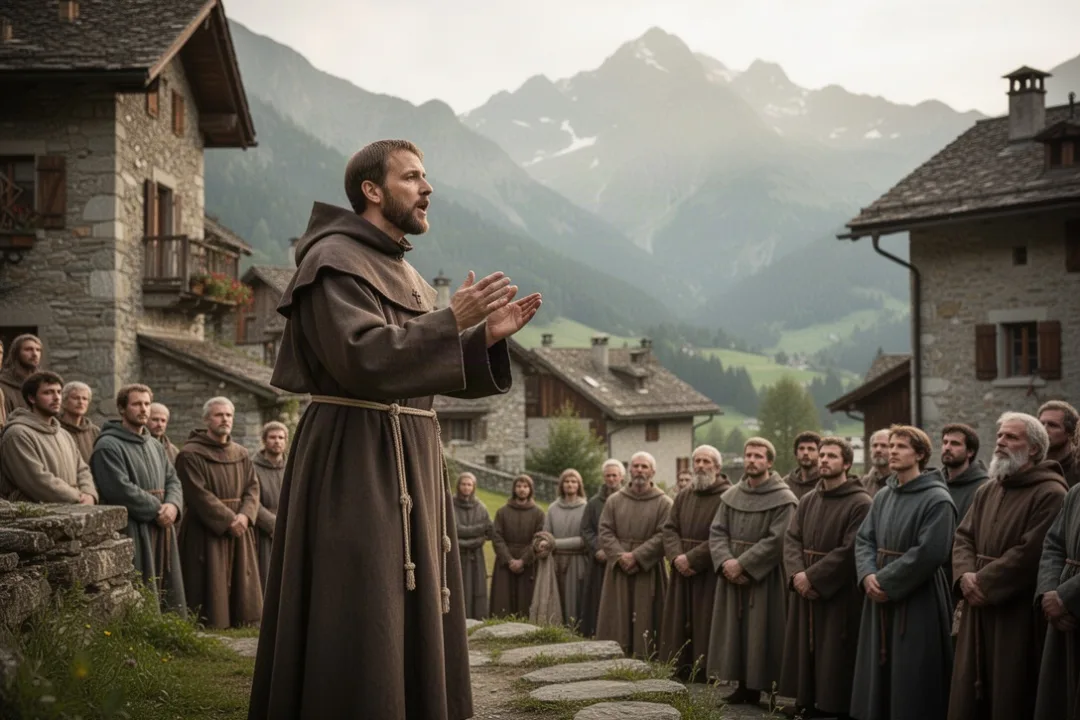
Capuchin ministry often brought friars into direct contact with people through preaching and the sacrament of penance. A friar might move between towns, preach in churches or public settings, visit the sick, hear confessions, and encourage Catholics whose religious practice had weakened. This work required endurance and the ability to communicate clearly.
Fidelis became known for a demanding style of preaching and for serious personal discipline. Accounts of his life emphasize his prayer, fasting, study, and concern for moral reform. Some devotional biographies describe him in highly idealized language, so individual details should be read with awareness of the conventions of saintly biography. The broad picture remains consistent: he was a learned Capuchin priest whose ministry combined teaching with personal austerity.
Why he was sent to the Grisons mission
The mission in the Grisons was not merely an assignment to preach in a new parish. It was an effort to serve Catholics and defend Catholic teaching in a region where religious identities were contested. Fidelis worked under the authority of the Church’s missionary structures and with support from Catholic political interests, including the Habsburg side of the wider conflict.
That political connection made the mission especially sensitive. A Catholic preacher could be viewed not only as a religious representative but also as an agent of a larger institutional or political program. The danger was increased by military movements and local resistance to outside influence.
Fidelis’s task included preaching, visiting communities, hearing confessions, and strengthening Catholic organization. His work was not limited to formal theological disputation. It involved personal encounters with people whose religious loyalties were tied to local custom, family history, communal authority, and political concerns.
How to understand his preaching and controversy
Fidelis is frequently described as a forceful defender of Catholic doctrine. In the language of his period, defending the faith often meant publicly identifying errors and urging people to return to Catholic teaching. Such preaching could be experienced as courageous clarification by supporters and as provocation by opponents.
Modern readers should avoid reducing the situation to a simple story of one heroic speaker and a uniformly hostile crowd. The region contained several groups, and the political circumstances were changing quickly. Reports about Fidelis’s final sermon, his words during the confrontation, and the identity of those involved were shaped by later Catholic memory as well as by contemporary conflict.
That caution does not erase the central fact of his witness. He accepted a difficult assignment, continued to minister in a dangerous setting, and died violently while carrying out priestly work. His canonization rests on the Church’s judgment that he died as a martyr, meaning a person who gives his life in fidelity to Christian faith rather than abandoning it under threat.
What happened at Seewis in 1622
Fidelis preached at Seewis in April 1622. Soon afterward, he was confronted by armed men and killed. Sources differ in their details about the precise exchange, the number of attackers, and the sequence of events, so responsible accounts avoid presenting every traditional detail as equally certain.
The wider setting was one of armed revolt and religious tension. The killing occurred during the Bündner Wirren, or Grisons troubles, a period in which local conflicts were connected with the larger Thirty Years’ War. Fidelis’s death therefore had both a religious and a political context, although the Church honors him specifically for the religious meaning of his witness.
He was about forty-four years old. His body was later recovered and eventually associated with relic devotion in several places. The most important point for his religious memory is that he did not die in private retreat; he died while engaged in public pastoral ministry among people divided by confession and power.
What “martyr” means in Fidelis’s case
In Catholic usage, martyrdom is not simply any death that occurs during religious work. It refers to death suffered because of fidelity to Christ and the Christian faith. The Church’s recognition of a martyr involves theological and historical judgment, not only admiration for bravery.
For Fidelis, martyrdom is connected with his refusal to abandon his mission when opposition became severe. He was not remembered because he sought conflict or because violence itself was considered admirable. Rather, his death was interpreted as the consequence of remaining faithful to his priestly duty and religious convictions.
This distinction matters when applying his example today. Christian courage does not mean provoking danger, ignoring prudent advice, or treating opponents with contempt. Fidelis’s story can be read as a call to faithfulness with prudence: speak honestly, serve people conscientiously, and do not confuse personal aggression with religious conviction.
When the Church recognized him as a saint
Devotion to Fidelis developed after his death, particularly among Capuchins and Catholics who regarded him as a missionary martyr. He was beatified in 1729 by Pope Benedict XIII. Pope Benedict XIV canonized him in 1746, more than a century after his death.
His liturgical memorial is generally observed on April 24. Calendar practices can vary by region and by the particular liturgical calendar being used, but April 24 is the date most commonly associated with his feast in the Roman Catholic tradition.
His canonization placed him among the saints honored not only for personal holiness but also for the public witness of missionary service. Churches, chapels, schools, and religious communities have adopted his name, especially where Capuchin ministry or missionary devotion has been influential.
What Saint Fidelis symbolizes
Fidelis’s name, taken from the Latin word for “faithful,” became especially meaningful in light of his life and death. He symbolizes steadfastness in vocation, disciplined preparation for service, and the willingness to remain present when religious work becomes difficult.
His example can be understood through several connected themes:
Faithfulness: He continued to serve according to his vocation despite pressure and danger.
Learning placed at service: His legal education became a resource for preaching and pastoral leadership rather than a private achievement.
Mission among divided people: He worked in a setting where religious disagreement affected the entire community.
Personal discipline: His prayer and simplicity supported a demanding public ministry.
Courage shaped by responsibility: His witness was tied to service, not a search for notoriety.
These themes explain why he appeals to people who work in law, education, preaching, missions, and public service. His life suggests that professional skill and spiritual vocation need not be separated. A person’s earlier training can be redirected toward service without losing its seriousness or value.
Why lawyers and missionaries may look to him
Fidelis is commonly associated with lawyers because he practiced law before entering the priesthood and because his intellectual formation was central to his ministry. The connection is not based on a modern professional organization alone; it arises from the unusual combination of legal training and religious vocation in his life.
Missionaries may honor him because he carried out ministry in a contested territory and is remembered as a martyr connected with the Congregation for the Propagation of the Faith. His example reflects the risks that religious workers have sometimes faced when service crosses cultural, political, and confessional boundaries.
People involved in ecumenical or interfaith work may also find his history instructive, although his own ministry belonged to a period of sharp confessional competition. His story invites careful reflection on how religious conviction can be maintained while speaking about opponents responsibly. Historical admiration should not require repeating polemical language that no longer helps communities understand one another.
How to honor Saint Fidelis today
Honoring a saint does not require copying every feature of the saint’s historical setting. It means recognizing the virtues the Church sees in that person and practicing them in forms appropriate to present circumstances. For Fidelis, the emphasis falls on truthful service, prayer, preparation, and courage under pressure.
Practical ways to observe his feast or learn from his example include:
Read a reliable biography that distinguishes documented history from later devotional detail.
Pray for people who serve in regions marked by religious or political violence.
Ask how your own education or profession can benefit people who need practical help.
Practice disagreement without caricaturing the person who disagrees with you.
Support responsible missionary, pastoral, legal-aid, or reconciliation work.
Attend Mass or another appropriate service on his feast day according to your tradition.
A parish or school named for Saint Fidelis might mark April 24 with a service, a presentation on his history, a discussion about religious liberty, or a prayer for persecuted Christians. The most useful observance connects his memory to concrete responsibility rather than treating martyrdom as a distant and dramatic story.
A balanced lesson: Saint Fidelis represents conviction that is willing to suffer for truth, but his life should not be used to excuse hostility. Courage in religious service includes careful speech, respect for human dignity, and prudent concern for the safety of others.
How his legacy differs from a simple heroic legend
Saints are often remembered through stories that highlight a few defining qualities. With Fidelis, the central image is the courageous preacher who dies during a mission. That image is meaningful, but it can obscure the years of study, legal work, religious formation, prayer, and ordinary pastoral ministry that came before the final event.
His death was important because of the life it completed. A martyr’s witness is not created by a final moment alone. Fidelis had already formed habits of service and discipline, accepted the responsibilities of religious life, and committed himself to a mission that required perseverance.
His legacy also needs historical care. The religious conflicts of the seventeenth century produced suffering across confessional lines. Remembering Fidelis faithfully means honoring his Catholic identity while acknowledging that his era’s polemical language and political entanglements should not be transferred uncritically into the present.
What his life can teach about religious disagreement
Fidelis’s ministry shows how closely belief and community life were linked in early modern Europe. It also demonstrates that serious disagreement can become dangerous when institutions, territory, political allegiance, and religious identity reinforce one another.
For contemporary readers, his story offers several questions rather than a single slogan. How should a person defend convictions without dehumanizing opponents? When does public religious speech serve a community, and when does it intensify conflict? What responsibilities belong to leaders who send workers into unstable environments?
These questions make his life relevant beyond devotional settings. He was a lawyer, teacher, priest, preacher, and missionary who had to use judgment in situations where simple answers were unavailable. His example encourages integrity joined with discernment, rather than courage separated from wisdom.
Where Saint Fidelis is remembered
Fidelis is especially associated with Sigmaringen, the Capuchin order, and Seewis in Graubünden. Churches and religious houses dedicated to him can also be found in places influenced by Capuchin ministry. His relics and images have supported local devotion, although the form of that devotion differs from one community to another.
Artwork commonly depicts him in the brown habit of a Capuchin friar, sometimes with a palm branch representing martyrdom. Other images may show a book or similar symbol of learning and preaching. These details point to the two dimensions most often connected with him: religious scholarship and martyr witness.
His name remains a reminder that sanctity can emerge through a life that changes direction. Markus Roy’s path moved from legal education and professional work to Capuchin poverty, priestly ministry, missionary preaching, and martyrdom. The continuity lies in the disciplined use of his abilities for what he believed was a greater responsibility.
Why Saint Fidelis still matters
Saint Fidelis of Sigmaringen matters because his life brings together conviction and service in a setting where both were costly. He was not only a figure from a confessional conflict; he was a trained professional who chose religious life, a priest who entered a divided region, and a missionary whose commitment ended in martyrdom.
His memory is strongest when it includes the whole story: the education before the friary, the legal and pastoral work, the realities of the Grisons mission, the uncertainty surrounding some historical details, and the Church’s later recognition of his sanctity. That fuller picture presents a saint whose courage was rooted in preparation, prayer, and responsibility.
For Catholics, his feast day offers an opportunity to pray for faithfulness and for those who serve amid persecution or conflict. For anyone studying history, law, religion, or public leadership, his life shows how personal convictions can shape a vocation—and how urgently courage must be accompanied by humility and care.
Frequently asked questions
When is Saint Fidelis of Sigmaringen’s feast day?
Saint Fidelis is generally commemorated on April 24 in the Roman Catholic liturgical calendar. Local calendars may observe saints differently, especially when a regional feast or another major celebration takes precedence. Churches and communities named for him may hold a Mass, prayer service, lecture, or other observance around that date.
What was Saint Fidelis’s original name?
He was born Markus Roy in Sigmaringen, in what is now southern Germany. After entering the Capuchin order, he took the religious name Fidelis, a Latin name associated with faithfulness. His earlier education and legal career remained important parts of his identity and later influenced his preaching and pastoral leadership.
Is Saint Fidelis the patron saint of lawyers?
He is commonly associated with lawyers because he studied civil and canon law, earned a doctorate in both fields, and practiced as a lawyer before becoming a Capuchin priest. He is also honored by missionaries and Capuchins. Patronage traditions can vary, but his legal background is the main reason for the connection with the legal profession.
Where was Saint Fidelis killed?
Fidelis was killed at Seewis, in the Swiss region of Graubünden, in April 1622. He had been serving as a missionary and had preached there shortly before his death. The area was experiencing serious religious and political conflict, and historical sources do not agree on every detail of the confrontation.














Leave a Reply