If you have heard the name Isaac Jogues but remember only that he was a martyr, you may be wondering what actually happened to him. Jogues was a French Jesuit missionary who worked among Indigenous peoples in seventeenth-century New France, endured brutal captivity among the Mohawk, escaped to Europe, and then chose to return to the mission where he had suffered.
His story is not simply about personal courage. It also reflects the difficult history of French colonization, Indigenous-European conflict, missionary activity, and the violence surrounding the fur trade and imperial rivalry. Jogues’s life can be understood most clearly by looking at both his religious commitment and the historical setting in which he worked.
Who Isaac Jogues was and why he came to New France
Isaac Jogues was born in Orléans, France, in 1607. He entered the Society of Jesus in 1624 and was ordained a Catholic priest in 1636. That same year, he traveled to New France, the French-controlled territory in North America, to join the Jesuit missions.
The Jesuits hoped to establish Christian communities among Indigenous nations, especially in the Great Lakes and St. Lawrence regions. Their work included preaching, learning Indigenous languages, traveling between settlements, caring for the sick, and trying to build relationships with communities caught in wars and trade competition.
Jogues served among the Huron-Wendat and other Indigenous communities. The name “Huron” was commonly used by French colonists, while many people today prefer the nation’s own name, Wendat. Jogues’s missionary work took place within Wendat territory and among neighboring peoples, including the Algonquin-speaking nations allied with the French.
The missions were not operating in a peaceful frontier. The Wendat Confederacy and the Haudenosaunee Confederacy had long-standing political, economic, and military conflicts. The Mohawk, one of the Haudenosaunee nations, were especially involved in attacks connected to warfare, trade routes, and control of the region. Europeans intensified these conflicts by forming alliances, supplying weapons, and competing for influence.
Jogues and the other Jesuits depended heavily on Indigenous guides, translators, hosts, and allies. They could not simply travel through the region on their own. Missionary activity required a difficult combination of cultural learning, physical endurance, and diplomacy.
Historical context: Jogues was a missionary in a region shaped by Indigenous political power and European expansion. His story should not be separated from the communities, conflicts, and colonial pressures surrounding the missions.
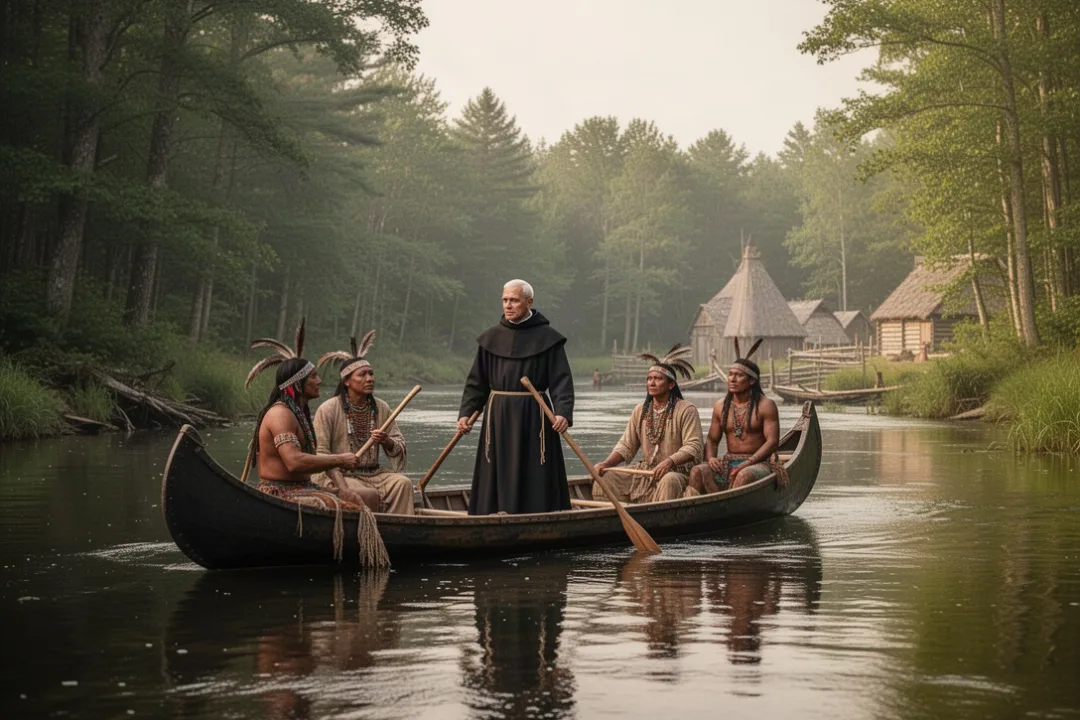
Jogues’s letters describe long canoe journeys, harsh weather, hunger, illness, and the challenge of communicating across languages. They also reveal his deep commitment to the Christian faith and his willingness to remain with people during danger. For Catholic readers, these qualities became central to his reputation as a saint. For historians, his writings are also evidence from one participant in a much larger and more complicated encounter.
How Isaac Jogues was captured and tortured
In 1642, Jogues was traveling with a group that included Rene Goupil, a French lay assistant connected with the Jesuit mission. The party was attacked by Mohawk forces near the southern end of Lake Champlain. Jogues, Goupil, and several Indigenous companions were captured and taken toward Mohawk territory.
The captives faced beatings, threats, and ritual violence as they were moved from one community to another. Jogues’s hands were severely mutilated. His fingers were cut or bitten, and he suffered injuries that made it difficult for him to hold objects or perform the gestures required for Catholic worship.
Goupil was killed after making the sign of the cross in the presence of a child. Jogues later understood Goupil’s death as martyrdom. The two men had been working together in the mission, and Goupil became one of the earliest companions associated with Jogues’s martyr story.
Jogues remained a prisoner among the Mohawk for months. He was forced to run a gauntlet, a form of punishment in which captives were struck as they passed between lines of people. He was exposed to physical abuse and treated as an enemy during a period of severe conflict.
At the same time, the captivity was not a single, uniform experience. Jogues encountered different Mohawk communities and individuals, and some people showed him kindness or helped him survive. He learned more about the people and customs around him, although his observations were shaped by the fear, pain, and religious assumptions of a captive missionary.
Jogues continued to pray and minister as he could. He secretly baptized some captives, according to accounts of his life, and tried to maintain his religious identity despite the loss of his freedom. His damaged hands became especially significant in later Catholic accounts because they symbolized both the violence he had endured and his refusal to abandon his priestly vocation.
Captivity among the Mohawk also gave Jogues direct knowledge of a society he had previously approached as an outsider. He lived within Mohawk communities, witnessed their political and family life, and learned about the consequences of the warfare affecting the region. His experience did not erase the cultural distance between him and his captors, but it changed the kind of knowledge he brought to the mission afterward.
How Isaac Jogues escaped and returned to France
After more than a year in captivity, Jogues escaped with the help of Dutch traders. He reached the Dutch settlement of New Amsterdam, located on Manhattan Island, and from there traveled back to France. The journey was physically difficult, and he arrived severely weakened.
When Jogues returned to Europe, people were shocked by the condition of his hands. He had been unable to celebrate Mass normally because of his injuries. The Catholic Church granted him a special permission to continue as a priest despite the damage, allowing him to celebrate the Eucharist in a manner adapted to his condition.
His return made him widely known in France. Many people considered him a living witness to the dangers of the North American missions. Yet the attention did not make him abandon missionary work. After recovering as much as possible, Jogues asked to return to New France.
That decision is one of the most striking parts of his life. Jogues knew that the Mohawk might kill him if he went back. He also understood that the political conditions responsible for his captivity had not disappeared. Still, he believed that he had a responsibility to resume his work among the people he had previously encountered.
Before his return, Pope Urban VIII is traditionally associated with permission for Jogues to celebrate Mass despite his mutilated hands. Catholic sources often preserve the phrase that a martyr should be allowed to celebrate Mass, although exact wording can vary among accounts. The underlying point is clear: Jogues’s injuries did not end his priestly ministry.
Jogues returned to New France in 1644. During this period, he worked to improve relations between the French and the Mohawk. He participated in diplomatic efforts and traveled as a representative of peace as well as a missionary.
His first mission period involved service among the Wendat and allied communities.
His captivity brought him into direct contact with Mohawk society under violent circumstances.
His return to France gave European Catholics a vivid account of the dangers of the mission.
His return to North America showed that he intended to continue both missionary and diplomatic work.
Jogues’s decision should not be reduced to a dramatic act of individual bravery. It was also part of the Jesuit ideal of remaining available for mission despite danger. At the same time, modern readers can recognize that his return took place within a colonial project whose goals did not always align with Indigenous sovereignty or religious traditions.
Why Isaac Jogues was killed in 1646
In 1646, Jogues traveled again toward Mohawk territory as part of a peace mission. Tensions had increased, and some Mohawk communities viewed him with suspicion. He was associated with the French, with Christianity, and with earlier epidemics and conflicts that had caused enormous suffering among Indigenous peoples.
Jogues was killed on October 18, 1646, at or near the Mohawk settlement commonly identified as Ossernenon. Accounts describe him being struck with a tomahawk. The next day, Jean de La Lande, a lay companion traveling with him, was also killed.
The circumstances surrounding Jogues’s death were connected to political uncertainty and fear. A peace agreement between the French and the Mohawk had not created complete trust. Some people believed Jogues might bring harm through spiritual practices or disease, while others opposed his presence for political reasons. His killing occurred in a tense environment rather than in isolation from regional events.
For the Catholic Church, Jogues died as a martyr for the faith. His willingness to enter Mohawk territory after surviving captivity became a central part of that interpretation. His death was remembered alongside those of other missionaries and companions who died in the region during the same era.
The phrase “North American Martyrs” generally refers to eight canonized Catholic missionaries and associates connected with the Jesuit missions. They were killed between 1642 and 1649 in areas that are now parts of the United States and Canada. Isaac Jogues and Jean de La Lande are included among them.
Remember the companions: Jogues is the best-known name, but the North American Martyrs were a group. René Goupil, Jean de Brébeuf, Gabriel Lalemant, Antoine Daniel, Charles Garnier, Noël Chabanel, and Jean de La Lande are also part of the Catholic commemoration.
The other missionaries died in different circumstances. Several were killed during the destruction of Wendat communities in the late 1640s. Jean de Brébeuf and Gabriel Lalemant were captured and killed in 1649. Their deaths, like Jogues’s, took place amid warfare, displacement, epidemic disease, and the collapse of political arrangements that had supported the missions.
These events deserve careful language. Catholic tradition honors the missionaries’ sacrifice, while Indigenous histories emphasize the damage caused by European colonization, epidemic disease, religious pressure, and military alliances. Both dimensions matter when studying the period.
How Isaac Jogues became a saint
Jogues and his companions were beatified in 1925 by Pope Pius XI. They were canonized in 1930, also during the pontificate of Pius XI, as the North American Martyrs. Their canonization formally recognized their deaths as martyrdom within the Catholic Church.
Jogues is often described as the first Catholic priest to be martyred in what is now the United States. The wording requires care because national borders did not exist in their modern form during his lifetime, and historical claims about “firsts” can depend on how a region and priesthood are defined. His death occurred in present-day New York State, in the Mohawk homeland.
His feast is observed with the other North American Martyrs. In the United States, the liturgical memorial is commonly observed on October 19, although local calendars and communities may emphasize the saints differently. Some churches and Catholic institutions are named for Jogues alone, while others honor the full group.
Several themes explain why Catholic communities continue to remember him:
Perseverance: he continued serving after captivity, mutilation, and prolonged physical suffering.
Faithfulness: he remained committed to his priestly vocation even when his injuries changed how he could minister.
Reconciliation: his later journeys toward the Mohawk were connected to peace efforts as well as evangelization.
Companionship: his story is inseparable from Goupil, La Lande, and the other missionaries who shared the dangers of the missions.
Historical witness: his letters and reports provide one perspective on seventeenth-century Indigenous-European relations.
For Catholics, canonization does not mean that every action associated with a saint’s historical setting should be copied or admired without question. Saints lived within particular cultures and institutions. Jogues’s sanctity is understood through his fidelity, suffering, and service, while the broader mission history must still be examined critically.
What Isaac Jogues’s legacy means today
Isaac Jogues is remembered in churches, schools, parishes, retreat centers, and religious communities across North America. His name appears in places connected to Catholic education and missionary history, especially in the northeastern United States and Canada. Statues and stained-glass windows often portray him with a crucifix, missionary clothing, or the damaged hands that became part of his iconography.
His legacy is strongest when it includes both religious memory and historical honesty. A devotional account may focus on his courage, while a historical account also asks how missionaries affected Indigenous societies and how French alliances shaped regional warfare.
Jogues’s writings should be read as valuable but limited sources. They reveal his concerns, observations, and religious interpretations. They do not provide a complete account of Mohawk, Wendat, or other Indigenous perspectives. To understand the period more fully, readers should place Jesuit records alongside Indigenous histories and modern scholarship.
His life also raises questions about the meaning of martyrdom. In Catholic theology, martyrdom is not simply dying violently. It involves death accepted because of fidelity to Christian faith. Jogues’s supporters saw his return to Mohawk territory as evidence that he accepted this risk freely. That interpretation is central to his canonization.
At the same time, readers should distinguish voluntary risk from the violence that surrounded him. Jogues did not control the wars, epidemics, colonial ambitions, or political decisions of the region. His personal choices were made inside forces much larger than one missionary.
A balanced way to remember him includes several questions:
What did Jogues believe he was called to do?
What Indigenous communities made the missions possible?
How did French and Haudenosaunee political interests shape his movements?
What do his accounts reveal, and what do they leave out?
How can Catholic devotion honor the martyrs without ignoring Indigenous suffering and sovereignty?
Isaac Jogues’s story remains compelling because it combines extraordinary endurance with a complicated historical setting. He was a priest, captive, diplomat, traveler, and martyr. Remembering him well means holding those identities together rather than treating him only as a symbol of suffering.
For Catholic believers, he represents a life given to mission even after severe injury and captivity. For students of history, he offers a window into the early French missions and the conflicts of northeastern North America. For anyone approaching his story today, the most responsible view honors his convictions while also listening for the Indigenous voices that missionary records alone cannot fully preserve.
Where to learn more about Isaac Jogues
Readers who want to study Jogues beyond a short biography can begin with the Jesuit Relations, a collection of reports and letters produced by Jesuit missionaries in New France. These sources contain valuable details about travel, language, diplomacy, religious practice, and conflict, but they reflect the missionaries’ perspective and should be read critically.
Church histories and biographies can help explain Jogues’s spirituality, captivity, and canonization. Academic histories of the Wendat, Mohawk, Haudenosaunee, French colonial expansion, and the fur trade provide essential context that devotional biographies may treat only briefly.
Useful research habits include:
Compare Catholic biographies with Indigenous-authored or Indigenous-centered histories.
Check whether a source distinguishes historical evidence from later devotional tradition.
Use the names that communities use for themselves, such as Wendat and Haudenosaunee, while recognizing older terms in quotations and historical titles.
Remember that modern borders do not perfectly describe seventeenth-century Indigenous homelands.
Studied in this wider context, Isaac Jogues is more than a name attached to a feast day. He becomes part of a difficult history involving faith, cultural encounter, colonial power, human suffering, and attempts at peace.
Frequently asked questions
When was Isaac Jogues born?
Isaac Jogues was born in 1607 in Orléans, France. He entered the Society of Jesus in 1624 and became a priest in 1636. Soon afterward, he traveled to New France to work as a missionary among Indigenous communities in the Great Lakes and St. Lawrence regions.
What happened to Isaac Jogues’s hands?
During his captivity among the Mohawk, Jogues suffered severe injuries to his hands and fingers. The damage affected his ability to celebrate Mass in the usual way. After returning to France, he received permission to continue serving as a priest despite those injuries.
Where did Isaac Jogues die?
Jogues was killed in 1646 at or near Ossernenon, a Mohawk settlement in the area that is now New York State. He died during a period of strained relations between the French and Mohawk. His companion Jean de La Lande was killed the following day.
Why is Isaac Jogues called a martyr?
The Catholic Church considers Jogues a martyr because he was killed after continuing his missionary and diplomatic work despite the danger and because of his association with Christian ministry. He was canonized in 1930 with the other North American Martyrs.














Leave a Reply