Junipero Serra: missions, biography, and historical legacy
Junipero Serra: missions, biography, and historical legacy
Junipero Serra was a Spanish Franciscan friar who founded the first nine Catholic missions in Spanish California between 1769 and 1782. Born on the island of Mallorca in 1713, he became a missionary in Mexico and later led the effort to establish a chain of missions along the California coast. He died at Mission San Carlos Borromeo in Carmel in 1784.
Serra is remembered by the Catholic Church as a determined evangelist and was canonized by Pope Francis in 2015. At the same time, many Native people and historians criticize the mission system for disrupting Indigenous societies, restricting movement, imposing Christianity, and exposing communities to violence, forced labor, and devastating disease.
Junipero Serra was born Miquel Josep Serra Ferrer in Petra, Mallorca, in 1713. Mallorca was then part of the Spanish monarchy, and Serra grew up in a Catholic farming community. He joined the Franciscan order as a young man, took the religious name Junipero, and became a priest and academic.
Before becoming a missionary, Serra taught philosophy and theology. He earned a reputation as an able scholar and preacher, but his religious vocation eventually led him away from a settled academic career. In 1749, he traveled to New Spain, the Spanish territory that included much of present-day Mexico and the American Southwest.
Serra’s journey across the Atlantic was difficult. After reaching Mexico, he worked among Indigenous communities and learned about missionary life in the field. His early work included service in the Sierra Gorda missions in central Mexico, where Franciscans attempted to establish churches, schools, agricultural settlements, and Christian communities.
Those missions shaped Serra’s approach in California. He believed Catholic missionaries should live among the people they hoped to convert, teach Christian doctrine, and build permanent communities. He also accepted the assumptions of the Spanish colonial system, which treated religious conversion and imperial expansion as connected goals rather than separate activities.
A useful distinction: Serra’s personal intentions and the effects of the mission system were not identical. Supporters focus on his religious dedication and concern for the missions; critics examine the coercive colonial structure in which that dedication operated.
In 1767, Serra moved to the Baja California missions after the Spanish government expelled the Jesuits from its territories. The Franciscans took responsibility for many former Jesuit missions, while the Dominicans later assumed control of much of Baja California. This transition placed Serra in a larger imperial project that sought to secure Spain’s northern frontier.
How Serra established the California mission chain
Spain became increasingly concerned that Russia, Britain, or other foreign powers might occupy the Pacific coast. In response, Spanish authorities organized expeditions to Alta California, the region that now includes the U.S. state of California. The military and missionary ventures worked together: soldiers protected the settlements, while missionaries created communities intended to strengthen Spain’s claim to the territory.
Serra traveled north with the expedition led by Gaspar de Portolá. In 1769, he founded Mission San Diego de Alcalá, generally regarded as the first of the California missions. The mission chain eventually extended north along the coast, with each site intended to serve as a center for conversion, farming, craft production, and Spanish settlement.
Serra personally founded or helped establish nine missions. They included:
Mission San Carlos Borromeo, established in 1770 and later moved from Monterey to Carmel.
Mission San Antonio de Padua, founded in 1771.
Mission San Gabriel Arcángel, founded in 1771.
Mission San Luis Obispo de Tolosa, founded in 1772.
Mission San Francisco de Asís, commonly called Mission Dolores, founded in 1776.
Mission San Juan Capistrano, founded in 1776.
Mission Santa Clara de Asís, founded in 1777.
Mission San Buenaventura, founded in 1782.
The missions were not independent churches in the modern sense. They were part of settlements governed through Spanish colonial institutions. A typical mission included a church, living quarters, workshops, storehouses, gardens, livestock areas, and agricultural fields. Indigenous people who joined the mission were expected to be baptized, live at or near the settlement, learn Catholic practices, and work under the direction of mission authorities.
Serra served as president of the Alta California missions, coordinating their religious and practical affairs. He traveled between widely separated settlements, often under physically demanding conditions. He petitioned colonial officials on several occasions, including over the treatment of Indigenous people by soldiers, and his correspondence shows that he wanted missionaries to have authority over the spiritual communities they were building.
His conflicts with military officials were real, but they had limits. Serra did not reject Spanish colonization or the mission system itself. He sought to make the system more firmly controlled by missionaries and, in his view, more effective at converting Indigenous people. That distinction helps explain why accounts of Serra can portray him as both a defender of Native people in particular disputes and an agent of a broader colonial program.
What life was like inside the California missions
California’s missions depended on the labor and knowledge of Indigenous people. Native communities supplied agricultural expertise, local environmental knowledge, labor, and cultural traditions. Mission residents cultivated wheat, barley, corn, beans, and other crops; raised cattle and sheep; made leather goods; produced textiles; and maintained buildings and irrigation systems.
The mission system changed Indigenous life in profound ways. Many Native people entered missions voluntarily at first, sometimes seeking food, protection, trade goods, or a way to respond to changing conditions. Others resisted or left. After baptism, however, mission authorities generally treated people as members of the mission community who were expected to remain there and follow its rules.
Movement was restricted, and discipline could include corporal punishment. Mission residents could be assigned daily work, and families were separated from some traditional patterns of residence and subsistence. Religious instruction often involved rejecting Indigenous spiritual practices, languages, and ceremonies. These policies weakened established political and cultural relationships, even as Native people adapted Christianity and mission life in ways the missionaries did not fully control.
The population decline associated with the missions had several causes. European-introduced diseases such as smallpox, measles, and respiratory infections spread through communities that lacked immunity. Poor nutrition, crowded living conditions, demanding labor, and disruption of traditional food systems intensified the danger. Violence, punishment, and the loss of mobility also contributed to suffering.
Historical records do not provide a simple picture of every mission or every decade. Conditions varied by location, leadership, local Indigenous communities, and relations with nearby military settlements. Some people negotiated with missionaries, used mission resources strategically, or maintained Native identities and practices. Others resisted through desertion, attacks, refusal to work, or participation in larger uprisings.
The fact that some Indigenous people entered missions willingly does not erase the coercive conditions that could follow. Nor does evidence of abuse mean that every interaction was identical. A careful account recognizes Indigenous agency while also examining the unequal power structure imposed by Spanish colonization.
Why the debate is difficult: Serra’s defenders often evaluate him by his stated intentions and individual interventions, while critics evaluate the institutions and outcomes connected to his leadership. Both personal conduct and systemic effects belong in the historical record.
Serra’s relationship with Indigenous communities
Serra described Indigenous people as capable of becoming Catholics and members of settled communities. He learned some local languages through interpreters and promoted religious instruction, baptism, and the construction of churches. His letters also reveal concern that soldiers and settlers not exploit or mistreat Native people.
One frequently discussed example involves the mission at San Diego after a 1775 Indigenous uprising. Native people attacked the mission, and several people, including the resident priest, were killed. Serra wrote to request that participants who surrendered not receive execution. Supporters cite this intervention as evidence that he opposed excessive military retaliation.
That episode should not be treated as proof that Serra opposed all forms of coercion. His goal remained the preservation of the mission and the continuation of conversion. He believed Indigenous people should live under missionary supervision and accept Catholic religious authority. His efforts to reduce certain abuses existed within, rather than outside, a colonial system that denied Native communities full control over their land and institutions.
Serra also supported the use of mission discipline. Historical evidence indicates that corporal punishment occurred in California missions, although the records and interpretations differ by place and period. The question is not simply whether Serra personally ordered every punishment. As mission president, he helped lead an institution whose rules allowed missionaries to discipline residents and restrict their freedom.
Indigenous perspectives have become more prominent in public discussions of Serra. Descendants of California Indian peoples have described missionization as a source of cultural loss, family disruption, disease, and intergenerational trauma. Some Native people oppose Serra statues and commemorations, while others hold more varied views, including forms of Catholic practice that exist alongside Indigenous identity.
These perspectives challenge older heroic accounts that described Serra as a lone religious pioneer bringing civilization to an empty wilderness. California was not empty. It was home to many distinct Native nations and communities with their own languages, economies, political systems, and sacred traditions. Mission expansion took place on their homelands.
Why Junipero Serra remains controversial today
Serra died at Mission San Carlos Borromeo in Carmel on August 28, 1784. He was buried there, and the mission became closely associated with his memory. Over time, Catholic organizations, civic authorities, and California institutions honored him through statues, schools, streets, parks, and public ceremonies.
The Catholic Church opened a formal process to recognize his holiness. Serra was beatified in 1988 by Pope John Paul II and canonized in 2015 by Pope Francis during the pope’s visit to the United States. The canonization reflected the Church’s view that Serra showed heroic religious commitment and defended Indigenous people against some forms of colonial abuse.
Canonization also intensified public debate. Critics argued that honoring Serra overlooked the damage caused by the mission system. Statues of Serra were removed, toppled, or vandalized in several places, particularly during nationwide protests over racial injustice in 2020. Other communities defended the statues as religious or historical symbols, while some institutions chose contextual plaques, relocation, or removal rather than simple preservation.
The disagreement is not only about one friar. It concerns how the United States and California remember colonization, whose testimony receives authority, and whether a person can be honored for religious devotion while being associated with institutions that caused widespread harm. Public memorials often compress complicated history into a single heroic image, making those questions especially visible.
A balanced evaluation does not require treating every interpretation as equally supported. The evidence supports several points at once:
Serra was a committed Franciscan missionary who worked for decades to expand Catholic missions.
He sometimes challenged military officials and advocated limits on violence against Indigenous people.
He helped lead a mission system that restricted Native autonomy and depended heavily on Indigenous labor.
Missionization contributed to cultural disruption, population loss, and the spread of deadly disease.
Indigenous communities resisted, negotiated, adapted, and preserved identities despite the colonial system.
Some writers describe Serra as a product of his era, meaning that his beliefs reflected assumptions common in eighteenth-century Catholic and imperial societies. That context can explain his actions, but it does not excuse the consequences. Historical context is most useful when it clarifies how a system worked rather than when it turns harm into an unavoidable footnote.
How to understand Serra’s legacy at California mission sites
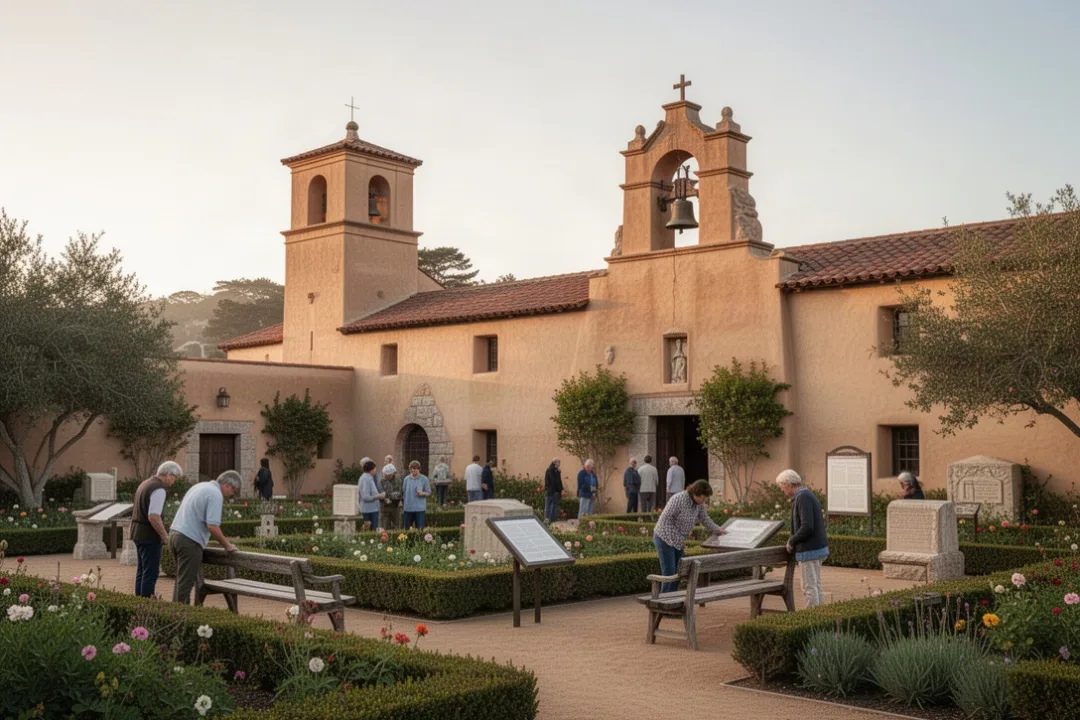
Many former missions are active Catholic parishes, museums, historic landmarks, or cultural sites. Visitors may see restored churches, gardens, burial grounds, religious art, and exhibits about Spanish settlement. The buildings can provide valuable information about architecture and material life, but the surviving structures do not tell the whole story.
When visiting a mission associated with Serra, look for information about the Indigenous nation whose ancestral land includes the site. Exhibits may describe baptisms, population records, food production, religious practice, and the mission’s relationship with the nearby presidio. They may also address disease, punishment, resistance, and the mission’s later secularization.
Useful questions include:
Which Native communities lived in the area before the mission was founded?
How did the mission acquire land, food, livestock, and labor?
What choices did Indigenous people have after baptism?
How does the site describe Native resistance and survival?
Are descendant communities involved in interpretation or programming?
Does the site distinguish Serra’s personal actions from the broader colonial system?
Studying Serra also benefits from comparing sources. Mission records were usually created by missionaries or colonial officials, so they reveal administrative priorities and religious interpretations. Archaeology, Native oral histories, linguistic research, and descendant scholarship can provide evidence about daily life and cultural continuity that official documents often omit.
Junipero Serra’s historical significance rests on more than the number of missions he founded. He helped shape the religious and political landscape of Spanish California, and the institutions he led left enduring effects on Native communities. Understanding him requires holding those dimensions together: the friar’s personal faith, the ambitions of the Spanish empire, the practical workings of mission life, and the experiences of Indigenous people whose homelands became the foundation of the mission system.
Frequently asked questions
When did Junipero Serra live?
Junipero Serra was born in 1713 in Petra, Mallorca, and died in 1784 at Mission San Carlos Borromeo in Carmel, California. He spent the earlier part of his religious career in Spain and Mexico before traveling to Alta California in 1769.
How many California missions did Junipero Serra establish?
Serra founded or helped establish nine of the 21 Spanish missions eventually created in California. The first was Mission San Diego de Alcalá in 1769, and the last associated with his work was Mission San Buenaventura in 1782.
Why did the Catholic Church canonize Serra?
The Catholic Church recognized Serra for his religious devotion, missionary work, and efforts to defend Indigenous people from certain abuses by colonial authorities. Critics argue that canonization gives insufficient weight to the coercion, disease, labor demands, and cultural disruption connected to the mission system he led.
What is Serra’s connection to Carmel, California?
Serra made Mission San Carlos Borromeo in Carmel his headquarters after it moved from Monterey. He died there in 1784 and was buried at the mission. The site remains closely associated with his life, work, and legacy.














Leave a Reply