Mexican saint: Juan Diego, Guadalupe, and other holy figures
Mexican saint: Juan Diego, Guadalupe, and other holy figures
If you are looking for the best-known Mexican saint, the answer is usually Saint Juan Diego, the Indigenous Catholic convert associated with the apparitions of Our Lady of Guadalupe. Mexico has several canonized saints, but Our Lady of Guadalupe is not technically a saint; she is a title for the Virgin Mary and the country’s most beloved religious figure.
Mexican Catholic tradition brings together canonized saints, martyrs, missionaries, religious founders, and widely honored figures whose devotion developed through local communities. Understanding the difference helps you identify who is officially a saint, what each person represents, and why Guadalupe remains central to Mexican identity.
Saint Juan Diego Cuauhtlatoatzin is generally regarded as the most famous Mexican-born saint. According to Catholic tradition, Mary appeared to him on Tepeyac Hill near present-day Mexico City in December 1531. She asked him to request a church at the site, and the image associated with the apparitions appeared on his tilma, or outer garment.
Juan Diego was an Indigenous man from the region of central Mexico who had converted to Christianity after the Spanish conquest. He was baptized as an adult and lived a life marked by prayer, humility, service, and devotion to Mary. The Catholic Church canonized him in 2002, making him the first Indigenous person from the Americas to receive that recognition through the modern canonization process.
His feast day is July 9. Churches and devotional materials often portray him wearing simple Indigenous clothing and carrying flowers, especially the roses connected with the Guadalupe tradition. He is remembered as a messenger who trusted what he had experienced even when church authorities initially questioned his account.
Important distinction: Saint Juan Diego is the Mexican saint associated with Guadalupe, but Our Lady of Guadalupe is Mary, not a canonized human saint. Catholics honor her as the mother of Jesus under this particular title.
Juan Diego’s importance extends beyond the apparition story. For many Catholics, he represents the dignity of Indigenous peoples, the value of ordinary believers, and the idea that a person without wealth or institutional power can carry an important spiritual message. His story is especially meaningful in Mexico, where Indigenous, Spanish, and mestizo traditions have influenced religious life for centuries.
Why Our Lady of Guadalupe is central to Mexican devotion
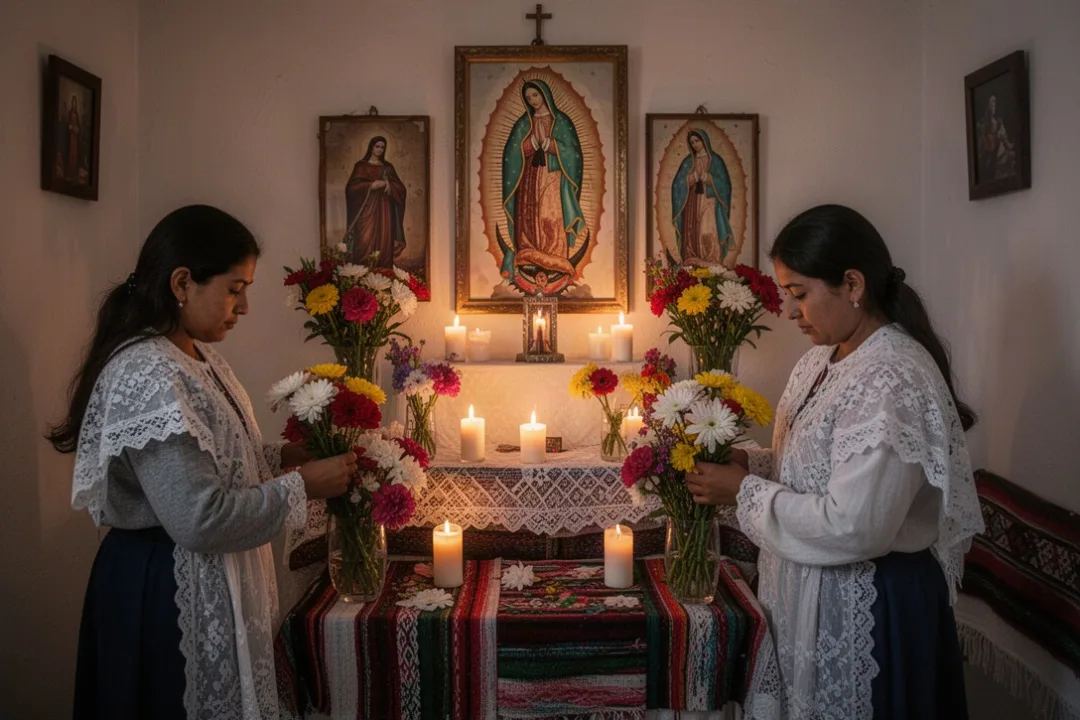
Although she is not a saint, Our Lady of Guadalupe is the central religious symbol associated with Mexico. Her feast day, December 12, is observed with Masses, processions, music, dances, candles, and pilgrimages. Millions of people visit the Basilica of Our Lady of Guadalupe in Mexico City, while parishes and families around the world celebrate her in Mexican communities.
The Guadalupe image shows Mary with features and clothing understood by many devotees as reflecting the cultural setting of sixteenth-century Mexico. She is often called La Morenita, a tender name that highlights her dark complexion and closeness to the people. For many Mexican Catholics, she is not a distant theological figure but a compassionate mother who listens to suffering and offers protection.
The traditional account says that Mary spoke to Juan Diego in Nahuatl, his Indigenous language. She identified herself as the mother of the true God and asked for a church to be built at Tepeyac. When Juan Diego returned to the bishop with roses that had appeared out of season, the image on his tilma served as the sign that persuaded church authorities to take his report seriously.
Devotion to Guadalupe can express several kinds of belonging at once:
Religious belonging: Catholics ask Mary to intercede for healing, family needs, guidance, and protection.
Cultural belonging: Mexican families use her image in home altars, celebrations, tattoos, murals, jewelry, and community events.
National identity: Guadalupe has appeared in public rituals and historical movements connected with Mexico.
Immigrant identity: Mexican communities outside the country often turn to her as a visible link with home, family, language, and heritage.
Her image can therefore carry different meanings depending on the person viewing it. One person may see a devotional icon, another a symbol of Mexican history, and another a maternal figure connected with migration and family separation. These meanings can overlap without being identical.
The Basilica of Our Lady of Guadalupe stands near Tepeyac Hill, the traditional location of the apparitions. The modern basilica houses the image associated with the Guadalupe tradition and receives pilgrims throughout the year. December 12 is the busiest period, but prayer and pilgrimage continue during ordinary weeks as well.
Other canonized Mexican saints and what they represent
Mexico has more than one recognized saint. Some were born in Mexico, while others served there or died there. The following figures are among the most important Mexican Catholic saints and are often included when people ask about a Mexican saint.
Saint Felipe de Jesús
Saint Felipe de Jesús, also called Philip of Jesus, is commonly identified as the first Mexican-born person canonized by the Catholic Church. Born in Mexico City, he joined the Franciscan order and later traveled to the Philippines. He was killed in Japan in 1597 during a persecution of Christians and was canonized in 1862 as one of the martyrs of Japan.
His feast day is February 5. He is the patron saint of Mexico City and is remembered for missionary commitment and martyrdom. His life also shows that a Mexican saint need not have spent the whole of his ministry in Mexico; Mexican Catholic identity has always included connections with other parts of the world.
Saint Cristóbal Magallanes and the Cristero martyrs
Saint Cristóbal Magallanes Jara was a Mexican Catholic priest who served rural communities and helped form seminarians during a period of intense conflict between the Mexican government and the Catholic Church. He was executed in 1927 after being accused of supporting the Cristero movement. He was canonized in 2000 with 24 other Mexican martyrs.
The group includes priests and laymen who were killed between 1926 and 1929. Their stories are linked to the Cristero War, a complicated chapter in Mexican history involving religious restrictions, armed rebellion, political conflict, and violence. Catholic devotion usually emphasizes their fidelity and willingness to die rather than treating the period as a simple story with no historical disputes.
Saint Cristóbal Magallanes is commemorated on May 21 with the other Mexican martyrs. He is especially important to Catholics who honor priests, seminarians, and laypeople who continued religious practice under persecution.
Saint José María de Yermo y Parres
Saint José María de Yermo y Parres was a Mexican priest and founder who worked with people living in poverty. He established the Servants of the Sacred Heart of Jesus and of the Poor, a religious congregation dedicated to education, care for abandoned children, and service to vulnerable communities.
He was canonized in 2000. His life is associated with practical charity rather than a single dramatic event. He organized institutions, supported children, and responded to social needs through sustained work. Catholics who look to him as a model often focus on service to the poor, compassionate leadership, and care that combines prayer with concrete action.
Saint María de Jesús Sacramentado Venegas
Saint María de Jesús Sacramentado Venegas was a Mexican religious sister, nurse, and founder of the Daughters of the Sacred Heart of Jesus. She devoted much of her life to caring for sick people and training women for religious service. She was canonized in 2000 and is remembered for humility, medical care, and dedication to patients.
Her example is particularly relevant to people who connect holiness with nursing, caregiving, and attention to people who are vulnerable because of illness. She shows that the Catholic understanding of sainthood includes quiet, repeated acts of mercy as well as martyrdom or public preaching.
Saint Rafael Guízar y Valencia
Saint Rafael Guízar y Valencia was a Mexican bishop who served during a period when Catholic ministry was restricted. He supported priests and seminarians, cared for people affected by conflict, and continued pastoral work despite danger. He was canonized in 2006.
He is closely associated with the Diocese of Veracruz and with the formation of clergy. His feast day is June 24. Devotion to him often emphasizes courage, pastoral responsibility, and the protection of religious education during political instability.
Saint Julio Álvarez Mendoza was a Mexican priest and martyr canonized in 2000 with the other Cristero-era martyrs. He served parish communities and was executed in 1927. Accounts of his ministry emphasize his care for ordinary people and his refusal to abandon his priestly responsibilities.
He is commemorated on March 30. Like Saint Cristóbal Magallanes, he is often invoked as a model of faithfulness under pressure and of pastoral service in rural Mexico.
Choosing a patron: Choose Juan Diego for Indigenous identity or Guadalupe devotion, Felipe de Jesús for Mexico City and missionary courage, María de Jesús Sacramentado for nursing and caregiving, or Yermo y Parres for service to people living in poverty.
How Mexican saints differ from popular religious figures
Not every revered figure in Mexico is a canonized saint. The Catholic Church follows a formal process that investigates a person’s life, writings, reputation for holiness, and alleged miracles. A declaration of sainthood means the person may be publicly honored throughout the worldwide Catholic Church.
Local communities may honor someone long before, or without, formal canonization. A deceased priest, healer, child, or community leader may become the subject of prayers, candles, and pilgrimage. These devotions can be culturally significant, but they do not automatically mean the person is recognized as a saint by Catholic authorities.
Santa Muerte is one example that requires careful distinction. Santa Muerte, or Holy Death, is a folk figure represented as a skeleton and honored by some devotees in Mexico and elsewhere. She is not recognized as a saint by the Catholic Church. Catholic bishops and other church authorities have repeatedly distinguished devotion to Santa Muerte from official Catholic worship and veneration.
Another frequently honored figure is Jesús Malverde, a folk saint associated in popular culture with Sinaloa. He is not canonized by the Catholic Church. Stories about him vary, and his image has been adopted by different groups for different reasons, including requests for protection and help with difficult circumstances.
Popular devotion can still reveal what communities fear, hope for, and value. People may turn to unofficial figures for protection from violence, help with illness, assistance in migration, or relief from poverty. Those practices belong to Mexican religious culture, but they should not be confused with the Church’s official list of saints.
When identifying a Mexican religious figure, ask three questions:
Is the person formally canonized? If so, the Catholic Church recognizes the person as a saint for universal veneration.
Is the figure Mary or another title for a biblical person? Guadalupe is a title of the Virgin Mary, not a separate human saint.
Is the devotion local or folk-based? A strong following does not necessarily indicate approval or recognition by the Catholic Church.
How Mexican saints are honored in daily life
Mexican Catholic devotion often takes place in homes and neighborhoods rather than only inside churches. A family may keep an image of Guadalupe near the entrance, place a candle before a saint’s picture, or pray a novena for a relative who is ill. These practices connect private prayer with family memory and community tradition.
A novena is a series of prayers traditionally said over nine days. People may use a novena before a feast day, during a crisis, or while asking for a saint’s intercession. The exact prayers vary by community, but the practice usually includes a request, an expression of trust, and a closing prayer.
Feast days can include far more than a religious service. A parish or town may organize a procession, decorate an altar, sing hymns, present flowers, prepare regional foods, and gather relatives who live far away. The celebration reflects both spiritual devotion and social bonds.
Praying a novena or rosary while asking for intercession.
Walking in a pilgrimage to a shrine or parish church.
Lighting a candle and placing flowers before an image.
Making a promise to complete an act of service or pilgrimage after receiving help.
Wearing a medal or carrying a prayer card.
Teaching children the saint’s story through family celebrations.
A candle, medal, or image does not function as a magical object in official Catholic teaching. The saint is not considered a god, and Catholics do not worship saints in the same way they worship God. Instead, Catholics ask saints to pray for them, much as they might ask a trusted Christian friend to pray.
That distinction can be confusing because devotion is often expressed with intense emotion. A person may speak tenderly to an image, touch a shrine, or make a promise after surviving an accident. These actions are best understood within the broader Catholic belief that saints remain part of the communion of believers and can intercede before God.
How to choose the right Mexican saint for prayer
If you want to pray with a Mexican saint, begin with the need or value that brings you to the devotion. You do not have to choose a saint because of a formal assignment or a family tradition, although those connections can be meaningful. Reading a short biography often helps you find a figure whose life speaks to your circumstances.
Consider these associations:
Saint Juan Diego: Indigenous dignity, humility, listening, and devotion to Guadalupe.
Our Lady of Guadalupe: maternal care, Mexican identity, family protection, migration, and hope.
Saint Felipe de Jesús: Mexico City, missionary work, and courage in persecution.
Saint Cristóbal Magallanes: priestly service, rural communities, and steadfastness under danger.
Saint José María de Yermo y Parres: service to poor people and care for abandoned children.
Saint María de Jesús Sacramentado Venegas: nursing, illness, caregiving, and compassion.
Saint Rafael Guízar y Valencia: bishops, seminarians, religious education, and pastoral courage.
Saint Julio Álvarez Mendoza: parish ministry and faithfulness during persecution.
Prayer can be simple. You might name your concern, ask the saint to pray for you, and end with a prayer directed to God. If you are honoring Guadalupe, you are addressing Mary; if you are honoring Juan Diego or another canonized person, you are asking that saint’s intercession.
You can also connect devotion with an action that reflects the saint’s life. Someone inspired by María de Jesús Sacramentado might visit a sick neighbor. Someone drawn to Yermo y Parres might support a food pantry or children’s charity. A person praying with Juan Diego might listen carefully to someone whose voice is being overlooked.
The most meaningful devotion is not limited to displaying an image. It joins prayer, memory, and conduct. Mexican saints are honored not only because people ask them for help, but because their lives point believers toward compassion, courage, faithfulness, and service.
Frequently asked questions
Is Our Lady of Guadalupe a Mexican saint?
No. Our Lady of Guadalupe is a title for the Virgin Mary, the mother of Jesus, rather than a canonized human saint. She is Mexico’s most prominent Catholic devotional figure and is celebrated throughout the country on December 12. Saint Juan Diego is the canonized Mexican saint most closely connected with the Guadalupe apparitions and tradition.
Who was the first Mexican-born saint?
Saint Felipe de Jesús is generally recognized as the first Mexican-born person canonized by the Catholic Church. He was a Franciscan missionary who was martyred in Japan in 1597. Canonized in 1862, he is the patron saint of Mexico City and is remembered among the martyrs of Japan.
Are Santa Muerte and Jesús Malverde Catholic saints?
No. Santa Muerte and Jesús Malverde are popular religious or folk figures, but neither is canonized or officially recognized as a saint by the Catholic Church. Some people in Mexico and elsewhere pray to them or maintain shrines, yet those practices are distinct from approved Catholic devotion to canonized saints.
What is the difference between Saint Juan Diego and Saint Felipe de Jesús?
Saint Juan Diego was an Indigenous man associated with the Guadalupe apparitions and was canonized in 2002. Saint Felipe de Jesús was a Franciscan missionary from Mexico City who was martyred in Japan and canonized in 1862. Juan Diego is linked with Guadalupe and Indigenous identity; Felipe is linked with missionary courage and Mexico City.












Leave a Reply