Virgin of Guadalupe: history, meaning, and devotion
Virgin of Guadalupe: history, meaning, and devotion
You may have seen the Virgin of Guadalupe on candles, home altars, church walls, or clothing and wondered who she is and why she matters so deeply to so many people. She is a Catholic title for Mary, the mother of Jesus, associated with a series of apparitions traditionally said to have occurred near Mexico City in December 1531.
For Catholics, Guadalupe is both a beloved Marian devotion and a sign of God’s care for ordinary people. Her story is closely connected with Saint Juan Diego, the Indigenous Christian who reported seeing Mary at Tepeyac Hill. The devotion has since spread far beyond Mexico, especially throughout Latin America and among Mexican American communities in the United States.
Who the Virgin of Guadalupe is and why she matters
The Virgin of Guadalupe is not considered a different person from Mary. “Virgin” refers to Mary, while “of Guadalupe” identifies the place and form through which Catholics believe she made herself known. Different cultures use other titles for Mary, such as Our Lady of Lourdes, Our Lady of Fatima, or Our Lady of Sorrows.
Guadalupe is especially associated with Mexico, Indigenous dignity, family, compassion, and hope. Her image shows a young woman with brown skin, dark hair, and a calm expression. For many devotees, those features communicate closeness to the people of the Americas rather than distance from them.
The devotion emerged during a difficult period in Mexican history. The apparitions are traditionally placed a decade after the Spanish conquest of the Aztec Empire, when Indigenous communities faced immense social disruption, disease, forced labor, and religious conflict. In that setting, the message associated with Guadalupe emphasized tenderness, protection, and a motherly welcome.
A useful distinction: Catholics honor the Virgin of Guadalupe as Mary, but they do not worship Mary. Worship belongs to God; Mary is honored as the mother of Jesus and as an example of faithful discipleship.
Her importance is religious, cultural, and personal at the same time. Some people turn to her while asking for healing or help with family problems. Others see her as a symbol of Mexican identity, resistance, migration, motherhood, or solidarity with people who feel overlooked.
That broad meaning explains why Guadalupe appears in many settings: parishes, homes, public murals, processions, cemeteries, businesses, and community celebrations. The image can represent private prayer, national heritage, or both. Its meaning may differ from one person to another without losing its central connection to Mary and Christian faith.
The story of Juan Diego and the apparitions at Tepeyac
The traditional account comes primarily from a Nahuatl-language text known as the Nican Mopohua, generally associated with the sixteenth-century Guadalupe tradition. It tells of Juan Diego Cuauhtlatoatzin, an Indigenous Christian from the area of present-day Mexico City, who encountered a radiant woman at Tepeyac Hill on December 9, 1531.
According to the account, the woman identified herself as the mother of the true God and asked Juan Diego to tell Bishop Juan de Zumárraga to build a church at the site. Juan Diego went to the bishop, but the bishop wanted a sign before accepting the request.
The story says that Juan Diego returned to Tepeyac and received further instructions. On one occasion, he found flowers growing on the hill even though the season and location made them unexpected. He gathered the flowers in his tilma, a traditional cloak or outer garment, and carried them to the bishop as the requested sign.
When Juan Diego opened the tilma before the bishop, the flowers fell to the floor. The account says that the image of Mary appeared on the cloth. The bishop then accepted the sign, and a shrine was built at Tepeyac. The hill had connections with an earlier Indigenous sacred site, which adds another layer to the story’s historical and cultural significance.
Several details help explain why the narrative remains powerful:
Juan Diego is central: the message comes through an Indigenous layman rather than a powerful official.
The request is practical: Mary asks for a place where people can come to her, pray, and receive care.
The sign is accessible: flowers and a cloak connect the extraordinary event with the ordinary landscape and life of the people.
The message is relational: Mary is presented as a compassionate mother who knows the struggles of those who approach her.
Some versions of the story also describe Mary as speaking to Juan Diego in Nahuatl, the language he understood. That detail is especially meaningful because it portrays the message as meeting him within his own culture rather than requiring him to become someone else before being heard.
The name “Guadalupe” has generated historical discussion. The Spanish title may reflect the name by which the devotion became known after the apparitions, while scholars continue to examine how Indigenous language, Spanish religious vocabulary, and local traditions interacted. These questions do not erase the devotion, but they show that the history includes both faith and careful interpretation.
The Catholic Church formally recognized Juan Diego as a saint in 2002. His canonization strengthened his place in Catholic life, especially as an example of humility, courage, and faithful service. The recognition also reflected the significance of an Indigenous Mexican figure within the wider history of Christianity in the Americas.
What the Guadalupe image symbolizes
The image associated with Guadalupe contains many details that Catholics interpret symbolically. Not every interpretation has the same official status, and some popular explanations go beyond what can be established with certainty. Still, the image’s visual language has helped generations of people pray and understand Mary’s role.
Mary stands in front of a field of rays, which many viewers understand as a sign of light, holiness, and God’s presence. Her posture is gentle and prayerful rather than triumphant. She appears to point beyond herself, consistent with Catholic teaching that Mary directs attention toward Christ.
A dark band around her waist is often interpreted as a sign of pregnancy in the clothing customs of the period. For many believers, this makes the image an especially tender representation of Mary as the woman carrying Jesus. The small flower-like design over her tunic is commonly connected with life, beauty, and sacred meaning, although particular symbolic readings vary.
She wears a blue-green mantle decorated with stars. The colors have been given different interpretations, including associations with royalty, the heavens, and the dignity of the woman depicted. A crescent moon appears beneath her feet, while an angel supports the lower part of the image. These elements can evoke biblical and Christian imagery, but interpretations should not be treated as a complete code with one universally confirmed explanation for every detail.
Her face has become one of the most recognizable religious images in the Western Hemisphere. Devotees often describe it as peaceful, compassionate, and attentive. The combination of Indigenous and European visual features has allowed different communities to see themselves reflected in her while still recognizing the traditional Catholic subject.
For many people, the most important symbolism is not a single color or shape but the image’s overall message:
Mary is near: she is shown as approachable rather than remote.
Human dignity matters: the story gives an Indigenous messenger a decisive role.
Faith can cross cultures: the devotion developed in a place where Indigenous and Spanish traditions encountered each other.
Care includes the vulnerable: the image is frequently connected with migrants, families, the sick, and people facing hardship.
Hope is embodied: Mary’s presence points believers toward Christ without denying suffering.
That symbolism also explains why some people who are not practicing Catholics still connect with Guadalupe. They may see her as a maternal figure, a cultural ancestor, or a representation of Mexican and Mexican American identity. Catholic devotion gives the image a specific theological meaning, while its cultural meanings may be wider and more varied.
What is known about the tilma and the image
The cloth associated with the Virgin of Guadalupe is traditionally identified as Juan Diego’s tilma. It is displayed at the Basilica of Our Lady of Guadalupe in Mexico City, where large numbers of pilgrims come throughout the year. The basilica complex stands near Tepeyac, the location connected with the apparition tradition.
Many claims have circulated about the image’s materials, durability, pigments, and supposed hidden details. Some accounts say that the image could not have been produced by ordinary artistic methods or that scientific examinations discovered extraordinary features. These claims are often repeated without enough context, and different examinations have produced different interpretations.
There is no universally accepted scientific proof that establishes the image as supernatural. The exact history of the cloth and the process by which the image was formed remain subjects of discussion. Faith in Guadalupe does not depend solely on laboratory claims; it rests within Catholic tradition, the testimony of generations, the Church’s devotional practice, and the spiritual meaning believers find in the image.
It is also helpful to separate several questions that are sometimes blended together:
What the image looks like: this can be observed directly and studied through art history and conservation.
How the image was made: this concerns materials, technique, age, restoration, and historical evidence.
What the image means: this involves theology, culture, personal experience, and tradition.
Whether the event was miraculous: this is a religious claim that cannot be settled by visual admiration alone.
Approaching the tilma responsibly means avoiding two extremes. One extreme treats every popular scientific story as proven fact. The other dismisses the entire devotion simply because some claims are debated. A careful approach can respect Catholic belief while acknowledging the limits of available evidence.
When evaluating extraordinary claims: distinguish official Catholic teaching from popular tradition, devotional interpretation, and unverified reports. That distinction makes the history clearer and protects the devotion from sensationalism.
The image has also undergone conservation and protection because of its religious and historical importance. Visitors normally see it from a distance and under controlled conditions. The scale of the basilica and the steady movement of pilgrims reflect not only interest in an artifact but also the living nature of the devotion.
How people celebrate the Virgin of Guadalupe
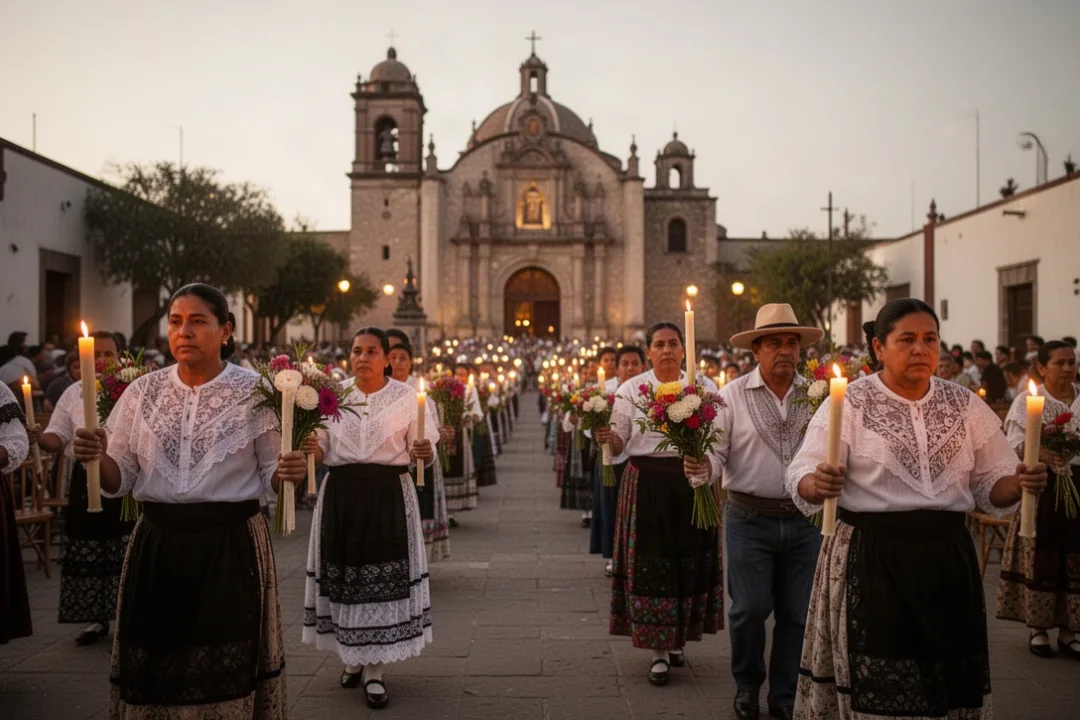
The main feast of the Virgin of Guadalupe is December 12. Celebrations often begin days earlier, especially in Mexican and Mexican American communities. Customs vary by parish and family, but many include Mass, music, prayers, processions, candles, flowers, and traditional foods.
One well-known custom is the singing of Las Mañanitas to Mary, often around midnight or in the early morning of December 12. The song functions as a birthday-style serenade, expressing affection and honor. Churches may also host dances, reenactments, cultural performances, or community meals.
Children and adults sometimes dress as Juan Diego or as Indigenous figures associated with the story. Families may make a pilgrimage on foot, light a candle before an image, or bring roses to a church. Some people make a promise to complete a pilgrimage or act of service as an expression of gratitude for a favor they believe they have received.
A typical celebration may include:
A novena: nine days of prayer leading up to the feast.
A pilgrimage: walking to a parish, shrine, or local Guadalupe altar.
A Mass: communal worship centered on Jesus and Mary’s role in Christian faith.
Music and dance: cultural expressions offered as prayer and celebration.
Food and fellowship: shared meals that bring families and neighbors together.
Works of mercy: donations, visits, or practical help for people in need.
In the United States, the feast may bring together Spanish-speaking and English-speaking Catholics. Parishes often combine regional traditions, and celebrations can include people whose families have lived in the United States for generations as well as recent immigrants. The devotion can therefore serve as a bridge between religious practice, family memory, and community identity.
The Basilica of Our Lady of Guadalupe in Mexico City is the most prominent pilgrimage destination connected with the devotion. Millions of people visit the area, especially around the feast, although the basilica’s importance is not limited to December. For those unable to travel, a small image in a home, car, workplace, or neighborhood chapel can serve as a local place of prayer.
Praying before Guadalupe does not require a specific object or special formula. A person might say the Rosary, ask Mary to pray for a family member, read the Gospel accounts of Jesus’ birth, or sit quietly with a concern. Catholic prayer ultimately addresses God, with Mary understood as an intercessor who brings people closer to her son.
How to approach Guadalupe with respect and understanding
If you are learning about the Virgin of Guadalupe, begin by recognizing that she is both a religious devotion and a living cultural tradition. A museum label, a history book, a parish celebration, and a family altar may each present a different aspect. None should automatically be assumed to explain the whole meaning of Guadalupe.
It helps to ask what kind of claim you are hearing. Is it part of the traditional apparition story? Is it a statement of Catholic doctrine? Is it a historical argument about sixteenth-century Mexico? Or is it a personal testimony from a devotee? Keeping those categories separate prevents confusion and allows the subject to be treated with both respect and accuracy.
Visitors to a Guadalupe celebration should also remember that it is not merely a cultural show. For many participants, the prayers, songs, candles, and processions are acts of worship and personal commitment. Photography may be welcome in some settings but not others, particularly during Mass or private prayer.
You can learn more respectfully by following a few practical guidelines:
Listen to devotees: ask how the image and feast matter in their own lives rather than assuming one meaning.
Use the full name when appropriate: “Our Lady of Guadalupe” is common in Catholic settings, while “Virgin of Guadalupe” is also widely used.
Separate history from legend: present traditional details as tradition when documentary certainty is limited.
Avoid treating sacred images as decorations alone: recognize their role in prayer and identity.
Learn the local context: a parish in Mexico, Texas, California, or another region may have distinct customs.
For Catholics, Guadalupe remains a reminder that God’s care is understood as reaching people in their language, land, and circumstances. For historians, the devotion offers a window into colonial Mexico, cultural exchange, and the formation of religious identity. For families, it may be a treasured connection to parents, grandparents, and the places they came from.
The enduring power of the Virgin of Guadalupe comes from those meanings held together: Mary, Juan Diego, Tepeyac, the tilma, Mexican history, and the daily prayers of ordinary people. Her image continues to invite questions about faith and culture, but for millions of believers her central message is simple: no one who seeks compassionate care is forgotten.
Frequently asked questions
Is the Virgin of Guadalupe the same as the Virgin Mary?
Yes. The Virgin of Guadalupe is a title and appearance associated with Mary, the mother of Jesus. Catholics use different titles for Mary to honor particular events, places, or aspects of her relationship with believers. Guadalupe refers specifically to the tradition connected with Tepeyac in Mexico and the image associated with Juan Diego.
When is the feast day of the Virgin of Guadalupe?
The feast day is December 12. Churches and families may begin observing it earlier with prayers, processions, music, or a novena. Celebrations often include Mass and community gatherings, while some devotees make a pilgrimage or offer flowers as a personal act of gratitude and devotion.
Where can the original Guadalupe image be seen?
The image traditionally associated with Guadalupe is displayed at the Basilica of Our Lady of Guadalupe in Mexico City, near Tepeyac Hill. It is protected and viewed by pilgrims from a distance. Local churches around the world often display faithful reproductions for prayer and community celebrations.
What does Juan Diego have to do with Guadalupe?
Juan Diego is the Indigenous Christian at the center of the traditional apparition account. Mary is said to have appeared to him at Tepeyac in 1531 and asked him to request a church from the bishop. The story says that flowers in his tilma and the resulting image served as the sign that confirmed his message.











Leave a Reply