The phrase Fatima miracles usually refers to the extraordinary events associated with the Marian apparitions reported in Fatima, Portugal, in 1917. The best-known event is the Miracle of the Sun on October 13, when a large crowd reported unusual movements and changes in the sun after three shepherd children said the Virgin Mary would provide a sign.
Other events connected with Fatima include reported healings, the children’s visions, and the later religious meaning attached to their message. The Catholic Church recognizes the Fatima apparitions as worthy of belief, but that recognition is not the same as scientific proof that every reported phenomenon had a supernatural cause.
Fatima is a town in central Portugal where three children reported seeing the Virgin Mary several times between May 13 and October 13, 1917. The children were Lucia dos Santos and her cousins, Francisco Marto and Jacinta Marto. They lived in a rural community and were tending sheep when the reported encounters began.
According to Lucia’s accounts, the apparition identified herself as “Our Lady of the Rosary” and asked for prayer, repentance, and the Rosary. The messages were given during a period marked by World War I, political unrest, and religious tension in Portugal. The children also said the apparition promised a public sign in October so that people would believe.
When people speak of Fatima miracles, they may mean several different things:
The Miracle of the Sun: the public event reported by a large crowd on October 13, 1917.
Private healings: physical recoveries that individuals or families have attributed to prayer or to Our Lady of Fatima.
The children’s experiences: visions, predictions, and events that believers regard as signs of divine activity.
Spiritual change: conversions, renewed prayer, reconciliation, or a return to Christian practice associated with devotion to Fatima.
These categories should not be treated as identical. A public event witnessed by many people, a personal healing, and a spiritual conversion involve different kinds of evidence. The term miracle is therefore used in both a formal religious sense and a broader devotional sense.
Keep the distinction clear: Catholic approval of Fatima concerns the legitimacy of the devotion and the reported apparitions. It does not require every unusual detail, healing claim, or interpretation connected with Fatima to be officially verified.
What happened during the 1917 apparitions
The first reported apparition took place on May 13, 1917, near the village of Aljustrel. Lucia, Francisco, and Jacinta said they saw a woman dressed in white above a small holm oak. They described the figure as brighter than ordinary light and said she asked them to return to the same place on the thirteenth day of each month.
The children continued to report apparitions in June, July, August, September, and October, although the August encounter did not occur at the usual site. Local authorities detained the children in August and questioned them, so they said the apparition appeared to them later at a place called Valinhos.
News of the reported visions spread quickly. Some people were curious, while others doubted the children or opposed the gatherings. By October, many thousands of people had traveled to Fatima, expecting the promised sign. Accounts differ in details, including the exact size of the crowd and what each person observed.
The reported message emphasized prayer for peace, especially through the Rosary, and called for conversion and penance. Lucia later connected the apparitions with requests concerning devotion to the Immaculate Heart of Mary and the consecration of Russia. These themes became central to Fatima devotion, but they are separate from the question of whether a physical miracle occurred.
The children also reported a vision of hell during the July apparition and spoke of future suffering, the end of the war, and the need for humanity to turn toward God. Because these accounts were recorded and interpreted over time, readers should distinguish between what the children reportedly said in 1917 and later explanations of those words.
The three children and their later lives
Francisco and Jacinta were younger than Lucia. After the apparitions, both died during the influenza pandemic that followed World War I. Francisco died in 1919, and Jacinta died in 1920. The Catholic Church canonized them in 2017, recognizing them as saints and presenting their lives as examples of prayer, sacrifice, and faith.
Lucia lived much longer and later became a Carmelite nun, taking the religious name Sister Maria Lucia of Jesus and of the Immaculate Heart. She wrote memoirs and other accounts about Fatima. Since much of the historical record depends on testimony given at different times, historians examine the timing, wording, circumstances, and development of those accounts.
The children’s deaths are sometimes described as additional Fatima miracles, but death itself is not a miracle in the formal Catholic sense. The religious significance lies in how believers understand the children’s faith and suffering, not in the fact that their lives ended young.
What witnesses reported during the Miracle of the Sun
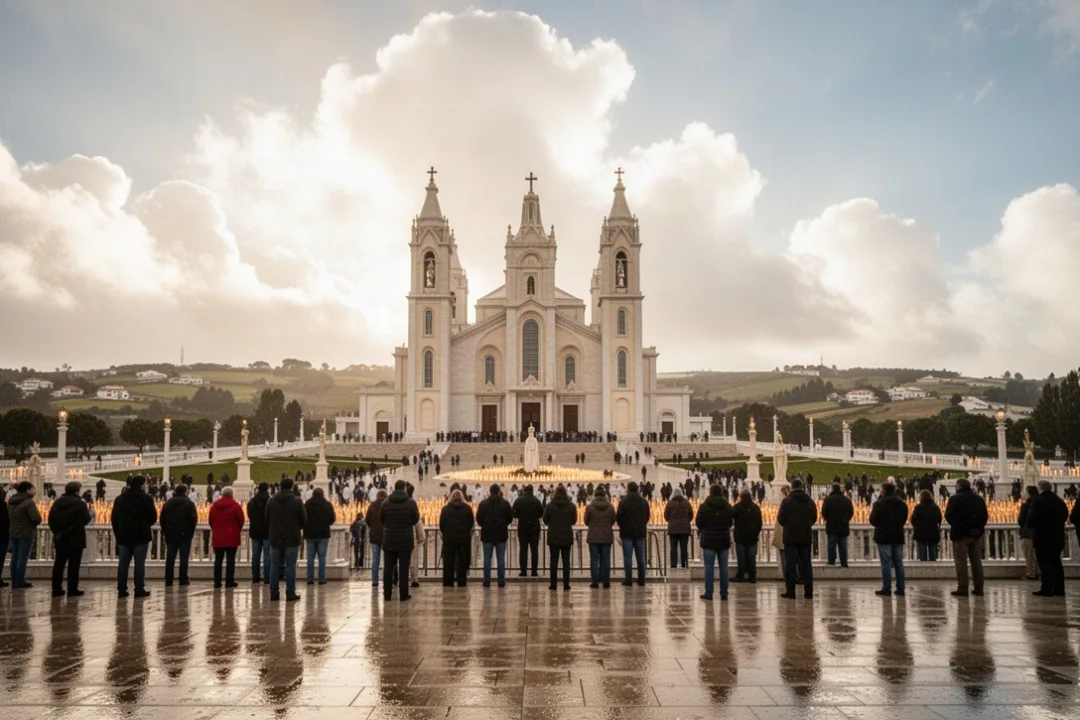
The Miracle of the Sun is the central public event associated with Fatima. On October 13, 1917, a crowd gathered near the Cova da Iria despite heavy rain. After the children reported seeing the apparition, many witnesses said the clouds opened and the sun appeared in an unusual way.
Reports described the sun as changing color, appearing to spin or move, and seeming to move toward the earth before returning to its usual position. Some witnesses said the event lasted several minutes. Others reported seeing little or nothing unusual. People at different distances also gave varying descriptions.
One feature frequently mentioned in eyewitness accounts is that the crowd’s soaked clothing seemed to dry quickly after the event. This detail appears in historical reports, but it is difficult to test scientifically because the accounts were written or collected under different conditions and do not provide controlled measurements.
Newspapers reported the event, and photographs of the crowd exist. However, a photograph of people looking toward the sky does not prove that the sun itself changed. It confirms that a large gathering took place and that people were reacting to something they considered remarkable.
Several natural explanations have been proposed for the reports. They include optical effects caused by looking toward a bright sun, atmospheric conditions, afterimages, cloud movement, and differences in perception among members of the crowd. Looking directly at the sun can also damage the eyes and create temporary visual effects. None of these explanations can establish exactly what every witness experienced.
From a Catholic perspective, the value of the event is not limited to a physical explanation. Believers see the Miracle of the Sun as a sign that supported the children’s testimony and directed attention to the call for prayer and conversion. Skeptics may accept that people sincerely reported an unusual experience while rejecting a supernatural interpretation.
Why accounts vary: The crowd was large and spread across an open area, so witnesses did not share identical viewing conditions. Different reports can reflect honest differences in location, eyesight, expectation, weather, and interpretation.
Visitors to Fatima have long prayed for physical and emotional healing. Some have credited the shrine, the intercession of Our Lady of Fatima, or the prayers of the children with recovery from illness. These stories are meaningful to the people involved, but a personal report is not automatically a formally recognized miracle.
The Catholic Church uses a careful process when it investigates an alleged healing. Medical records, the nature of the illness, the timing of the recovery, available treatments, and whether the improvement lasted may all be considered. A claim may be accepted as medically unexplained without the Church declaring that its supernatural cause has been proven.
For a healing to receive formal recognition in a Catholic context, investigators generally look for characteristics such as:
A serious illness or injury that was clearly documented.
A recovery that occurred rapidly or in a way doctors could not adequately explain.
A recovery that appears complete rather than temporary.
The absence of a convincing medical treatment or natural explanation.
Evidence that the improvement remained stable over time.
Even when doctors cannot explain a recovery, “medically unexplained” does not mean the same thing as scientifically proven supernatural intervention. Medical knowledge changes, records may be incomplete, and some illnesses have unpredictable courses. Religious authorities may still regard a healing as a sign of God’s action, but that judgment belongs to a different category from a laboratory finding.
Many people also use the word healing for experiences that are not physical. Someone may overcome fear, forgive another person, return to religious practice, or find peace after grief. These changes can be deeply important without meeting the Church’s criteria for a certified physical miracle.
If you are considering a pilgrimage or prayer for someone who is sick, it is sensible to combine spiritual support with qualified medical care. Devotion to Fatima does not replace diagnosis, treatment, medication, surgery, or emergency assistance.
What the Catholic Church officially recognizes
The local bishop of Leiria approved the cult associated with the Fatima apparitions in 1930. This means the Church judged the apparitions to be worthy of belief and permitted public devotion. The approval followed years of investigation and testimony, rather than occurring immediately after the events.
Church approval does not function like a scientific certification. It gives Catholics permission to accept the apparitions as credible in faith, while not requiring them to believe every private interpretation or prediction associated with Fatima. Catholics may practice the devotion, attend the shrine, and pray the Rosary without claiming that every reported phenomenon has been independently demonstrated.
The Vatican has also published materials concerning the so-called third part of the secret of Fatima. The text was made public in 2000, together with an interpretation connecting its imagery with persecution, suffering, and the assassination attempt against Pope John Paul II. Some people continue to dispute whether the published material fully answers every question, but speculation should not be confused with official teaching.
Fatima’s religious importance is often expressed through several practices:
Praying the Rosary, especially for peace and conversion.
Honoring Mary under the title Our Lady of Fatima.
Making acts of repentance and reparation.
Receiving the sacraments and seeking reconciliation.
Marking the thirteenth day of the month, particularly from May through October.
Visiting the Sanctuary of Fatima as a pilgrim.
These practices show why the apparitions remain significant even for people who are uncertain about the Miracle of the Sun. The heart of the devotion is not a demand to stare at the sky or chase unusual phenomena. It is a call to prayer, moral change, compassion, and trust in God during periods of violence and uncertainty.
Claims about Fatima should be approached with both respect and careful reasoning. Respect matters because witnesses and pilgrims may be describing experiences that genuinely changed their lives. Care matters because memory, expectation, group pressure, visual conditions, and later storytelling can affect how events are understood.
When evaluating a particular claim, ask what kind of claim it is. A report that thousands gathered in one location is historical and can be examined through documents and newspapers. A claim that the sun physically changed requires evidence of a different kind. A claim that a person experienced inner conversion cannot be measured in the same way as a claim about a medical recovery.
Useful questions include:
What is the original source? A firsthand account recorded near the time of the event is different from a story repeated many decades later.
Were witnesses independent? People who discussed expectations before an event may influence one another’s memories.
Did everyone observe the same thing? Variation does not automatically disprove an event, but it affects how confidently it can be described.
Are there alternative explanations? Weather, vision, illness, coincidence, and social expectation should be considered before concluding that an event was supernatural.
What does the Church actually claim? Official statements may be narrower than popular accounts or online speculation.
It is also helpful to avoid two opposite mistakes. One mistake is treating every extraordinary report as proof of a miracle. The other is assuming that a natural explanation for one aspect of an event makes every witness dishonest. People can sincerely describe unusual experiences even when their interpretation is uncertain.
For believers, the lasting message of Fatima may be found in the call to peace, prayer, repentance, and care for others. For historians, the apparitions provide a case study in religious experience, mass pilgrimage, journalism, and twentieth-century Catholic culture. For skeptics, the events raise questions about perception and collective expectation. These perspectives can be discussed without pretending that they are the same type of evidence.
Fatima miracles therefore occupy several levels of meaning. The Miracle of the Sun remains the most famous public claim, while reported healings and personal transformations continue to shape devotion. The Church’s position gives Fatima a recognized place in Catholic life, but it leaves room for prudence about claims that go beyond what has been officially established.
Frequently asked questions
Did the sun really move at Fatima?
Many witnesses reported that the sun appeared to move, spin, change color, or approach the earth on October 13, 1917. However, no scientific observation demonstrated that the sun physically moved. Possible explanations include optical effects, weather, and visual strain from looking toward bright light. Catholics may accept the event as a sign of faith, while historical and scientific conclusions remain more cautious.
How many people saw the Miracle of the Sun?
Historical accounts commonly describe a crowd of many thousands at the Cova da Iria, but exact estimates vary. Not everyone present reported the same experience, and some people said they saw nothing unusual. The size of the crowd supports the importance of the gathering, but it does not establish that every person witnessed an identical supernatural event.
Are Fatima healings officially recognized miracles?
Some people have attributed recoveries to prayer at Fatima, but personal testimonies and medically unexplained improvements are not automatically formal miracles. A recognized healing requires careful medical and religious investigation, including evidence about the original illness, the recovery, possible treatments, and its permanence. Many reported healings remain matters of personal belief rather than official certification.
Do Catholics have to believe in Fatima?
Catholics are not generally required to accept private revelations such as Fatima in the same way they accept central doctrines of the faith. Church approval means the devotion and reported apparitions are considered worthy of belief and compatible with Christian faith. A Catholic may practice the devotion while remaining cautious about particular predictions, interpretations, or alleged miracles.













Leave a Reply