If you have heard the name Saint Bernadette of Lourdes, you may wonder who she was and why a poor teenage girl from southern France became central to one of the world’s best-known Catholic pilgrimage sites. Bernadette was Bernadette Soubirous, a young miller’s daughter who reported seeing the Virgin Mary near a grotto in Lourdes in 1858.
Her story is not mainly about fame or dramatic achievement. It is about a girl who lived with poverty, illness, and social suspicion, yet remained consistent about what she had experienced. The apparitions led to the development of the Sanctuary of Our Lady of Lourdes, where millions of visitors have sought prayer, healing, and comfort.
Saint Bernadette was born Marie-Bernarde Soubirous on January 7, 1844, in Lourdes, a town in the Hautes-Pyrénées region of France. Her family was poor, and Bernadette was the eldest child in a household that struggled financially after her father’s business failed.
The family lived for a period in a former prison cell known as the Cachot. Bernadette’s health was fragile, and she suffered from asthma and other illnesses during her life. She also had limited formal education and was still preparing for her First Communion when the apparitions began.
Bernadette’s lack of education became significant because church officials and local authorities questioned whether she could have invented a religious message. She did not present herself as a theologian or visionary. Instead, she repeated what she had seen and heard in simple, steady language.
On February 11, 1858, Bernadette went with her sister Toinette and a friend to gather firewood near the Massabielle grotto, beside the Gave de Pau River. There, she said she saw a woman dressed in white with a blue sash and a yellow rose on each foot. Bernadette referred to the figure at first as Aquerò, meaning “that one” in the local dialect.
At a glance: Bernadette was 14 when the apparitions began. They occurred at Massabielle between February 11 and July 16, 1858, with the most commonly cited count being 18 appearances.
What happened during the Lourdes apparitions?
The first apparition took place on February 11, 1858. Bernadette said the woman invited her to return to the grotto. At first, her family did not know what to make of the account, and some people suspected that she was imagining things or seeking attention.
Bernadette returned repeatedly over the following weeks. The gatherings gradually attracted neighbors and curious observers, although Bernadette maintained that the woman appeared to her rather than to the crowd. Her descriptions remained focused on the figure’s clothing, gestures, and words rather than on elaborate visual details.
During one apparition, Bernadette was told to pray for sinners. She was also asked to do penance and to pray for the conversion of people who had turned away from God. These requests reflected familiar Catholic devotional themes, but their public setting made the events unusual and controversial.
At another visit, Bernadette was instructed to wash and drink from the spring. Since there was no visible spring at that spot, she scraped at the muddy ground and tried to drink from the small amount of water that appeared. The area later developed into the Lourdes water source associated with the shrine.
The woman also asked for a chapel to be built at the grotto and for people to come there in procession. These requests helped shape Lourdes as a place of communal prayer rather than a private vision known only to Bernadette.
What did Bernadette say the woman called herself?
On March 25, 1858, the woman reportedly identified herself with the words “I am the Immaculate Conception.” Bernadette repeated the phrase to her parish priest and others, even though she did not fully understand its theological meaning.
The phrase referred to the Catholic doctrine that Mary was preserved from original sin from the beginning of her existence. Pope Pius IX had formally defined that doctrine in 1854, only a few years before the Lourdes events. Church authorities later viewed Bernadette’s report as significant because of her limited religious education.
The final reported apparition took place on July 16, 1858, the feast of Our Lady of Mount Carmel. By then, civil authorities had tried to restrict access to the grotto, and public interest had grown considerably. Bernadette’s encounters did not continue after that date.
How did the Catholic Church investigate Lourdes?
The Church did not immediately declare the apparitions authentic. Bernadette was questioned by family members, priests, civil officials, and other observers. Some people believed her, while others accused her of fabrication, mental confusion, or being influenced by adults around her.
The local bishop, Laurence of Tarbes, established an investigation into the reports. Church officials examined Bernadette’s character, the consistency of her testimony, the content of the messages, and the religious effects associated with the grotto.
On January 18, 1862, Bishop Laurence issued a declaration accepting the apparitions as worthy of belief. This did not mean that Catholics were required to believe in them in the same way they are required to accept central teachings of the faith. Private revelations, even when approved, are intended to support Christian faith rather than add new doctrine.
The Lourdes shrine expanded after the recognition. The Crypt was the first church built over the grotto, followed by the Basilica of the Immaculate Conception and other places of worship. Pilgrims began arriving from France and later from countries throughout the world.
What is the meaning of the Lourdes message?
The message associated with Lourdes centers on prayer, repentance, humility, and care for the suffering. Bernadette was asked to pray for sinners, perform acts of penance, and encourage people to come to the grotto in procession. These themes fit the broader Christian call to conversion and mercy.
The spring has also become a powerful symbol. Water can suggest cleansing, baptism, healing, and new life, but the shrine does not teach that the water works as a magical substance. Pilgrims generally use it as part of prayer, trusting in God rather than treating the water as a charm.
Lourdes is especially associated with people who are sick or disabled. The shrine welcomes the ill through organized pilgrimages, medical assistance, hospitality, and sacramental life. The presence of suffering is not hidden or treated as a failure of faith.
Not every person who prays at Lourdes receives a physical cure. The Catholic understanding of healing includes spiritual strength, peace, reconciliation, and the grace to face illness with support. Physical healings are investigated carefully rather than automatically accepted as miracles.
“I am the Immaculate Conception.”
This short reported phrase became the best-known statement connected with Lourdes. It matters not because it turned Bernadette into an independent source of doctrine, but because it linked the reported apparition to Mary’s role in Catholic belief.
What was Saint Bernadette’s life after the apparitions?
After the apparitions, Bernadette did not become the permanent public leader of Lourdes. She disliked attention and faced continuing questions about what she had seen. Her family remained poor, and she continued to experience health problems.
Bernadette entered the Sisters of Charity of Nevers in 1866. She took the religious name Sister Marie-Bernarde and moved to the convent in Nevers, where she spent the rest of her life. Her duties included prayer, work in the infirmary, and sewing, although illness often limited what she could do.
Life in the convent was not free from difficulty. Bernadette experienced pain, respiratory problems, and periods of weakness. She also had to answer questions from visitors and Church representatives who wanted to hear her account of Lourdes directly.
She died on April 16, 1879, at the age of 35. Her final years were marked by illness, prayer, and a strong desire to remain faithful to the ordinary religious life she had chosen rather than to the public reputation created by the apparitions.
The Church beatified Bernadette in 1925 and canonized her on December 8, 1933. Her feast day is generally celebrated on February 18, while February 11 is observed as the feast of Our Lady of Lourdes and, in the Catholic calendar, the World Day of the Sick.
Why is Saint Bernadette important to Catholics?
Bernadette is often remembered as a saint of humility and perseverance. She was not influential because of wealth, education, or social position. Her importance comes from the way she responded to an extraordinary experience while remaining connected to ordinary duties, family hardship, illness, and prayer.
Her life also challenges the assumption that holiness must look impressive. Bernadette did not found a large movement, write a major theological work, or live without physical suffering. Her spiritual path involved accepting limits and continuing to act faithfully within them.
Many Catholics pray to Saint Bernadette for people who are sick, poor, misunderstood, or facing persistent hardship. She is also associated with young people, shepherds, hospital workers, and Lourdes pilgrims. Her example can be meaningful to anyone who feels overlooked or lacks confidence in speaking about a difficult experience.
Her story should not be reduced to the question of whether a person will receive a cure. The deeper question is how prayer changes the way people face suffering, responsibility, uncertainty, and the needs of others.
What can visitors find at the Sanctuary of Lourdes?
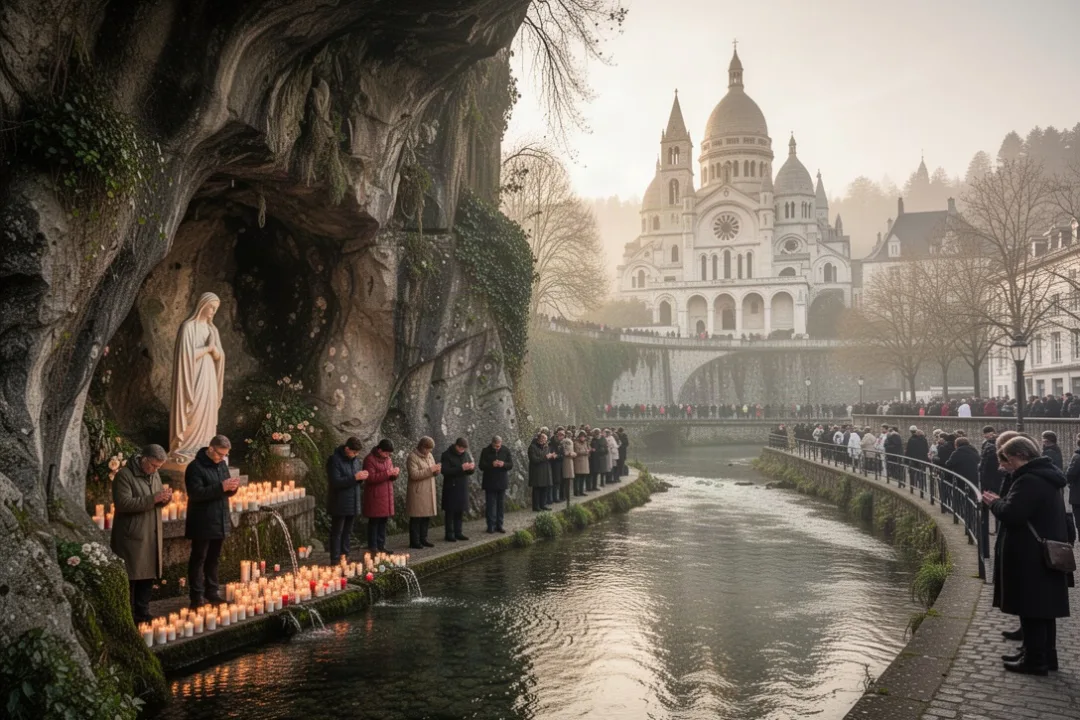
The Sanctuary of Our Lady of Lourdes includes the Massabielle grotto, where Bernadette reported the apparitions. Visitors may pray near the grotto, attend Mass, join processions, celebrate the sacrament of reconciliation, or take part in services connected with the sick.
The sanctuary contains several churches and chapels built at different times. The Basilica of the Immaculate Conception stands above the grotto, while the Rosary Basilica is known for its mosaics. The underground Basilica of Saint Pius X accommodates large gatherings and liturgies.
Pilgrims may also visit places connected with Bernadette’s life, including the Cachot, where her family lived for a time, and the Moulin de Boly, her birthplace. These sites help place the apparitions within the real conditions of nineteenth-century Lourdes rather than presenting Bernadette as a distant religious symbol.
The sanctuary’s ministry includes special care for people with disabilities and serious illnesses. Volunteers, medical personnel, religious communities, and pilgrimage groups help make participation possible for visitors who could not manage the journey without assistance.
How are Lourdes healings evaluated?
Lourdes has long been connected with reports of physical healing, but the Catholic Church uses a process intended to separate medically unexplained recoveries from ordinary improvement or incomplete diagnosis. The Lourdes Medical Bureau reviews cases and may request medical records, examinations, and long-term follow-up.
A recovery is not automatically declared miraculous when doctors cannot explain it. The case may be examined over time, and a diocesan bishop ultimately evaluates whether a particular healing should be formally recognized as a miracle. The process is cautious because medical knowledge can change and because extraordinary claims require careful evidence.
The shrine’s medical approach is unusual within religious pilgrimage sites because it invites doctors of different beliefs to participate in reviewing cases. The purpose is not to pressure anyone into belief, but to assess whether a reported recovery meets demanding medical and religious standards.
Keep the focus clear: Lourdes is a place of prayer, not a guarantee of physical recovery. Visitors can seek healing while also receiving medical care, following professional advice, and supporting the dignity of every sick person.
Common mistakes when learning about Saint Bernadette
Confusing Bernadette with Mary: Bernadette was the visionary; Mary was the figure she said appeared to her.
Assuming every visitor sees an apparition: The reported visions were specific to Bernadette, not a repeated public spectacle.
Treating Lourdes water as magic: Catholic devotion understands it as a sign used in prayer, not as an independent supernatural substance.
Thinking Church approval makes belief compulsory: Approved private revelations may be accepted as spiritually credible, but they are not equal to required articles of faith.
Remembering only the grotto: Bernadette spent most of her later life in Nevers, living with illness and religious responsibilities away from Lourdes.
Expecting a cure as proof of faith: The absence of physical healing does not mean that a sick person prayed incorrectly or lacked faith.
How can you honor Saint Bernadette in daily life?
You do not need to travel to France to reflect on Bernadette’s example. Her spirituality can be expressed through practical acts of prayer, patience, and attention to people who are suffering. The emphasis is less on copying the external details of Lourdes and more on responding faithfully to the needs in front of you.
Pray for someone who is sick or isolated. Use Saint Bernadette’s name as a reminder to include people whose suffering is easy to overlook.
Visit or contact someone who needs support. A phone call, meal, transportation, or quiet presence can be more useful than vague promises to help.
Practice honest humility. Bernadette did not claim expertise she did not possess. You can speak truthfully about what you know, what you believe, and what remains uncertain.
Make room for repentance and reconciliation. The Lourdes message repeatedly returns to conversion, prayer, and a renewed relationship with God.
Respect medical care. Prayer and professional treatment do not have to be opponents. Supporting a sick person includes respecting informed medical decisions.
Learn the history before sharing it. Accurate details prevent devotional stories from turning Bernadette into a caricature or promising results the shrine itself does not promise.
What does Bernadette’s example say to people facing illness?
Bernadette’s own health problems make her especially meaningful to people who live with chronic pain or disability. She was not a saint who escaped bodily weakness. Her life shows that physical limitation can shape a person’s vocation without defining the whole of that person’s worth.
Her example also makes room for frustration. Christian devotion does not require someone to pretend that illness is easy or that every unanswered prayer feels peaceful. People can seek help, grieve losses, ask difficult questions, and still pray.
At Lourdes, the sick are not merely objects of charity. They participate in worship, carry their own hopes, encourage one another, and often become sources of courage for healthier pilgrims. That shared dignity reflects one of the most enduring aspects of Bernadette’s legacy.
How should Saint Bernadette’s story be understood today?
Saint Bernadette can be understood at several levels: as a young woman in nineteenth-century France, as a Catholic religious sister, as the reported visionary of Lourdes, and as a saint whose life continues to shape care for the sick. Holding these aspects together gives a more accurate picture than focusing only on miracles or appearances.
Her story invites careful faith rather than sensationalism. The apparitions remain a matter of religious belief, while Bernadette’s poverty, illness, discipline, and treatment of others are historical features of a life that can be studied and admired even by people who approach the supernatural claims differently.
For Catholics, Lourdes points toward Mary, Christ, prayer, repentance, and compassion. For visitors of many backgrounds, the shrine can also be a place to sit quietly, remember loved ones, seek strength, or accompany someone whose life has been changed by illness.
Bernadette’s lasting influence comes from the combination of the extraordinary and the ordinary: a report of visions at a grotto, followed by years of hidden work, sickness, prayer, and service. That combination is why Saint Bernadette of Lourdes remains more than a name associated with a pilgrimage site; she is remembered as a person who endured attention without seeking it and suffering without allowing it to erase her humanity.
Frequently asked questions
What is Saint Bernadette the patron saint of?
Saint Bernadette is commonly associated with illness, poverty, shepherds, and people who visit Lourdes. Many people also ask for her intercession when dealing with chronic health conditions, disability, or social hardship. These associations reflect both her personal experience of illness and poverty and the role Lourdes has developed as a major place of prayer for the sick.
Where is Saint Bernadette buried?
Saint Bernadette’s body is preserved at the convent of the Sisters of Charity of Nevers in Nevers, France. Her shrine there is separate from the grotto and basilicas at Lourdes. Visitors can learn about her religious life in Nevers, where she lived after entering the convent and remained until her death in 1879.
Did Saint Bernadette claim that everyone would be healed at Lourdes?
No. The Lourdes tradition does not promise a physical cure to every visitor. People come to pray, receive support, seek reconciliation, and ask for healing, but many remain ill. Reported physical recoveries are examined through a formal medical and Church process rather than accepted automatically.
What is Saint Bernadette’s feast day?
Saint Bernadette’s feast day is generally celebrated on February 18. February 11 is the feast of Our Lady of Lourdes and is also associated with the World Day of the Sick. Both dates are connected with her story, but they honor different aspects of the Lourdes tradition.












Leave a Reply