The feast day of Our Lady of Fatima is celebrated on May 13. It commemorates the first reported apparition of the Virgin Mary to three shepherd children at Fatima, Portugal, on May 13, 1917.
For Catholics, the day is marked through Mass, the Rosary, prayer for peace, and acts of conversion. It is a Marian observance, but May 13 is not generally a holy day of obligation for Catholics in the United States. Local parishes and dioceses may observe it with different levels of solemnity.
On May 13, 1917, three children—Lucia dos Santos and her cousins Francisco and Jacinta Marto—reported seeing a woman brighter than the sun while tending sheep near the village of Fatima. The children said the woman asked them to return to the same place on the thirteenth day of each month.
The reported apparitions continued from May through October 1917, with the exception of August, when the children were prevented from reaching the meeting place on the expected date. The August apparition was later reported to have taken place on August 19.
The May 13 feast focuses especially on the first apparition. It does not attempt to recreate every event associated with Fatima. Instead, it provides a liturgical and devotional occasion to reflect on the central themes connected with the message: prayer, repentance, conversion, the Rosary, and concern for peace.
Calendar note: May 13 is the traditional feast day of Our Lady of Fatima. Its exact liturgical rank and the way it is celebrated can vary by country, diocese, religious community, or parish.
The Fatima story in its historical context
Fatima was a rural community in central Portugal during a period marked by the First World War, political instability, and religious tension. Lucia was born in 1907, while Francisco and Jacinta were younger. They were children from Catholic families who practiced a simple rural faith.
Before the reported Marian apparitions, the children said they had experienced appearances of an angel in 1916. These experiences were described as calls to prayer and penance. The Fatima story therefore places the 1917 apparitions within a wider period of spiritual preparation rather than treating May 13 as an isolated event.
According to the children’s accounts, the woman who appeared identified herself during the October event as Our Lady of the Rosary. She urged prayer, especially the daily Rosary, and connected prayer with the needs of the world. The title “Our Lady of Fatima” comes from the place where the apparitions were reported, not from a separate name for Mary in the Bible.
The Catholic Church investigated the reports over several years. In 1930, the bishop of Leiria authorized the devotion and permitted the celebration of the apparitions, while recognizing them as worthy of belief. Catholics are not required to accept private revelations in the same way they accept the central teachings of the faith.
How to observe the feast day of Our Lady of Fatima
You do not need to travel to Portugal or attend an elaborate ceremony to observe May 13. A faithful observance can be simple, centered on prayer and a sincere effort to respond to the spiritual themes associated with Fatima.
Attend Mass if possible. Check your parish schedule because the feast may be included in a weekday Mass, celebrated with a special Marian devotion, or observed privately by individuals.
Pray the Rosary. You may pray all five decades or choose one set of mysteries according to your time and circumstances. Offer the prayer for peace, conversion, your family, or a specific need.
Read about the apparitions carefully. Use a reliable Catholic source, parish resource, or approved devotional material rather than relying only on sensational accounts.
Examine your life. Consider where you need greater honesty, forgiveness, patience, or faithfulness. Fatima’s emphasis on conversion is practical, not merely historical.
Make an act of charity. Help someone who is lonely, burdened, poor, or in need of encouragement. Prayer for peace is strengthened when it affects the way you treat other people.
Pray for peace. Include families affected by war, violence, persecution, and displacement, as well as the leaders responsible for protecting human life.
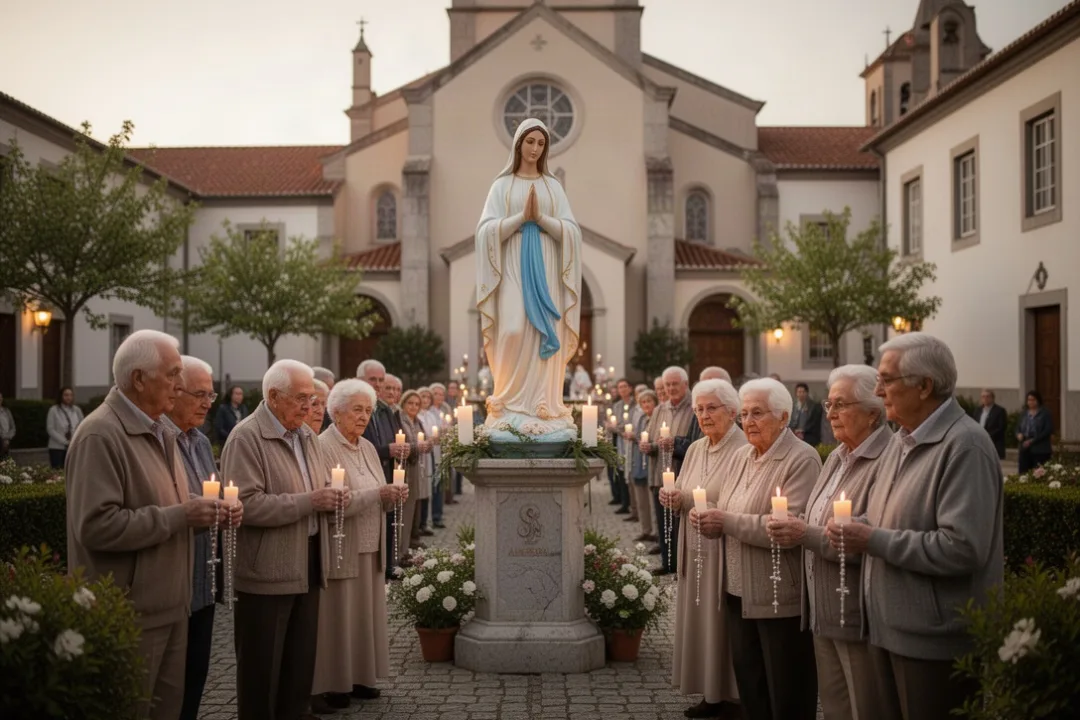
Some people also display an image or statue of Our Lady of Fatima, light a candle where permitted, or take part in a parish procession. These practices can support prayer, but the object itself is not the focus. Mary is honored as a person who points Christians toward Christ, not worshiped as a goddess or independent source of salvation.
What the message of Fatima emphasizes
The Fatima message is commonly summarized through several connected themes. These themes should be understood together, because prayer without conversion can become routine, while concern about world events without trust in God can become fear-driven.
Prayer: The children were repeatedly associated with prayer, especially the Rosary and prayer for sinners.
Repentance: Fatima calls people to turn away from sin and take the moral life seriously.
Penance: Sacrifice and self-denial are presented as ways to unite personal hardship with prayer and concern for others.
Peace: The devotion connects spiritual renewal with prayer for peace in the world.
Hope: The message does not end with disaster or punishment. It points toward God’s mercy and the possibility of restoration.
Mary’s guidance: Mary’s role is understood as leading people toward Jesus, the sacraments, and a life shaped by the Gospel.
These themes fit within broader Christian teaching. The call to repentance echoes the preaching of John the Baptist and Jesus. The attention to prayer recalls Jesus’ teaching in Matthew 6 and Luke 11. The concern for peace reflects the biblical blessing of peacemakers in Matthew 5 and the Christian duty to love one’s neighbor.
Fatima is therefore best approached as a devotional call to live the faith more seriously. It should not be treated as a substitute for Scripture, the sacraments, the teaching of the Church, or responsible moral judgment.
The three children connected with Fatima
Lucia dos Santos was the oldest of the three children and the principal surviving witness to the apparitions. After the events at Fatima, she entered religious life and later became known as Sister Lucia. Her written memoirs and other accounts helped preserve the children’s testimony, although individual accounts should be read with attention to their historical setting and development over time.
Francisco Marto was known in the Fatima tradition for his contemplative response to the apparitions. He died in 1919 after an illness. Jacinta Marto, his younger sister, died in 1920. The Catholic Church later recognized both children as saints, and their liturgical memorial is celebrated on February 20.
The canonization of Francisco and Jacinta in 2017 placed particular attention on their holiness as children. Their example does not suggest that children must copy every detail of their lives. It highlights qualities such as prayer, compassion, courage, and willingness to endure difficulty without abandoning faith.
The children’s age also affects how the message is understood. They were not political leaders or theologians. They described what they believed they had experienced, and the Church’s approval of the devotion does not turn every private detail of their memories into a doctrine binding on all Catholics.
The importance of the Rosary on May 13
The Rosary is closely associated with Fatima because the reported apparitions repeatedly emphasized it. A Rosary combines vocal prayer with meditation on significant events in the lives of Jesus and Mary. Its repeated structure can help you remain attentive to the mysteries rather than trying to produce complicated words.
On the feast day, you can pray the Joyful, Sorrowful, Glorious, or Luminous Mysteries. The traditional assignment of mysteries to different days varies among communities, so there is no need to treat one set as the only acceptable choice. Choose the mysteries that best fit your parish practice or personal intention.
A simple prayer routine might look like this:
Begin with a quiet moment and name your intention.
Pray the opening prayers of the Rosary at a measured pace.
Announce each mystery and spend a short time considering its connection to Christ.
Pray each decade without rushing, allowing the repeated words to support meditation.
End by asking for help in carrying the feast’s themes into your actions.
The Rosary is not a magical formula. Its value comes from faithful attention, humility, and relationship with God. If you become distracted, gently return to the mystery. A shorter prayer prayed sincerely is better than abandoning prayer because you cannot create perfect concentration.
How the First Saturday devotion relates to Fatima
Many people associate Our Lady of Fatima with the First Five Saturdays devotion. This practice is related to Fatima but is not the same thing as the May 13 feast day. It is connected especially with reported later revelations to Sister Lucia and includes receiving Communion, going to confession, praying a Rosary, and spending time meditating on the mysteries of the Rosary on five consecutive first Saturdays, with the intention of making reparation.
Specific conditions and timing can be explained differently in devotional materials, so you may want to ask a priest or consult an approved Catholic resource before beginning the practice. The devotion should be approached as an invitation to deeper prayer and repentance, not as a transaction that guarantees a desired outcome.
May 13 is also distinct from October 13, which recalls the final reported apparition and the event commonly associated with the “Miracle of the Sun.” Both dates appear in Fatima devotion, but they highlight different moments in the story. A parish may observe either date with a Rosary, procession, Eucharistic celebration, or other public prayer.
Keep the focus balanced: Fatima devotion should lead to Christ, the Gospel, prayer, repentance, and charity. Predictions, fear, and speculation about current events should not replace those central practices.
The apparitions are often discussed through the “three secrets of Fatima,” although this phrase can make the message sound more mysterious than it is. The first two parts were recorded by Lucia and later made public. They involved a vision of hell, a call to devotion to Mary’s Immaculate Heart, concern about war and persecution, and a request for the consecration of Russia in connection with peace.
The third part was written separately and released by the Holy See in 2000. It described a symbolic vision involving suffering, persecution, and the Church. The text has been interpreted in relation to the twentieth century, including the attempted assassination of Pope John Paul II, but Catholic devotion does not require treating every interpretation as settled doctrine.
Several points can prevent confusion:
The secrets are part of private revelation, not a new addition to the deposit of faith.
They do not provide a timetable for the end of the world.
They should not be used to identify political figures or ordinary disasters as certain fulfillments.
Their spiritual purpose is connected with prayer, conversion, sacrifice, and trust in God.
Curiosity about hidden details should not become more important than the ordinary duties of Christian life.
The third secret is sometimes presented online as if the Church concealed an additional message beyond the published text. Claims of this kind require careful verification. Reliable Catholic sources distinguish between the original document, official commentary, later interpretations, and unsupported speculation.
Our Lady of Fatima and prayer for peace
Peace is one of the strongest reasons people observe May 13. The Fatima tradition developed during wartime, and its prayers have continued to be used for people suffering from armed conflict, persecution, terrorism, and political violence. A parish celebration may therefore include petitions for nations, civilians, military personnel, refugees, and leaders.
Prayer for peace is not limited to international affairs. It also includes the smaller conflicts that shape family and community life. You might pray for reconciliation after an argument, wisdom in a difficult marriage, healing between relatives, or restraint when public disagreement becomes hostile.
Christian peace does not mean ignoring injustice or pretending that serious harm does not matter. It includes a desire for truth, protection of the vulnerable, fair judgment, and the conversion of those who cause violence. Prayer can be joined with concrete responsibility, such as supporting relief work, visiting someone in distress, or refusing to spread unverified claims that increase fear.
How parishes commonly celebrate May 13
There is no single required format for celebrating the feast. A parish may observe it quietly during a weekday Mass or organize a larger event, especially if it has a strong Portuguese, Brazilian, Hispanic, or other Catholic community connected with Fatima devotion.
Common elements include:
A Mass with prayers honoring the Blessed Virgin Mary.
A public or private recitation of the Rosary.
A candlelight procession or procession with a statue of Our Lady of Fatima.
Marian hymns and a homily about conversion, prayer, or peace.
Exposition of the Blessed Sacrament or a time of Eucharistic adoration.
Confession and opportunities for spiritual counsel.
Prayers for the sick, families, the Church, and nations affected by war.
If you plan to attend, check whether the event is a liturgy, a devotional service, or a procession. A procession can be meaningful, but it is not a replacement for Sunday Mass or the sacraments. Follow local instructions about candles, outdoor walking routes, accessibility, and photography.
What Catholics are and are not required to believe
The apparitions of Fatima are classified as a form of private revelation. This means they may help some Catholics live the Christian faith, but they do not add new public revelation that every Christian must accept. The core of Catholic faith comes from Christ, Scripture, and apostolic Tradition as taught by the Church.
A Catholic may therefore attend a Fatima celebration while maintaining a careful and well-formed approach to the apparitions. You can honor Mary, pray the Rosary, and seek conversion without accepting every dramatic story circulated about Fatima. You can also be devoted to Mary without making Fatima your preferred Marian devotion.
The Church’s recognition of a Marian devotion generally concerns whether it is compatible with faith and morals and may be practiced safely by the faithful. It does not mean that every private interpretation, alleged prediction, or devotional image has equal authority.
This distinction is useful when discussing Fatima with family members or friends who have different levels of interest. A respectful conversation can focus on prayer, peace, and the lives of the children rather than turning the feast into an argument about speculation.
You can create a short personal observance even if you cannot attend a parish service. Begin with the sign of the cross, read a trustworthy account of the May 13 apparition, and spend several minutes in silence. Then pray a decade or a full Rosary according to your circumstances.
Possible intentions include:
For peace in places affected by war and violence.
For people who have lost family members, homes, or security.
For the conversion of hearts and the healing of divisions.
For children who are afraid, neglected, or exposed to violence.
For greater faithfulness in your own family and parish.
For the grace to forgive, make amends, and serve someone in need.
If you use a Marian prayer, keep its meaning clear. Asking Mary to pray for you is similar to asking another Christian for prayer, while recognizing her unique place as the mother of Jesus. Catholic devotion honors Mary because of what God has done through her and because she directs believers toward her Son.
The most useful observance is one that continues beyond May 13. A daily Rosary, regular examination of conscience, Sunday worship, sacramental confession when appropriate, and acts of mercy can give the feast lasting substance. The date is a reminder; the Christian life is the response.
Common misunderstandings about the feast
Some people assume that May 13 is a universal obligation or a major solemnity everywhere. It is not generally a holy day of obligation in the United States, and local calendars differ. Your parish bulletin or diocesan calendar is the best source for the schedule in your area.
Others assume that every image labeled “Our Lady of Fatima” represents a precise historical description. Statues and paintings are devotional art, and their details can vary. They may show Mary with a white garment, a rosary, and a star-topped crown, but these artistic features should not be confused with a photograph or an official doctrinal portrait.
It is also a mistake to reduce Fatima to predictions about catastrophe. The feast is not designed to feed anxiety about news events. Its central invitation is to pray, turn away from sin, seek peace, and trust God while acting responsibly in the world.
May 13 can therefore be observed by Catholics with both devotion and discernment. The date recalls a specific event in Portugal, but its spiritual purpose reaches beyond geography: prayer should shape conduct, repentance should produce change, and hope should lead to faithful action.
Frequently asked questions
Is the feast day of Our Lady of Fatima always May 13?
Yes. May 13 is the established feast day associated with the first reported apparition at Fatima in 1917. Local calendars may give the observance a different liturgical rank or transfer a parish celebration to another convenient date, especially when pastoral scheduling is involved. October 13 is also significant because it recalls the final reported apparition, but it is not the principal feast date.
Is May 13 a holy day of obligation?
Generally, no. In the United States, the feast day of Our Lady of Fatima is not normally a holy day of obligation. You may still attend Mass, pray the Rosary, or join a parish procession as a voluntary devotion. Requirements can differ in other countries or under local diocesan arrangements, so consult your parish or diocese for the applicable calendar.
What should I pray on May 13?
The Rosary is the prayer most closely associated with Fatima, and you can offer it for peace, conversion, the sick, or your family. You may also attend Mass, spend time in silent prayer, read the Gospel, go to confession when appropriate, or perform an act of charity. No special prayer is required for the feast to be meaningful.
Are Catholics required to believe the apparitions at Fatima?
No. Fatima is considered private revelation, so Catholics may accept its spiritual value without treating it as a required article of faith. The Church permits the devotion because it is judged compatible with Christian faith and morals. Catholics should distinguish approved devotion from later predictions, sensational claims, or personal interpretations that may circulate online.










Leave a Reply