Our Lady of Perpetual Help is a Catholic title for Mary associated with a beloved icon of the Virgin Mary holding the child Jesus. The title points to Mary’s continuing care: she helps Christians turn toward Christ, especially when they are afraid, grieving, sick, or unsure what to do next.
The prayer is not meant to replace a direct relationship with God. Instead, it reflects the Catholic practice of asking Mary to pray with you and for you. Catholics believe that Mary’s role always leads to Jesus, just as the icon shows the child Jesus at the center of her arms.
“Perpetual help” does not mean that every request will receive the exact answer you want. It means that you can seek Mary’s intercession at any time and trust that God’s care is not limited by the hour, the seriousness of the problem, or your own ability to find the right words.
Remember: This devotion is an invitation to bring your needs to Christ through Mary’s prayer, not a promise that prayer will remove every hardship immediately.
You may pray this devotion in a church, at home, beside a hospital bed, or quietly during an ordinary day. A formal prayer is helpful, but sincere words spoken in your own language are also appropriate. The essential movement is simple: turn to God, ask for help, and remain open to grace, wisdom, courage, and peace.
A traditional prayer to Our Lady of Perpetual Help
There are several prayers and novena versions connected with Our Lady of Perpetual Help. The wording can differ among parishes, prayer books, and religious communities. The following is a clear, original form that preserves the central themes of the devotion.
Our Lady of Perpetual Help, loving Mother of God, I come before you with trust. You know my needs, my worries, my weaknesses, and the burdens I carry. Bring me closer to your Son, Jesus, and ask him to give me the grace I need today.
Help me to follow Christ with a faithful heart. Obtain for me wisdom in difficult decisions, strength in suffering, healing according to God’s will, and peace when I am afraid. Watch over my family and all those who need your care.
Mother of Perpetual Help, teach me to rely on God rather than on fear. Help me to forgive, to serve others, and to persevere in hope. Stay near me throughout my life, and lead me safely to your Son. Amen.
You can pray the entire form slowly, or use a single line that speaks to your circumstances. For example, you might repeat, “Bring me closer to your Son”, when you feel spiritually distracted, or “Give me wisdom in difficult decisions” before an important conversation.
Some people add a personal petition after the opening paragraph. Keep it specific and honest: mention a medical concern, a strained relationship, financial pressure, a child’s needs, or the desire to grow in patience. You do not need to use polished religious language. A direct request can be deeply prayerful.
For illness: “Mary, pray that I may receive healing, courage, and wise care.”
For anxiety: “Help me place this fear in God’s hands and take the next faithful step.”
For family concerns: “Watch over the people I love and guide us toward understanding.”
For discernment: “Ask Jesus to give me clarity, patience, and freedom from selfish motives.”
For grief: “Remain near me as I mourn, and lead me toward hope.”
How the icon supports the prayer
The image associated with Our Lady of Perpetual Help is an Eastern Christian icon traditionally identified with the Virgin Mary and the child Jesus. The icon shows Mary holding Jesus while angels present instruments associated with his future suffering. Jesus appears to turn toward his mother, and one of his sandals is shown slipping from his foot.
These details invite reflection on both tenderness and suffering. The child Jesus is not shown as unaware of danger. He sees what is represented by the angels, yet he seeks security in his mother’s embrace. Mary’s expression directs attention beyond herself, toward the person praying and toward her son.
The icon’s symbolic details can shape your prayer in several ways:
Mary’s eyes: They are often understood as looking outward toward the person who comes to her, suggesting attentive care.
Jesus’ posture: His movement toward Mary can represent trust, vulnerability, and the comfort of seeking refuge.
The angels: Their presence points to Christ’s saving mission and the suffering he will endure.
Mary’s hands: She holds Jesus securely while also directing attention toward him rather than claiming attention for herself.
The slipped sandal: This small detail is commonly read as a sign of the child’s startled movement and human vulnerability.
The icon is not an object believed to possess magical power. Its purpose is to help you remember the Gospel, collect your attention, and contemplate Mary’s relationship with Jesus. You can pray before an image, but you can also pray without one. The faith expressed by the devotion does not depend on owning a particular picture.
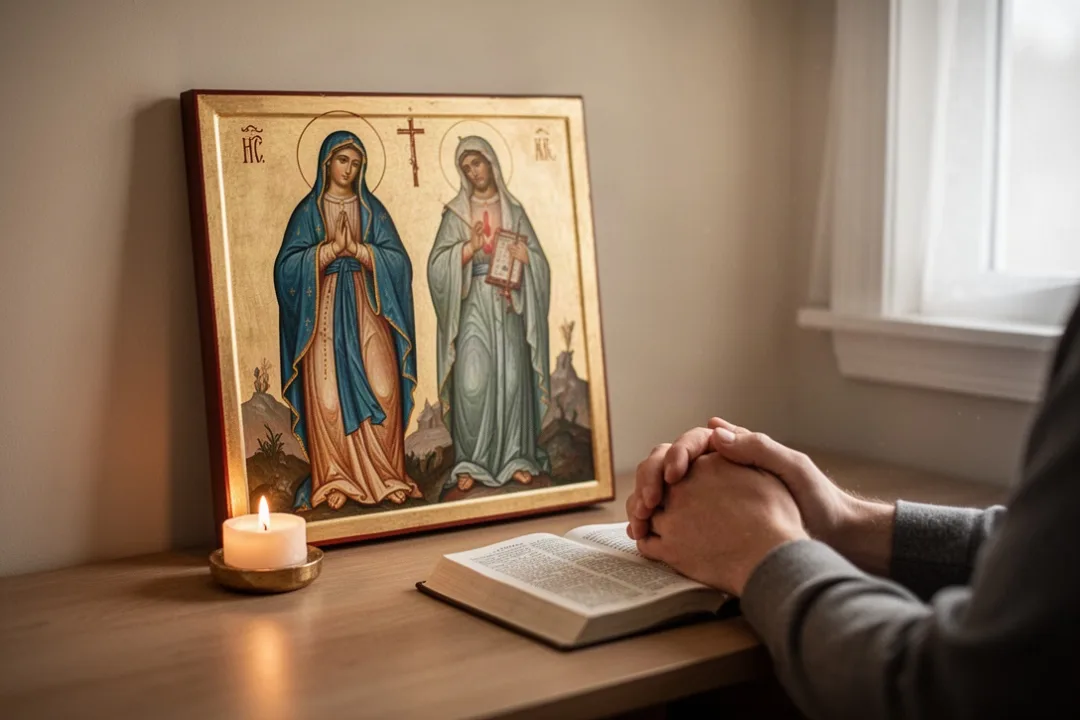
If you have an icon or holy card, place it somewhere that naturally supports prayer. A bedside table, a quiet shelf, or a small home prayer space can work well. Keep the setting simple. The image should assist recollection, not become a source of pressure or superstition.
Ways to pray the devotion during ordinary life
A regular prayer practice does not require a long block of uninterrupted time. The Our Lady of Perpetual Help prayer can be adapted to the rhythm of your day. What matters most is consistent attention and a willingness to place your concerns before God.
A five-minute daily practice
Begin by making the Sign of the Cross if that is part of your tradition. Look at an image of Our Lady of Perpetual Help, or simply become aware of Mary’s presence as a fellow believer who points you toward Christ.
Become still: Take a few slow breaths and name the main concern occupying your mind.
Pray the opening: Address Mary as your mother and ask her to bring you closer to Jesus.
State your petition: Speak plainly about the person, problem, or decision you are carrying.
Listen in silence: Remain quiet for a minute and notice any invitation toward patience, truth, forgiveness, or action.
End with trust: Ask for the grace to take the next good step, even if the full solution is not yet clear.
This pattern helps prevent prayer from becoming only a list of requests. You bring your need, but you also ask for the character and wisdom needed to respond well. Sometimes the answer to prayer unfolds through a conversation, professional help, a difficult apology, medical treatment, or the strength to wait.
Praying a novena
A novena is a prayer offered over nine days, usually for a particular intention or spiritual grace. Parishes and prayer books may use different texts for an Our Lady of Perpetual Help novena. You can follow an established version from your parish, or repeat the prayer above each day while adding one focused petition.
Choose a realistic time and keep the intention stable throughout the nine days. You may also include a short passage from the life of Jesus, a decade of the Rosary, a period of silence, or a practical act of charity. The extra practice should deepen your attention rather than make the devotion feel impossible to maintain.
When the situation is urgent, do not treat a novena as a requirement that must be completed before God will hear you. God hears prayer from the first moment. The nine-day structure gives you a way to persevere, reflect, and remain spiritually present while circumstances develop.
Praying with other people
This devotion is often prayed in families, parish groups, and church communities. Shared prayer can be especially helpful when a person is ill, facing bereavement, or carrying a concern that feels too heavy to manage alone.
One person may lead the prayer while others respond with a short invocation such as, “Our Lady of Perpetual Help, pray for us.” Avoid forcing anyone to disclose private details. A person may request prayer without explaining the entire situation, and the group can honor that privacy.
If you are praying with children, use simple language. Invite them to name one person who needs help and one thing for which they are grateful. This teaches that prayer includes both intercession and trust, not only fear or emergency requests.
What to ask for in difficult circumstances
The title “Perpetual Help” naturally draws people to prayer during crises, but the devotion can also shape ordinary responsibilities. You can ask for help with a difficult attitude, a repeated temptation, an unresolved conflict, or the patience required to care for another person over time.
Prayer does not mean ignoring practical responsibility. If you are facing depression, addiction, domestic violence, serious illness, financial hardship, or another urgent problem, prayer can accompany appropriate support from qualified people. Seek medical, pastoral, legal, financial, or emergency assistance when the situation calls for it.
Use prayer alongside action: Ask for Mary’s intercession, then consider the concrete step that love and wisdom require today—making a call, telling the truth, accepting help, setting a boundary, or caring for someone safely.
These petitions can help you pray with greater focus:
For healing: Ask for recovery when possible, skilled treatment, endurance, and comfort for the sick and those who care for them.
For employment or finances: Ask for opportunities, responsible judgment, generosity from others, and freedom from despair.
For a troubled relationship: Ask for honesty, restraint, reconciliation when possible, and protection from harmful behavior.
For a major decision: Ask for clear judgment, good counsel, patience, and the courage to choose what is right.
For spiritual dryness: Ask for faithfulness even when prayer feels empty or produces no immediate emotional comfort.
For someone who has died: Entrust that person to God’s mercy and ask for consolation as you grieve.
Try to avoid turning prayer into an attempt to control another person. Instead of asking that someone be forced to make a particular choice, pray for that person’s good, freedom, healing, and openness to truth. You can also ask for the grace to recognize what is and is not yours to change.
When you pray for yourself, do not assume that your needs are selfish. Rest, healing, wisdom, and protection can help you serve others more faithfully. Mary’s care is often represented as both compassionate and practical: she notices human need and brings it to Jesus.
The Catholic roots of the devotion
Our Lady of Perpetual Help is especially associated with an ancient icon venerated under that title and with the Redemptorists, a Catholic religious congregation that helped spread the devotion widely. The icon has been honored in Rome and in many churches around the world.
The devotion belongs within the broader Catholic tradition of Marian prayer. Catholics honor Mary as the mother of Jesus and ask her intercession because of her close relationship with him. This practice does not place Mary above God. Worship belongs to God alone; Marian devotion is intended to honor her and ask for her prayers.
The feast of Our Lady of Perpetual Help is observed on June 27 in the Roman Catholic calendar. Local communities may celebrate the devotion with a novena, a special Mass, a procession, or communal prayers at a different time. Parish customs vary, so a local church calendar is the best guide for specific observances.
The devotion also reflects themes found throughout the Bible: trust in God, care for the vulnerable, perseverance in suffering, and the importance of faithful prayer. When you pray to Our Lady of Perpetual Help, you can connect the devotion with Scripture by reflecting on episodes from Mary’s life, such as the Annunciation, the visitation, the birth of Jesus, or her presence near the cross.
Rather than repeating a Bible passage word for word, consider its central message. Luke 1:26–38 presents Mary responding to God with faith despite uncertainty. John 2:1–11 shows Mary noticing a practical need and directing attention toward Jesus. John 19:25–27 places Mary near the cross, where her faithful presence remains significant amid suffering.
These scenes provide a balanced understanding of help. Mary’s help is not presented as a way to avoid every hardship. It is a way of remaining close to Christ through uncertainty, responding faithfully to what is asked, and trusting God when the path is painful or unclear.
How to make the prayer your own
A written prayer can give you structure, especially when stress makes it difficult to think. After praying the traditional form, add a few sentences in your own words. Tell God what you fear, ask Mary to intercede, and name the grace you hope to receive.
You might use this simple pattern:
Address: “Mary, Mother of Perpetual Help, I come to you with trust.”
Honesty: “I am worried about…” or “I feel unable to…”
Petition: “Please ask Jesus to give me…”
Response: “Show me how to act with faith and love today.”
Trust: “I place this concern in God’s care. Amen.”
Write your prayer in a notebook if you find that writing helps you concentrate. You can also set a reminder for a consistent time, pray while traveling, or say a brief invocation before answering a difficult message. Short prayers have a legitimate place in Christian life when they help you turn your attention toward God.
Some days, your prayer may feel peaceful. On other days, you may feel distracted, angry, numb, or doubtful. Those experiences do not make the prayer worthless. Bring the whole truth of your interior life to God, and ask Our Lady of Perpetual Help to teach you steady trust rather than emotional perfection.
Let the devotion lead to concrete love. If you pray for a lonely person, consider contacting them. If you pray for peace in your family, examine the words you use. If you pray for healing, accept appropriate care. A prayer shaped by Mary’s example should gradually make you more attentive, compassionate, truthful, and willing to serve.
Frequently asked questions
Can I pray to Our Lady of Perpetual Help for any need?
Yes. You can bring personal, family, spiritual, medical, financial, and community concerns to this devotion. Ask Mary to intercede with Jesus, while remembering that prayer is not a guarantee of a particular outcome. It can help you receive courage, wisdom, comfort, patience, and guidance as you respond to the situation.
Do I need a special image to pray this prayer?
No. An icon, statue, or holy card can help you focus, but it is not required. You can pray anywhere and at any time. The image serves as a visual reminder of Mary’s care and her role in directing believers toward Jesus; it does not have magical power.
Is the Our Lady of Perpetual Help prayer the same as a novena?
Not necessarily. The prayer is a devotional prayer that can be said once or regularly. A novena is a pattern of prayer followed for nine days, often with additional petitions or readings. Different parishes and prayer books use different novena texts connected with Our Lady of Perpetual Help.
When is the feast of Our Lady of Perpetual Help?
The feast is observed on June 27 in the Roman Catholic calendar. Local parishes may hold novenas, special liturgies, or other celebrations at different times. If you want to participate in a community observance, check the schedule of a nearby Catholic church or shrine.












Leave a Reply