Mother of Perpetual Help: Meaning, History, and Prayer
Mother of Perpetual Help: Meaning, History, and Prayer
When you see an image of Mary holding the child Jesus, you may wonder why he looks frightened and why two angels are shown carrying instruments of his future Passion. The image is Our Mother of Perpetual Help, one of the best-known Marian icons in Catholic devotion. People turn to her when they need comfort, guidance, healing, or help for someone they love.
The title does not mean that Mary replaces God or guarantees a particular result. It expresses a belief that Mary continually brings human needs to Christ, just as she did at Cana. Devotion to Mother of Perpetual Help is therefore a way of asking for her intercession while placing your trust in Jesus, the center of the icon and of Christian prayer.
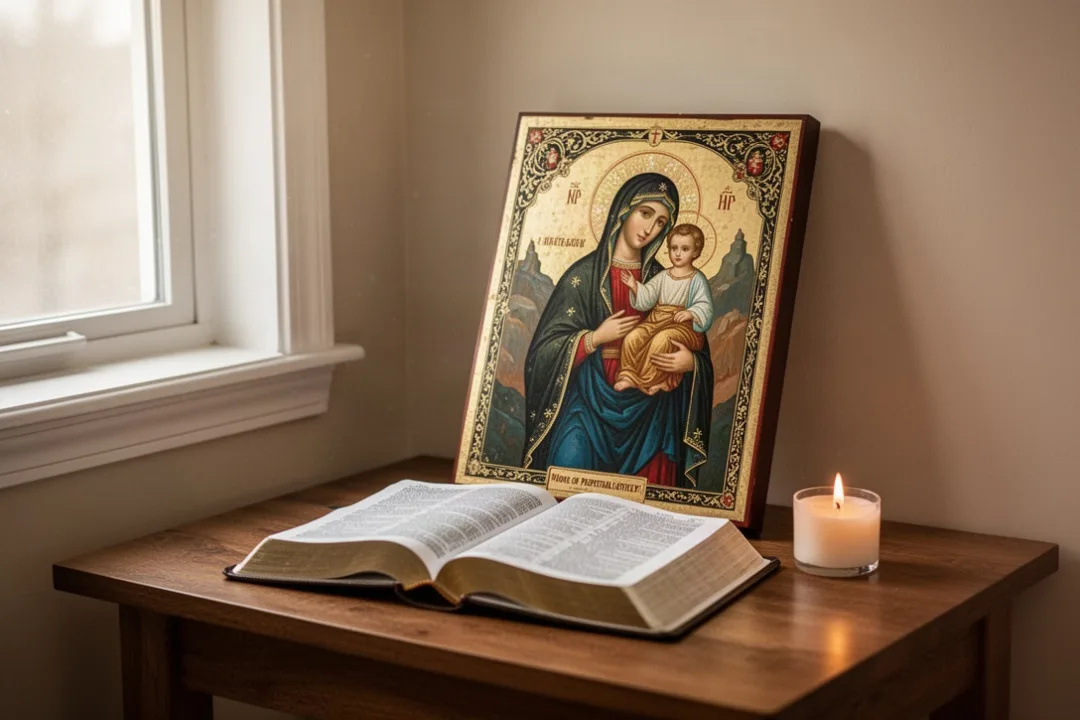
Mother of Perpetual Help is a title given to Mary and the name commonly used for a Byzantine icon of the Virgin Mary and the child Jesus. In the Eastern Christian tradition, an icon is not simply a religious decoration or a realistic portrait. It is a sacred image intended to direct the person praying toward the mystery it represents.
Mary is shown as the compassionate mother who presents Christ to the world. Jesus is not pictured as a passive infant. He turns toward his mother after seeing the signs of his Passion, while Mary looks outward toward the person praying. Her expression combines tenderness and seriousness: she acknowledges human suffering while pointing beyond herself to her Son.
The word perpetual refers to the enduring care associated with Mary’s intercession. Catholics who pray under this title are asking for help in every season of life, including ordinary responsibilities, serious illness, family conflict, grief, temptation, uncertainty, and concern for the poor or vulnerable.
The central focus: Mother of Perpetual Help is a Marian devotion, but its purpose is to lead you closer to Christ. Mary’s role is understood as intercessory and maternal, not as a replacement for God’s grace.
Where the icon came from
The icon is generally understood to have originated in the Byzantine tradition and to have been painted centuries ago, probably in the eastern Mediterranean world. Its early history is not fully documented, so some popular accounts contain details that cannot be verified with certainty. What is clear is that the image eventually became associated with a church in Rome called San Matteo in Merulana.
According to the established historical tradition, the icon was brought to Rome by a merchant from Crete. It was placed in the church of San Matteo, where it was venerated for generations. The church stood between the Basilica of Saint Mary Major and Saint John Lateran and became a destination for people seeking Mary’s intercession.
After San Matteo was destroyed during political upheaval in Rome, the icon was moved and eventually placed in less prominent surroundings. Its location was later identified, and Pope Pius IX entrusted the image to the Redemptorists in the 19th century. The Redemptorists, formally known as the Congregation of the Most Holy Redeemer, promoted the devotion throughout the world.
The original icon is now associated with the Church of Sant'Alfonso all'Esquilino in Rome, which belongs to the Redemptorists. Copies can be found in parishes, homes, schools, hospitals, chapels, and prayer groups across many countries. These copies are not treated as separate gods or magical objects. They serve as visual reminders of Mary’s relationship with Christ and of the believer’s prayerful trust.
How to read the symbols in the icon
Every major detail in the image contributes to its meaning. The icon uses posture, color, gesture, and symbolic objects rather than a written explanation. Looking at those details slowly can turn a familiar picture into a focused form of prayer.
Mary’s eyes: Her gaze is directed toward the person praying, creating a sense of personal attention and maternal concern.
The child Jesus: He is held securely by Mary, yet he turns toward the signs of the Passion carried by the angels.
The angels: The archangels Michael and Gabriel are traditionally identified as the figures holding the instruments of Christ’s Passion.
The instruments: The cross, spear, and other symbols point toward suffering, death, and the saving work Christians associate with Jesus.
Jesus’ sandal: One sandal appears to be slipping from his foot. This small detail emphasizes the child’s sudden movement and the emotional force of what he sees.
Mary’s hand: Her hand supports Jesus while also directing attention toward him. She is presented as the one who leads the believer to Christ.
The colors: Traditional iconographic colors carry theological associations, although their precise interpretation can vary. Mary’s garments are commonly understood to express both her humanity and her unique role in the story of salvation.
The child’s reaction is especially significant. He appears to seek his mother’s protection, but Mary does not turn away from the viewer or hide the reality before him. The image holds together maternal tenderness and the mystery of suffering. It can speak to people who want comfort without pretending that pain does not exist.
What the title teaches about Mary and Jesus
The title “Mother of Perpetual Help” conveys several connected ideas within Catholic theology. Mary is honored as the mother of Jesus, the mother of the Church, and a spiritual mother who prays for those who ask her help. These teachings are understood in relation to Christ, whose life, death, and resurrection remain the source of salvation.
Mary’s help is therefore not usually understood as an independent power. A person may ask Mary to pray for healing, wisdom, reconciliation, strength, or protection, much as someone might ask a trusted Christian friend to pray. The difference is that Marian devotion places this request within the Church’s long-standing belief that Mary has a unique relationship with Jesus.
The icon also offers a model of faithful attention. Mary receives the frightened child, remains present before the signs of suffering, and points toward Christ. For someone praying with the image, this can become an invitation to practice trust, courage, compassion, and openness to God’s will.
Mary’s role in the icon is not to draw attention away from Jesus, but to hold him before the eyes of the person who is praying.
How to pray with Mother of Perpetual Help
You do not need a special setting, a particular statue, or a memorized formula to begin. A small image can help, but the essential elements are attention, honesty, and a desire to place your concern before God. You can pray alone, with family members, or with a parish community.
Become still. Sit quietly for a moment and allow your breathing and attention to settle.
Look at the image. Notice Mary’s face, her hand, the child’s movement, and the angels carrying the signs of the Passion.
Name your concern. Speak plainly about the person, decision, fear, loss, or responsibility you are carrying.
Ask for Mary’s intercession. Request that she pray with you and help you remain close to Christ.
Pray to Jesus. Offer your concern directly to God and ask for the grace needed to respond faithfully.
Remain receptive. Sit in silence, read a short Gospel passage, or repeat a simple prayer such as “Mother of Perpetual Help, pray for us.”
Choose a faithful action. If your concern involves another person, consider a concrete step such as making a call, seeking counsel, apologizing, or asking for practical assistance.
This pattern keeps prayer from becoming only a request for a desired outcome. You can certainly ask for a specific result, but you can also ask for patience, clear judgment, reconciliation, courage, and perseverance. Those graces may shape the way you face a situation even when circumstances do not change immediately.
A simple prayer to Mother of Perpetual Help
You may use your own words, but a short prayer can make it easier to begin. The following is an original prayer of petition rather than a quotation from a formal liturgical text:
Mother of Perpetual Help, pray for me and for the people I carry in my heart. Bring our needs to Jesus, help us trust him in suffering, and teach us to respond with patience, courage, and love. Guide us toward the help we need and keep us close to God’s will. Amen.
After praying, name each person or concern slowly. If you are praying for someone who is ill, you might ask for competent medical care, comfort, strength for caregivers, and peace for the family rather than treating prayer as a substitute for treatment.
How the novena to Mother of Perpetual Help works
A novena is a period of prayer traditionally lasting nine days. Many parishes hold a Perpetual Help novena on a regular weekday, often inviting people to bring written petitions and join in communal prayers. The exact wording and schedule differ among parishes, countries, and religious communities.
A novena is not a spiritual contract in which nine days of prayer obligate God to grant a request. It is a structured period for persistence, reflection, and surrender. The repeated prayer can help you return to the same concern with greater honesty and patience instead of reacting to it only when fear becomes intense.
If you pray a novena at home, choose a realistic format. You might use a parish booklet, pray a decade of the Rosary, read a short Gospel passage, and spend a few minutes presenting your intentions. Include a request for the ability to recognize and accept appropriate help from other people.
Set aside the same general time each day.
Begin by recalling that prayer is directed to God, with Mary’s intercession.
State your intention without demanding a particular outcome.
Include the needs of others, especially people who are sick, poor, isolated, displaced, or grieving.
End by considering one practical act of charity or responsibility.
Missing a day does not mean that the novena has failed. You can continue, begin again, or use the interruption as a reminder that prayer is not measured by perfect performance. The value lies in returning to God with trust and allowing the devotion to form your character.
Why people pray to Mother of Perpetual Help in difficult times
People often discover this devotion during a period when ordinary solutions feel inadequate. A parent may pray for a child, a patient may ask for strength before treatment, or someone facing unemployment may seek guidance and hope. Others come to the image through a parish tradition, a relative, or a memory of seeing it in a childhood home.
The image can be particularly meaningful because it does not present a picture of easy faith. Jesus is startled by the signs of what lies ahead. Mary is calm but not detached. Her face recognizes the person praying, while her arms continue to hold Christ. This combination can help people express fear without concluding that fear means they have lost faith.
Devotion also creates a bridge between private prayer and community support. A parish novena may bring together people who would otherwise face illness, bereavement, or financial strain alone. Prayer can open the door to practical care, including meals, transportation, visits, counseling, and referrals to social services.
Use prayer alongside practical help: For medical, mental health, legal, financial, or safety concerns, seek qualified assistance. Asking Mary’s intercession and accepting responsible human help are not competing choices.
How the feast day is observed
The liturgical memorial of Our Mother of Perpetual Help is celebrated on June 27 in the Catholic calendar. Local observances may include Mass, a novena, a procession, a blessing, a parish mission, or special prayers for families and people in need.
The way the day is marked depends on local custom. Some communities place the icon in a prominent location, while others gather for a service focused on Mary’s intercession. A parish may also invite people to bring petitions, offer donations to charitable work, or visit people who are sick or isolated.
You do not need to attend a large celebration to honor the feast. You could spend time with the icon, read one of the Gospel passages about Mary and Jesus, pray for someone who needs help, or perform a quiet act of service. The most fitting observance joins prayer with mercy.
Mother of Perpetual Help and the Rosary
The Rosary is one possible way to pray in connection with this devotion. Both the icon and the Rosary direct attention to episodes in the life of Jesus as seen with Mary. The Rosary can provide a steady rhythm for people who find it difficult to concentrate or who need a familiar prayer during grief.
You might place the icon nearby and reflect on one mystery at a time. Rather than trying to force a feeling of peace, let the repeated prayers create space to bring your concern before God. If your mind wanders, gently return to the words or to the image of Mary holding Christ.
Other forms of prayer can serve the same purpose. You might read a Gospel passage, practice silent prayer, attend Eucharistic adoration where available, or use a short repeated invocation. No single prayer method is required, and devotion should not become a source of anxiety about doing everything correctly.
How to display the icon respectfully at home
A home image of Mother of Perpetual Help can mark a small prayer space, but it does not need to be placed in an elaborate shrine. Choose a clean, quiet location where you can pause without damaging the image or treating it as a decorative object that has no spiritual meaning.
You might place a Bible beside the icon, add a small candle when it is safe to do so, or keep a notebook for prayer intentions. If children are present, explain the picture in simple language: Mary is holding Jesus, the angels show that he will suffer, and Mary helps people bring their needs to him.
Keep candles away from curtains, paper, children, and pets.
Do not treat the image as a charm that guarantees protection.
Refresh your prayer intentions regularly rather than focusing only on personal problems.
Let the image prompt action, such as checking on a neighbor or supporting a person in crisis.
A blessed image may have special meaning for a Catholic household, but a blessing does not turn the object into a magical source of power. Its purpose is to support worship, remembrance, and prayer. The respect shown to the icon should lead to respect for the people it represents—especially those who are vulnerable or suffering.
How this devotion can shape everyday life
Praying to Mother of Perpetual Help can become more than a request made during emergencies. Mary’s posture in the icon suggests habits that can be practiced every day: staying present to someone who is afraid, acknowledging suffering honestly, and directing attention toward Christ rather than toward panic.
For a parent, that may mean listening before offering advice. For a caregiver, it may mean accepting rest and asking relatives to share responsibility. For someone dealing with conflict, it may mean seeking wise counsel before sending an angry message. Devotion becomes concrete when it changes the way you treat people and make decisions.
You can also use the icon as a prompt for a brief daily examination:
Where did I need help today, and did I allow anyone to support me?
Whose suffering did I notice, and how did I respond?
Where was I tempted to lose hope or control?
What would a patient, truthful, and compassionate response look like tomorrow?
These questions do not promise an easy life. They help connect prayer with responsibility. The title “perpetual help” can remind you that grace may arrive through prayer, friendship, professional care, community support, forgiveness, and the strength to take the next right step.
One misunderstanding is that praying before the icon guarantees a miracle or a particular answer. Catholic devotion does not require that interpretation. Prayer asks for God’s help and Mary’s intercession while leaving the outcome in God’s hands.
Another misunderstanding is that honoring Mary competes with honoring Jesus. In the icon, Mary holds and presents Christ. The image’s structure makes her maternal role inseparable from him. Marian devotion is healthiest when it leads to deeper love of God, greater trust in Christ, and more generous concern for other people.
A third misunderstanding is that suffering should simply be endured without treatment or support. The icon acknowledges suffering, but it does not instruct people to reject medicine, counseling, safety planning, or practical assistance. Seeking competent help can be one way of receiving the care for which you have prayed.
Finally, people sometimes assume that they need perfect words or a strong emotional experience. You can pray while confused, angry, distracted, or exhausted. A simple request for help, offered honestly, is enough to begin.
Ways to honor Mother of Perpetual Help through service
The devotion naturally points beyond private comfort. If Mary is honored as a mother who attends to human need, then people who pray under this title can look for ways to attend to others. Service does not have to be dramatic. It may involve a meal, a phone call, a donation, an errand, or patient attention to someone who feels forgotten.
Consider connecting prayer with one specific response:
Pray for a person who is struggling.
Ask what kind of help is actually wanted or needed.
Offer a realistic form of assistance without taking control.
Respect the person’s dignity, privacy, and choices.
Continue to care without expecting gratitude or a quick result.
This approach guards against using religious language to avoid action. It also guards against trying to rescue everyone alone. Compassion includes boundaries, wisdom, and cooperation. Sometimes the most loving response is to connect someone with a doctor, counselor, shelter, clergy member, legal advocate, or trusted support network.
Beginning a personal devotion today
Start with a few quiet minutes and an image of Mother of Perpetual Help if one is available. Tell God what is happening, ask Mary to pray with you, and look at the way she holds Jesus. You can end by choosing one concrete act that expresses trust and care.
If the devotion becomes meaningful, attend a parish service, learn the history of the icon, or use a novena booklet approved or provided by a Catholic parish. Let the practice remain centered on Christ, honest prayer, and compassionate action. Over time, the image can become a steady reminder that you do not have to carry every burden alone and that asking for help can be an act of faith.
Frequently asked questions
Is Mother of Perpetual Help the same as the Virgin Mary?
Yes. Mother of Perpetual Help is a Marian title associated especially with a Byzantine icon of Mary holding Jesus. Catholics do not understand her as a different divine being or a separate mother. The title highlights Mary’s continuing intercession and maternal care, while keeping Jesus at the center of the devotion.
Can non-Catholics pray to Mother of Perpetual Help?
Anyone may reflect on the icon or ask God for help through Mary’s intercession, although the devotion belongs particularly to Catholic and Eastern Christian traditions. People from other backgrounds can respectfully learn its meaning, pray in their own tradition, or simply use the image as a prompt for compassion, trust, and care for those who are suffering.
What should I do if my prayer is not answered as requested?
An unanswered request does not mean you prayed incorrectly or that Mary ignored you. Continue bringing the concern to God, while remaining open to a different outcome, additional support, or a gradual change. Seek practical help when needed, and consider speaking with a trusted priest, counselor, medical professional, or other qualified person.
Where can I find a Mother of Perpetual Help novena?
A Catholic parish, especially one served by Redemptorists, may offer a regular novena or provide a prayer booklet. You can also ask a parish office, religious community, or Catholic bookstore for a reliable version. Practices vary, so follow the schedule and wording used by your local community rather than assuming every novena is identical.











Leave a Reply