Perpetual Eucharistic adoration: Meaning and practice
Perpetual Eucharistic adoration: Meaning and practice
Perpetual Eucharistic adoration is continuous prayer before the exposed Blessed Sacrament, usually maintained by scheduled adorers in a chapel or church.
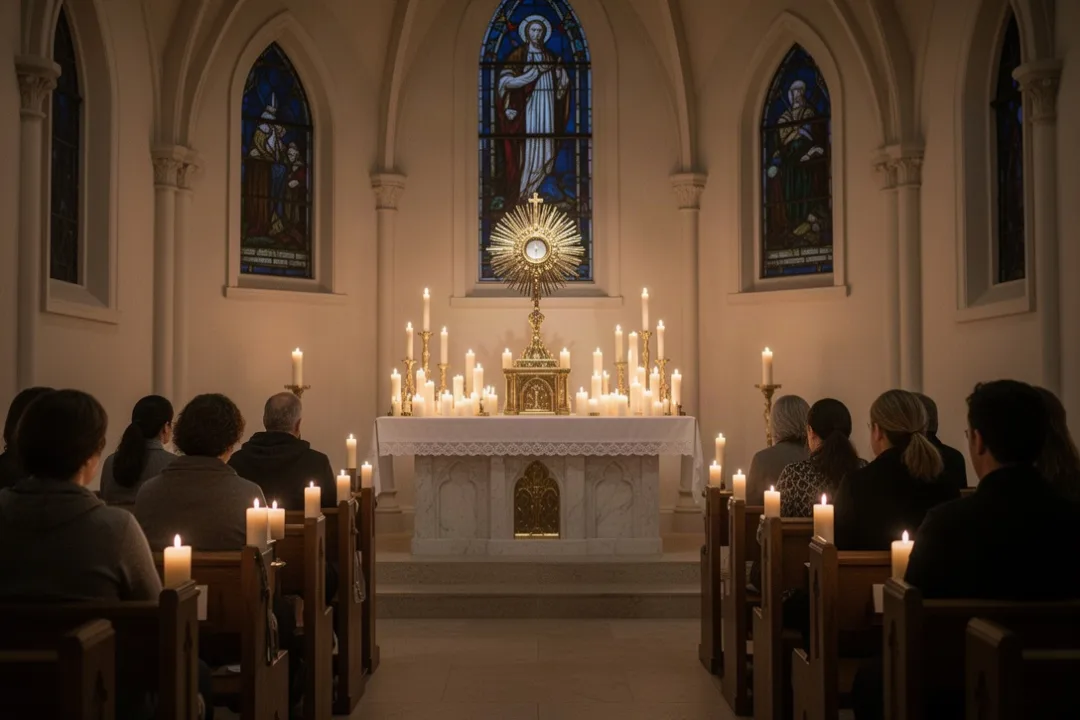
In Catholic practice, the consecrated host is placed in a sacred vessel called a monstrance so people can pray in Christ’s presence outside the celebration of Mass. “Perpetual” generally means that adoration continues day and night, often throughout the year, although a parish may pause exposition for necessary reasons such as liturgical celebrations, emergencies, or a lack of scheduled coverage.
The Eucharist is the sacrament of Christ’s Body and Blood, Soul and Divinity according to Catholic faith. During adoration, Catholics worship Jesus Christ present in the consecrated host, not merely a religious symbol or reminder. The host is placed in a monstrance, and the faithful remain nearby in prayer, silence, and reverence.
Perpetual adoration differs from ordinary visits to a tabernacle. A church may reserve the Eucharist in a tabernacle for prayer and Communion outside Mass, while eucharistic exposition places the consecrated host where it can be seen. Perpetual adoration refers specifically to an ongoing schedule of exposition and prayer, normally supported by people who take assigned hours.
The purpose is not to create a spiritual performance or require a particular emotional experience. Some people pray with strong devotion; others experience quiet, distraction, sorrow, gratitude, or even dryness. The central act is being present with Christ, offering attention and prayer according to your circumstances.
Essential distinction: Adoration does not replace the Mass. The Mass is the Church’s central act of worship, while adoration extends prayerful attention to the Eucharist that has been consecrated and celebrated.
How perpetual adoration developed in Catholic practice
Christians have reserved the Eucharist from the early Church, first especially for bringing Communion to people who were sick or unable to attend the liturgy. Over time, reservation also became associated with prayer and reverence outside Mass. Eucharistic processions, Benediction, Forty Hours devotions, and periods of exposition developed in different places and historical periods.
Longer periods of exposition became more common as devotion to the Eucharist grew in Catholic communities. Some parishes and religious communities eventually organized continuous adoration, with individuals taking regular shifts so that someone would remain present at all times. The form varies from one location to another, depending on local custom, clergy, facilities, and the availability of committed adorers.
Perpetual adoration is therefore a devotional practice within Catholic sacramental life, not a separate sacrament or a requirement for every parish. A chapel can foster deep prayer without being open around the clock, and a person can practice eucharistic devotion through Mass, a holy hour, visits to the tabernacle, or other forms of prayer.
How to visit a perpetual adoration chapel
If you have never attended, the first visit can be simple. You do not need specialized knowledge, a particular prayer book, or a long list of intentions. Check the chapel’s access instructions first, especially if it is located inside a locked church, requires an entry code, or limits access to registered adorers during overnight hours.
Learn the local expectations. Find out whether the chapel is open to visitors, whether a scheduled adorer must accompany you, and whether the parish asks guests to sign in.
Enter quietly. Silence your phone, genuflect or bow according to local Catholic custom, and take a seat where you can pray without disturbing others.
Begin with a simple act of faith. You might acknowledge Christ’s presence, thank God, ask for mercy, or offer the time for another person.
Remain for the time you can give. There is no universal minimum for a casual visit. A few attentive minutes can be meaningful, while scheduled adorers usually commit to a set hour.
Leave respectfully. Gather your belongings quietly, maintain silence near the monstrance, and follow the chapel’s instructions when departing.
You may pray from memory, read Scripture, use a rosary, sit in silence, or bring a trusted devotional book. If other people are praying, keep any spoken prayer soft enough not to interrupt them. A chapel may contain candles, kneelers, or written guidelines, but these details vary by parish.
What to do during eucharistic adoration
There is no single correct way to spend an hour before the Blessed Sacrament. Prayer can include praise, repentance, intercession, thanksgiving, and quiet contemplation. You can also bring ordinary concerns to God: family relationships, work, illness, decisions, grief, or the needs of your community.
Adoration: Recognize God’s holiness and Christ’s presence with words such as “Jesus, I trust in you” or another familiar prayer.
Thanksgiving: Name specific gifts, people, opportunities, or graces for which you are grateful.
Contrition: Ask for forgiveness and consider how you can respond to God’s mercy.
Intercession: Pray for people who are suffering, the Church, public leaders, the poor, the unborn, the dying, or particular needs.
Contemplation: Rest quietly in God’s presence without trying to fill every moment with words.
Spiritual reading: Read a Gospel passage, a psalm, or a sound Catholic devotional text slowly and prayerfully.
Distraction does not mean your prayer has failed. When your attention wanders, gently return to the presence of Christ without becoming preoccupied with judging your performance. A simple phrase, slow breathing, or looking quietly toward the monstrance can help you begin again.
Practical approach: If an hour feels difficult, divide it into smaller periods such as ten minutes of thanksgiving, ten minutes of Scripture, ten minutes of intercession, and quiet prayer for the remaining time.
Why Catholics spend time before the exposed Eucharist
Catholic eucharistic adoration rests on the belief that Christ remains truly present in the Eucharist after the celebration of Mass. The practice gives worshippers a focused setting for personal prayer before Christ. It can strengthen awareness that the Eucharist is not only received during Communion but also reserved for worship and for the needs of the faithful.
Many Catholics describe the chapel as a place where they can become more attentive to God. The quiet does not automatically solve a problem, and adoration should not be presented as a guaranteed method for receiving a particular answer. Its value lies in faithful prayer, openness to conversion, and a relationship with God shaped by the Church’s sacramental life.
Adoration can also direct a person back toward other responsibilities. Prayer before the Eucharist may lead someone to seek reconciliation, care for a neighbor, forgive another person, serve the poor, or participate more fully in Sunday Mass. Authentic devotion is not measured only by the length of time spent in the chapel; it also appears in how prayer influences daily conduct.
How perpetual adoration differs from Mass and Benediction
Mass is the liturgical celebration in which the Church gathers for the Liturgy of the Word and the Liturgy of the Eucharist. The Eucharist is consecrated during Mass, and Catholics who are properly disposed may receive Holy Communion. Adoration is a separate devotional period that ordinarily takes place before the already-consecrated host.
Benediction is a liturgical blessing with the Blessed Sacrament. In a Benediction service, a priest or deacon may use the monstrance to bless the congregation after prayers, hymns, readings, or other elements prescribed by the Church. The sacrament is then typically returned to the tabernacle.
Exposition is the act of displaying the consecrated host for adoration. Perpetual adoration is an ongoing schedule of exposition and prayer. These terms are related, but they do not describe identical practices.
How a perpetual adoration program is organized
A continuous chapel depends on more than an open door. It requires a responsible priest or pastoral authority, a suitable sacred space, clear procedures, and enough people to cover each scheduled hour. Many chapels use a coordinator or team of coordinators who recruit adorers, maintain the schedule, communicate changes, and respond when someone cannot attend.
Most programs assign recurring shifts, such as one hour each week. A person who chooses a particular hour becomes responsible for being present at that time or arranging a substitute. Some chapels also have substitutes or a communication system for emergencies, holidays, weather disruptions, and unexpected absences.
Useful organizational practices may include:
Two-person coverage: Having more than one scheduled adorer during each hour can provide support and continuity.
Reliable contact information: Coordinators need a current way to reach adorers and substitutes.
Written chapel guidelines: Instructions can cover silence, visitors, children, emergencies, lighting, doors, and what to do if the monstrance is unattended.
Regular schedule reviews: A coordinator can identify difficult hours and recruit specifically for overnight, weekend, or holiday periods.
Pastoral oversight: The parish should ensure that the practice remains reverent, safe, and consistent with Catholic norms.
A parish should never treat continuous exposition as more important than the safety of people or the proper care of the Eucharist. If coverage fails, the responsible person should follow the local procedure and contact the designated coordinator or clergy member rather than improvising.
What scheduled adorers are responsible for
A scheduled adorer’s main responsibility is faithful presence. You are not expected to lead a service, teach others, or produce a particular spiritual result. You are there to pray and to help ensure that the Blessed Sacrament is not left exposed without the attention required by the parish’s procedures.
Arrive a few minutes early when possible. If the next person has not arrived, follow the chapel’s instructions rather than leaving immediately. Some programs ask you to contact a coordinator, another adorer, or a substitute. The correct response depends on the local plan, which should be explained when you sign up.
Keep the space peaceful and secure. Do not handle the monstrance, ciborium, altar linens, or other sacred objects unless a priest, deacon, or authorized minister gives you a specific instruction. If you notice a medical emergency, suspicious behavior, damage, or a problem involving the Eucharist, seek appropriate help promptly.
How to prepare for your first regular hour
A regular hour is easier to sustain when you choose a realistic time. Consider transportation, work, sleep, caregiving, weather, and your ability to reach the chapel reliably. An overnight commitment can be deeply meaningful, but it should not be accepted casually if you already know that the schedule will be difficult.
Bring only what helps you pray. A Bible, rosary, journal, or devotional book may be useful, but the chapel is not a place for routine phone use, casual conversation, or unrelated work. If you need to read from a phone, silence notifications and use it discreetly according to local expectations.
Before committing, ask practical questions:
Is the chapel accessible at the assigned hour?
What happens if I am sick or traveling?
Who covers the hour when I cannot attend?
What should I do if no one relieves me?
Are children or guests welcome, and what supervision is expected?
Who should I contact during an emergency?
These questions are not signs of weak devotion. Clear expectations help the ministry remain dependable and protect both the adorers and the Blessed Sacrament.
Respectful behavior in an adoration chapel
The chapel is a place of worship, so dress and behavior should reflect reverence without turning local customs into a competition. Silence is usually expected, though a parish may permit quiet whispered prayer. Avoid conversations near people who are praying, loud movement, strong fragrances, food, and activities that distract from the sacred setting.
Genuflection, kneeling, standing, or sitting can vary according to physical ability and personal devotion. People with disabilities, health conditions, or caregiving responsibilities should not feel pressured to adopt a posture they cannot safely maintain. Reverence is expressed through the heart and conduct, not through discomfort or appearances.
Parents can teach children that the chapel is a place for quiet prayer while recognizing that young children may need guidance and appropriate supervision. A person who is unfamiliar with Catholic customs should be treated with patience. Visitors may be observing, learning, or seeking prayer during a difficult time.
Common spiritual difficulties during adoration
Some people expect immediate peace and become discouraged when their mind remains busy. Others wonder whether they are praying correctly, especially when they feel nothing unusual. These experiences are common in prayer and do not by themselves indicate that adoration is ineffective.
Try setting aside the pressure to “do” something impressive. Begin with the reality of where you are, name your intention, and allow the time to unfold. If silence becomes difficult, read a short Gospel passage, pray a decade of the rosary, or repeat a brief act of trust.
Adoration should not be used as a substitute for professional help when you are facing serious mental health symptoms, danger, addiction, abuse, or a medical emergency. Prayer and pastoral care can accompany appropriate professional support, but neither should be presented as a replacement for it.
Questions to ask before starting a local chapel
A parish considering perpetual exposition should begin with discernment rather than a promise to maintain a particular schedule at any cost. The pastor and parish leaders can assess whether there is genuine interest, adequate clergy support, an appropriate chapel, secure access, and a sustainable pool of adorers.
They should also consider the Church’s liturgical and canonical requirements, including who may expose and repose the Blessed Sacrament and how the Eucharist will be handled. Local diocesan policies may provide additional guidance. A diocesan office or qualified liturgical adviser can help a parish address questions before the chapel opens.
Practical planning may include:
Confirm pastoral support. Identify the priest or authority responsible for the chapel.
Assess the space. Review accessibility, security, lighting, heating, seating, and emergency arrangements.
Build a core team. Recruit dependable coordinators before public promotion.
Gather realistic commitments. Seek recurring adorers and substitutes rather than relying only on occasional interest.
Review the ministry. Adjust the schedule when participation, safety, or pastoral circumstances change.
A chapel that operates for fewer hours can be a better pastoral choice than a nominally perpetual schedule that repeatedly lacks coverage. The quality of prayerful care matters more than the label attached to the program.
How adoration can shape everyday Catholic life
Time before the Eucharist can become a school of attention. By returning regularly, you may become more honest in prayer, more aware of other people’s needs, and more willing to place decisions before God. These effects usually develop gradually rather than through a single dramatic experience.
Adoration is best connected with the wider life of the Church: Sunday Mass, the Sacrament of Reconciliation, Scripture, service, works of mercy, and fellowship with other Catholics. The chapel is not an escape from the world or from relationships. It is a place to bring the world to God and to receive strength for faithful action within it.
For some people, the most fruitful practice is a weekly scheduled hour. For others, a brief visit after Mass or a monthly period of prayer is more appropriate. Consistency, sincerity, and reverence matter more than comparing your practice with someone else’s.
How to begin without making an unrealistic commitment
Start by visiting a parish chapel during a publicized hour and observing how the space functions. Speak with the parish office or adoration coordinator about access and expectations. If the experience fits your spiritual life, ask whether you can serve as a substitute before taking a permanent weekly hour.
Give yourself time to learn the rhythm of prayer. You can arrive with one intention, remain attentive as well as you can, and leave quietly when your time ends. Perpetual Eucharistic adoration is sustained by ordinary acts of faithfulness: one person arrives, another takes the next shift, and the community continues to place itself before Christ in prayer.
Frequently asked questions
Is perpetual Eucharistic adoration required for Catholics?
No. Catholics are not required to attend perpetual adoration or serve a scheduled hour. Participation is a voluntary devotion. Catholics are obligated to participate in Sunday Mass and certain holy days according to Church discipline, while eucharistic adoration offers an additional way to pray. You can practice it through a regular hour, occasional visits, or other forms of Eucharistic devotion.
Can non-Catholics visit a perpetual adoration chapel?
Policies differ by parish, but visitors are often welcome to enter respectfully and pray. Since Catholics believe the exposed host is the Blessed Sacrament, guests should follow the chapel’s silence and conduct guidelines without feeling pressure to imitate Catholic gestures. Ask the parish about access, especially for overnight entry or a chapel inside a secured building.
Can I bring a rosary or Bible to adoration?
Yes. Many people pray the rosary, read Scripture, use a prayer book, journal, or sit quietly. Choose materials that help you focus on God rather than distract you or others. If you use a phone for a Bible or prayer app, silence notifications and follow the chapel’s expectations about electronic devices.
What should I do if the next scheduled adorer does not arrive?
Follow the chapel’s established procedure rather than making your own decision. Contact the coordinator, substitute list, or designated clergy member if instructed. Some programs ask you to remain until coverage is arranged; others provide another response for emergencies. Ask about this situation before accepting a regular hour so you know whom to call.










Leave a Reply