The order of Mass is the Church’s established pattern for gathering, hearing God’s word, celebrating the Eucharist, and being sent out to live the Gospel.
The Roman Catholic Mass follows a consistent structure, although the readings, prayers, music, and homily change from day to day. This combination of a familiar framework and changing texts allows Catholics to participate actively while also observing the seasons and feasts of the Church year.
The complete celebration is commonly organized into four major parts:
The Introductory Rites: The congregation gathers, prepares for worship, and listens to the opening prayer.
The Liturgy of the Word: Scripture is proclaimed, explained, and answered through prayer and profession of faith.
The Liturgy of the Eucharist: Bread and wine are presented, and the Eucharistic Prayer gives thanks and consecrates them as the Body and Blood of Christ.
The Concluding Rites: The congregation receives a blessing and is dismissed to carry out its Christian vocation.
These four parts are not separate services placed next to one another. They form one act of worship. The gathering leads to listening, listening leads to prayer and offering, and the Eucharist leads to communion and mission.
Central idea: The Mass is both a meal of communion and a sacrifice of praise. Catholics gather around the word of God and the Eucharist, then leave with a responsibility to live what they have celebrated.
The term Order of Mass can also refer to the fixed portions of the liturgy printed in a missal or worship aid. These texts are often called the Ordinary of the Mass. The changing prayers and readings for a particular Sunday, weekday, or feast are called the Proper.
What happens during the Introductory Rites
The Introductory Rites begin when the congregation gathers and end with the Collect, or opening prayer. Their purpose is to bring many individuals into one worshiping assembly and prepare everyone to hear Scripture and celebrate the Eucharist.
The entrance procession and greeting
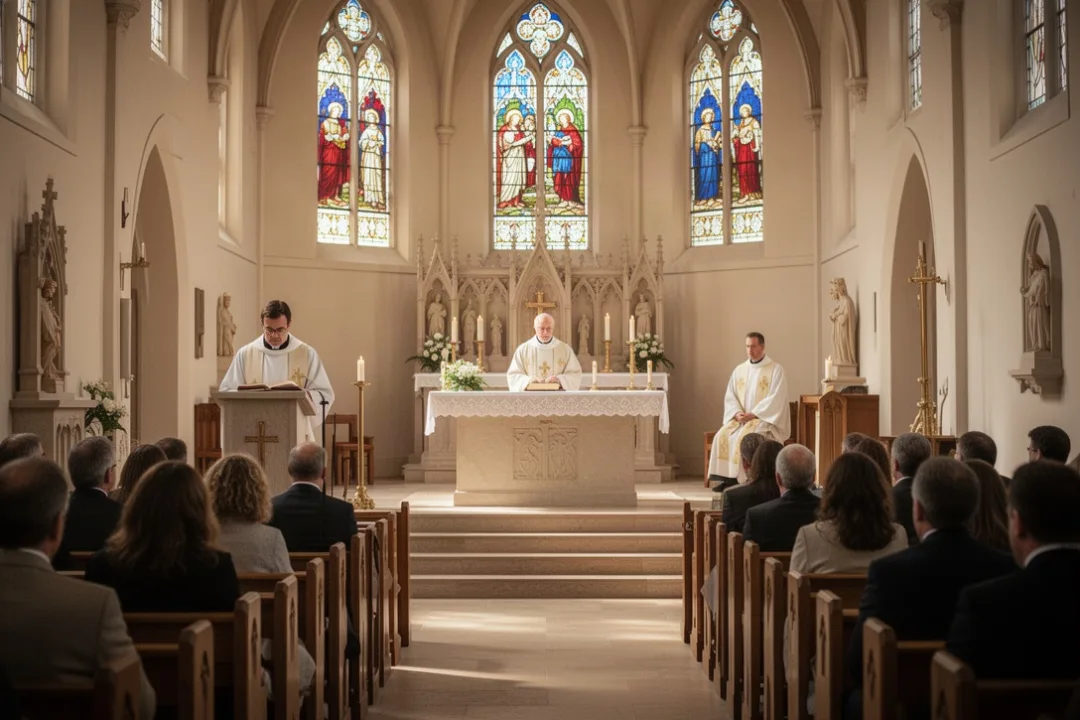
The Mass begins with an entrance chant or hymn while the ministers process into the church. The priest and deacon, when present, approach the altar, which represents Christ and is treated with special reverence. The priest may kiss the altar, and incense may be used on certain occasions.
After the entrance song, the priest leads the Sign of the Cross. The people respond, “Amen,” affirming their participation in the prayer. The priest then greets the congregation with a liturgical greeting, and the people answer with a response that acknowledges the Lord’s presence among them.
This opening is more than a welcome announcement. The Sign of the Cross identifies the celebration as Christian worship in the name of the Father, Son, and Holy Spirit. The greeting also makes clear that the Mass is not a private devotion led by one person; it is the prayer of the assembled Church.
The Penitential Act and Gloria
The congregation next takes part in the Penitential Act. The people acknowledge their need for God’s mercy, often through a general confession, a brief dialogue, or another approved form. This act expresses repentance and trust, but it is not the sacrament of Reconciliation and does not replace individual confession when serious sin is present.
The priest then leads or concludes the absolution formula, asking God to have mercy and guide the people toward eternal life. The congregation responds with “Amen.” On Sundays outside Advent and Lent, and on solemn celebrations, the Gloria is usually sung or recited as a joyful hymn of praise. It is generally omitted during the penitential seasons of Advent and Lent.
The Collect, or opening prayer
After inviting the people to pray, the priest observes a brief silence and proclaims the Collect. This prayer gathers the intentions of the congregation and places them before God. The people conclude with “Amen,” making the priest’s prayer their own.
Several customary postures appear in these opening moments. The congregation usually stands for the entrance, greeting, Penitential Act, Gloria, and Collect, although local practice can vary. Standing expresses attentive participation and readiness to worship.
How the Liturgy of the Word unfolds
The Liturgy of the Word centers on proclaimed Scripture. God’s word is not treated as background information; it is proclaimed publicly so the congregation can listen, respond, and allow the message to shape its prayer and conduct.
On Sundays and major feasts, the first reading usually comes from the Old Testament, although the Easter season uses readings from the Acts of the Apostles. A psalm follows, with the congregation responding to a repeated refrain. The psalm gives the assembly a prayerful way to answer the first reading.
The second reading generally comes from the New Testament letters or another New Testament book. It often addresses Christian faith, community life, moral conduct, perseverance, or hope. After the second reading, the congregation stands for the Gospel acclamation.
On weekdays, the number and arrangement of readings are usually shorter, but the same basic movement remains: Scripture is proclaimed, the people respond, and the Gospel receives special attention.
The Gospel and homily
The deacon or priest proclaims the Gospel, the high point of the Liturgy of the Word. The congregation normally stands and responds with a brief acclamation before and after the reading. The Gospel is honored because it announces the words and deeds of Jesus Christ.
Before the Gospel, many Catholics make a small cross on their forehead, lips, and heart. This gesture expresses a prayer that the Gospel may be understood in the mind, spoken with the mouth, and received in the heart. It is a gesture of preparation, not a requirement that must be performed perfectly.
The homily explains the readings and applies them to Christian discipleship. A strong homily may connect the biblical texts with the Church’s teaching, the season of the year, and concrete choices in family, work, community, and personal prayer. It should help the congregation hear how God’s word calls for a response.
The Profession of Faith and Universal Prayer
On Sundays and certain solemnities, the congregation recites or sings the Profession of Faith, usually the Nicene Creed or, on some occasions, the Apostles’ Creed. The creed summarizes central Christian beliefs about God, Jesus Christ, the Holy Spirit, the Church, baptism, resurrection, and eternal life.
The Liturgy of the Word concludes with the Universal Prayer, also called the Prayer of the Faithful. The usual intentions include the needs of the Church, public authorities and the world, people facing hardship, and the local community. The priest introduces the prayers, a deacon or reader announces them, and the priest concludes.
The congregation normally sits for the readings and homily, then stands for the Gospel, creed, and Universal Prayer. These postures support attention, but the meaning of the liturgy does not depend on physical ability. Anyone who cannot stand, kneel, or sit at a particular time may remain in a comfortable and respectful position.
What takes place during the Liturgy of the Eucharist
The Liturgy of the Eucharist begins with the preparation of the altar and gifts and reaches its central moment in the Eucharistic Prayer. Catholics believe that, through the prayer of the Church and the action of the Holy Spirit, the bread and wine become the Body and Blood of Christ while retaining the appearances of bread and wine.
The preparation of the altar and gifts
The altar is prepared, and representatives of the congregation may bring forward bread and wine. The gifts may also include offerings for the poor or the support of the Church. This procession shows that the assembly is not merely watching the priest; the people present their lives, work, needs, and resources to God.
The priest prepares the chalice and paten, may add a small amount of water to the wine, and offers prayers of blessing. The priest then invites the congregation to pray that the sacrifice may be acceptable to God. The people answer with a response asking God to receive the sacrifice for the praise of God’s name and the good of the Church.
The congregation usually sits during the preparation of the gifts. After the invitation to prayer, local custom may have the people stand. The precise timing can differ slightly among parishes, so following those around you is reasonable if you are unfamiliar with the practice.
The Eucharistic Prayer
The Eucharistic Prayer is the center and high point of the entire celebration. The priest invites the people to lift their hearts and give thanks, and the congregation responds. The opening section, called the Preface, praises God for creation, salvation, or a particular mystery celebrated that day.
The congregation then sings or recites the Holy, Holy, Holy, followed by the main prayer of thanksgiving. Several Eucharistic Prayers are approved for use, and their wording varies according to the occasion. Each includes praise, a request for the Holy Spirit, the institution narrative, remembrance of Christ’s death and resurrection, intercession for the Church and the world, and a final offering of praise.
During the central section, the priest repeats Christ’s actions at the Last Supper over the bread and wine. Catholics call this moment the consecration. The congregation may kneel, according to local practice, as the priest elevates the consecrated host and chalice for adoration.
After the consecration, the priest announces the mystery of faith, and the people respond with an approved acclamation. The Eucharistic Prayer continues with the Church’s offering of Christ and prayer for the living and the dead. It ends with the great Amen, often sung, in which the congregation gives its assent to the whole prayer.
The word “Amen” is especially significant at the end of the Eucharistic Prayer. It means that the people affirm and make their own the priest’s prayer of thanksgiving and offering. For this reason, the great Amen is not a minor response; it is the congregation’s full participation in the central prayer of the Mass.
How the Communion Rite is celebrated
The Communion Rite prepares the congregation to receive the Eucharist and then completes the movement from sacrifice to communion. It begins with the Lord’s Prayer and includes a sign of peace, the breaking of the bread, and the distribution of Holy Communion.
The Lord’s Prayer and sign of peace
The priest invites the congregation to pray as Jesus taught his disciples. The people recite or sing the Lord’s Prayer, asking for the coming of God’s kingdom, daily sustenance, forgiveness, and protection from evil.
The priest then prays for peace and unity in the Church. The congregation exchanges a sign of peace according to local custom. This may be a handshake, a nod, a bow, or another respectful gesture. The purpose is not social conversation but a brief expression of reconciliation and communion before receiving the sacrament.
The breaking of the bread and invitation to Communion
During the Fraction Rite, the priest breaks the consecrated host. This action recalls the way Jesus broke bread and also expresses that the one bread is shared among the many members of the Church. The congregation sings or recites the Lamb of God during this rite.
The priest then shows the consecrated host and invites the people to Communion. Catholics who are properly prepared receive the Eucharist with reverence. Preparation ordinarily includes being baptized Catholic, being in a state of grace, observing the required fast, and recognizing the Church’s teaching about the Eucharist.
If you are not receiving Communion: You may remain in your seat and pray, or follow your parish’s custom for approaching the minister to receive a blessing where that practice is offered. Do not feel pressured to receive.
Receiving Communion and the prayer after Communion
A communicant approaches the minister, responds “Amen” to the declaration about Christ’s Body, and receives the host reverently. The Eucharist may be received on the tongue or in the hand according to the norms and practice of the Catholic Church in the United States. If the chalice is offered, the communicant may receive from it, though receiving only the consecrated host is still full participation in the Eucharist.
After Communion, the congregation spends time in silent prayer or joins a hymn of thanksgiving. The priest purifies the sacred vessels, and the people usually sit or kneel according to local custom. A period of silence gives each person space to pray, give thanks, and ask for the grace to live as a disciple of Christ.
When the Communion Rite is complete, the priest invites the people to pray and says the Prayer after Communion. The congregation responds “Amen.” This prayer asks that the sacrament bear fruit in the lives of those who received it and in the entire worshiping community.
What happens in the Concluding Rites
The Concluding Rites are brief, but they give the Mass its direction beyond the church building. The priest may make announcements, especially when they concern parish life or upcoming worship. On some occasions, a solemn blessing or a special prayer over the people is used.
The priest then gives the final blessing in the name of the Father, Son, and Holy Spirit. The deacon or priest dismisses the congregation with one of the approved formulas. The dismissal does not simply mean that the service is over; it sends the people to serve God and neighbor through their daily lives.
The congregation responds, “Thanks be to God,” and the ministers leave in procession. A closing hymn may be sung. Some people remain for personal prayer, while others leave quietly so that people who are praying can continue without interruption.
The dismissal explains why the Mass is connected to Christian conduct. The Eucharist is not complete as a private spiritual experience detached from ordinary responsibilities. Catholics are sent to practice mercy, pursue justice, forgive others, care for the vulnerable, and make decisions shaped by the Gospel.
Common responses, postures, and practical guidance
Visitors often worry about knowing every response or gesture. You can participate respectfully without having the entire order memorized. A worship aid, missal, or parish bulletin usually provides the people’s responses, and the congregation’s rhythm will make many transitions clear.
The most common pattern of postures is:
Stand: During the entrance, opening prayers, Gospel, creed, Universal Prayer, and concluding rites.
Sit: During the readings, responsorial psalm, homily, and preparation of the gifts.
Kneel: During the Eucharistic Prayer after the Holy, Holy, Holy, according to local practice, and after receiving Communion when the congregation returns to prayer.
Postures may vary because of the bishop’s norms, the design of the church, or practical circumstances. People with disabilities, health conditions, pregnancy-related needs, or other limitations should choose a posture that is safe and sustainable.
Several responses appear repeatedly throughout the Mass. The congregation answers “Amen” to affirm a prayer, says “And with your spirit” in response to certain liturgical greetings, and replies to invitations with set phrases. The exact language is easy to follow in a missal or worship aid.
Music also serves a liturgical purpose. The entrance chant, responsorial psalm, Gospel acclamation, Eucharistic acclamations, Communion chant, and other songs help the congregation pray together. A parish may use an organ, piano, choir, unaccompanied singing, or other instruments, but the music should support the words and actions of the Mass.
If you arrive after Mass begins, enter quietly and take an available seat. If you are unsure when to stand or sit, follow the people nearby. During Communion, remain seated if you are not receiving, and avoid treating the procession as a time for conversation.
The order of Mass may feel repetitive, but repetition gives the celebration its stability. The same basic movement holds together a weekday Mass, a Sunday Mass, a wedding, a funeral, and major celebrations such as Christmas and Easter, while the readings and prayers reveal the particular character of each occasion.
Frequently asked questions
Is the order of Mass the same at every Catholic church?
The basic order is the same throughout the Roman Rite, but individual parishes may differ in music, language, preaching style, and local customs. The approved Eucharistic Prayer, readings, and ritual options can also vary according to the day or celebration. Other Catholic rites have their own liturgical structures, so their order of worship may not match the Roman Catholic form exactly.
What is the difference between the Ordinary and Proper of the Mass?
The Ordinary consists of the parts that remain generally consistent, such as the Kyrie, Gloria, creed, Holy, Holy, Holy, and Lamb of God. The Proper contains texts that change according to the date or celebration, including the entrance chant, Scripture readings, prayers, and Communion chant. Together, they provide the complete texts used for a particular Mass.
Can someone attend Mass without being Catholic?
Yes. Visitors and non-Catholics are welcome to attend, listen, pray, and observe respectfully. The main restriction concerns receiving Holy Communion, which is ordinarily reserved for Catholics who meet the Church’s requirements. If you are not receiving, you can remain seated during the Communion procession or follow the local custom for approaching the minister without receiving the Eucharist.
Why does the congregation stand, sit, and kneel during Mass?
These postures express different forms of participation. Standing commonly shows readiness, respect, or praise; sitting supports attentive listening; and kneeling expresses adoration or humble prayer. Customs can vary by region and parish, and physical limitations are not a barrier to participation. Following the congregation is enough if you are unfamiliar with the sequence.











Leave a Reply