Catholic Mass in English: What to Expect and How to Participate
Catholic Mass in English: What to Expect and How to Participate
A Catholic Mass in English follows the same Roman Catholic liturgy used around the world, with the prayers and readings proclaimed in language you can understand.
What a Catholic Mass in English is and why the language matters
The Mass is the Catholic Church’s central act of worship. Catholics gather to hear Scripture, give thanks to God, pray for the Church and the world, and receive Christ in Holy Communion. The English language makes the spoken parts accessible, but the Mass remains a sacred liturgy rather than a lecture, concert, or informal gathering.
Most English-language Masses in the United States use the Roman Missal, the official book containing the priest’s prayers and the people’s responses. The exact wording may vary slightly according to the approved edition, the celebration’s season, or a particular feast day. Readings come from the Lectionary, and music, silence, incense, gestures, and the arrangement of the church may differ from one parish to another.
Using English does not create a different kind of Mass. The same essential liturgical structure is present when Mass is celebrated in English, Spanish, Latin, Vietnamese, or another approved language. The language helps you follow the prayers, while the Church’s worship is shaped by the same faith and sacramental tradition.
For a first visit: You do not need to know every response or gesture before you arrive. Sit where you can observe others, follow the worship aid if one is provided, and participate at a comfortable pace.
A Sunday Mass often lasts about an hour, although the length depends on the number of readings, the homily, music, and the distribution of Communion. Weekday Masses are commonly shorter and may have less music. A special celebration, such as a wedding, funeral, vigil, or major holy day, can follow a somewhat different schedule.
The congregation participates through spoken responses, singing, listening, silence, standing, sitting, and kneeling. These actions are not tests of religious knowledge. They help the assembly pray together as one body while leaving room for personal prayer and reflection.
How the four main parts of Mass fit together
The Mass has four broad parts: the Introductory Rites, the Liturgy of the Word, the Liturgy of the Eucharist, and the Concluding Rites. Each part leads naturally into the next. The opening gathers the people, the readings proclaim God’s word, the Eucharistic liturgy offers and consecrates the gifts, and the final rites send the assembly out to live the Christian mission.
The Introductory Rites gather the congregation
Mass usually begins with an entrance procession and an entrance hymn or antiphon. The priest and other ministers enter, and the congregation stands. After reverencing the altar, the priest leads the people in the Sign of the Cross and greets them.
The Penitential Act follows. The congregation acknowledges sin and asks for mercy; this is a communal act of repentance, not the Sacrament of Reconciliation. On some occasions, the priest may use another approved form. During certain seasons and celebrations, the Gloria is included, while it is generally omitted during Advent and Lent except on particular feasts.
The priest then says the Collect, a prayer that gathers the intentions of the community. The congregation responds, “Amen,” affirming its participation in the prayer. The people usually sit after the opening prayer to listen to the readings.
The Liturgy of the Word proclaims Scripture and applies it to life
The first reading is usually taken from the Old Testament, although the Easter season often uses Acts of the Apostles. A psalm follows, with the congregation responding to a repeated refrain. The second reading generally comes from a New Testament letter or another apostolic book and is included on Sundays and major celebrations.
Everyone stands for the Gospel acclamation and remains standing while the Gospel is proclaimed. The Gospel reading comes from Matthew, Mark, Luke, or John. Before it is read, the priest or deacon announces the Gospel, and the congregation responds with words of praise to Christ.
The homily explains or applies the readings and may connect them to the season, the feast, or the concerns of ordinary life. It is meant to help the congregation hear God’s word and respond through faith. A homily may be brief or more developed, and its style varies according to the celebrant.
On Sundays and holy days of obligation, the congregation professes the Nicene Creed or, on some occasions, another approved profession of faith. The Prayer of the Faithful follows. These intercessions usually include prayers for the Church, public authorities and the needs of the world, people who suffer, and the local community.
The Liturgy of the Eucharist offers praise and thanksgiving
The congregation sits while bread and wine are brought to the altar. The priest offers prayers over these gifts, and the assembly responds. A collection may take place at this point, although parish customs differ. Visitors are not expected to contribute, and you may simply pass the basket along.
The priest then invites the congregation to pray that the sacrifice may be acceptable to God. The Eucharistic Prayer begins with the Preface and the Holy, Holy, Holy. It is the central prayer of the Mass, giving thanks to God and asking the Holy Spirit to sanctify the gifts.
During the Eucharistic Prayer, the priest recounts Christ’s actions at the Last Supper and repeats the essential words of institution. Catholics believe that, through the action of Christ and the Holy Spirit, the bread and wine become the Body and Blood of Christ, while the appearances of bread and wine remain. This change is called transubstantiation.
The congregation participates through acclamations and attentive silence. The Eucharistic Prayer includes remembrance of Christ’s death and resurrection, prayers for the Church, and intercessions for the living and the dead. The prayer ends with a solemn doxology, and the people give their assent with a strong “Amen.”
The Communion Rite and Concluding Rites send people into daily life
The congregation stands for the Lord’s Prayer. After a prayer for peace, people may offer one another a brief sign of peace according to local custom. The priest breaks the consecrated host while the people sing or say the Lamb of God.
Before receiving Communion, Catholics make an act of humility and faith. Those who receive typically come forward in procession, responding “Amen” when the minister says, “The Body of Christ.” You may receive the host in the hand or on the tongue according to local norms. Some parishes also offer the chalice, while others distribute Communion under the form of the consecrated host only.
After Communion, the congregation returns to its place for silent prayer or a hymn. The priest may say a prayer after Communion, and announcements may follow. The final blessing and dismissal send the people out to carry the Gospel into their work, families, relationships, and service to others.
What to say and do during an English-language Mass
A worship aid, missalette, or parish bulletin may print the congregation’s responses. If one is available, use it as a guide rather than trying to memorize everything. The following sequence covers the most common posture changes, although local practice can differ.
Stand for the entrance, the Gospel, the Creed, the Prayer of the Faithful, and the concluding rites.
Sit for the readings, the psalm, the homily, and the preparation of the gifts.
Kneel during the Eucharistic Prayer where the parish observes this custom, usually after the Holy, Holy, Holy.
Stand or kneel during other moments according to the parish’s practice and your physical ability.
Remain seated or stand quietly if you cannot kneel; no one is expected to harm themselves to follow a posture.
Postures express unity, but they are not the substance of the sacrament. If you are pregnant, injured, disabled, elderly, or otherwise unable to use a particular posture, remain in a position that is safe and respectful. You can participate fully through prayer and attention.
Common responses in English include the greeting after the Sign of the Cross, the response to the readings, the Holy, Holy, Holy, the memorial acclamation, the Great Amen, and the response before Communion. Wording can differ depending on the approved liturgical text. Listening to the congregation is usually enough to join in.
Several gestures may appear throughout the celebration. Catholics commonly make the Sign of the Cross at the beginning and end of Mass, bow before receiving Communion, and bow or genuflect when entering or leaving a pew according to local custom. These gestures are outward signs of reverence; visitors may observe without copying them.
Silence is also part of participation. Quiet moments before Mass, after the readings, after Communion, and at other points allow prayer to continue without spoken words. Turning off or silencing your phone, keeping conversation low, and avoiding unnecessary movement helps preserve that atmosphere for everyone.
When you do not know a response: It is perfectly acceptable to remain quiet, listen, and join the next part you recognize. No one expects a visitor to perform the liturgy flawlessly.
How visitors and non-Catholics can attend respectfully
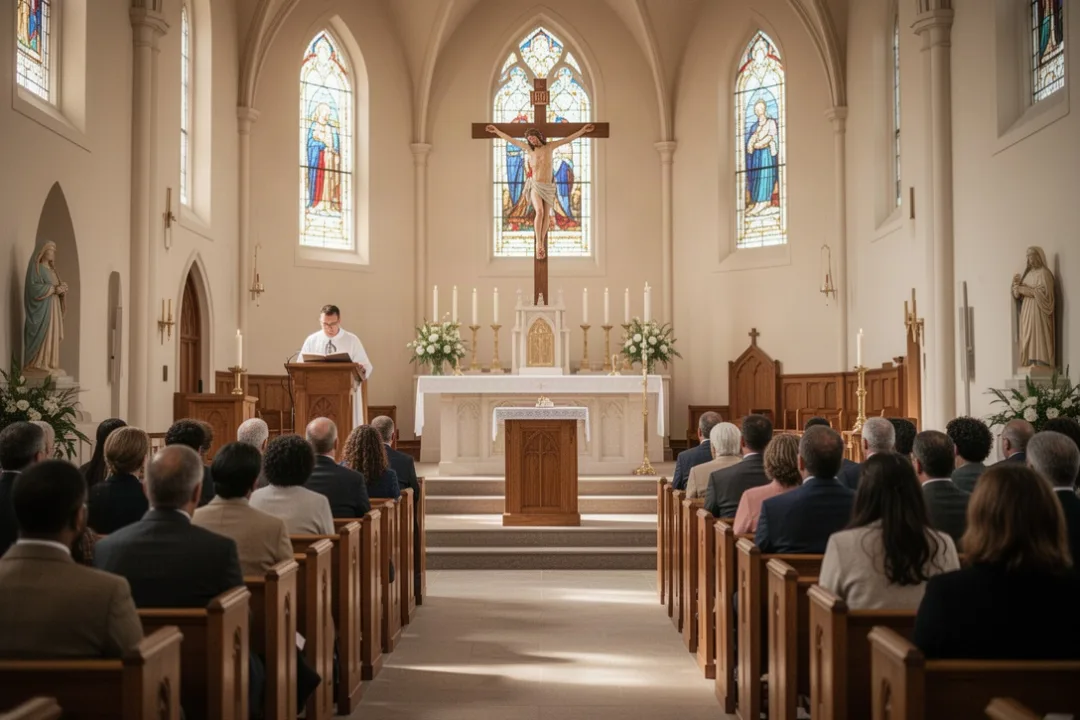
People attend Mass for many reasons. You may be exploring Christianity, accompanying a Catholic friend, visiting a parish, attending a funeral, or returning to church after a long absence. You are welcome to be present and pray in your own way. A Catholic church may have a crucifix, statues, images, candles, holy water, and devotional practices that are unfamiliar; you may simply observe them respectfully.
Arriving a few minutes early gives you time to find a seat and look through the bulletin or worship aid. In many churches, people sit in any open pew. If the church has reserved seating for a wedding, funeral, choir, or ministry, follow the signs or ask an usher.
Dress should be clean, modest, and suitable for a religious service. Parish customs vary, and visitors do not need special clothing. Avoid disruptive conversation, food, or photography during the liturgy unless permission has been given. Quietly caring for a baby or assisting a child is normal; many parishes provide a cry room or family seating.
Visitors may join the congregation for many parts of Mass: listening to Scripture, standing and sitting with the assembly, singing if comfortable, and praying during the Eucharistic Prayer. You are not required to say every response. If you prefer not to sing, quiet attention is a respectful form of participation.
Receiving Holy Communion is different from attending Mass. The Catholic Church normally admits to Communion those who are baptized Catholics in full communion with the Church and properly prepared to receive. Catholics are expected to observe the required fast and be free from serious sin for which they have not sought reconciliation, according to Church teaching.
People who are not Catholic, or Catholics who should not receive at that time, can remain in the pew and pray. In some parishes, people who do not receive may come forward with arms crossed to receive a blessing, but this custom is not universal. You can also stay in your seat. Never feel pressured to approach the minister.
At a funeral, wedding, or other special Mass, guests may be unfamiliar with Catholic practice. The invitation to attend does not automatically mean that every guest should receive Communion. The parish or celebrant may provide specific guidance, and following that guidance helps avoid confusion.
Before Mass: silence your phone, find a seat, and review the worship aid.
During the readings: listen attentively even if you do not know the references.
During the collection: pass the basket along if you do not wish to contribute.
During Communion: remain seated or follow the parish’s local blessing custom.
After Mass: leave quietly if others are praying, or speak with a parishioner outside the church.
How to find a Catholic Mass in English near you
Parish websites commonly list Mass times and identify the language used at each celebration. A parish may offer English at some times and other languages at others. If the website is unclear, call the parish office or check the weekly bulletin before traveling.
When searching online, include your city, state, or ZIP code with phrases such as “Catholic Mass in English” or “English Mass near me.” Diocesan websites may provide parish directories, but schedules can change for holy days, weather, priest availability, or special events. Confirm the time, address, and language when the visit matters.
Is the Mass celebrated entirely in English, or does it include another language?
Is the listed time for Sunday Mass, a Saturday vigil, or a weekday celebration?
Does the parish offer accessible parking, seating, restrooms, or hearing assistance?
Is childcare, a cry room, or children’s liturgy available?
Are there special instructions for a wedding, funeral, holy day, or confession?
The Saturday vigil Mass is generally celebrated in the evening and fulfills the Sunday obligation for Catholics, while Sunday Masses are offered at various times. Weekday Mass schedules may be limited, especially at smaller parishes. A Catholic chapel at a school, hospital, military installation, or university may have separate access rules and schedules.
Confession is not part of the Mass itself, although many parishes schedule it before or after Mass. If you want to receive Communion after being away from the Church or after a serious sin, ask the parish about the Sacrament of Reconciliation. A priest or parish staff member can explain the appropriate preparation without assuming what you already know.
Mass in English can be a familiar home for practicing Catholics and a first point of contact for someone who has never attended. The most helpful approach is simple: arrive with respect, listen carefully, follow what you can, and allow the liturgy’s rhythm to become clearer over time.
How the seasons and celebrations change an English Mass
The basic structure remains stable, but the liturgical year changes the prayers, Scripture readings, music, color of vestments, and overall tone. Advent emphasizes watchful hope, Christmas celebrates Christ’s birth, Lent calls for repentance, and Easter proclaims the Resurrection. Ordinary Time focuses on the ongoing story of Christ’s ministry and the life of the Church.
On Sundays and solemn celebrations, Mass normally includes more readings and the Creed. On weekdays, the structure is usually simpler. Major feasts may include special hymns, incense, processions, or additional ministers. A parish may also celebrate a patronal feast, confirmation, first Communion, or another occasion within the normal framework of the liturgy.
Some parts of Mass are spoken or sung by the priest, some by a deacon or lector, and some by the whole congregation. The music ministry supports the prayer of the assembly rather than replacing it. You may encounter a traditional hymn, a contemporary setting, a sung psalm, or periods of silence, depending on the parish and the celebration.
The English text can make the words easier to understand, but understanding grows through repeated participation. You may notice recurring themes: praise, repentance, thanksgiving, intercession, sacrifice, communion, and mission. Those themes connect the spoken prayers to the Church’s belief that Christ gathers his people and gives himself for the life of the world.
If you attend regularly, consider obtaining a missal or using the parish’s approved worship aid to follow the readings and responses. Avoid relying on unofficial online versions for the exact liturgical text, since wording and permissions can vary. The parish bulletin is also useful for current schedules, seasonal changes, and opportunities for further instruction.
Frequently asked questions
Do I need to be Catholic to attend Mass in English?
No. Anyone may attend Mass respectfully, including visitors who are exploring Catholicism or accompanying someone else. You may listen to the readings, join appropriate postures, pray silently, and remain seated during Communion. Attending does not require you to recite every response or adopt Catholic beliefs before you enter the church.
Can I receive Communion if I am not Catholic?
As a general rule, non-Catholics do not receive Holy Communion at a Catholic Mass. Communion expresses full unity in Catholic faith and sacramental life, not simply hospitality. You may remain in your pew, pray, or follow the parish’s custom for receiving a blessing. Ask a priest if a particular circumstance requires specific guidance.
Is an English Mass different from a Latin Mass?
The language is the most obvious difference, but celebrations may also differ in music, ceremonial style, and the form of the Roman Rite being used. An English Mass normally follows the current Roman Missal in English. A Latin-language celebration may use the same ordinary form or another approved form, so language alone does not describe every difference.
What should I bring to an English Catholic Mass?
You do not need to bring anything. A parish usually provides a missalette, worship aid, or printed readings, although some churches use screens. You may bring a Bible, prayer book, or notebook if helpful. Dress respectfully, silence your phone, and arrive a few minutes early so you can settle in without interrupting the opening rites.










Leave a Reply